The useful turn at Montevideo’s Tristán Narvaja fair is away from the thickest stream of people. In a September 2026 report for Galería, local shopkeeper and regular browser Foncho Martínez Brianza describes approaching through a parallel street, avoiding the crowded first stretch. His route gives a visitor permission to begin somewhere other than the beginning.[1] For a Sunday among secondhand books and objects, that small adjustment changes the morning: there is room to stop when something deserves a closer look.
The fair began in 1909, selling fruit and vegetables, and expanded into the extraordinary mixture that the city’s tourism office describes today. Permanent bookshops and antique shops also took root along the street.[2] This overlap gives the place its particular pleasure. Groceries, discarded possessions and carefully selected stock share a neighborhood, while shoppers arrive with very different ideas of what counts as a find.
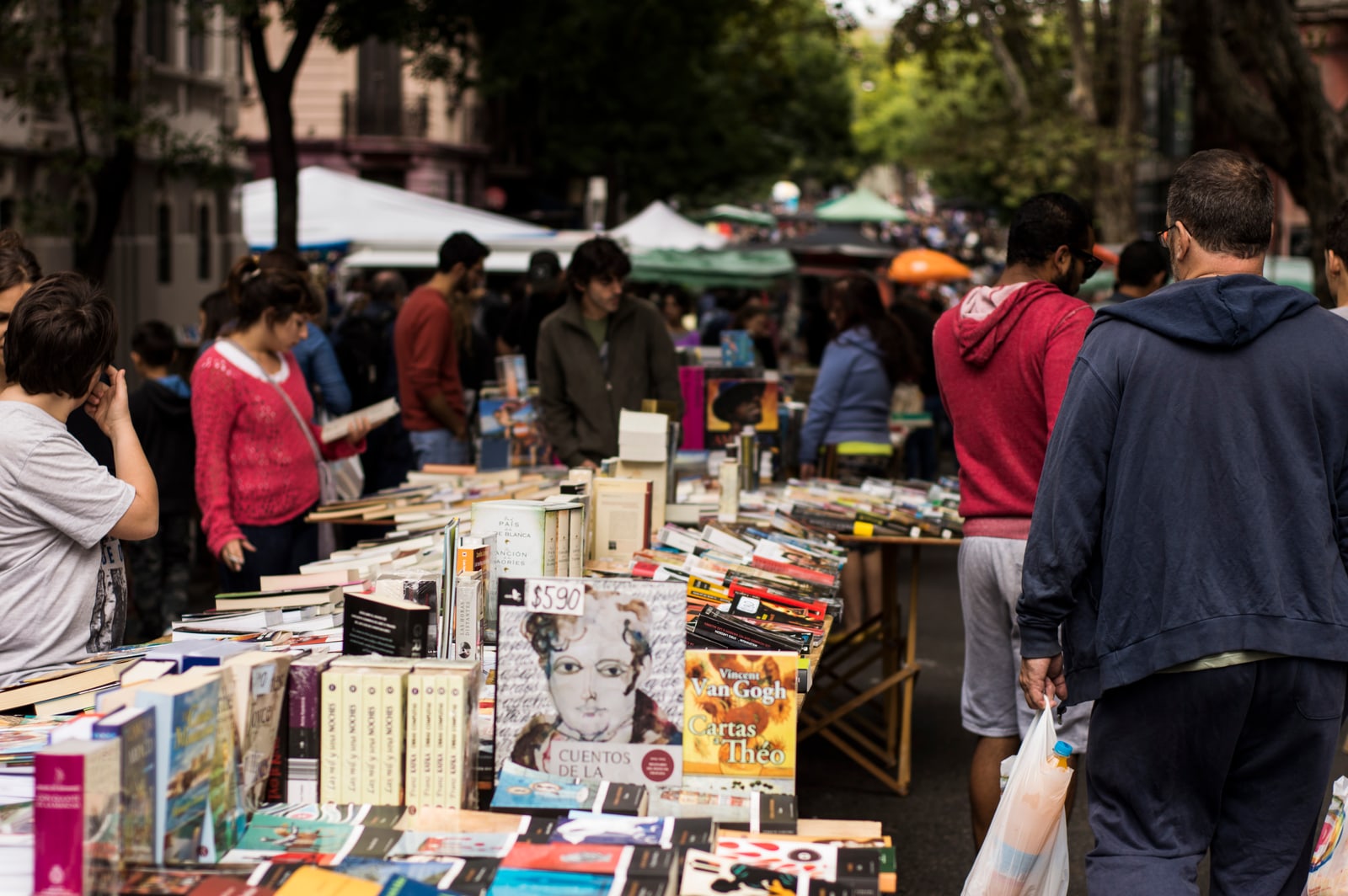
Give the morning room
Aim to arrive between 09:00 and 11:00 on Sunday. In a June 2026 r/AskUruguayan discussion, a weekly visitor favors morning browsing and identifies 12:15–13:15 as especially crowded; several residents also describe congestion along the central passage. These are individual experiences, not a crowd forecast.[3] Allow 90–120 minutes for a deliberately small exploration, with time to open a book rather than simply register its cover.
Use Tristán Narvaja and Avenida 18 de Julio as your orientation point, the intersection given by the tourism office.[2] You need not force your way through every stall from there. If the entrance is congested, take the parallel-street approach described in the local report and rejoin farther along.[1] Choose an open crossing rather than squeezing between a seller’s tables.
For books, make Paysandú your next cue. The June community discussion identifies the concentration of bookstalls there; a contributor who lives in the neighborhood describes using the perpendicular streets instead of following the slow procession along Tristán itself.[3] Stand at the display’s edge when browsing, leaving the through-route clear. It is easier to enjoy a shelf when you are no longer being carried past it.
There is no admission reservation or ticket queue: this is a free street market.[8] Its bottleneck is pedestrian space. A useful spending envelope for this walk is UYU0–1,000 per person, excluding food and transport: zero to browse, with an optional purchase ceiling you choose before arriving. That is a suggested budget, not a claim that any particular book or antique will cost less than UYU1,000.
Look before naming a price
A stall’s abundance can make every purchase feel urgent. Slow that decision down. Ask before opening a fragile volume, then look at the binding, the pages and any marks that matter to you. With an object, ask what it is and whether it works before deciding that its age makes it desirable. This is practical buying advice; a convincing story does not establish an object’s provenance.
Mariel Varela’s 2019 reporting for El País captures the negotiations that form part of the fair’s social life. One antique seller explained prices through condition, age and usefulness; another refused a requested reduction while offering a deal on two objects together.[5] A polite offer belongs in that conversation. A discount remains the seller’s choice. Take a refusal calmly, and avoid handling someone’s stock as if the price has already been agreed.
Bring some Uruguayan peso cash and establish the payment method before settling on a purchase. Varela described cash-only trading in 2019; that older observation is a reason to prepare, not proof that every stall refuses cards today.[5]
The other easy mistake is assuming the word “fair” guarantees a bargain. In a May 2026 r/uruguay discussion, a shopper reported finding the same household products cheaper at supermarkets; replies disagreed about which goods offered value.[6] Those anecdotes cannot price a used book for you. They do justify comparing before buying. If you intend to return to a stall, note its nearest intersection and a distinctive neighboring display. Memory becomes optimistic when several tables contain similar piles.
Leave while there is still something to find
The tourism office lists approximately 09:00–16:00, but that broad window should not become an invitation to arrive at the end.[2] In a September visitor-advice thread, a local contributor warns that newcomers sometimes mistake the fair for a permanent market: stalls pack away during the afternoon, and municipal cleaning follows.[7] The shops and the Sunday street market have different rhythms. Give the stalls your morning; check an individual shop’s hours separately if you plan to return.
There is no need to complete the fair. The recent Galería account moves between formal displays and objects spread on blankets or gathered in boxes, paying attention to the act of looking itself.[1] Try staying with one modest discovery long enough to understand your interest in it. A dedication inside a book, a repaired hinge or a familiar illustration can hold more attention than another block of hurried browsing.
You may leave with a purchase. You may remember a conversation and leave the object behind. Either way, the sideways turn has done its work: a Sunday street has become somewhere you had time to notice.
Visitor information checked 29 October 2026. The morning window and spending ceiling above are planning recommendations; stall stock, payment methods and packing-up times vary.
Sources
- Búsqueda / Galería, “El arte de encontrar lo que no estabas buscando, un recorrido por Tristán Narvaja”, 30 September 2026 — recent local reporting with regular browser Foncho Martínez Brianza on side-street approaches and unhurried looking.
- Descubrí Montevideo, “Feria de Tristán Narvaja” — official city tourism listing: history, Sunday hours, intersection and permanent bookshops; checked 29 October 2026.
- r/AskUruguayan, “¿Son de ir a la feria de Tristán Narvaja? ¿Sigue valiendo la pena ir? ¿Qué opinan?”, 27–30 June 2026 — resident and regular-visitor discussion of crowds, morning browsing, Paysandú bookstalls and perpendicular streets; individual accounts.
- Rodrigo Olivera, “Libros en Feria Tristán Narvaja”, 6 March 2016, Wikimedia Commons — original photograph, location, date and attribution.
- Mariel Varela, “Tristán Narvaja, una feria que conjuga tiempos”, El País, 3 March 2019 — historical reporting on antique sellers, condition-based pricing and negotiation; its prices and payment observations are not treated as current.
- r/uruguay, “Precios feria”, 24 May 2026 — local discussion of comparison shopping and variable value; anecdotal rather than a market-wide price survey.
- r/uruguay, “Voy a Montevideo, ¿me dan recomendaciones?”, September 2026 — community clarification that the Sunday stalls pack away during the afternoon.
- Fleamapket, “Feria de Tristan Narvaja” — specialist market directory confirming free admission; checked 29 October 2026.