Pha That Luang is the image everybody knows: a gold stupa lifted above a broad esplanade. But Vientiane’s most important festival does not begin when that image fills the frame. Its official ritual description begins at Wat Si Muang, beside the city’s founding pillar, before the wax-castle movement reaches the gold on a following afternoon [1][9]. Treating the stupa as the only destination turns a civic-religious sequence into another monument visit.
For 2026, the Lao tourism ministry lists the That Luang Festival and Trade Fair from November 21 through November 24; JICA Laos’s office calendar separately labels Tuesday, November 24 a “Lao Holiday” for That Luang Festival [1][2]. Those dates are firm enough to protect. The hour-by-hour ceremonial programme is not. As of September 14, the official event page gives the ritual order but no dated daily schedule, and the detailed 2025 preview did not appear until October 22, ten days before that year’s fair opened [1][3]. The useful move now is to reserve the window, not invent the clock.
If only one sequence can fit, provisionally keep November 22 evening through November 24 evening open: a Wat Si Muang stage, a next-afternoon procession, then a following dawn’s almsgiving, afternoon ti khee and final candlelight [1]. That allocation is a planning inference from the published order, not a confirmed 2026 timetable. Check Tourism Laos, KPL and the Vientiane Times again in late October or November. This festival rewards people who know the order and remain flexible about the hour and assembly point.
The city moves its sacred centre
Wat Si Muang is not a convenient warm-up attraction. The temple contains Vientiane’s Lak Mueang, or city pillar, and the official capital guide connects it to the colourful phasat pheung wax-pavilion procession before That Luang [9]. A 2024 Vientiane Times account says the solemn procession starts at Si Muang while residents of the capital’s nine districts gather at Nongbon before processing to the stupa [4]. In 2025, KPL reported the main parade beginning at Nongbon [7]. Wat Si Muang therefore explains the ritual beginning; it does not guarantee one uninterrupted 2026 walking route.
At the stupa, the movement changes scale. Local accounts describe participants circling the cloister three times in reverence to the Buddha, the Dhamma and the Sangha [4][7]. That sequence is why a visitor’s position matters. You are not waiting for three identical photo opportunities. You are watching a repeated act whose meaning accumulates with each turn.
Pha That Luang also binds the annual ritual to Vientiane’s political history. At the 2025 opening, the city’s mayor linked the festival tradition to King Setthathirath’s 1560 move of the capital and a seven-day, seven-night celebration; Tourism Laos dates construction of the current grand stupa to 1566 [5][9]. The city pillar and national stupa are therefore not two unrelated sacred sites on an itinerary. During this seasonal handoff, Vientiane moves from the symbol of its foundation toward the monument that came to embody the state.
Then commerce arrives without cancelling devotion. In 2025, local reporting counted more than 2,300 stalls across the That Luang esplanade and Lao-ITECC, with nightly performances scheduled from 20:00 to 22:30 [5]. Those figures document last year, not a promise for 2026. They do clarify the shape of the place: prayer, procession, provincial performance and trade occupy adjacent clocks. The better visit does not sneer at the fair as contamination or mistake the fair for the whole festival.
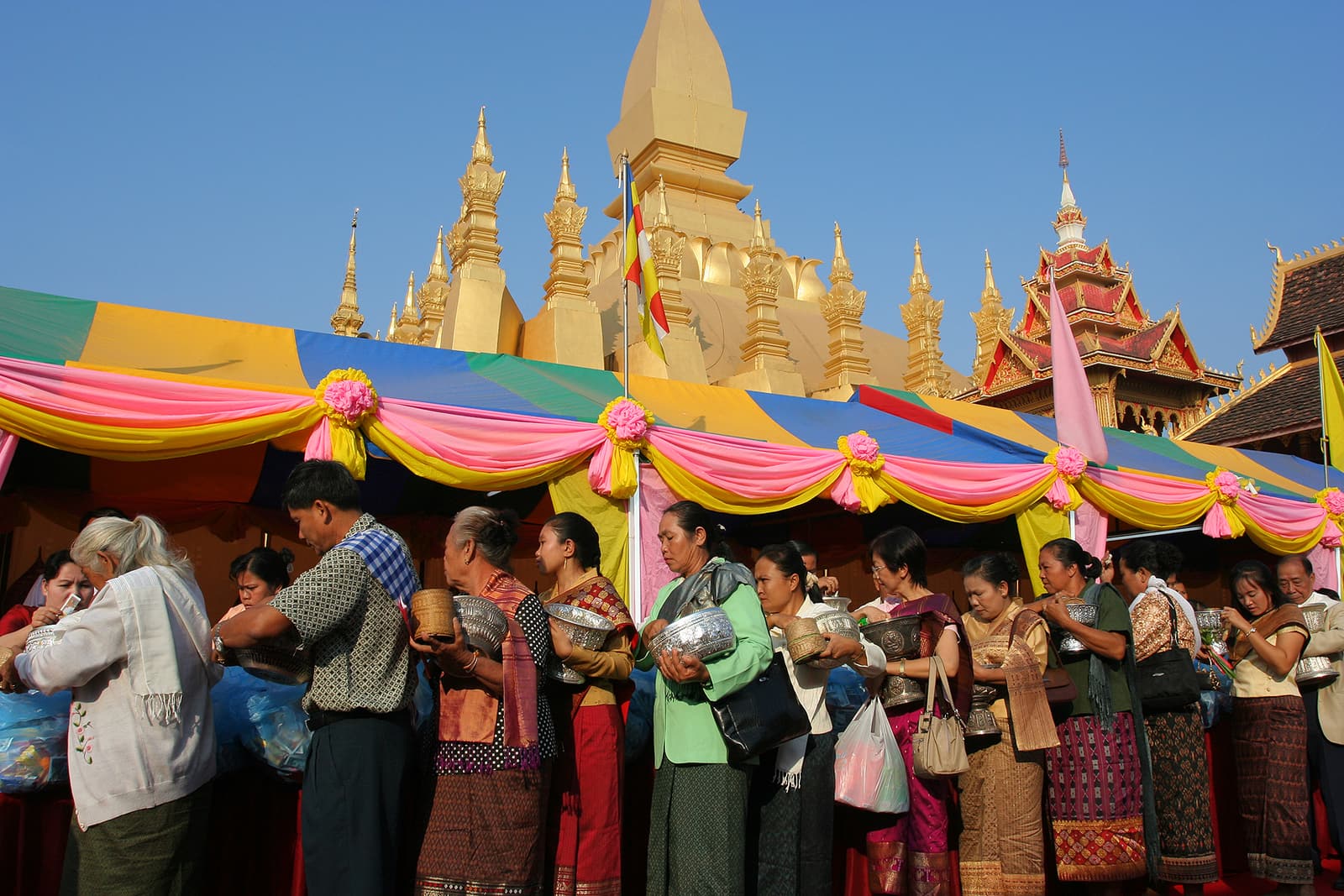
The cover photograph holds that balance. Jialiang Gao made it at Pha That Luang in November 2006: women with silver bowls and woven baskets stand beneath a striped canopy while the gold stupa remains legible behind them [10]. It is archival evidence of people and place, not an illustration of this year’s crowd, route or programme.
Nine moves for the 2026 handoff
First, save two pins before saving any performance. Use Wat Si Muang on Setthathirath Road as the opening anchor and Pha That Luang as the finish [9]. Several English spellings circulate—Wat or Vat, Si Muang or Simeuang—so keep both pins offline. Searching only “That Luang festival” encourages a ride straight to the esplanade and deletes the city-pillar beginning.
Second, protect all four published dates. November 21–24 is the ministry’s current festival window, while JICA Laos’s office calendar marks November 24 as a Lao holiday [1][2]. Do not compress that into a single calendar alert yet. The 2025 programme proves how much can sit around the culminating day: prayers, the wax-castle procession, dawn alms, sport, a candlelit close and a trade fair running on its own long hours [3][5].
Third, revisit the sources when the local clock arrives. Set a reminder for October 22, not because the 2026 schedule is guaranteed then, but because that was the release date of KPL’s detailed 2025 preview [3]. Use the final notice to replace every provisional hour in your plan. A recycled blog timetable can put you at the right temple on the wrong day.
Fourth, meet Wat Si Muang before procession pressure. Visit the exterior and locate the shoe line while daylight and foot traffic still let you read the entrance. The city guide places the original pillar here, and local reporting establishes Si Muang as the ritual beginning while showing that the main assembly point can differ [4][7][9]. When the gathering begins, remain at its edge until the flow is obvious. The event belongs to worshippers carrying offerings, not to a visitor trying to seize the front rank.
Fifth, dress for both anchors at the first one. Local festival guidance asks men and women to wear modest clothing; long trousers or skirts are appropriate, a sinh can be rented when available, and shoes come off before entering sacred areas [6]. Solve that before the crowd closes around the doorway. A long evening does not turn temple space into a concert ground.
Sixth, let the wax castles pass before crossing. The decorated structures can be large, and the procession combines monks, officials, district groups, musicians and dancers [4]. Do not walk backward in front of a carrier for a photograph or cut through a group to keep pace. Choose one side, leave an open corridor, and move only after the people bearing the offering have moved.
Seventh, take the outer position at Pha That Luang. The three circuits are the ritual, not three laps staged for cameras [4][7]. Stand where the stupa, canopy and moving line can share the frame without requiring you to enter that line. As a courtesy, keep the phone below faces during prayer, skip flash, and follow stewards if an area closes. The strongest recognition cue is the gold rising behind the participants, not an isolated close-up obtained by blocking them.
Eighth, use the fair after you understand the ceremony. In 2025 the public grounds ran from 07:30 to 23:30, while the performance stage occupied a narrower evening window [5]. Do not copy those hours into 2026; use them to understand why “the festival is open” is an incomplete question. Decide whether you are going for procession, alms, ti khee, candlelight or the fair, then confirm that component’s actual time.
Ninth, carry small kip and price the exit before entering the crush. A recent Vientiane field report describes cards as unreliable, local QR payments as common and the LOCA app as a practical way to call a car [8]. Check the live ride quote in both directions rather than trusting an old tuk-tuk estimate. Tourism Laos lists ordinary, non-festival Pha That Luang admission at 30,000 kip, but the 2026 event page currently gives no festival price or booking link [1][9]. For planning, ring-fence 100,000–250,000 LAK plus two live-quoted rides for the regular admission baseline and modest offerings, drinks or fair purchases. That is a conservative cash buffer, not a posted festival price, and the final notice should replace it. Arrange the return from a clear road outside the procession area rather than asking a driver to find you against the stupa gate.
Three ways visitors flatten the festival
Mistake one: going straight to the gold. Pha That Luang is the visual climax, but Wat Si Muang explains the city-pillar beginning of the ritual arc [1][4][9]. The better alternative is the two-anchor order: pillar first, stupa second.
Mistake two: treating last year’s programme as a reusable timetable. The 2025 festival ran for five days with specific stage and ceremony hours; the current 2026 listing gives a different four-day window and has not yet assigned every ritual an hour [1][3][5]. The better alternative is to reserve November 21–24 and lock individual sessions only after the local programme appears.
Mistake three: turning the ritual arc into a fixed walking route. The 2024 local account gives Si Muang as the start and Nongbon as the nine-district gathering point, while KPL says the 2025 parade itself began at Nongbon [4][7]. The better alternative is to understand why Wat Si Muang comes first, then use the final 2026 assembly and road notice before deciding where to walk or meet a car. Wherever you enter, dress for a temple, stay behind offerings and leave the ritual lane open [6].
The compact go plan
- Anchors: Wat Si Muang first; Pha That Luang second as a ritual sequence, not yet a walking instruction [1][4][7][9].
- Confirmed window: November 21–24, 2026; JICA Laos’s office calendar labels November 24 a Lao holiday [1][2].
- Best working window: provisionally hold November 22 evening through November 24 evening, but replace that inference when the 2026 ceremony timetable appears [1].
- Expected spend: carry 100,000–250,000 LAK plus two live-quoted rides as an editorial buffer; ordinary stupa admission is listed at 30,000 kip, but no 2026 festival price is posted [1][8][9].
- Queue and reservation reality: the current official listing provides no booking link; unless the final notice says otherwise, use 45–60 minutes as a conservative arrival allowance and treat crowd position, not a ticket line, as the constraint [1][5].
- Navigation cue: pin Wat Si Muang on Setthathirath Road and Pha That Luang separately, then check the final assembly notice; 2025’s main parade began at Nongbon [7][9].
- Where to stand: at the outer edge of the moving line, with a clear corridor for offerings and the stupa behind it [4][7].
- Etiquette: covered shoulders and knees, shoes off where required, and no stepping into the three circuits [4][6]; as a courtesy, skip flash during prayer.
That Luang becomes more legible when the famous monument is allowed to be an arrival. Begin beside Vientiane’s pillar, understand how the district offerings converge, and meet the ritual at the stupa without trying to own the front of the line. For four November days, the city does not merely display its gold. It moves toward it.
Sources
- Lao Tourism Marketing Department, “That Luang Festival and Trade Fair in Vientiane Capital” — official 2026 listing for the November 21–24 window and the sequence from Wat Si Muang through dawn almsgiving, ti khee and candlelight at Pha That Luang.
- JICA Laos Office, Office Working Hours and Holidays in 2026 — dated institutional calendar identifying Tuesday, November 24 as the That Luang Festival holiday, with a notice that government changes may alter holidays.
- Lao News Agency (KPL), “That Luang Festival Set for November 1–5 to Celebrate Traditions and Boost ‘Lao Visit Laos’ Tourism” (October 22, 2025) — recent local preview used to establish the late programme-release boundary and the 2025 fair scale.
- Vientiane Times, “Wax castle procession: a highlight of the That Luang festival” (November 2024) — local account of Wat Si Muang’s founding pillar, participation by the capital’s nine districts and the meaning of the three circuits.
- Vientiane Times, “That Luang festival kicks off, uniting faith, culture and trade” (November 2025) — recent local report on Setthathirath, the 2025 ceremony order, fair hours, stall count and nightly performance window.
- Phon Thikeo, Vientiane Times, “It’s time to pay respect to That Luang” (November 11, 2024) — local practical guidance on modest clothing, sinh availability, removing shoes and the final-day sequence.
- Lao News Agency (KPL), “Crowds Join Wax Castle Procession at That Luang Festival in Vientiane” (November 5, 2025) — recent local report placing that year’s parade start at Nongbon and naming the Buddha, Dhamma and Sangha as the three circumambulations’ objects of reverence.
- r/Laos, “First-timer tips for Laos (Vientiane)” (October 23, 2025) — recent community field report on cash, local QR payments, ATMs and using LOCA for rides in the capital.
- Lao Tourism Marketing Department, “Vientiane Capital” — official city guide locating Wat Si Muang and its Lak Mueang, connecting the temple to the annual wax-pavilion procession, and listing ordinary Pha That Luang hours and admission.
- Jialiang Gao, “That Luang Festival Vientiane Laos” (November 2006) — source page for the archival documentary festival photograph at Pha That Luang; CC BY-SA 3.0.