Algiers is often introduced from a distance: white buildings stepping around the bay, the Mediterranean beyond them, Maqam Echahid high on the ridge. The Jardin d'Essai du Hamma works at the opposite scale. Inside its gates, the city becomes a choice between straight and curved paths, exposed perspective and deep shade, a formal western garden and a looser eastern one. The useful first visit is not a hunt for every specimen. It is a 90-to-120-minute reading of two different ideas of order.
Planning Hamma requires one honest uncertainty. A June 24, 2026 announcement on the garden's operator-managed Facebook page said it would open daily from 08:30 to 20:00, including public holidays [2]. Yet the institution's website is still being rebuilt and publishes no current tariff, general-admission booking path or live operations panel [1]. Meanwhile, two 2026 guides disagree on both the opening pattern and adult price [7][8]. Use the latest operator notice as a starting point, not an eternal timetable: recheck shortly before leaving for the garden.
The clean sequence is simple. Let the French garden establish the long axis, turn through the dragon-tree avenue while the day is still cool, then slow down around the English garden. That order gives the famous formal view its due without allowing it to consume the place. It follows what visitors notice most clearly: Hamma's character lies in the contrast between its symmetrical and shaded halves, not in a single photogenic tree [7][9].
A garden built to test, then learned as a refuge
The word essai matters. Hamma was established in 1832, two years after the French invasion of Algiers, as a colonial trial and acclimatization garden on land below the Arcades hill. A contemporary account in Nature described a government garden for plants considered ornamental or economically useful, intended for distribution or sale [5]. Plants were not gathered only for beauty; the site tested what could be propagated, classified and put to work in a conquered territory.
Calling Hamma a timeless oasis erases that history. Historians Ghanem Laribi and Sofiane Hadjadj place the garden within a wider colonial remaking of territory through straight roads, planted alignments and new administrative landscapes [4]. That context does not mean every visible axis dates unchanged from 1832. The collections and design evolved across later planting campaigns, concessions and reconstruction. It does mean that acclimatization, utility and control belong to the garden's origin story as surely as botany does [4][5].
The garden did not remain frozen in that origin. A Paris–Algiers cooperation project in the 2000s repaired water systems, paths, pools, glasshouses, planting zones and visitor infrastructure before the garden reopened in 2009 [6]. Its record distinguishes the French garden, English garden, collection plots and glasshouses because each demanded a different kind of care [6]. Colonial inheritance and present civic use occupy the same ground; neither cancels the other.
That local afterlife is easy to miss if Hamma is treated only as heritage scenery. In a January 2026 Algerian community post, one repeat visitor wrote that they had come since childhood and still found the walk lovely [10]. In another local discussion, a photographer asking for accessible green space received a plain navigational answer: take the metro to the entrance [11]. These are narrow anecdotes, not demographic proof. They nevertheless show how one public garden can sit inside an ordinary metropolitan routine as well as a visitor itinerary.
The official metro page gives the scale as 32 hectares and connects the station not only to the garden but also to the National Museum of Fine Arts and the cable car toward Maqam Echahid [3]. That abundance creates the visitor's main problem. Everything nearby appears combinable. It is not. Hamma becomes legible when it is allowed to be the anchor, with the surrounding hill and monument held as orientation rather than treated as the next compulsory stop.
Nine moves for reading Hamma
First, use the station named for the garden. On Metro Line 1, get off at Jardin d'Essai, not the neighboring Hamma station. The official operator presents the garden as the station's defining destination [3]. A local community answer makes the last movement even simpler: surface for the garden entrance rather than inventing a taxi approach [11]. Saving the exact station name offline is more useful than saving a generic pin in a 32-hectare site.
Second, choose opening light over afternoon heat. The latest operator announcement available for this article is the June 24 notice giving 08:30–20:00 daily, including holidays [2]. Commercial guides published earlier in 2026 still show different seasonal schedules [7][8]. If the 08:30 opening is reconfirmed, aim for 08:30–08:45. The point is not a supposedly secret quiet hour; it is to cross the exposed formal garden before the day warms and preserve enough time for the shaded half. Check again within 24 hours of the visit, especially around maintenance, events or holidays.
Third, budget for conflicting evidence at the gate. One March 2026 local guide lists 150 DZD for the garden plus 150 DZD for the zoo; another May guide lists 200 DZD for an adult and says the zoo is separate, without fixing its price [7][8]. A visitor report from April says the zoo was closed during that visit [9]. Those figures do not justify pretending there is one verified current tariff. Keep a 400–500 DZD per-adult contingency, ask what is open, and read the posted prices before buying. That buffer is planning advice, not a quoted admission fee.
Fourth, give the formal garden one complete look. Its straight paths, pools and symmetry occupy the western side; from the main perspective, the planted axis ties hillside, garden and sea into one designed field [6][7]. Stand near the center long enough to see that construction before reaching for a close-up. Then move. The axis is an orientation device, not a command to spend the whole visit walking up and down the same exposed strip.
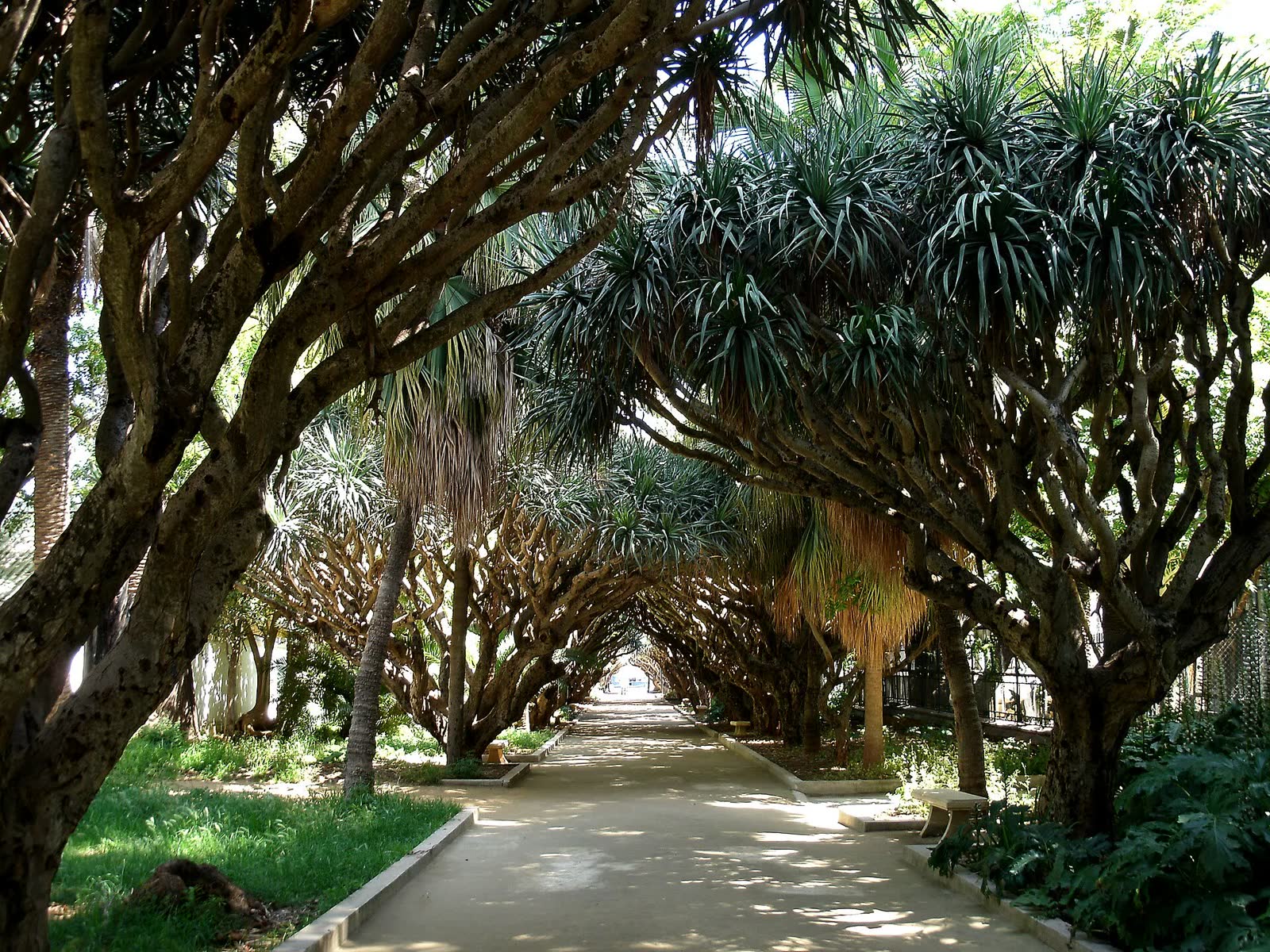
Fifth, turn into the Allée des dragonniers before looking for a celebrity tree. The dragon trees form a repeated, architectural shade room: trunks lean, crowns overlap and a rigidly straight path becomes visually enclosed. The cover photograph records exactly that recognition cue [14]. Give the avenue 15–20 minutes, including one pause without a camera. This is where Hamma's collections stop behaving like labels and start changing temperature, sound and pace.
Sixth, treat the so-called Tarzan tree as disputed lore, not the garden's purpose. Tourism pages keep repeating an association between a large ficus and the 1932 Tarzan the Ape Man [7][8]. The American Film Institute's production record, however, places that film's exterior work in western Mexico and California, not Algeria [13]. Enjoy the nickname as a local story, but do not report the location claim as settled fact. And do not climb the roots for a photograph: reporting from the garden's 2009 reopening specifically recorded a rule against climbing trees [12].
Seventh, save the English garden for the slow half. Its less rigid paths and pond landscape work as a release after the formal axis [6][7][9]. Do not race through it because the famous perspective is behind you. Give it 30–40 minutes, follow one curve rather than every spur, and let the shift from display to enclosure register. If the zoo is shut or unappealing, this is where the recovered time belongs.
Eighth, read today's signs rather than turning old rules into current law. Reporting from May 2009 says the newly reopened garden prohibited climbing trees, entering or lying on lawns, touching plants, picking flowers, eating in planted areas and throwing objects into pools [12]. That is valuable evidence of reopening-era management, not a substitute for current posted policy. Follow the signs you actually encounter. Even where a rule is not displayed, basic botanical-garden etiquette still holds: stay on paths, leave plants and roots alone, use designated seating and carry out waste.
Ninth, leave before the garden turns into a transfer platform. After 90–120 minutes, return to the metro unless you deliberately chose a longer day. The museum uphill and the cable car toward Maqam Echahid are real connections—the operator advertises them from the same station [3]—but proximity is not obligation. Hamma has done its work when you can distinguish the formal axis from the shaded garden without consulting a map.
Three ways visitors flatten the place
Mistake one: arriving for one “Tarzan” photograph. Current tourism pages make the nickname easy to mistake for the whole visit even though the film-location claim conflicts with the AFI record [7][8][13]. The better alternative is a three-part sequence: formal axis, dragon-tree shade, English-garden curve. The ficus becomes one detail inside a botanical and civic landscape, not proof that you were there.
Mistake two: treating every green surface as picnic space. Hamma looks generous, but it is a managed collection under heavy public use. The documented 2009 rules sought to protect lawns, roots, flowers and pools [12]. The better alternative today is to follow current signage, travel lightly, wait for designated seating and leave no trace on planted ground.
Mistake three: bundling garden, zoo, museum and memorial into one rushed block. A map encourages this because the metro, cable car and nearby institutions share one urban hinge [3]. Current visitor evidence shows why the bundle can fail: one component may be closed, while the garden alone can absorb two hours [7][9]. The better alternative is to protect Hamma first, verify the zoo at the gate, and add the hill only if time and attention remain.
The compact go plan
- Anchor: Jardin d'Essai du Hamma only; its formal western garden, dragon-tree avenue and English garden are parts of one place.
- Best window: the first two hours after the confirmed opening. The latest operator notice says 08:30, but recheck within 24 hours [2].
- Expected spend: published 2026 adult figures conflict between 150 and 200 DZD, and zoo admission is separate. Hold up to 500 DZD per adult as a contingency after checking the posted tariff; this is a buffer, not a claimed price [7][8][9].
- Queue and reservation reality: the official website currently has no general-admission booking path or posted tariff, so advance booking cannot be verified online [1]. No dependable wait-time estimate was found; leave the gate margin flexible instead of building a tight onward connection.
- Navigation cue: Metro Line 1 to Jardin d'Essai station; save the station name rather than a vague garden-center pin [3][11].
- Where to stand: center yourself once on the French garden's long axis, then step into the Allée des dragonniers for the shaded recognition view [6][7][14].
- Where to sit: use designated seating when it opens up; current signs, not a 2009 news report, decide present access [12].
- Time budget: 90–120 minutes for the garden; choose the zoo or hill connection only as a deliberate extension [3][7][9].
Hamma is most revealing when neither half wins. I read the formal garden's geometry as a trace of institutional control—not because every straight line has stood unchanged since 1832, but because contemporary and scholarly accounts link the garden's creation to colonial utility and territorial ordering [4][5]. Mature shade complicates that geometry with growth, enclosure and time. Algiers has kept both conditions in view, repaired the garden and connected it to the city by metro [3][6]. Walk the straight line once, then let the trees bend the experience.
Sources
- Jardin d'Essai du Hamma, official website — institutional page for the Wilaya d'Alger garden; at publication it is under reconstruction and provides no live general-admission schedule, tariff or booking path.
- Jardin d'Essai du Hamma Alger, official Facebook page — operator-managed channel whose June 24, 2026 announcement gives daily 08:30–20:00 opening, including public holidays.
- Métro El Djazaïr, “Station Jardin d'Essais” — official operator page for the named metro stop, the garden's 32-hectare scale and the cable-car connection toward Maqam Echahid.
- Ghanem Laribi and Sofiane Hadjadj, “Le Jardin d'essai du Hamma : histoire d'un jardin colonial” (2014), Histoire de l'Algérie à la période coloniale 1830–1962, pp. 120–123 — scholarly account connecting the garden and planted alignments to the colonial remaking of territory.
- E. P. W., “Jardin D'Essai, Alger,” Nature 4, 447–448 (October 5, 1871) — contemporary account of the 1832 garden's ornamental and economic plant-distribution purpose.
- Abderezak Ziriat, Laurent Bray, Alain Faugeron and Fabrice Fromond, Le Jardin d'Essai du Hamma (Alger) : un projet de coopération décentralisée pour un enrichissement partagé — Mairie de Paris–Wilaya d'Alger rehabilitation record covering water, paths, pools, glasshouses and distinct French and English zones.
- Algeria247, “Jardin d'Essai du Hamma” (March 22, 2026) — recent locally published guide to the French/English contrast, metro access, listed admission, opening hours and suggested visit length.
- Safar El Amir, “Jardin d'Essai du Hamma à Alger : horaires, prix et conseils de visite” (May 21, 2026) — local commercial guide whose seasonal schedule and 200 DZD adult figure demonstrate the conflict among current listings.
- Tripadvisor, “Le Jardin d'Essai du Hamma” — current community-review surface, including March–April 2026 reports on the two garden styles, visit pace and the zoo being closed during one visit.
- r/AlgeriaPics, “Pictures from Jardin d'essai 01-01-2026” (January 20, 2026) — recent community account from one repeat visitor who says they have walked the garden since childhood.
- r/algeria, “I'm a photographer and I want to shoot outdoor” (March 2023) — local community guidance identifying the garden as accessible public green space and the metro as the direct approach.
- Ahmed Saifi, Algerie360, “Le jardin d'Essai d'El Hamma, un joyau vandalisé” (May 2009) — local reporting used specifically as a dated record of public-use rules at the garden's reopening.
- American Film Institute Catalog, Tarzan the Ape Man (1932) — production record locating exterior filming in western Mexico and California, which conflicts with the popular Hamma location claim.
- Yelles, “Dragonniars.JPG” (May 11, 2011), Wikimedia Commons — source page for the documentary photograph of the Allée des dragonniers; this copy uses CC BY-SA 3.0, selected from the file's multiple licenses.