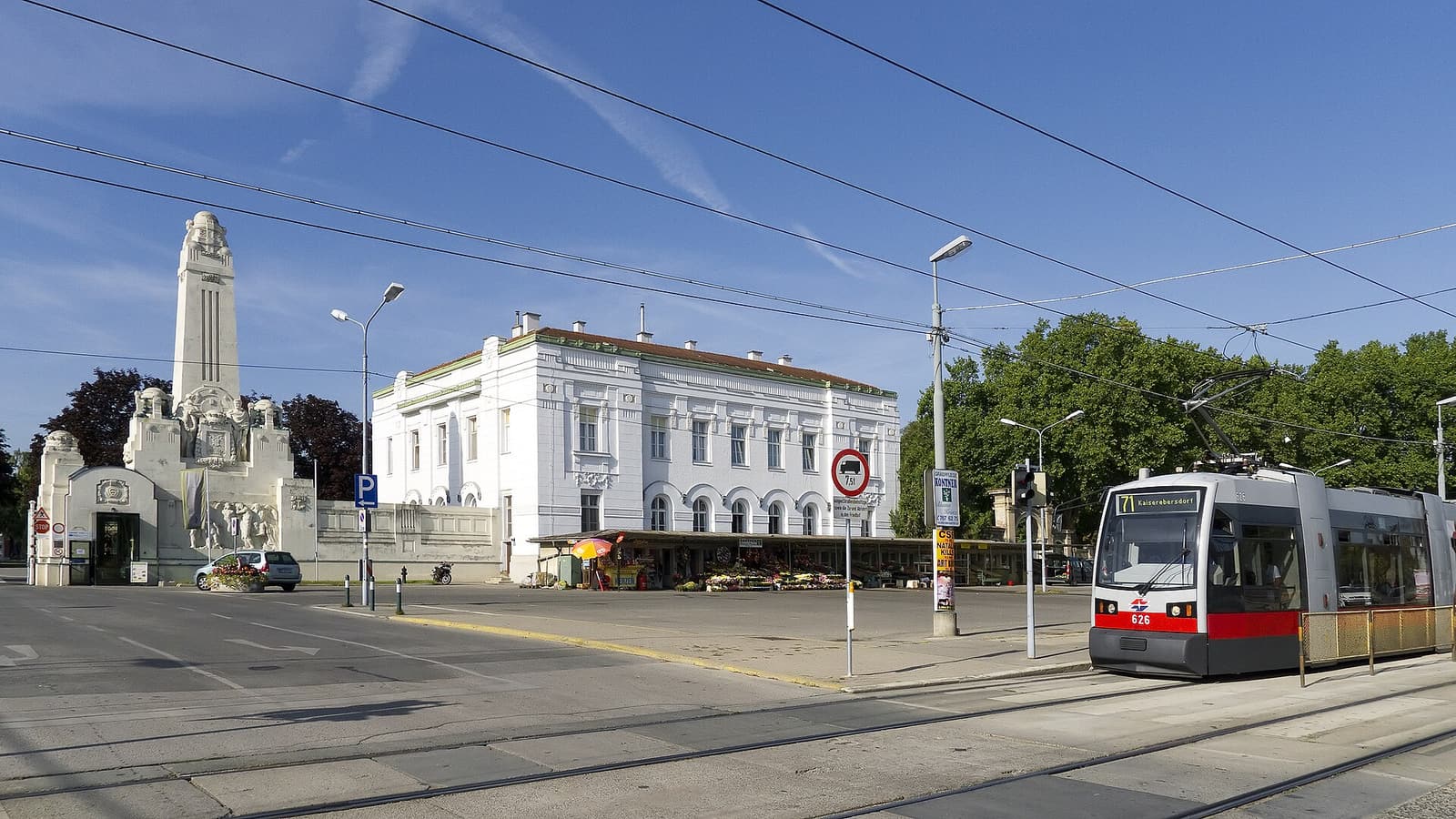
Vienna has grander set pieces than this, but few places explain the city’s emotional mechanics so quickly. Keep the route to two anchors only: tram 71 at Zentralfriedhof 2. Tor and the main roadway leading to the Karl-Borromäus Church. That pairing matters because the Zentralfriedhof is not a dead museum. Friedhöfe Wien says 20 to 25 funerals still take place here every day, while Vienna’s official guide still treats Gate 2 as the working main entrance and the straight axis to the church as the place where the cemetery becomes legible.[1][2]
That is the local frame most visitors miss. Outside Vienna, central cemeteries are often treated as side trips or “famous graves” errands. In Vienna, this one behaves more like a civic room with burial function still intact. The main gate at Tor 2 was built by Max Hegele in 1905 in the Art Nouveau style; beyond it, the road pulls directly toward the cemetery church, which Hegele built between 1908 and 1910.[1] Friedhöfe Wien adds the architectural scale that explains why the axis lands so hard in person: the central dome rises 58.5 meters, the church covers 2,231 square meters, and the approach culminates in 22 steps.[2] The proportions are ceremonial without becoming theatrical.
Image context: the cover uses a real documentary photograph of tram 71 at Zentralfriedhof 2. Tor from Wikimedia Commons. It belongs here because this article is about arrival behavior first and monuments second; without the tram stop, the route loses its Viennese opening move.[7]
The working window
This route is best used as a 45- to 90-minute control move, not a half-day completion challenge. Vienna’s official page publishes the useful seasonal timing clearly: the cemetery runs 08:00-17:00 from 03 November to the end of February, 07:00-18:00 in March, 07:00-19:00 from April to September, and 07:00-18:00 from October to 02 November. From May to August, it stays open every Thursday until 20:00.[1] The church itself keeps a slightly tighter rhythm: 08:00-17:00 from March to October and 08:00-16:00 from November to February.[1]
That is why the cleanest visit is not “wander until it gets dark.” It is to arrive with the clock already solved. In spring and summer, late afternoon is the best balance: the main road has enough light to hold its geometry, the church is still open, and the cemetery is long enough open afterward that you do not need to rush your exit.[1] In colder months, the place works better earlier, because Vienna park logic reasserts itself and the closing hour arrives faster than many visitors expect.[1]
If you want one deeper move without turning the visit into a march, the internal roundline is the useful fallback. The cemetery bus departs Tor 2 at 10:00, 12:00, 13:00, and 15:00 on weekdays and Sundays, with a 16:00 cycle on Saturdays; the fare is EUR 1.20 per person, children under 12 ride free, and passengers already holding a valid Vienna core-zone ticket ride without surcharge.[3] That small operational detail is exactly the kind of thing that turns the Zentralfriedhof from “huge” into manageable.
8 local moves that materially improve the stop
First, start at tram 71 and commit to Tor 2. Do not enter from some random edge and then wonder why the cemetery feels shapeless. Vienna’s own tourism page describes Gate 2 as the main entrance for a reason.[1]
Second, walk the main axis to the church before doing any honorary-grave detours. The axial read is the whole point. If you scatter into celebrity names immediately, the cemetery collapses into a checklist.[1][2]
Third, use the church dome as your pacing device. The route works best when the dome keeps drawing you forward in one clean line, then lets the side paths happen afterward.
Fourth, stand halfway down the main roadway before you climb the final steps. That is the best place to read the scale: gate behind you, dome ahead, graves and trees compressing the perspective.
Fifth, if you have limited time, stay between Tor 2 and the church. Vienna’s community chatter about the cemetery often drifts toward remote corners and overgrown mood, but the first high-yield read is still the main ceremonial strip.[1][6]
Sixth, treat the roundline as a rescue tool, not as the main event. Use it only if you want to extend deeper after you have already read the central axis.[3]
Seventh, if you care about interior access, line up with church hours, not only cemetery hours. The outer grounds can still be open when the church itself has already closed.[1]
Eighth, keep budget logic simple. The core walk costs EUR 0 once you arrive by regular public transport; only add the EUR 1.20 roundline if your legs or time budget need it.[3]
Non-local trapline: 4 mistakes that flatten the visit
Mistake 1: arriving too late in shoulder season because “cemeteries stay open forever”
Better move: in March and from October 1 to November 2, treat 18:00 as a hard outer limit, not a suggestion.[1]
Mistake 2: turning the cemetery into a composer scavenger hunt on entry
Better move: read the main road and church first, then decide whether the honorary graves still matter to you afterward.[1]
Mistake 3: assuming the church interior follows the same clock as the grounds
Better move: remember the church closes at 17:00 in the warmer season and 16:00 in winter, even when the cemetery grounds run later.[1]
Mistake 4: overbuilding mobility plans
Better move: use one simple ladder only. Core route on foot first; roundline second if needed; carriage tours only if you deliberately want the old-Vienna version. Those carriage tours cost EUR 65 for 30 minutes or EUR 110 for 60 minutes, with reservations handled Monday to Wednesday.[1]
One-screen logistics card
- Best working window: late afternoon in April-September, especially Thursday evenings in May-August when the cemetery stays open until 20:00.[1]
- Fast winter rule: from 03 November to late February, think 08:00-17:00, not open-ended wandering.[1]
- Church access: 08:00-17:00 from March-October; 08:00-16:00 from November-February.[1]
- Fallback mobility: roundline from Tor 2 at 10:00 / 12:00 / 13:00 / 15:00, plus a 16:00 Saturday cycle; EUR 1.20 per person, free with a valid Vienna core-zone ticket.[3]
- Expected spend: EUR 0-1.20 for the main route, unless you intentionally add a carriage tour.[1][3]
- Reservation reality: none for the core walk or roundline; carriage tours are the only part that need advance coordination.[1]
- Place-specific number worth remembering: the cemetery church’s dome reaches 58.5 meters, and the final approach resolves in 22 steps.[2]
- Navigation cue:
tram 71 -> Zentralfriedhof 2. Tor -> straight main roadway -> Karl-Borromäus Church.
The Zentralfriedhof works best when you accept Vienna’s own tempo for it. One tram stop, one gate, one straight ceremonial line, then a measured drift outward. That is enough for the city to show its softer machinery: not spectacle exactly, not grief exactly, but a public culture that still gives death architecture, timetable, and room.[1][2][4][6]
Sources
- Vienna Tourist Board, "Vienna Central Cemetery" (official opening hours, main-gate route, Karl Borromäus context, church hours, and carriage-tour pricing).
- Friedhöfe Wien, "Wiener Zentralfriedhof" (official Tor 2 address, daily burial activity, and church architecture details).
- Friedhöfe Wien / Wiener Lokalbahnen, "ZF Rundlinie Zentralfriedhof" timetable PDF (Tor 2 departures, EUR 1.20 fare, and Vienna core-zone ticket note).
- Friedhöfe Wien, "Nachklang 2025" (recent confirmation that the Tor 2 to Karl-Borromäus corridor is still used as a live event route).
- Google Maps search, "Wiener Zentralfriedhof Tor 2" (current local review and wayfinding surface).
- r/wien thread, "Schöne Orte zum Lesen in Wien?" (local community note on the quiet, shaded stretch between Tor 1 and Tor 2).
- Wikimedia Commons, "File:Wien Linie 71 19 Zentralfriedhof 2.Tor a.jpg" (documentary photograph used for the cover image).