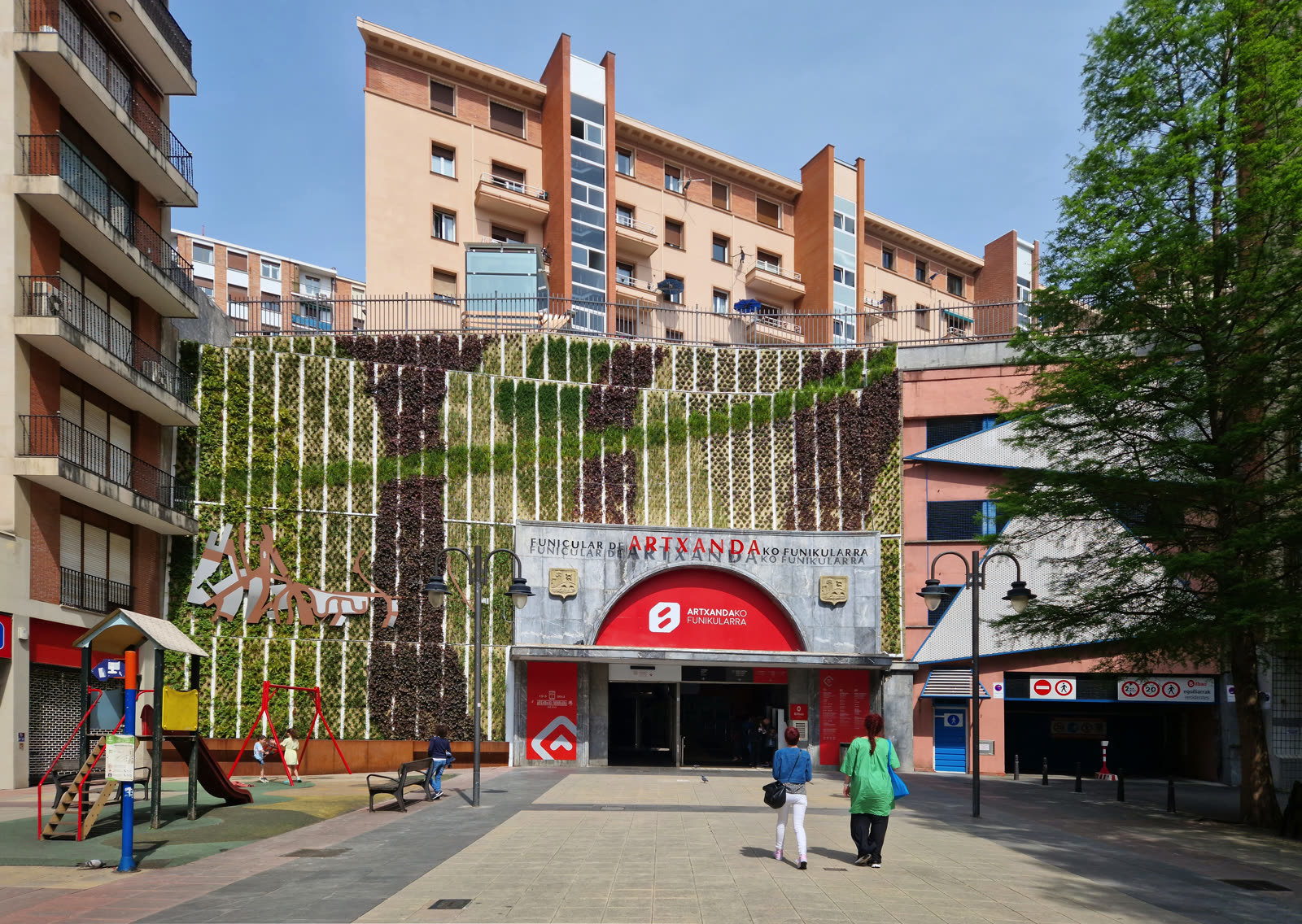
Bilbao gets flattened when Artxanda is sold as a generic "best view" and nothing more. The useful version is narrower. Start at Plaza del Funicular in Castaños, ride the Funicular de Artxanda for 3 minutes, get out at the top, and turn left for about 100 metres to the first mirador rail.[1][3] That is the whole place portrait: one lower station, one short climb, one first terrace where the river bend, the towers, and the old industrial basin all settle into one frame.
The strength of the move is operational, not romantic. The official timetable page says the funicular runs on winter hours from 7:15 to 22:00 Monday to Saturday and 8:15 to 22:00 on Sundays and holidays; in summer it stays open until 23:00 on Fridays, Saturdays, and holiday eves.[1] It also states that trains run every 10 minutes from 11:00 to 20:00 and every 15 minutes outside that band, with frequency increased if crowds build.[1] Fares are just as clear: EUR3.50 one way, EUR6.00 return, and only EUR0.42 with a standard Barik card.[1] Once those numbers are in your head, Artxanda stops being a special-excursion problem and becomes a repeatable local climb.
Place-specific texture is what keeps this from turning into one more lookout deck. Bilbao Turismo's page notes that the line opened in 1915 and that the lower station is only a 10-minute walk from City Hall.[2] Bilbon's January 2026 note adds a better local cue: the lower access sits in Castaños, reached naturally by crossing Zubi Zuri, and the neighborhood still carries the feel of "Bilbao of all life" rather than museum-district gloss.[4] Bilbao Insider then gives the detail that matters most on arrival: if you leave the top station and simply turn left, the main viewpoint is there almost immediately, roughly 100 metres away, before the outing has time to become vague.[3]
Why this upper edge works better than the generic "go up for the view" advice
The first reason is scale. Bilbao Insider's guide points out that from the mirador you can read the Guggenheim, Iberdrola Tower, Santiago Cathedral, San Mamés, the estuary line, and even the airport side of the valley when the air is clear.[3] That matters because the viewpoint is not just "high." It is diagrammatic. Bilbao suddenly becomes legible as a city of water, bridges, slope, and former industrial seams rather than a list of isolated attractions.
The second reason is friction. Bilbon describes the funicular as a public service that became a tourist attraction, which is a better description than the other way around.[4] You do not need a booking window, a security queue, or a half-day commitment. The climb itself lasts 3 minutes.[1][2][4] If you hold the visit to 45-75 minutes at the top, the stop remains useful in the middle of a normal city day instead of swallowing it.
The third reason is that Artxanda improves when you stop early. Visitors often assume the "real" experience lies deeper into the ridge, at a long lunch, or in a full uphill hike. Those are separate outings. The stronger city move is shorter: rise, turn left, hold the first rail, and let the basin explain itself. If you still have energy, Bilbao Insider notes that the walk back down toward Plaza Moyua takes about one hour.[3] The fact that you can extend the outing is useful. The fact that you do not need to is what makes the place portrait work.
8 local moves that materially improve the stop
- Use the 11:00-20:00 band if your priority is minimal waiting. That is the official 10-minute frequency window.[1]
- On winter Sundays and holidays, remember that service starts at 8:15, not 7:15.[1]
- Approach from the center on foot if you are already near the river. Bilbao Turismo's 10-minute walk from City Hall to the lower station is short enough that a taxi adds little value.[2]
- If you already have a Barik card, use it. The difference between EUR0.42 and EUR3.50 is too large to ignore for such a short climb.[1]
- At the top, do not drift right or linger in the station forecourt first. Turn left and take the 100-metre walk to the first mirador before deciding whether the stop is crowded or worth staying for.[3]
- Keep the first stay to 45-75 minutes. Long enough to watch the light shift; short enough that the place stays precise.
- Treat the carriage like local transit, not a snack break. The official rules explicitly ban eating, drinking, smoking/vaping, and using music devices without headphones.[1]
- If the top terrace feels too static, convert the return into the extension rather than the ascent. The downhill walk to Plaza Moyua is the cleaner way to add movement once you already have the view.[3]
Non-local trapline: 4 mistakes and the cleaner alternative
Mistake 1: arriving at 10:50 and assuming the line is already in its fastest rhythm
Better move: if frequency matters, think in official service bands. The 10-minute pattern starts at 11:00; outside it, assume 15-minute spacing.[1]
Mistake 2: buying a tourist return automatically when you already carry local transit
Better move: check whether you have a usable Barik card first. The local fare logic is far cheaper than the occasional ticket.[1]
Mistake 3: stepping out at the upper station, taking one photo from the forecourt, and leaving
Better move: finish the move properly. Turn left, walk the quoted 100 metres, and let the city open from the actual mirador edge.[3]
Mistake 4: treating Artxanda as a half-day hilltop obligation
Better move: use it as a short public climb with one clear terrace. The whole point is that Bilbao gives you a high read with very little friction.[1][2][4]
Concrete go details
- Best time window: inside the 11:00-20:00 high-frequency band, ideally when the city is tipping toward evening and the estuary begins to separate into light and shadow.[1][3][4]
- Expected spend: EUR0.42 with standard Barik, EUR3.50 one way, EUR6.00 return.[1]
- Queue and reservation reality: no reservation; if station crowds accumulate, the operator states it will increase frequency to clear them.[1]
- Where to stand or sit: hold the first mirador rail if you want the broadest city read; if it is busy, step back and use the upper-path edge until the front line opens again.[3][6]
- Navigation cue:
City Hall -> Zubi Zuri -> Plaza del Funicular -> top station -> left 100 metres.[2][3][4] - Numeric anchors worth remembering: 1915, 3 minutes, 10 minutes, 15 minutes, 7:15, 8:15, 22:00, 23:00, 100 metres, 45-75 minutes, 1 hour, EUR0.42, EUR3.50, EUR6.00.[1][2][3]
Bilbao has more famous icons than this. That is exactly why Artxanda is useful. It lets the city declare its structure through a very ordinary piece of public machinery: one lower platform, one short ascent, one rail, and suddenly the whole basin makes sense.
Sources
- Funicular de Artxanda, "Horarios y tarifas" (current hours, service bands, journey time, fares, and onboard rules).
- Bilbao Turismo, "Artxanda's Funicular" (opened in 1915, 3-minute ride, and 10-minute walk from City Hall).
- Bilbao Insider, "Mount Artxanda Guide" (published 2025; Barik fare, 100-metre left turn to the viewpoint, and one-hour downhill option).
- Bilbon magazine, "Artxanda Funicular" (January 2026; Castaños lower access via Zubi Zuri and the line's public-service character).
- Google Maps search, "Funicular de Artxanda Bilbao" (local review stream and current place-status surface).
- Google Maps search, "Mirador de Artxanda Bilbao" (local review stream and current crowd surface for the first terrace).
- Wikimedia Commons, "File:Funicular de Artxanda 1 modified.jpg" (documentary photograph used for the cover image).