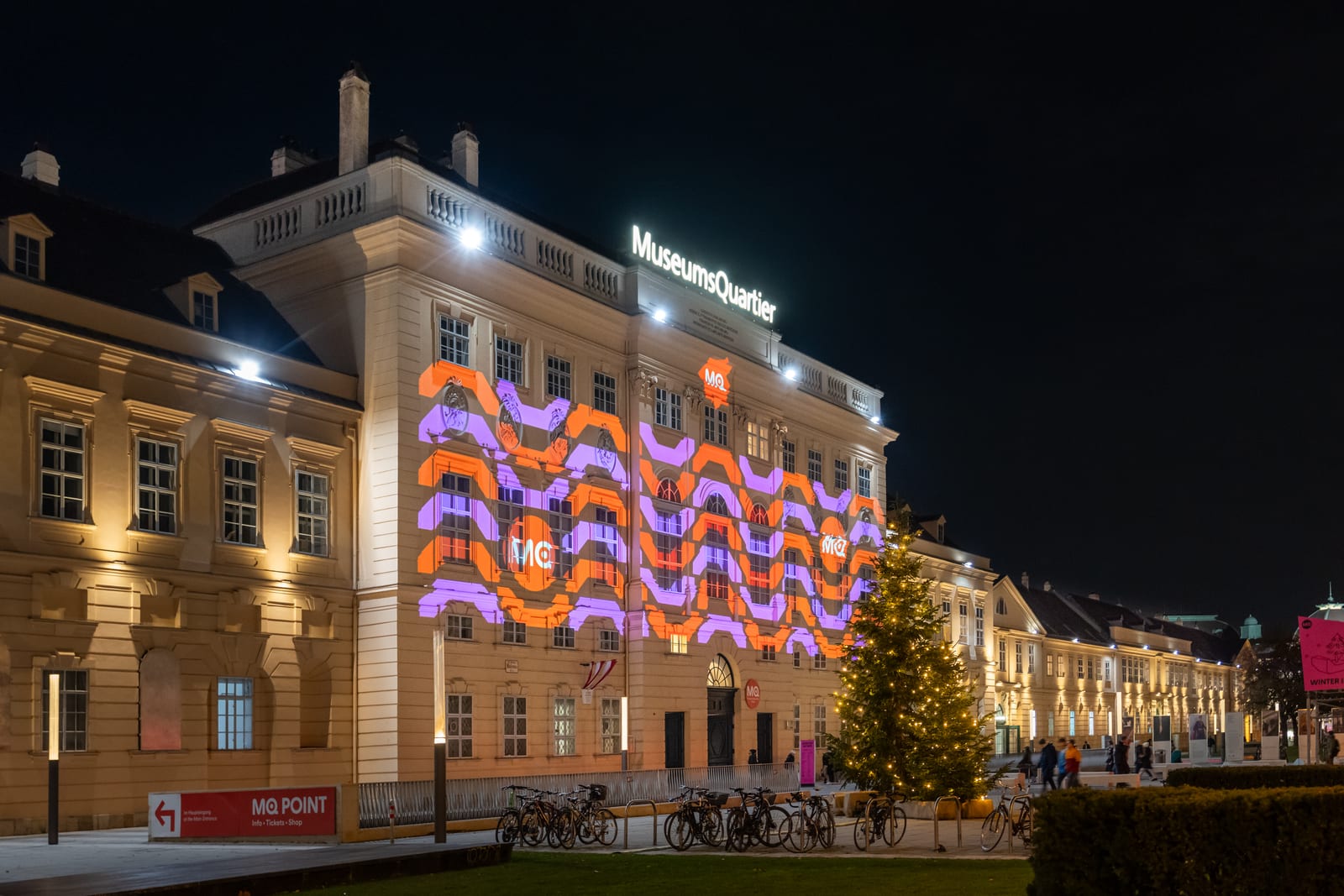
Many city complexes ask you to choose between architecture and use. Vienna's MuseumsQuartier works better when you read both at once: first as a public room, then as a rooftop lookout. Keep the scope tight to Main Courtyard 1 and MQ Libelle and the area stops feeling like a museum bundle and starts behaving like a local piece of city.
This is a non-food Vienna run. The first anchor is the courtyard itself, where the Enzi seating turns the site into what Vienna's own tourism language bluntly calls an "open-air living room." The second anchor is the MQ Libelle on the roof of the Leopold Museum, a free terrace reached by two east-side elevators.[1][3][4]
Place-specific texture matters here. The complex began as imperial court stables designed in 1725, was remade as a trade-fair palace in 1922, and then turned, from 1998 onward, into the mixed cultural district that now spans 90,000 m2, more than 50 institutions, 8 inner courtyards, and Vienna's longest baroque facade at 355 meters.[3] That layered history is exactly why the place rewards sequence rather than checklist behavior.
Anchor 1: Main Courtyard 1 - where the MQ becomes usable
If this is your first pass, start in Main Courtyard 1 instead of treating the whole site as one blurred plaza. Vienna's city guide singles this courtyard out as the most distinctive one, framed by the Leopold Museum and mumok and shaped by the rebuilt museum volumes from the turn of the millennium.[3] That framing gives you the right mental map immediately.
The operational insight is simple: the courtyard is not dead time between museums. It is one of the actual reasons to come. The MQ is always open and free of charge, and in the warmer months the Enzi furniture is the working unit of the place, not decoration.[3][4][5][7] People stop, wait, read, meet, and reset here before deciding whether they even need an indoor ticket.
That matters because it changes how long the visit should be. If you only want a 30-45 minute urban pause, the courtyard may already be enough. If you want the full two-anchor run, the courtyard is where you decide whether the roof will feel like a clean second act or a rushed add-on.
Anchor 2: MQ Libelle - where the district turns vertical
The roof works because it is free, easy to reach, and still directly inside the complex rather than detached from it. The current MQ Libelle page says the terrace is reached via two elevators on the east side of the Leopold Museum, with opening hours 10:00-22:00 and the last elevator ride up at 21:30.[1] Vienna's tourism guide keeps the seasonal frame even tighter: March 1 to October 31, daily 10:00-22:00, with seating on the terrace and the same east-side lift access.[4]
There is one boundary worth respecting rather than smoothing over. The current English MQ page says the terrace area is "open daily except for Tuesday," while the German page and Vienna tourism copy describe it as daily access in season.[1][4][6] Treat that as a real operational caution: if Tuesday evening is your whole plan, check the page on the day instead of assuming the wording glitch will resolve itself for you.
The roof is not only about panorama. MQ's own architecture tour notes that the glass surface carries 2.35 million white dots, while Eva Schlegel's glass wall and Brigitte Kowanz's light elements give the terrace a deliberately art-worked edge instead of a generic viewing deck.[8] That is why the best move is not to sprint upward at once. The roof reads better after the courtyard has already given you scale.
8 local moves that materially improve the stop
First, run the place courtyard first, roof second. MuseumsQuartier becomes legible at ground level before it becomes photogenic from above.[3][4]
Second, treat Main Courtyard 1 as the anchor, not whichever gap you happen to enter through. It is the cleanest read on the district's museum massing and the Enzi furniture culture.[3][5][7]
Third, if you are using MQ as a city reset rather than a museum day, late afternoon is the high-yield band by inference from the site's opening window: you still have usable light, but you are not turning the roof into a last-lift dash.[1][4]
Fourth, make Tuesday your double-check day. The official pages are not perfectly aligned, so this is the one day when lazy assumptions cost the most.[1][4][6]
Fifth, if the roof is your real goal, be at the east-side lifts by about 21:00, not 21:29. "Last elevator up" is a cutoff, not an invitation to gamble.[1]
Sixth, keep the terrace behavior light and public-space aware. The house rules allow access only within the marked route, cap entry when the terrace is full, and permit only private, non-commercial photo and film use unless written approval exists.[2]
Seventh, remember that a EUR0 visit is a real visit here. The courtyard is free, the roof is free, and the district was built to hold lingering as well as ticketed culture.[1][3][4]
Eighth, in warm months, use the Enzi furniture as your first dwell point. Vienna's own local and tourism coverage keeps returning to the same fact: the MQ became socially sticky because people actually stay in the courtyard instead of merely crossing it.[4][5][7]
Non-local trapline: 3 common mistakes and cleaner alternatives
Mistake 1: treating MuseumsQuartier as a museum-ticket problem
Better move: enter the site before you decide on any indoor institution. The courtyard and Libelle already make a complete short visit.[3][4]
Mistake 2: going straight to the roof and leaving
Better move: read Main Courtyard 1 first. The roof is stronger as a second view than as a blind first one.[3][8]
Mistake 3: building the whole visit around the very last lift
Better move: leave a 30-minute margin, and double-check Tuesday status or bad-weather closures if the rooftop is your main reason to go.[1][2][4]
Concrete go details
- Site scale: 90,000 m2, 50+ cultural institutions, 8 inner courtyards.[3]
- Historical spine: court stables in 1725, trade-fair conversion in 1922, current redevelopment from 1998 onward.[3]
- Baroque facade length: 355 m.[3]
- MQ Libelle season: March 1-October 31 in Vienna tourism copy.[4]
- MQ Libelle hours: 10:00-22:00.[1][4]
- Last elevator up: 21:30.[1][4]
- Access point: 2 elevators on the east side of the Leopold Museum.[1][4]
- Guided architecture tour: every Saturday, 14:00 in German and 15:00 in English.[8]
Portable takeaway artifact: a 60-100 minute MQ sequence
| Segment | Target window | Time budget | Decision rule |
|---|---|---|---|
| Main Courtyard 1 first read | 16:30-18:00 or 19:00-20:00 | 20-35 min | Sit before you photograph; decide whether the place is working for you at ground level |
| MQ Libelle ascent | 17:00-20:30 | 20-30 min | Use the roof only if you still have a comfortable buffer before the 21:30 last lift |
| Courtyard return or exit toward Ring/Neubau | Any time after roof | 20-35 min | If the courtyard still feels good after the roof, stay; if not, the visit is already complete |
Vienna has bigger monuments, but few places explain the city's current social texture faster than this one. A former imperial service complex became a public living room. If you run it in the right order, that transformation becomes the actual attraction.
Sources
- MuseumsQuartier Wien, "MQ Libelle" (reopening note, 10:00-22:00 hours, last elevator 21:30, east-side lift access, free entry).
- MuseumsQuartier Wien, "Hausordnung Libelle" (capacity control, weather closures, route rules, private-use photo boundary).
- Vienna Tourist Board, "MuseumsQuartier Wien" (90,000 m2, 50+ institutions, 8 courtyards, 355-meter facade, history, free/open courtyard use).
- Vienna Tourist Board, "Summer in the MuseumsQuartier" (March 1-October 31 Libelle season, terrace access, seating, summer-stage context).
- Vienna Tourist Board, "The famous MQ seating" (Enzi furniture origin, summer meeting-place role, Daniela Enzi naming).
- MuseumsQuartier Wien, German "MQ Libelle" page (German-language daily-access wording for cross-checking the Tuesday discrepancy).
- Goodnight.at, "Gratzl Guide: Entdecke das MuseumsQuartier" (local Vienna lifestyle framing of the Enzi furniture as the social core of the courtyard).
- MuseumsQuartier Wien, "Architecture Tour: Secrets of the MuseumsQuartier Wien" (2.35 million white dots on the MQ Libelle glass surface; Saturday tour times).
- Google Maps search, "MQ Libelle Vienna" (local review stream and current crowd-timing surface).
- Wikimedia Commons, "File:MQ 18 MuseumsQuartier Wien 2024.jpg" (photographic image source used for the cover).