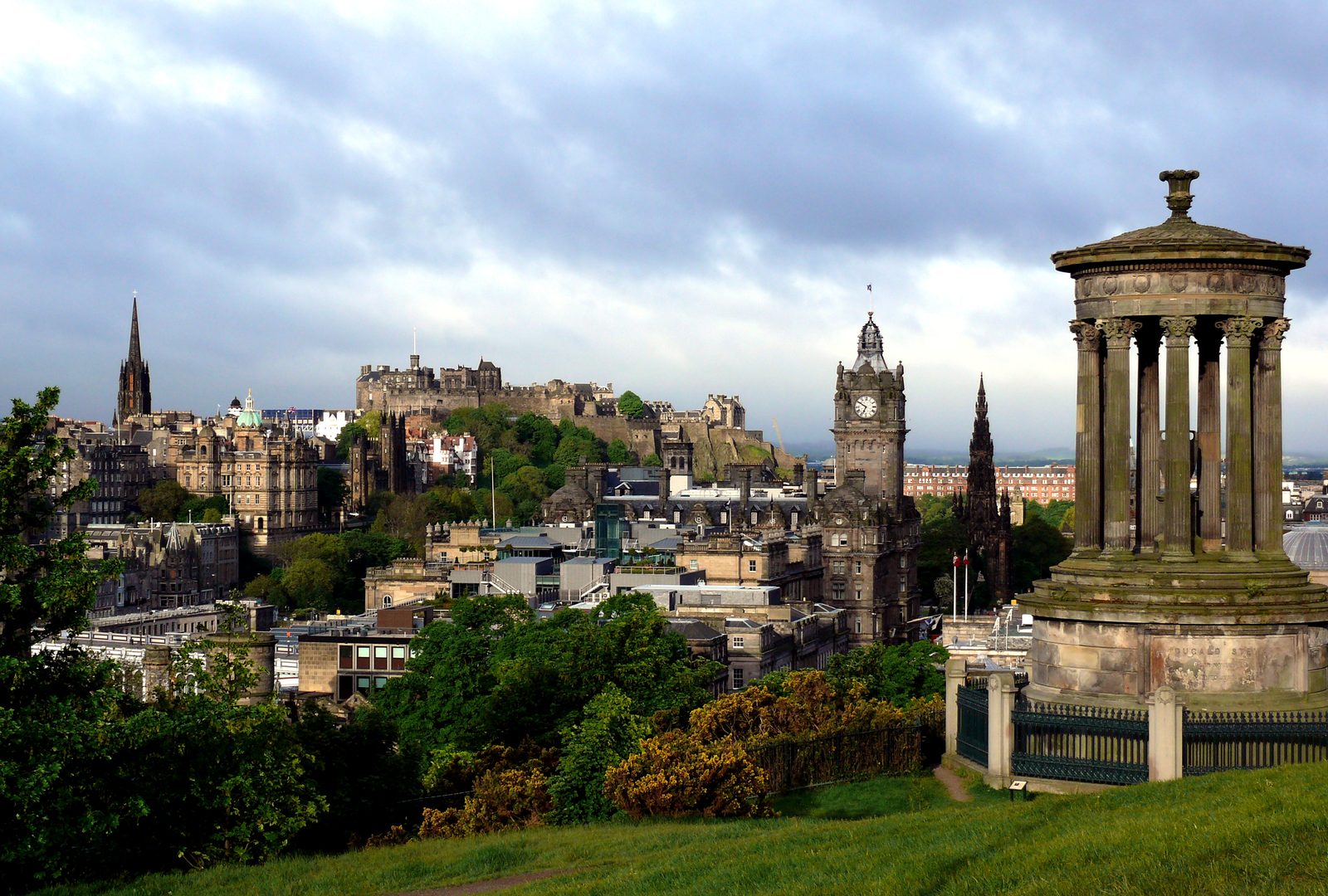
Edinburgh has bigger hills. Arthur's Seat reaches 251 metres and takes two-plus hours to do properly. Calton Hill is only 100 metres, a 5–10 minute walk from Waterloo Place, and it contains more decipherable city per square metre than any other open ground in Edinburgh. What makes it useful as a place rather than a detour is that the three monuments on its summit are not interchangeable set dressing — they each do a different thing, and the correct reading order changes what you take away.[1][2][7]
This is a non-food Edinburgh run. The first anchor is the summit circuit built around the National Monument and the Dugald Stewart Monument: twelve columns of an unfinished Parthenon replica next to a philosopher's memorial that happens to be the best framing device in the city. The second anchor is the Nelson Monument, a 32-metre inverted-telescope tower at the hill's highest point, with a time ball that still drops every day at exactly 1pm.[4][5][6]
Place-specific texture matters here. The National Monument was designed by Charles Robert Cockerell and William Henry Playfair to be Scotland's memorial to the Napoleonic dead. Construction began in 1826 with a first contract of roughly £15,000, all that had been raised of a projected £42,000. By 1829 the money had gone and only 12 columns — one portico end, nothing else — had been completed. Edinburgh has been calling it "Scotland's Disgrace" and "Edinburgh's Folly" ever since, while also photographing it obsessively and declining to finish it.[3] The unfinished state is, at this point, the entire point.
Anchor 1: the summit circuit — where Calton Hill becomes legible
Approach from Waterloo Place rather than Regent Road if this is your first pass. The Waterloo Place staircase brings you up the east slope and deposits you at the summit level with the monuments already in sight rather than making you work around the hill's edge to find them.[5]
The Dugald Stewart Monument is the operational anchor of the summit, not because the philosopher is the reason to come but because the position is. The circular Greek Choragic form — a small rotunda modelled on the Lysicrates monument in Athens, designed by Playfair in 1831 — sits at the south-west lip of the hill and the gap between it and the hilltop means that standing directly behind it places Edinburgh Castle, the Old Town roofline, the Scott Monument, and Princes Street Gardens into a single unbroken frame below.[5][2] This is the most photographed view in Edinburgh for a specific structural reason: the monument gives the foreground an architectural register that raw hillside cannot.
The National Monument is a two-minute walk from the Dugald Stewart position. Up close the scale becomes clearer — each column is 5.6 metres tall, cut from Craigleith sandstone — and the view from the platform level between the columns adds a north-facing read: the Firth of Forth, the Forth Bridges on a clear day to the west, Fife across the water, and the port of Leith in the middle distance.[3][7] The unfinished edge of the monument, where the columns simply stop with no entablature and no roof, is better than a completed version would have been. Edinburgh needs a folly.
Anchor 2: the Nelson Monument — the city's daily clock
The Nelson tower is at the summit's highest point, a short walk north from the National Monument. The 32-metre structure was built between 1807 and 1815 to designs by architect Robert Burn, and its upturned-telescope profile makes it the strangest looking of the hill's monuments, though also the most practically interesting.[4][6]
Two things make it worth the small admission:
First, the views from the top extend further than the open hilltop allows — east to Berwick Law and the Bass Rock on a clear day, west to the Queensferry Crossing.[4] The city reads differently from 32 metres of enclosed staircase than from ground level.
Second, and uniquely, there is a time ball at the mast. Installed in 1853 by astronomer Charles Piazzi Smyth (then Astronomer Royal for Scotland), the ball is raised to the top of the mast just before 1pm and drops at the precise moment the One O'Clock Gun fires from Edinburgh Castle. The original purpose was to give ships in Leith harbour a daily time signal to set their chronometers. The mechanism was restored and the ball returned to the mast in 2025 after a major renovation. Timing the clock side-by-side with the distant Castle gun report is one of those Edinburgh moments that the tourist maps do not flag but the locals treat as part of the background rhythm of the city.[4][6]
Opening hours: April–September, Monday 1pm–6pm, Tuesday–Saturday 10am–6pm; October–March, Monday–Saturday 10am–3pm.[1] Note the Monday gap in the summer season — if Monday is your only Edinburgh day, you arrive after 1pm or you skip the tower interior.
8 local moves that materially improve the stop
First, approach via Waterloo Place. The east-slope staircase is the correct first pass: it gives you the summit level and monument orientation in one clean movement.[5]
Second, do the circuit before the tower. Walk the National Monument and Dugald Stewart positions before paying for the Nelson interior. The free summit read already covers the south and west panoramas; the tower adds east and far-north extension.[4][5]
Third, treat the Dugald Stewart Monument as a viewfinder, not a subject. Walk past it initially; circle back and use it as a foreground frame for the Old Town. The Castle-framing effect only works from a specific position a few metres behind the rotunda.[5][2]
Fourth, use the seasonal window: from roughly October through March, the sun sets over the Castle direction and the golden hour light falls directly into the south-facing viewpoint. In summer the sunset angle shifts north-west, which is still attractive from the Monument side but loses the Castle alignment.[2]
Fifth, if the time ball is your reason for the tower, be inside before 12:45pm. The ball mechanism is visible through the mast structure from the viewing platform, and watching the ball rise, hover, and drop with the distant castle gun is timed to the second — give yourself enough margin to be positioned rather than still climbing.[4][6]
Sixth, check the Monday hours before you plan. Monday closure in the morning (April–September) is a real practical boundary that the hill's always-open nature can obscure.[1]
Seventh, Collective — the contemporary art centre in the old City Observatory buildings — is free and the grounds are part of the Calton Hill public space. It adds 20–30 minutes if you want an indoor counterpoint to the open-air monuments.[8]
Eighth, wind is not a footnote. Calton Hill is exposed on all sides and the north face especially has significant gusts in winter. The monuments provide no shelter.[7]
Non-local trapline: 3 common mistakes and cleaner alternatives
Mistake 1: climbing to Calton Hill as a 15-minute photo stop
Better move: budget 45–60 minutes for the full summit circuit. The Dugald Stewart viewpoint, the National Monument platform, and the tower each reward separate attention — treating all three as one glance produces the same photos and none of the spatial understanding.[2][5]
Mistake 2: arriving at the monument and not knowing which direction to face
Better move: orient south-west first (Castle/Old Town), then north (Forth), then east from the tower. The south-west face is the primary read; the north and east only add context once you have the city baseline.[5]
Mistake 3: skipping the tower on a Monday without checking hours
Better move: if Monday visit is unavoidable, go after 1pm in summer season — the tower opens then, and the time ball mechanism is also live at that exact moment. Arriving at 10am Monday in April will find the tower locked.[1]
Concrete go details
- Walk from Waterloo Place to summit: 5–10 minutes.[5]
- Hill summit elevation: approximately 100 metres above sea level.[5]
- National Monument columns: 12 completed (of a projected full Parthenon replica), each 5.6 metres tall, built 1826–1829.[3]
- Nelson Monument height: 32 metres, 143 steps inside.[4]
- Time ball installation: 1853; restored and operational again as of 2025.[4][6]
- Nelson Monument hours (Apr–Sep): Mon 1pm–6pm, Tue–Sat 10am–6pm.[1]
- Nelson Monument hours (Oct–Mar): Mon–Sat 10am–3pm.[1]
- Calton Hill park access: always free, no closing time.[5][7]
- Collective gallery: free entry to exhibitions, within the hill precinct.[8]
Portable takeaway artifact: a 45–75 minute Calton Hill circuit
| Segment | Target window | Time budget | Decision rule |
|---|---|---|---|
| Waterloo Place approach and summit orientation | Any time of day | 10 min | Arrive from east; get Monument positions before shooting |
| Dugald Stewart Monument south-west viewpoint | 1h before sunset (Oct–Mar) or morning (summer) | 10–15 min | Stand behind the rotunda for Old Town/Castle frame |
| National Monument platform (north read) | Immediately after DS Monument | 10–15 min | Use the column platform for the Forth view; read the folly on its own terms |
| Nelson tower interior + time ball | Before 12:45 if ball is goal | 15–20 min | Check Monday hours before committing; tower adds east and far views |
| Collective gallery (optional) | During opening hours | 20–30 min | Free indoor counterpoint if weather shifts |
Edinburgh has higher ground and more dramatic approaches. What Calton Hill offers instead is density — a complete city map, two centuries of architectural ambition and failure, and a daily mechanical spectacle — packed into a hill that most visitors cross in fifteen minutes without registering any of it.
Sources
- City of Edinburgh Council, "Nelson Monument" (opening hours: Apr–Sep Mon 1pm–6pm, Tue–Sat 10am–6pm; Oct–Mar Mon–Sat 10am–3pm; address: 32 Calton Hill EH7 5AA).
- Highlands2Hammocks, "Calton Hill Sunset — Edinburgh's Best Sunset Spot" (seasonal sun-direction logic: Oct–Mar sun sets over Castle; summer shift north-west; crowd timing).
- Edinburgh World Heritage, "The National Monument" (Napoleonic memorial brief; Cockerell/Playfair design; 1826 construction start; 1829 abandonment; £42,000 projected vs £15,000 raised; nickname history).
- Culture Edinburgh, "Nelson Monument" (Robert Burn architect; 1807–1815 build; inverted-telescope form; 32m height; time ball 1853; drops at 1pm with One O'Clock Gun; views to Queensferry Crossing, Berwick Law, Bass Rock; Charles Piazzi Smyth exhibition).
- Zigzag on Earth, "Calton Hill Edinburgh: Sunset Tips and Visitor Guide" (Waterloo Place approach; 5–10 min walk; Dugald Stewart Monument framing logic; circuit description; crowd pattern at golden hour).
- Deadline News, "173-year-old time ball returned to Calton Hill's Nelson Monument" (2025 restoration and return of the time ball mechanism).
- City of Edinburgh Council, "Calton Hill" (Friends of Parks listing; hill description; UNESCO World Heritage designation; wind and weather exposure notes).
- Collective Gallery, Edinburgh (contemporary art centre in the City Observatory buildings on Calton Hill; free entry; accessibility via Regent Road gate).
- Wikimedia Commons, "File:Edinburgh from Calton Hill with Dugald Stewart Monument 3.JPG" (photographic image source used for the cover; Panasonic DMC-FZ50, 2011).