Valparaíso punishes the visitor who tries to solve it from above. A lookout gives you color, a bay, stacked houses, and a few ships; it does not teach you how the city works. The better first move is smaller and more mechanical: start near Plaza Aníbal Pinto, find the lower station of Ascensor Reina Victoria, ride up, and let Paseo Dimalow slow you down before you wander farther into Cerro Alegre. This is not the whole city. It is a street microcosm, and that is the point.[1][2][3]
The route works because Valparaíso is a port city split between el plan, the flatter lower city, and the steep hills above it. UNESCO describes the historic quarter as a late-19th-century port landscape in a natural amphitheatre, with vernacular hillside fabric, port infrastructure, public spaces, funicular elevators, and trolley systems all part of the place's heritage logic.[1] Chile's National Monuments Council gives the more local mechanism: as the flat commercial city densified in the late 19th century, the hills needed practical links to the civic and port center below; the ascensores emerged from that need, not from tourist nostalgia.[2]
That is why Reina Victoria is a strong first hill move. It was built in 1902, opened in 1903, and was declared a Historic Monument under decree 866 on September 1, 1998.[2][3] The current local ascensor register lists it as municipal property, operative, open 7:00 to 21:30, with a CLP 200 local fare and CLP 1,000 foreign-tourist fare per ride.[3] Early-2026 local reporting confirms the broader tariff reset from January 2, 2026, including the general CLP 200 fare and the foreign-tourist differential.[4] Those numbers matter because they keep the ride in the right category. This is not an attraction you reserve around. It is a tiny piece of working urban access that happens to be beautiful.
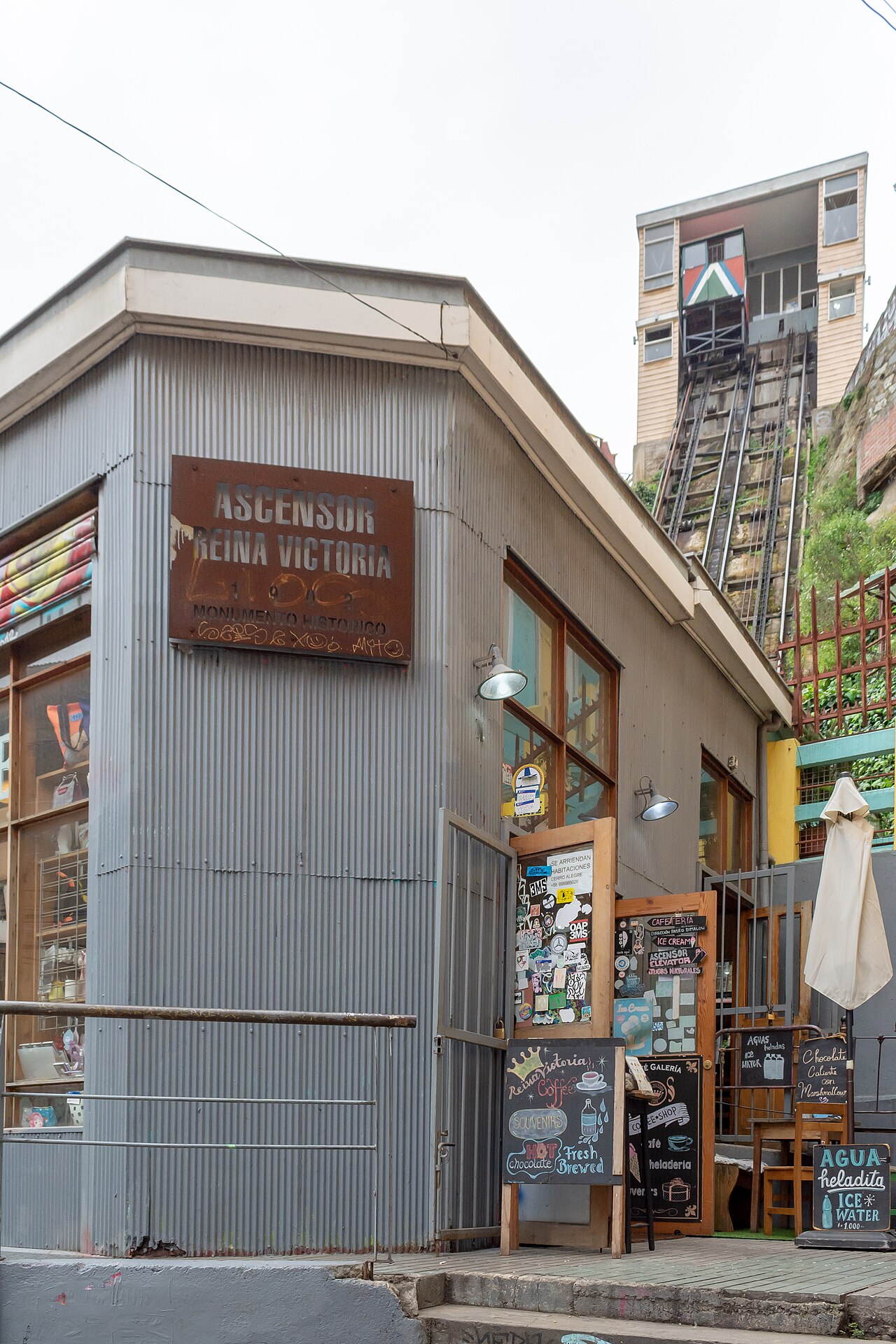
The cover image uses a September 2023 Wikimedia Commons photograph by Carlos Figueroa Rojas because it shows the actual subject: Reina Victoria's track, station, and hillside setting rather than a distant city panorama.[9]
The Correct Use Of Dimalow
The mistake is to treat Paseo Dimalow as an Instagram strip immediately after the ride. It is better understood as a hinge. The municipal government recently described Dimalow, in Cerro Alegre, as a place where residential life, tourism, and local commerce coexist; in April 2026, it was telling residents and visitors that local businesses continued operating normally while emergency repairs advanced around the walkway and viewpoint beside Reina Victoria.[5] That recent note is useful for two reasons. It confirms that the area is active now, and it warns you not to read the route as a frictionless scenic set. Dimalow is a lived street with repairs, businesses, neighbors, and visitor pressure.
The local rhythm is therefore simple: do not rush off the upper station. Step away from the exit, let faster commuters and confident locals pass, and use Dimalow as a five-minute adjustment zone. Look back toward the track, then forward into the hill. The line between lower station, upper station, Dimalow, and Cerro Alegre explains the city better than one more wide-angle view. The ascent makes the hillside physical; Dimalow makes it social.
There is also a small myth-clearing pleasure here. Valparaisología, a local history site, notes the popular but absurd story that Queen Victoria herself inaugurated the ascensor; the queen died in 1901, and the lift opened in 1903.[6] That detail is more than trivia. It is a reminder that Valparaíso's heritage is full of names, port-era memory, borrowed prestige, repairs, and local retellings. The funicular is not just old. It is old enough to have acquired stories that locals now have to correct.
Why This Beats A Loose Cerro Alegre Wander
The common visitor script says: go to Cerro Alegre and Cerro Concepción, look at murals, take photos, find a café, leave before dark. That is not wrong, but it is too loose to be useful. A recent r/travel review of Valparaíso argues for using a local walking tour and being deliberate about where you walk, especially because the most interesting and beautiful parts sit close to places where a first-timer can misjudge safety and route quality.[7] A recent r/chile thread is warmer but still bounded: locals describe Valparaíso as unique, vibrant, bohemian, and walkable in the hills, while also acknowledging that non-local fear and local frustration can both distort the city.[8]
Reina Victoria and Dimalow give that advice a practical shape. They keep you inside a compact, legible zone. They also prevent the two worst readings of Valparaíso: the naive version, where every painted wall becomes charm, and the cynical version, where every rough edge becomes decay. The lift says this is infrastructure. The repairs at Dimalow say this is maintenance. The UNESCO description says the hillside fabric is historically meaningful because it is adapted to difficult topography, not because it produces pretty disorder from a distance.[1][5]
8 Local Moves That Make The Route Land
- Start from Plaza Aníbal Pinto instead of from a random hill taxi drop. The lower-city start lets the ride actually perform its job: moving you from the plan into the hill.[2][3]
- Carry small cash even if you expect card or QR options elsewhere. The fare is tiny, but the whole point is to move like the system is practical, not like you are negotiating a private transfer.[3][4]
- Ride up first, walk down later only if the street feels right. The up-ride teaches the slope quickly; the down-walk should depend on daylight, comfort, and local advice rather than bravado.[7][8]
- Do not block the upper-station exit for photos. Step aside first; locals use this as transport, and the best view of the mechanism is better taken after you have cleared the flow.[3]
- Let Paseo Dimalow be a pause, not a shopping lane checklist. The municipality's 2026 repair note makes clear that Dimalow is active local fabric, not just a visitor boardwalk.[5]
- Keep bags low-profile and hands free. Recent community advice on Valparaíso repeatedly treats route choice and situational awareness as part of enjoying the city well, not as paranoia.[7][8]
- Use the ascensor as one anchor, not the whole afternoon. The ride is short; the value comes from how it changes your reading of Cerro Alegre.[1][2]
- Go in daylight or late afternoon, not deep night on a first pass. The route is strongest when the hillside color, track, and Dimalow repairs are visible and when you can still choose your descent calmly.[5][7]
Non-Local Trapline
Mistake 1: treating Valparaíso as a viewpoint city. The better move is to use a piece of transport first. Reina Victoria turns the hill from a picture into a gradient, and that changes how you read every stair, passage, and terrace afterward.[1][2][3]
Mistake 2: treating Cerro Alegre as risk-free because it is popular. The better move is to keep the route compact and intentional. Recent traveler and local-community threads both reward walking the hills, but neither supports careless drifting without attention to route, time, and belongings.[7][8]
Mistake 3: assuming the ascensor is a preserved museum object. The better move is to ride it as working heritage. It has hours, fares, maintenance history, operating status, and a municipal ownership context.[3][4]
Mistake 4: arriving at Dimalow and forgetting neighbors exist. The better move is to slow down, clear exits, keep voices reasonable, and treat repairs or blocked sections as part of the living city rather than as an interruption to your photo plan.[5]
Concrete Go Details
- Best time window: daylight through late afternoon, roughly 16:00 to 18:30 for softer light without making the first hill descent a night-navigation problem.
- Expected spend: CLP 200 local fare or CLP 1,000 foreign-tourist fare per Reina Victoria ride under the 2026 tariff pattern; add only coffee, museum, or guide costs if you choose them.[3][4]
- Queue or reservation reality: no reservation. If the lift is temporarily closed, do not force the route; use the closure as a signal to reroute through a staffed local tour, another operating ascensor, or a simple uphill walk in daylight.[3][7]
- Navigation cue:
Plaza Aníbal Pinto -> Avenida Elías / lower Reina Victoria station -> upper station -> Paseo Dimalow -> Cerro Alegre lanes -> return before dark or descend deliberately. - Where to stand: first at the lower station looking up the track, then just clear of the upper-station exit, then on Dimalow after the pedestrian flow has opened.
- Numeric anchors worth keeping: 1902, 1903, September 1, 1998, 7:00 to 21:30, CLP 200, CLP 1,000, January 2, 2026, and the register's 40,000 monthly trips figure for 2018.[2][3][4]
Valparaíso does not need to be made simpler than it is. This route works because it accepts the city's complication at street scale: port below, hill above, machine between, paseo beside it, repairs in progress, and a neighborhood that is both loved and used. Ride once, pause properly, then walk as if the city is not scenery but an argument in elevation.
Sources
- UNESCO World Heritage Centre, "Historic Quarter of the Seaport City of Valparaíso" (official World Heritage description used for the amphitheatre setting, hillside urban fabric, port infrastructure, and funicular systems).
- Consejo de Monumentos Nacionales de Chile, "Ascensor Reina Victoria" (official monument file used for construction year, monument status, and the functional reason Valparaíso's ascensores linked hills to the lower city).
- Ascensores de Valparaíso, "Reina Victoria" (local ascensor register used for operating status, 7:00-21:30 hours, fare notes, municipal ownership, and 2018 monthly-trip figure).
- Epicentro Chile, "Ascensores de Valparaíso ajustan su valor: Conoce los nuevos precios" (January 5, 2026 local report used for the January 2 tariff reset, CLP 200 general fare, and CLP 1,000 foreign-tourist fare).
- Ilustre Municipalidad de Valparaíso, "Locales de Paseo Dimalow continúan funcionando con normalidad en medio de obras de mejoramiento" (April 2026 municipal update used for current Dimalow repair context and the residential-tourism-commerce mix beside Reina Victoria).
- Valparaisología, "Archivos / enero 2019" (local history note used for the Queen Victoria inauguration myth and the 1901/1903 correction).
- Reddit / r/travel, "Valparaiso, Chile - the review i wish i found" (November 2025 recent community report used for route-deliberateness, local walking-tour advice, and practical safety framing).
- Reddit / r/chile, "Showing some appreciation for Viña del Mar (and Valparaíso)" (March 2026 local/community thread used for the local perception of Valparaíso as unique, walkable, beautiful, and complicated).
- Wikimedia Commons, "File:Ascensor Reina Victoria, Valparaíso 20230902.jpg" (documentary photographic source page for the lead image by Carlos Figueroa Rojas, photographed September 2, 2023).