Sarajevo rewards the visitor who separates the city's two best high views instead of collecting them like duplicates. The clean version is simple: ride the Trebević Cable Car early, when mountain visibility still has a chance, then keep Yellow Fortress for the final sunset pause above Baščaršija. One view explains the city as a bowl between slopes; the other lets the old town settle into sound, dusk, and everyday gathering.[1][3][4][5]
That order matters because the two anchors do different work. The cable car is a moving threshold from Bistrik and Stari Grad into Trebević, a mountain Sarajevo residents used as an outing place long before the revived gondola became a visitor staple.[2][3] Yellow Fortress, by contrast, is not a machine at all. It is the low-tech evening room: a short uphill walk, a wall, the valley, and people arriving slowly enough that sunset becomes a civic habit rather than a photo stop.[4][5][7]
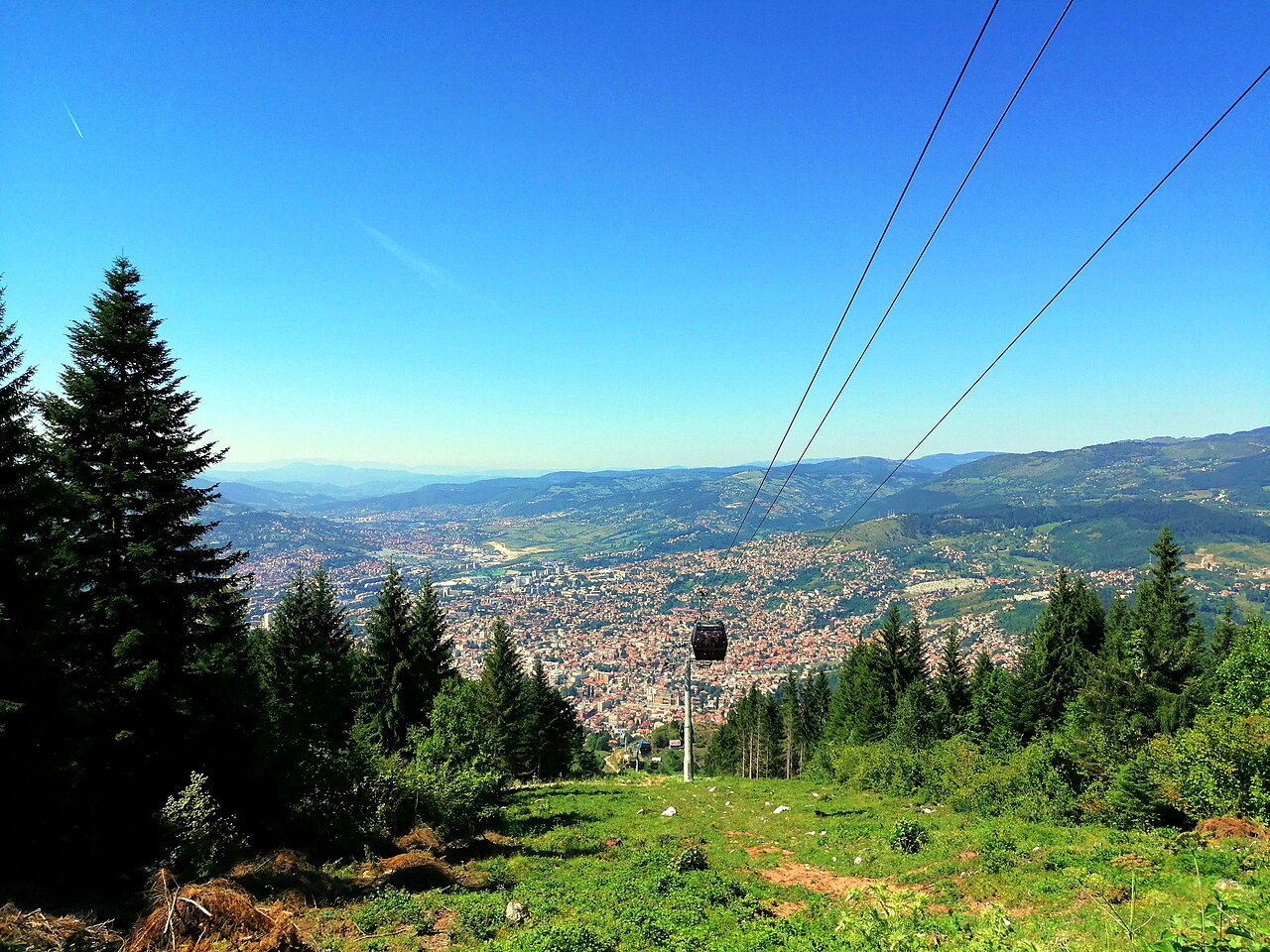
The cover image uses a 2019 Wikimedia Commons photograph by MarinaSimic showing the cable car above Sarajevo. It is the right recognition cue for this route because the article is about how one piece of transport changes the city's geometry before the free sunset view changes its tempo.[8]
Start With The Lift, Not The Sunset
The cable car should come first because it is the more weather-sensitive anchor. The official Sarajevo Cable Car site lists the current 2026 service pattern as 12:00-19:00 on Mondays and 09:00-19:00 on other days, with the lower station at Hrvatin bb.[1] A local guide published with 2026 prices says the ride from the old town area to Trebević takes about 10 minutes and puts the return ticket at 30 KM; SoulHaus Sarajevo gives the same basic shape more sharply, describing the lift as reaching 1,163 metres in about 7 minutes.[4][5] Those numbers are not trivia. They tell you the outing is short enough to fit into a city day, but exposed enough that cloud and late planning can waste it.
Trebević also carries history in the infrastructure itself. The cable car operator's history page says the mountain had long been one of Sarajevo's closest favorite outing spots, with preparatory works beginning in 1956, construction starting in 1958, and the cable car replacing the long climb or road approach in 1959.[2] Destination Sarajevo adds the interruption and repair layer: the old cable car was devastated during the war and renovated in 2018, restoring a direct link from the heart of Stari Grad and Bistrik to the mountain.[3]
That background changes how to ride it. Do not treat the cabin as only a view box. Stand at the lower station long enough to understand that the city is not flat: minarets, tiled roofs, roads, cemetery slopes, and forest all start stacking at once. On the way up, keep the phone down for part of the ride. The point is to feel how quickly Sarajevo leaves the bazaar grid and becomes mountain city.
At the top, keep the visit disciplined. The local-guide version points to the café, trails, city views, and the 1984 Olympic bobsled track, about 20 minutes on foot from the upper station.[4] That is useful if you have energy and clear weather. It is not mandatory. The non-local mistake is to let Trebević swallow the day because it seems like the "big" view. For this ritual, one clean high read is enough. Come down while you still have appetite for the city below.
Save Yellow Fortress For The Slow Hour
Yellow Fortress works best because it is less efficient. Sarajevo Day Trips calls it the sunset spot and suggests arriving 30 minutes before sunset after a short uphill walk from Baščaršija.[4] SoulHaus puts the climb at about 15 minutes and frames Žuta Tabija as the free walk-up viewpoint that makes Sarajevo's bowl-shaped valley legible.[5] Recent community confirmation lines up with that: a BosniaTravel visitor report from last week described returning to Yellow Fortress for sunset on multiple evenings, including the last evening of the trip.[7]
The difference from Trebević is bodily. You do not get lifted out of the city. You climb from it. The old town stays close enough that the call to prayer, tram noise, and conversations still feel connected to the slope under your feet. A local Sarajevo guide's phrasing is direct: go 30 minutes before sunset, find a place on the wall, and let the valley change color.[4] That is the rhythm to borrow.
The best version is deliberately plain. Bring water, not a full picnic production. Walk up before the last-minute rush. Sit where you are not blocking the wall edge. Let locals and families choose their usual spots without making them background texture for your camera. If you want a photograph, take it early, then stop performing the view. Yellow Fortress is strongest when you let the last light take time.
8 Local Moves That Make It Work
- Check the cable-car clock before you leave the hotel. The current operator schedule is not a midnight attraction: Monday starts later, and the listed close is 19:00.[1]
- Use Baščaršija as the mental center, not as a trap. The lower station is close enough to the old-town orbit that you can reach it deliberately instead of defaulting to a taxi for a short move.[1][4][6]
- Do Trebević in clearer daylight. Local guidance is blunt that cloud cover weakens the ride; this is the anchor most likely to suffer if you wait for atmospheric drama.[4]
- Keep the summit optional. If the upper station view is enough, come down. If visibility is strong and legs are good, add the bobsled-track walk; do not turn a short ritual into an obligation.[3][4]
- Leave a buffer between the two views. Trebević is the morning or early-afternoon lift; Yellow Fortress is the end-of-day pause. Collapsing them into one frantic hill chase makes both worse.[4][5]
- Walk to Yellow Fortress early enough to choose your place calmly. Ten to fifteen uphill minutes is manageable, but it feels longer if you start at the exact sunset minute.[4][5]
- Use the fortress as a sit-down view, not a drone-free-for-all substitute. The local value is the shared pause: wall, valley, voices, and light.[4][5][7]
- Let recent community advice constrain your route. A two-month-old BosniaTravel thread calls Trebević highly accessible from Baščaršija and still points first-timers back toward Yellow Fortress and other core city anchors, which supports a compact route rather than a scattered checklist.[6]
Non-Local Trapline
Mistake 1: treating every Sarajevo viewpoint as interchangeable. The better move is to give each one a job. Trebević shows the city's mountain geometry; Yellow Fortress gives you the old-town sunset room.[3][4][5]
Mistake 2: saving the cable car for golden hour without checking the operating window. The better move is to ride when the service clock and visibility are on your side, then keep sunset for a free viewpoint that does not depend on machinery.[1][4]
Mistake 3: turning Trebević into a full mountain day by accident. The better move is to decide at the upper station whether the bobsled track adds value today. A 20-minute walk is fine when visibility and energy are good; it is needless when the point is a two-anchor city ritual.[4]
Mistake 4: reaching Yellow Fortress at the last second. The better move is to arrive early, sit down, and let the crowd settle around you. The experience is not only the final orange band over the city; it is the slow filling of the wall before that happens.[4][5][7]
Concrete Go Details
- Best time window: Trebević on a clear morning or early afternoon; Yellow Fortress 30-45 minutes before sunset so you are seated before the light changes.[4][5]
- Expected spend: 30 KM for the cable-car return ticket according to the 2026 local guide; Yellow Fortress itself is free.[4][5]
- Queue or reservation reality: no complicated reservation layer for this version; the real constraint is the operator's service window and weather.[1][4]
- Navigation cue:
Baščaršija / Bistrik -> Hrvatin bb lower cable-car station -> Trebević upper station -> return to old town -> uphill walk to Žuta Tabija before sunset. - Where to stand or sit: in the cable car, face back toward the valley after the first rise; at Yellow Fortress, sit on the wall only where you are not blocking the main edge or someone else's established spot.
- Numeric anchors worth keeping: 1956, 1958, 1959, 2018, 09:00-19:00, 12:00-19:00 Monday, 7-10 minutes, 1,163 metres, 20 minutes, 30 KM, and 30 minutes before sunset.[1][2][3][4][5]
The route works because it refuses to over-solve Sarajevo. It gives you one mechanical lift, one free climb, one mountain read, and one dusk pause. Between them, the city becomes easier to understand: not as a loose list of old-town sights, but as a valley whose best views ask for different kinds of attention.
Sources
- Sarajevo Cable Car, "Service info" (official 2026 operator page used for current working hours, service-information date, contact details, and Hrvatin bb station address).
- Sarajevo Cable Car, "History" (official operator history used for Trebević's outing-place role and the 1956/1958/1959 construction timeline).
- Destination Sarajevo, "Trebević" (official tourism page used for the Bistrik/Stari Grad access framing, war damage and 2018 renovation note, and mountain-route context).
- Sarajevo Day Trips, "Things to Do in Sarajevo: A Local Guide" (2026 local guide used for the cable-car ride time, 30 KM return-ticket note, bobsled-track walk estimate, clear-day advice, and Yellow Fortress sunset timing).
- SoulHaus Sarajevo, "5 Viewpoints Above Sarajevo You Can Reach on Foot" (local viewpoint guide used for Sarajevo's bowl-valley framing, Žuta Tabija walking time, and Trebević cable-car elevation/time note).
- Reddit / r/BosniaTravel, "My first time traveling to Sarajevo" (March 2026 community thread used for recent first-timer route advice on Trebević accessibility, the cable car, bobsled track, and Yellow Fortress).
- Reddit / r/BosniaTravel, "Beautiful Bosnia - where have you been all my life?" (May 2026 community trip report used as recent confirmation that Yellow Fortress sunset remains a repeat-worthy Sarajevo evening anchor).
- Wikimedia Commons, "File:Sarajevo cable car.jpg" (documentary photographic source page for the lead image by MarinaSimic, photographed August 19, 2019).