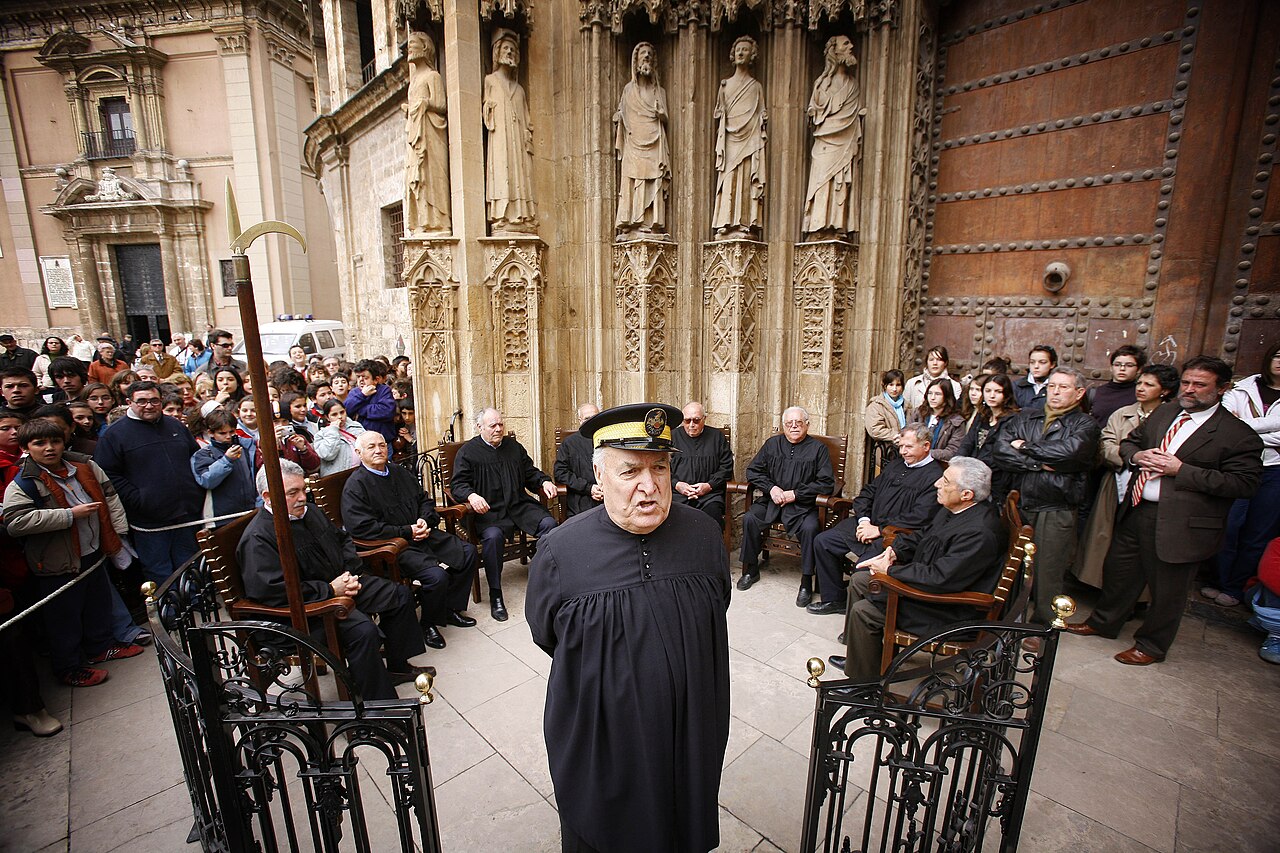
At about 11:30 on Thursday morning, furniture begins to turn stone into jurisdiction. High-backed chairs are placed beneath the carved apostles on Valencia Cathedral’s Gothic doorway. A low iron enclosure called the corralet curves around them. At 12:00, eight irrigation-community syndics take their seats and the court officer begins calling for defendants. Each community is called twice, in the order that its water is drawn from the Turia system [2][3].
Some Thursdays bring a dispute. A canal guard states the complaint, the accused answers, the syndics question both sides and a judgment is delivered orally in Valencian. Other Thursdays produce calls, silence and a closing declaration within minutes [2][3]. That brevity is not a failed performance. The Tribunal de les Aigües has done what a working court must do: constituted itself, made justice available and found that nobody required it that day.
This is the useful way to see Valencia’s Water Tribunal—not as a medieval show staged beside the cathedral, but as a weekly act of readiness. UNESCO inscribed the irrigators’ tribunals of Valencia and Murcia on its Representative List in 2009, describing customary water courts with roots in the al-Andalus period whose elected members settle disputes orally, rapidly and in public [8]. At the Apostles’ Gate, that institutional description becomes a small choreography of chairs, names, a brass hook and a passage through the crowd.
Arrive while the square is still becoming a court
The first local move happens before leaving your accommodation: verify the date on the Tribunal’s own visitor page. The public session is normally Thursday at noon, but when Thursday is a holiday it is often advanced to Wednesday. The institution explicitly directs visitors to its social account for such changes [1]. Treat “Thursday” as a rule with a live exception, not an immutable line in an old guidebook.
The second move is to reach Plaça de la Mare de Déu between 11:25 and 11:35. There is no ticket desk, reservation or admission charge for the public session—expected spend is €0—so the early arrival is about reading the room, not joining a sales queue [1]. Local reporting places the chair setup at roughly 11:30, before a passage is opened through the gathering for the court officer, president, syndics and any parties to a case [3]. If you arrive exactly as the bells mark noon, the crowd may already have hidden the most revealing part: a civic square being rearranged into a courtroom.
Do not stop at the cathedral entrance that first looks grand enough. The third move is to find the Puerta de los Apóstoles on the side facing the square. Use Casa Vestuario at Plaça de la Mare de Déu 1, directly across from the court, as the recognition cue [1][2]. The reclining bronze river figure in the square’s fountain offers a second cue. Around that Turia figure, eight smaller figures with pitchers personify the principal irrigation channels—a twentieth-century monument making the same water geography visible that the chair order will soon enact [7].
The fourth move is choosing an edge rather than chasing the front row. Stand outside the corralet, preferably across the open centerline from the doorway, and keep the temporary passage clear. Community reviews describe the hearing as short and recommend arriving promptly; one visitor found the opposite steps gave a clear view even without understanding the language [5]. The better lesson is geometric, not competitive: a sightline is useful only if the syndics, guards and possible litigants can still enter their own court.
Learn the grammar before the bells
The fifth move is to know what the first words are doing. The officer’s recurring call—“Denunciats de la séquia de…”—asks for the accused associated with each irrigation community. The calls proceed in water order, beginning with Quart and ending with Rovella, and are made twice [2][3]. You do not need to memorize every canal name. Listen for the repeated sentence and for the changing final word. What can sound like a ceremonial chant is actually the court checking its docket aloud.
The brass implement carried by the officer is equally practical. Its hooked form derives from a tool used to lift or move boards in irrigation dividers; at the cathedral it functions as the officer’s insignia [2][4]. This is Valencia-specific texture at its best: the object that gives order to the hearing comes from the material work of directing water.
When the noon bells sound, the sixth move is to make yourself acoustically small. End the running explanation to companions, lower the phone, avoid flash and let the public circle become quiet. The proceeding is wholly oral and conducted in Valencian; there are no lawyers reading documents into a tourist-friendly script [2]. If a case is heard, watch the roles. The guard or complainant presents it. The accused answers. The syndic from the litigants’ own canal does not take part in deliberation, and syndics from the opposite bank propose the judgment—a spatial safeguard against partiality [2]. Form remains legible even when every word does not.
The seventh move is to stay through the president’s closing rather than leaving as soon as a camera frame has been secured. A community-review synthesis describes a typical visit as roughly 15 minutes, and the Tribunal tells confirmed educational groups that their longer visit usually finishes at about 12:15 [1][5]. Neither is a guaranteed runtime: an actual case can change it. Hold the window from 11:25 to 12:20, with a little flexibility, and let the court decide when the court is over.
A no-case sitting deserves the same attention. The institution’s own explanation makes the logic clear: when travel and communication were slower, the syndics still had to assemble because they could not know in advance whether a farmer needed judgment. Breaking the weekly habit would have weakened the mechanism itself [3]. The empty docket therefore reveals the ritual’s deepest function. Reliability is produced by appearing before necessity is visible.
The eighth move begins after the public session. The syndics cross to Casa Vestuario for the administrative meeting on water distribution, normally behind closed doors [2][3]. Do not follow the chairs as if the next room were an unofficial attraction. Wait until the passage clears, then turn toward the fountain. Its bronze Turia and eight channel figures are no longer generic civic decoration; they are the square’s permanent echo of the temporary court you have just watched [7].
A ritual old enough to have a present tense
The Gothic portal and black smocks can tempt a visitor to freeze the scene in an undefined “ancient” Valencia. The Water Tribunal is more interesting when chronology remains precise. UNESCO dates the customary court tradition to the ninth-to-thirteenth-century al-Andalus period while recognizing the two irrigators’ tribunals under Spanish law [8]. The present court’s own procedure is equally concrete: a defendant may be summoned up to three times, testimony and judgment are verbal, a case can use witnesses or an on-site inspection, and the ruling is executable without an ordinary appeal [2]. Continuity here is not the survival of a costume. It is the repeated use of a jurisdiction.
Nor is the semicircle socially motionless. On July 16, 2026, Mireia Sanmartín—identified by the Tribunal as its first female deputy syndic and member—sat in Quart’s chair in place of its syndic [6]. That recent sitting matters to the visitor’s gaze. The 2006 photograph above documents a real session, but it is not a permanent cast list. A living institution can preserve a weekly grammar while the people entitled to occupy its chairs change.
Four ways visitors misread the ritual
Mistake one: navigating to “the cathedral” instead of the Apostles’ Gate. The main façade is not the anchor. Better: enter Plaça de la Mare de Déu, find Casa Vestuario across the square and use the Turia fountain to orient toward the Gothic side door [1][7].
Mistake two: arriving at 12:00 because the event starts at 12:00. That catches the verdict-facing moment but loses the civic transformation and may leave only a poor sightline. Better: arrive around 11:25–11:35, watch the chairs and corralet appear, then take an outer position without blocking the passage [3][5].
Mistake three: expecting a guaranteed dispute or an explanatory performance. The proceeding is a real court, in Valencian, and may close quickly if nobody is called forward [2][3]. Better: learn the sequence beforehand and read a quiet docket as evidence of weekly availability, not as a cancellation.
Mistake four: treating every Thursday alike. A holiday can move the session to Wednesday, and a public square can have competing civic uses. Better: recheck the Tribunal’s live notice or social account during the same week, then keep 11:25–12:20 free rather than building a connection around a fixed 10-minute show [1].
Valencia’s Water Tribunal rewards a kind of attention that travel often edits out. Nothing is hidden, yet the essential thing is easy to miss. It is not merely the black clothing, the hook or even a judgment. It is the decision to build a courtroom in public every week before anyone knows whether a case will fill it.
Arrive before the chairs, listen until the closing, and the cathedral door stops looking like a picturesque backdrop. For a few minutes, it becomes infrastructure.
Sources
- Tribunal de les Aigües, “Visitas al Tribunal” — current official visitor rules for the Thursday 12:00 public session, free entry, holiday changes, guided-group limit of 25, Casa Vestuario address and approximate finish time.
- Tribunal de les Aigües, “Funcionamiento” — official account of the double calls, canal order, oral Valencian procedure, impartiality rules, judgments and the later Casa Vestuario meeting.
- Tourism Valencia, “Tribunal de las Aguas” — local account of the 11:30 chair setup, corralet, public passage, water-order seating and why the court assembles even when there is no complaint.
- Valencia Secreta, “El tribunal de justicia más antiguo de Europa es valenciano” (August 25, 2020) — local cultural guide to the officer’s call, brass hook, eight seated communities and the move to Casa Vestuario.
- Wanderlog, “Tribunal de las Aguas de Valencia” — current community-review synthesis and Google/Tripadvisor excerpts on the short runtime, noon arrival and viewing from the opposite side.
- Tribunal de les Aigües, “Mireia Sanmartín acude hoy como subsíndica a la sesión del Tribunal de las Aguas” (July 16, 2026) — recent official confirmation of Sanmartín occupying Quart’s chair.
- Ajuntament de València, “El Ayuntamiento inicia la restauración del emblemático Monumento al río Túria” (February 15, 2025) — municipal description of the Turia fountain and the eight figures that personify the principal irrigation channels.
- UNESCO Intangible Cultural Heritage, “Irrigators’ tribunals of the Spanish Mediterranean coast” — 2009 inscription, al-Andalus chronology, legal recognition and community role.
- Wikimedia Commons, “The Tribunal de las Aguas of Valencia” — José Jordan’s February 16, 2006 documentary photograph supplied by UNESCO, with original dimensions and provenance.