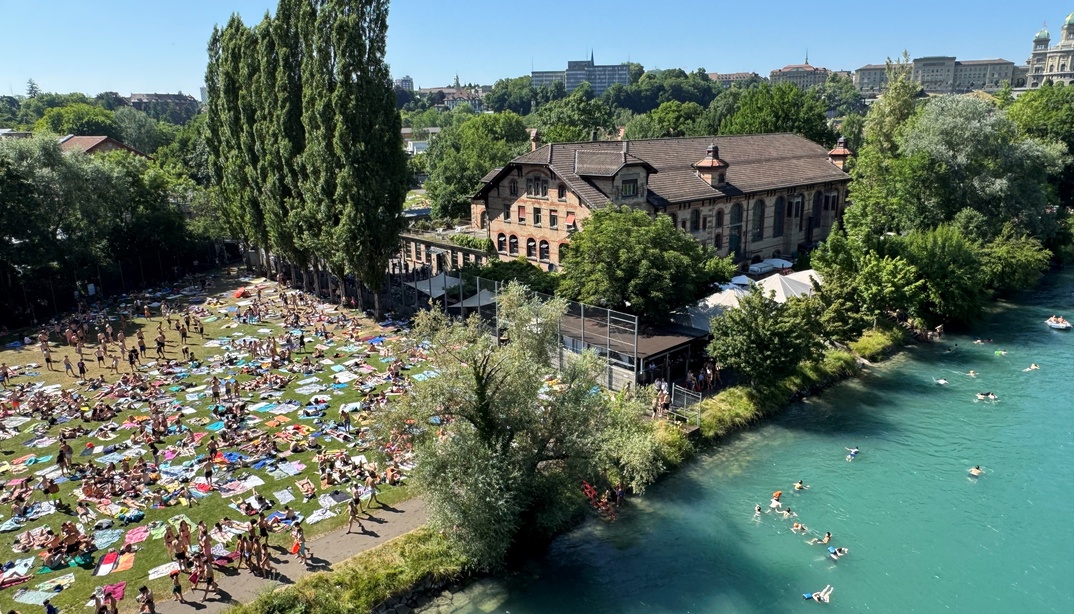
On a hot Bern morning, two streams move in opposite directions beside the Aare. People in sandals and swimwear walk upstream carrying bright waterproof bags. In the river, other bodies travel back toward the city, heads and shoulders sliding through turquoise water while the dome of the Federal Palace appears above the trees. The walk looks purposeful. The return looks effortless.
The important word is looks. The Aare is a fast natural river, not a lazy-river attraction, and the classic Eichholz–Marzili swim is only for strong, experienced river swimmers who have checked the conditions and are not going alone [1][2]. A weak swimmer, a first-time moving-water swimmer or anyone uncertain about making a deliberate lateral exit should stay out of this route. Bern’s free municipal pools, including the pool inside Lorraine Lido, offer honest alternatives; choosing one is good local judgment, not a lesser version of the city [1][6].
For a qualified swimmer, the classic route becomes a brilliant seasonal portrait because Bern organizes it backward. First inspect the finish at Marzili. Then walk roughly 2 kilometres upstream. Only then enter at Eichholz and let the current return you in about 20 minutes, with time varying materially by flow [5][7]. The swim begins, in other words, with a red handrail: the exit you have already seen from land.
That sequence is especially legible in summer 2026. Construction had closed the Eichholz-to-Dalmazibrücke section from September 2025, but the city lifted the swimming and boating ban on May 23, 2026 and reopened the river path and Marzili grounds. The renovated pools followed on June 13, and the current Marzili season runs through September 13 [3][4]. The river ritual is back, but altered banks, fresh infrastructure and live conditions make old habit an unreliable substitute for a same-day check.
Begin downstream, where the decision matters
The first local move is to enter Freibad Marzili from land, not to navigate directly to Eichholz. Walk to the river edge and identify the signed swimmer exits. Bern’s route guidance describes entry and exit points marked by red poles or steps; the city’s safety page stresses that swimmers must leave well before Dalmazibrücke, while current local discussion identifies the red handrails as the practical visual cue [5][6][8]. Look at the handrails from the waterline, then from the walking path. Choose the first exit you intend to take and one earlier fallback. If you cannot explain those landmarks to your companion without using a phone map, do not start walking upstream yet.
The second move is to read the day, not the postcard. A green flag means swimming is allowed with low risk; yellow means increased current or turbid water and calls for caution; red means swimming is prohibited [1]. Even green is not an invitation issued to every body. Bern Welcome says never to swim at high water or after heavy rain and recommends checking current and temperature before entry [1]. The local Aare route service makes the same three things explicit—start early, carry waterproof storage and check conditions before setting off [7]. If the water is cloudy, the flag is yellow or red, or locals with towels are staying on the bank, the better seasonal move is the lawn or pool.
The third move is an ability check with a hard answer. Bern’s current safety guidance says the river is for experienced swimmers at their own risk, advises against long-distance swimming alone and warns that novelty floats and Aarebags do not make deep water safe [2]. Two recent community discussions are blunter: Bern residents tell newcomers to go with someone experienced and reject the idea that popularity turns the Aare into a designed swimming channel [8][9]. Some commenters distinguish the Altenberg–Lorraine reach as a slower river route, but slower is not still: it continues to require moving-water competence [8]. For anyone without that competence, the alternative is a municipal pool or Lorraine Lido’s pool area, not a different Aare current [1][6]. A Bern-based writer of more than a decade captures the local boundary neatly: river swimming is a summer ritual, but the Aare is not a paddling lake and must be respected [12]. A companion is not a license to overreach, but a classic Eichholz swim without an experienced companion is an unnecessary gamble.
Use Marzili’s infrastructure before leaving. The facility has lockers and valuables boxes, direct Aare access, pools, showers and lawns; in the current August band it opens 07:00–20:00 on weekdays and 09:00–20:00 on weekends [4]. Store what you do not need. A waterproof bag can carry clothes, but treat it as luggage, not rescue equipment [2]. Keep alcohol for after the swim, when the decision-making is over [2].
Walk against the flow
The fourth local move is to let the upstream walk teach the route. From Marzili, follow the river past the Dampfzentrale, known in Bern Welcome’s route description as the “Dampfere,” then under or beside the Monbijou Bridge sports grounds, onward past Schönausteg and toward the Eichholz gravel beach [5]. The Dampfzentrale’s brick mass is more useful than a generic blue dot: it appears in the photograph above and fixes the ritual to an actual piece of Bern’s riverbank. When you later see it from the water, you are already approaching the part of the route you inspected.
Do not turn the walk into a countdown to a compulsory plunge. Its purpose is reconnaissance. Watch where strong local swimmers leave the river, how quickly they move relative to the bank and whether anyone is changing plans. The classic route page rates Eichholz–Marzili moderate, not easy, and gives 2.0 kilometres / 20 minutes as a planning profile rather than a guarantee [7]. A federal inventory of Bern’s living traditions explains why time can shift so much: discharge and season change the speed of the same stretch, and the Aare is unsupervised even alongside the city’s river baths [10].
The fifth move is to respect the redesigned bank. The 2026 flood-protection work widened about 200 metres of river edge near Gaswerkareal and created a roughly 2,000-square-metre shallow-water habitat with five islands. The city explicitly says this new zone is reserved for nature: it is not a bathing, picnic or play area, and the new dams should not be climbed [3]. Fresh shallows can look like a gentle place to improvise an entry. Here they are both habitat and boundary. Stay on the established route and signed access points.
At Eichholz, stop on the gravel beach before entering. This is the sixth move: cool the body gradually. Bern’s safety guidance says the Aare can be cold, advises wetting yourself first and warns against diving into cloudy or unknown water because rocks may be hidden below [2]. If the temperature, speed or entry feels wrong from the edge, walk back. The CHF 0 day has still delivered a river path, a civic bathing lawn and a close view of how Bern uses summer [1][10]. No ticket needs to be justified by taking a risk.
Let the Parliament appear; do not chase it
Once in, the route’s beauty comes from a peculiar reversal. The old town and Federal Palace are not destinations at the end of a climb. They arrive above the river while the current carries the swimmer toward Marzili [5]. Government sits on the bluff; bathing life occupies the water below. Bern’s federal square may be ceremonial, but from the Aare the capital reads as a green corridor with an official skyline almost casually attached.
That contrast is the place-specific heart of the ritual. The Swiss inventory describes Aare swimming as inseparable from Bernese summer, notes that the municipal outdoor baths remain free and records more than 800,000 estimated Marzili visits in the 2023 season [10]. The Sportamt’s 2025 photograph shows the social density those numbers imply: towels touching on the Spitz lawn, swimmers dispersed across the river and the Dampfzentrale holding the middle of the scene [11]. Bern has made access ordinary without making the river domesticated.
The seventh move is therefore to keep the view secondary to the exit. Do not drift into a poor line for a photograph, stop paying attention because the Federal Palace has appeared, or assume a waterproof phone justifies using it mid-current. You must retain enough control to move toward the bank at the planned point. If the first suitable red-railed exit is available, use it. “One more” is a bad river decision because the consequence of missing an exit travels downstream faster than reconsideration.
The eighth and final move is to finish the ritual on land. Account for your companion, close the route, shower, retrieve valuables and only then spread a towel or buy a drink. The grass is not an antechamber to the “real” experience. It is where the city converts a serious piece of moving water into a shared summer room—through exits, lockers, repeated local knowledge and the collective willingness to stop when the river says no.
Four ways visitors misread the moment
Mistake one: treating a busy river as a safe river. Hundreds of swimmers can show that the ritual is culturally normal; they cannot tell you whether your skills match today’s flow. Better: read the flag, check live conditions and make the ability decision independently [1][7][8][12].
Mistake two: making Eichholz–Marzili a first wild-river swim. Current community advice distinguishes a slower Altenberg–Lorraine reach, but that is still a moving-river swim rather than a beginner pool [8]. Better: use a municipal pool or the pool area inside Lorraine Lido unless you already have strong moving-water experience and a qualified local companion [1][6].
Mistake three: assuming a dry bag or novelty float solves the safety problem. It may keep clothes together; it does not create judgment, exit control or river skill, and official guidance says Aarebags and pool floats do not make deep water safe [2]. Better: separate luggage from approved safety equipment and never use either to rationalize a route beyond your ability.
Mistake four: walking upstream before learning the finish. From the path, every exit can look interchangeable. From the current, the usable window contracts. Better: scout the red rails at Marzili first, select an early exit and a fallback, then walk against the flow [5][6].
The go details
- Anchor: the single Eichholz–Marzili swim sequence; Dampfzentrale, Schönausteg and the Federal Palace are recognition cues, not extra stops [5].
- Ability gate: strong, experienced river swimmers only, with an experienced companion. Everyone else should choose a municipal pool or the pool area inside Lorraine Lido; the Altenberg–Lorraine river route still requires moving-water competence [1][2][6][8].
- Best window: an editorial 07:30–09:30 weekday window in the core summer season, after a same-morning flag, weather, flow and temperature check. Marzili’s current weekday opening is 07:00; the local route source recommends starting early [4][7].
- 2026 season boundary: Marzili is open through September 13; current hours vary by date and weekday, so recheck the official page rather than carrying these August hours forward [4].
- Expected spend: CHF 0 for the river and municipal outdoor-bath entry. Lockers or refreshments are optional extras; bring a payment method if using them [1][4][10].
- Queue and reservation reality: no ticket or reservation for the core experience. Heat creates crowd pressure on lawns, lockers, paths and exits, which is a reason to start early—not evidence that conditions suit you [7][11].
- Route profile: about 2.0 kilometres and 20 minutes in the water under the local guide’s reference conditions, preceded by the upstream walk; actual duration changes with flow [5][7][10].
- Navigation cue:
Bern station → Marzili (about 10 minutes on foot) → Dampfzentrale → Monbijou Bridge → Schönausteg → Eichholz gravel beach; return by water only if every safety condition still holds [4][5]. - Exit position: choose the first inspected, signed red-railed exit at Marzili and leave before Dalmazibrücke [5][6][8].
- Abort conditions: for a visitor on this route, a yellow or red flag, high or turbid water, recent heavy rain, uncertain exit, alcohol, cold shock, missing companion or any doubt about swimming strength [1][2]. Emergency numbers are 144 for ambulance and 117 / 112 for police [1].
Bern’s summer river ritual is memorable because the current does so much of the visible work. The deeper local knowledge lies in everything that happens before it: checking, declining, locking, scouting, walking and recognizing the red rail from the bank. Only after those decisions does the effortless image become honest.
The Federal Palace may be the grand recognition cue. The exit is the one that matters.
Sources
- Bern Welcome, “The River Aare” — current destination guide covering the experienced-swimmer boundary, marked exits, weather and water checks, free city pools, flag meanings and emergency numbers.
- Bern Welcome, “Staying safe in and on the River Aare” (May 5, 2026) — recent safety guidance on cold-water adjustment, hidden rocks, swimming with others, flotation limits and alcohol.
- City of Bern, “Marzili/Gaswerkareal: Ende der Bauarbeiten entlang der Aare” (May 18, 2026) — primary confirmation of the May 23 reopening, June 13 pool return, new exits and the protected widened habitat.
- Sportamt Bern, “Freibad Marzili” — live official facility page for 2026 season dates, current hours, infrastructure, direct Aare access and the station-to-Marzili walk.
- Bern Welcome, “Floating Down the Aare River: Our Three Favorite Routes” — local route narrative for the red-pole exits, roughly two-kilometre walk, Dampfzentrale, Monbijou Bridge, Schönausteg, Eichholz beach and Federal Palace view.
- City of Bern, “Outdoor pools and Lidos along the Aare” — official Aare You Safe guidance on Marzili exits, the experienced-swimmer restriction, Eichholz and the slower protected water at Lorraine.
- AareMarzili, “The classic: Eichholz–Marzili” — local live-conditions service classifying the 2.0-kilometre, roughly 20-minute route as moderate and advising an early start, waterproof storage and a pre-swim condition check.
r/bern, “good spot to swim in the Aare as first timer?” (July 2026) — recent local-community discussion distinguishing Lorraine’s slower water from the faster Marzili route and emphasizing exit scouting and experienced company.r/bern, “Aare Swimming” (May 2026) — recent local-community discussion of cold, current, dry bags, life jackets and why equipment does not turn a weak swimmer into a river swimmer.- Swiss Confederation, Living Traditions: Aare Swimming in Bern (August 2024) — cultural history, free-bath policy, attendance estimates, seasonal flow variation and the boundary between civic tradition and unsupervised river risk.
- Sportamt Bern, “Badi-Saison 2025: Neuer Rekord für Berns Freibäder” (September 17, 2025) — recent official attendance report and source page for the real Marzili photograph used as this article’s image.
- Visit Bern, “Erfrischendes Abenteuer in Bern: Das Aareschwimmen” — a Bern-based resident writer’s account of river swimming as both a local summer ritual and a current that demands respect.