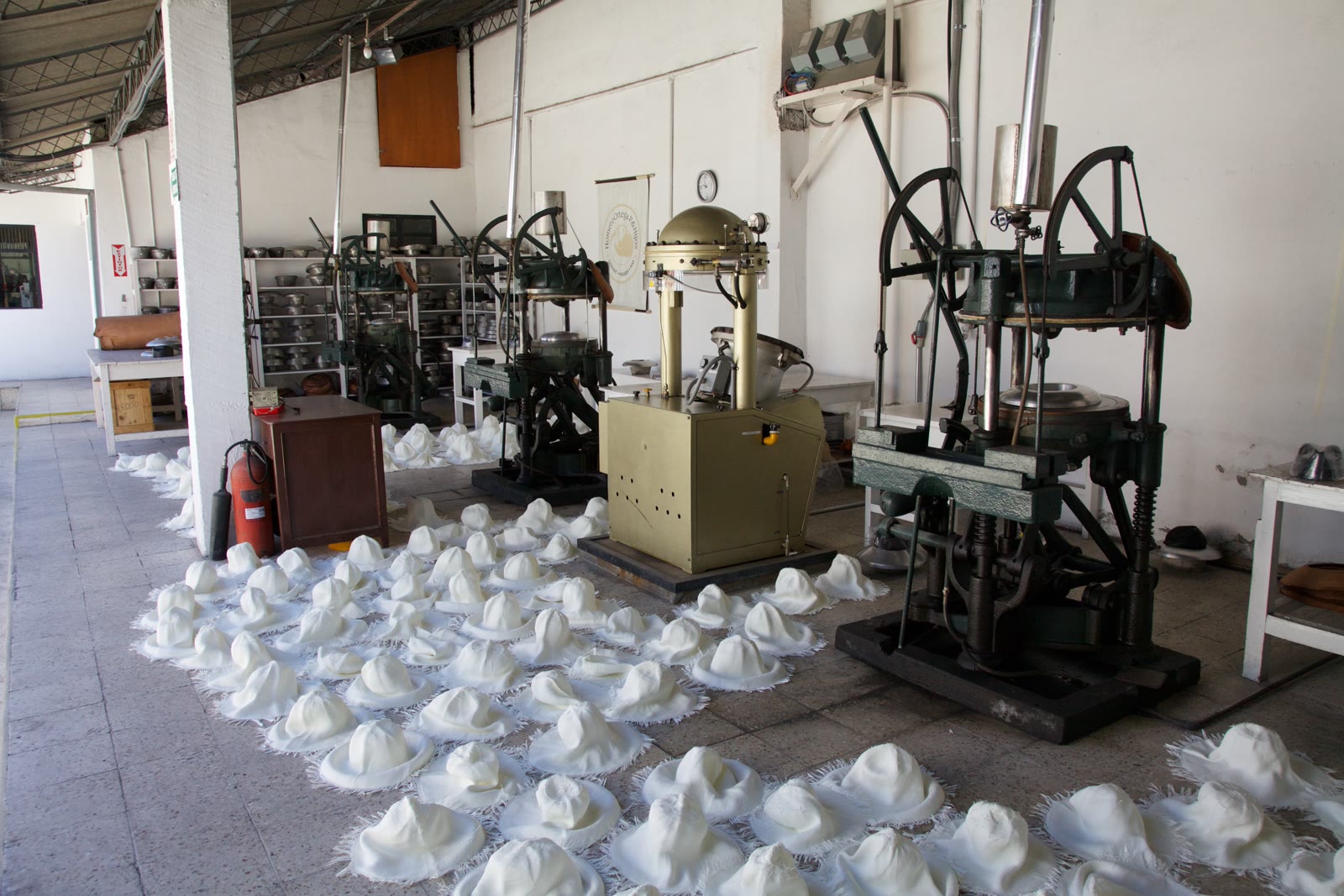
The most revealing object at Homero Ortega is not a finished fedora. It is the pale, floppy hat body waiting on the factory floor. Its crown has been woven and its brim spreads outward, but it has no settled silhouette yet—no crease, no confident edge, no ribbon to tell the eye what kind of person might wear it.
That unfinished form corrects two travel myths at once. The first is geographical: the object sold internationally as a “Panama hat” is an Ecuadorian toquilla-straw hat. The second is mechanical: a woven hat does not leave the weaver’s hands ready for a shop window. At Homero Ortega’s factory-museum in Cuenca, the useful story begins with a handoff. Much of the weaving takes place in family homes; the woven bodies arrive for tightening, trimming, washing, reshaping, blocking, pressing and decoration [3][4].
Build the visit around that single object. Spend 30–60 minutes at Museo “La Magia del Sombrero,” watch one soft body become legible as a hat, and let the showroom come last. This order matters. If you begin with color and price, every earlier stage starts to look like retail theatre. If you begin with the unfinished weave, the finished hat becomes accumulated work.
Use the factory clock, not the shop clock
The first move is to navigate to the exact venue: Avenida Gil Ramírez Dávalos 3-86, near Cuenca’s Terminal Terrestre. Search for Museo La Magia del Sombrero de Homero Ortega, not merely “hat museum”; Cuenca has other toquilla-hat museums, including one on Calle Larga and a municipal museum on Rafael María Arízaga [1][9]. The bus terminal is the practical recognition cue. This is not a doorway discovered while wandering the postcard center.
The second move is to use a weekday production window. Ecuador’s May 2026 craft guide lists free guided visits Monday–Friday from 08:00–12:30 and 15:00–17:30, in Spanish and English. Saturday’s listed window is 08:30–12:30 and Sunday’s 09:00–11:30, both in Spanish; the same guide says visible pressing, washing and finishing runs Monday–Friday only, until 16:00 [1]. The strongest plan is therefore 09:00–11:30 on a weekday. A compact second choice is 15:00–15:45.
Do not substitute the showroom’s broader opening hours for guided-production hours. Homero Ortega publishes slightly different visitor and retail clocks, and an older Cuenca tourism page says Sunday visits require an appointment [2][9]. For Sunday, a holiday, a group, or an English tour, message the venue’s published WhatsApp number—+593 98 415 7062—before setting out [1]. No current primary source promises a fixed walk-in departure time, and no authoritative queue time is published.
The third move is simple: ask for the guided circuit as soon as you arrive, then give yourself ten minutes before touching a hat or discussing a purchase. The museum’s three-room sequence covers the object’s history, its making and the company’s own history [2][9]. Remember that the final room is presented by a producer and retailer. It is valuable evidence about process, but it is not an independent account of the company.
Read the hat backward
Begin with the material. Toquilla fibre comes from Carludovica palmata, a fan-leaved Ecuadorian plant. Coastal growers harvest young stems, separate the fibres, boil and dry them, and prepare them for bleaching. Weavers then form the center, crown and brim by hand [3][4]. UNESCO inscribed the traditional weaving practice on its Representative List in 2012; it did not designate this company, museum or any individual hat [4].
The fourth move is to ask the guide to point out where the weave starts. Homero Ortega describes a small central plantilla expanding as more strands are added, followed by the copa or crown, the falda or brim, and the remate at the edge [3]. Do not worry about memorizing a vocabulary list. Look for the physical consequences: the circular beginning, the changing direction around the crown, the regularity of the rows and the unfinished fibres at the rim.
Now place time back inside the object. UNESCO says weaving can take from one day to eight months, depending on fineness and quality, and that knowledge is commonly transmitted within families through observation and imitation [4]. That range should make a visitor suspicious of any one-word grade presented as a complete explanation. “Fine” is not magic dust. Ask what the grade describes here: fibre fineness, weave regularity, points, time, finishing—or some combination.
The fifth move is the most important: on the production floor, look for the work that happens after weaving. Homero Ortega’s process account names tightening and trimming the finished edge, washing and dyeing, restoring form after washing, molding and decorating [3]. The current national guide narrows what a visitor may actually see to pressing, washing and finishing on weekdays before 16:00 [1]. If nobody is weaving during your visit, nothing essential has been omitted. The absence is evidence of a distributed production system rather than a failed demonstration.
The 2015 photograph above makes that handoff unusually clear. White woven bodies sit beside metal forms and green presses; they look related, but not identical. The image’s own archival description identifies the factory as Homero Ortega and says the bodies had been woven in homes before arriving for finishing [12]. Watch for that same before-and-after distinction in the room. A block determines shape. A press fixes it. Trimming cleans the edge. Decoration makes the object commercially specific. The hat is handmade, but “handmade” does not mean one uninterrupted pair of hands.
The press is part of Cuenca’s city history
Cuenca did not invent every stage of the toquilla hat, and it should not absorb the coastal cultivation or rural weaving into a convenient city brand. Its historical role is nevertheless substantial. UNESCO’s account of Cuenca’s historic center says nineteenth-century prosperity from exporting quinine and straw hats helped modernize the city’s architecture [5]. The trade is therefore not a souvenir story pasted onto the colonial street grid. It is one of the economic forces that changed the built city visitors now admire.
Homero Ortega’s factory sharpens that history because it sits outside the most romantic visitor frame, close to transport and distribution. Woven material arrives. It is graded and finished. Finished hats leave. The factory turns dispersed household labor into standardized shapes that can travel through a global market. That is why the blocking press is the right city object: it sits exactly where regional knowledge becomes a repeatable export form.
The sixth move is to resist turning workers into another display. Ask before making close photographs, stay outside marked production areas and do not interrupt a task for a pose. The official guide promises the chance to observe work; it does not promise unrestricted access to every bench [1]. Let the sound of the room—water, machinery, conversation, a press closing—carry some of the visit that a camera cannot.
Compare the same shape before choosing a different one
Only after the process should the showroom become useful. The seventh move is to compare the same silhouette across two or three weave grades before trying five different colors. Homero Ortega’s current online classic collection labels categories such as Standard, Llano Fino and Fino, with sampled prices running from about US$43 to US$146 [6]. That is a live online reference, not a guaranteed showroom range. Inventory, special pieces and promotion prices can differ.
Community reports confirm that the price spread can be much wider than a first glance suggests. Recent Google reviews surfaced by Wanderlog praise the factory explanation and describe everything from promotional hats to very fine four-figure pieces; Tripadvisor contributors describe both attentive guidance and, in a less positive account, a stop that felt oriented toward tour buses and sales [10][11]. These are anecdotes, not operating policy. Their shared lesson is useful: set a ceiling before entering the showroom, and keep the free museum visit complete even if you buy nothing.
The eighth move is to fit before judging appearance. The company’s measuring guide places the tape around the head at mid-forehead and lists sizes from S at 55–56 cm through XXL at 62 cm [7]. Ask to try the size on either side of your measurement. A finer weave does not rescue the wrong fit, and a flattering mirror does not predict how a tight crown will feel after an hour.
If you do buy, the ninth move is to leave with a transport plan, not just a receipt. Ask staff to name the weave grade on the exact hat, explain its care and provide a rigid box. The company’s own guide says not to fold the hat, not to wear it in rain and to dry it before storage if it gets wet [8]. Treat any “rollable” claim as model-specific and get it confirmed for the piece in your hands.
Four visitor traps, with better moves
Trap one: arriving during the lunch gap or after production has stopped. A shop may still be open while the guided or visible-work window is not [1][2]. Better: arrive on a weekday between 09:00 and 11:30, or at 15:00 with enough time to reach the floor before 16:00.
Trap two: expecting the whole hat to be woven in front of you. The newest visitor guide promises pressing, washing and finishing, while both UNESCO and the producer place much weaving in family and home settings [1][3][4]. Better: follow the handoff and ask which work happened before the body reached Cuenca.
Trap three: treating “Panama” as origin, or UNESCO as a brand endorsement. The familiar market name does not relocate the craft, and the 2012 inscription belongs to Ecuador’s weaving knowledge [4]. Better: say “Ecuadorian toquilla-straw hat,” then use “Panama hat” only when explaining the global name.
Trap four: buying the first hat that photographs well. Review surfaces describe a huge spread in selection, price and sales atmosphere [10][11]. Better: complete the three rooms, compare one shape across grades, confirm size and care, and remain comfortable leaving at US$0.
The compact go brief
- Anchor: Museo “La Magia del Sombrero” at Homero Ortega; do not add a second hat museum to the same visit.
- Best window: Monday–Friday, 09:00–11:30. Alternative: 15:00–15:45, with visible production listed only until 16:00 [1].
- Time on site: 30–60 minutes [1].
- Expected spend: US$0 required. If buying a classic hat, use roughly US$45–150 as a planning band from the current online collection, then verify the showroom price before committing [6].
- Reservation and queue reality: no current source requires a routine weekday reservation and no reliable queue time is published. Confirm Sunday, holidays, groups and English guidance by WhatsApp [1][9].
- Navigation cue:
Terminal Terrestre → Avenida Gil Ramírez Dávalos → number 3-86 → Homero Ortega museum/showroom[1][11]. - What to watch: the woven body’s edge, washing, restored form, block, press and finishing—not a staged promise that one person makes the entire hat onsite [1][3][4].
- Before leaving: exact weave grade, measured size, care instruction and rigid travel box [6][7][8].
The finished hat is designed to make its labor disappear. Its weave becomes surface; its pressed crown looks inevitable; its brim appears to have always known its curve. The factory visit is worthwhile because it reverses that illusion. Follow the soft body before it acquires a name and style, and Cuenca’s role becomes visible—not as the sole birthplace of the object, but as the place where scattered strands, household time and industrial finishing are made to hold one shape.
Sources
- Ecuador Travel, Tejido de Paja Toquilla (May 2026), pp. 56–57 — current national guide to Museo “La Magia del Sombrero,” including address, free entry, guided-language hours, 30–60-minute duration, contacts and the weekday 16:00 production cutoff.
- Homero Ortega, “Museo” — official description of the factory-museum, three-room circuit, guided visits and visitor hours.
- Homero Ortega, “Historia del sombrero de paja toquilla” — producer account of the Ecuadorian material, home-based weaving vocabulary and post-weaving finishing sequence.
- UNESCO Intangible Cultural Heritage, “Traditional weaving of the Ecuadorian toquilla straw hat” — 2012 inscription, coastal fibre preparation, one-day-to-eight-month weaving range, home transmission and finishing stages.
- UNESCO World Heritage Centre, “Historic Centre of Santa Ana de los Ríos de Cuenca” — city history connecting nineteenth-century straw-hat exports with prosperity and architectural modernization.
- Homero Ortega, “Clásicos” — current official online collection used only for sampled weave labels, sizes and the approximate US$43–146 price baseline.
- Homero Ortega, “Guía de Tallas” — official measuring method and S-to-XXL centimeter ranges.
- Homero Ortega, “Guía de Cuidado” — official storage, rain, drying, stain and folding guidance.
- Fundación Municipal Turismo para Cuenca, “Tejedores de sueños” — local official overview distinguishing Cuenca’s three hat museums and noting three rooms, free entry and advance Sunday contact at Homero Ortega.
- Wanderlog, “Homero Ortega Hats” — current Google-review aggregation used as anecdotal community evidence on visit length, guidance, production visibility, purchases and price spread.
- Tripadvisor, “Homero Ortega” — independent visitor-review surface used for the terminal-area navigation cue and competing reports of service, tour-group atmosphere, selection and sales pressure; its displayed hours were not used.
- Wikimedia Commons, “Panama Hat factory in Cuenca, Ecuador” — source page, authorship, location, date, license and original dimensions for David Brossard’s real 2015 photograph of Homero Ortega’s finishing floor.