Do Gandan first, before Ulaanbaatar has turned into traffic, museum decisions, cash errands, and day-trip negotiations. The right version is not "see the big monastery, then rush to Zaisan." It is narrower: arrive before the morning chanting, let the courtyard set your pace, follow local movement around the temples, and leave while the day is still small.
That matters because Gandantegchinlen Monastery is not just a boxed attraction west of the center. Ulaanbaatar's own tourism department has framed the area around Gandan, with its narrow winding streets, as a dedicated culture and tourism district rather than a detached landmark [1]. The city's investment department also records a public-space layer that a quick taxi stop would miss: the central square in front of the monastery was renovated with 8,400 square meters of natural stone paving, 820 square meters of green space, benches, lighting, bins, fencing, and renewed stairs [2]. In other words, the approach is part of the visit. The courtyard is not empty foreground. It is how the monastery meets the city.
The working window is 8:20-9:40 a.m. on a normal morning. A current local guide says Gandan is the perfect way to start a day in Ulaanbaatar and specifically recommends going before 9 a.m. to hear the monks begin their chants [3]. A practical travel guide gives the broader frame as daily 8:00 a.m.-5:00 p.m., with morning chanting around 8:00-9:00 a.m., and places the monastery about 2 km west of Sukhbaatar Square, roughly a 25-minute walk in decent weather [4]. Those numbers are the whole argument. This is a first-hour ritual, not a late-afternoon filler.
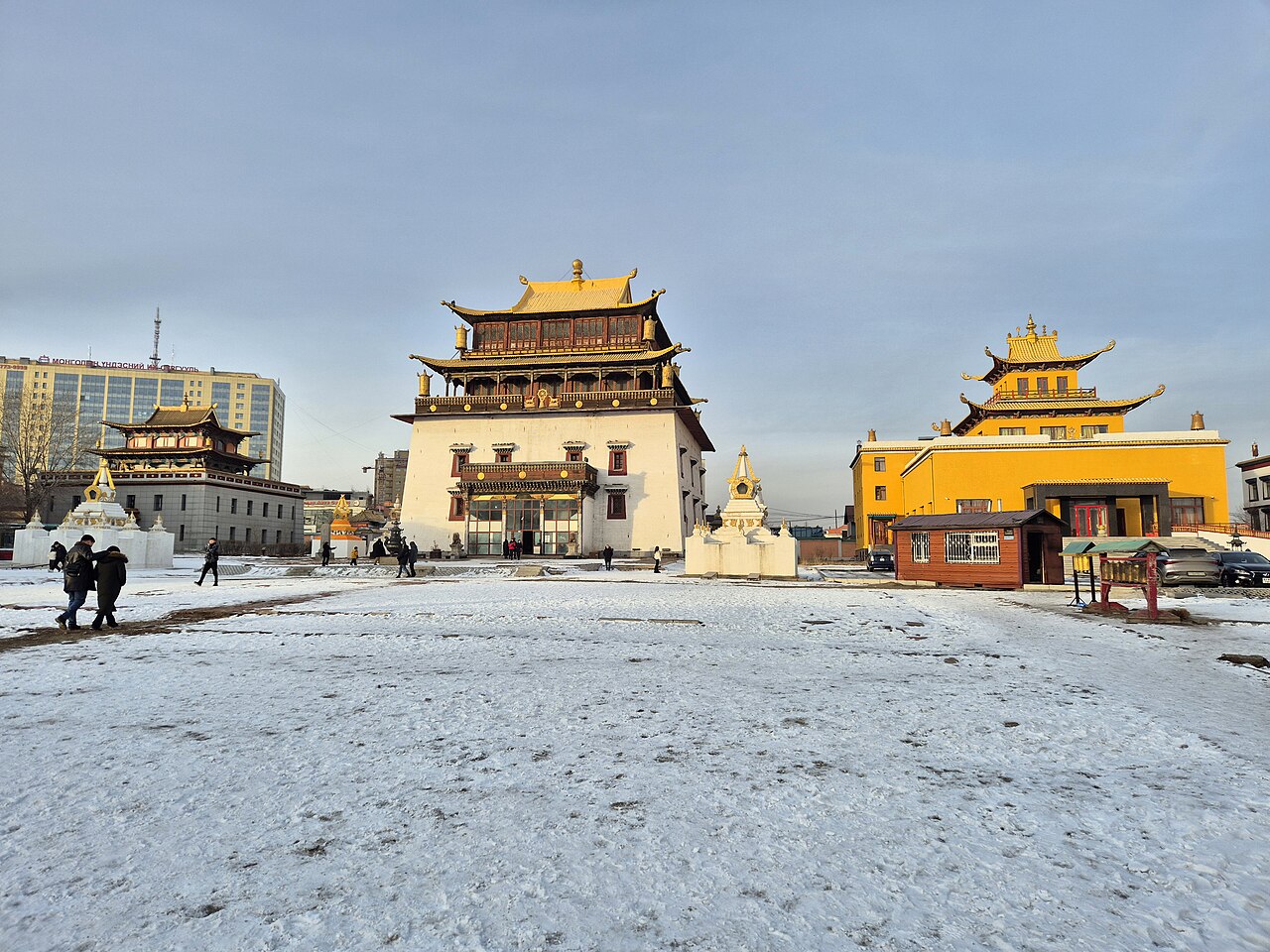
The cover image uses a Wikimedia Commons photograph taken in 2024 because it shows the exact texture the route needs: bright temple roofs, winter ground, ordinary pedestrians, and taller Ulaanbaatar buildings at the edge [7]. That mixed frame is the point. Gandan is most legible when you can see devotion, renovation, and urban pressure in the same glance.
Start outside the main flow. If you come by taxi, get dropped a little short of the gate rather than directly in front of it. If you walk from the central city, make the walk only when the weather, pollution, and pavement are on your side; 25 minutes can be pleasant in clear shoulder-season air and miserable when the road edge is dusty, icy, or rushed [4]. Either way, arrive with small cash. The recent local guide notes a 7,000 tugrik ticket for the Avalokitesvara statue, while another guide says a small donation or ticket fee around 5,000-10,000 MNT may be requested for maintenance or access [3][4]. Do not make the first interaction a search through a large bill.
Then slow down before the doors. The local move is to watch how people enter, pause, turn, and exit. The current Ulaanbaatar guide gives unusually specific etiquette: follow the lead of locals when entering and exiting the main temple, because turning your back on monks and relics is considered bad energy [3]. Even if you do not share the belief system, the practical rule is simple. Do not spin around for a selfie in the doorway. Do not cut across a worshipper's path because you saw a cleaner angle. Let the room teach you how bodies should move.
The second move is clockwise. Several local visitor guides describe the courtyard and prayer-wheel walk as something visitors can do by following locals around the temples [4]. Keep that as a behavior rule, not a photo prompt. Walk clockwise, touch nothing aggressively, keep your bag close to your side, and leave enough room for older worshippers who are there for practice rather than atmosphere. If you do not know whether to enter a smaller temple, wait for a local visitor to enter first or stay outside.
The third move is restraint with cameras. Outdoor photography is generally treated more casually, but interior photography may be restricted or require a fee; the same guide advises asking or paying where required [4]. That does not only protect you from a minor rule problem. It keeps the visit from becoming extractive. The chanting is not a soundtrack for your phone. If you photograph, do it after you have stood still long enough to know whether the image would interrupt anyone.
The fourth move is to spend the money, if you spend it, on the main statue rather than on adding extra stops. The local guide calls out the Avalokitesvara statue as the ticketed interior object worth seeing, while Koryo Tours' monastery guide adds the more important context: many Mongolians still come to Gandan for advice, blessings, and prayers from monks, not only for heritage viewing [3][6]. For this route, 60-90 minutes is the sweet spot. Shorter becomes a stamp. Longer starts pulling you into a museum-day rhythm that belongs somewhere else.
The fifth move is to let the renovated square and side streets register after the temple, not before. The city investment note is dry, but the details are useful: stone, benches, lighting, green space, stairs [2]. Those are the parts a visitor misses when they treat Gandan as a single golden-roof photograph. Step back into the square and notice how the front ground holds waiting, sitting, crossing, and soft gathering. That is the city-specific texture here: a Buddhist center pressed into a capital whose public spaces are still being actively repaired and re-scripted.
Review-derived community surfaces point in the same direction. Wanderlog's Google-backed Gandan page gives the monastery a 4.4 review score across more than 3,300 Google reviews, includes a January 2026 visitor note, and repeats the useful practical expectation that the whole place takes about two hours if you let it breathe [5]. That is the better local read. Gandan is not the thing you do because you cannot get to the steppe yet. It is the stop that keeps your first Ulaanbaatar morning from becoming a frantic launch pad out of town.
The Trapline
Mistake one is arriving after the morning has already lost its shape. By late morning, the monastery can still be worthwhile, but the main ritual advantage is gone. The better move is to plan around 8:20-9:40 a.m., using the before 9 local cue as the anchor [3][4].
Mistake two is making Gandan a statue-only errand. The Avalokitesvara interior is important, but the courtyard, prayer wheels, renewed square, and narrow district are what make the visit local rather than checklist-like [1][2][3]. Buy the ticket if you want the interior, then still give yourself time outside.
Mistake three is treating photography as harmless because the place is famous. Ask before interior photos, pay if a fee is posted, and do not photograph people in devotional motion as if they were props [4]. A quiet visit is not a passive visit. It requires judgment.
Mistake four is bolting straight from Gandan to Zaisan because both are "things to do in UB." That turns the morning into landmark arithmetic. Keep this route to one anchor. If you want a viewpoint later, make it a separate sunset decision, not the reason you rush the monastery.
Concrete Go Details
- Best time window: 8:20-9:40 a.m., with the strongest aim being arrival before 9 a.m. for chanting [3][4].
- Expected spend: 0-10,000 MNT depending on whether you only use the public courtyard, pay the 7,000 tugrik statue ticket noted by the local guide, or make a small maintenance donation [3][4].
- Queue/reservation reality: no reservation is needed for this route; the real bottleneck is behavioral, not ticketing. Avoid doorways, move with the local flow, and keep small cash ready.
- Navigation cue:
Sukhbaatar Square or central hotel -> west toward Gandan district -> main monastery gate -> courtyard clockwise -> main temple / statue if desired -> square pause -> leave before adding another landmark. - Where to stand: begin at the courtyard edge, not in the doorway. During chanting, stand or sit to the side if there is space; never plant yourself in the middle of an entrance or directly in front of worshippers.
- Etiquette cue: dress modestly, remove hats where appropriate, ask about photos inside, and follow locals when entering and exiting the main temple [3][4].
- Numeric anchors to keep in your head: 8:00, 9:00, 17:00, 2 km, 25 minutes, 60-90 minutes, 7,000 tugrik, 5,000-10,000 MNT, 8,400 square meters, and 820 square meters [2][3][4].
Gandan works because it makes Ulaanbaatar start softly. The capital can feel like a logistical threshold to the countryside, but that is not the only way to enter it. One careful monastery hour gives the city a different first sentence: chant, wheel, stone square, narrow streets, cash in small notes, camera lowered, and the discipline to leave before the day becomes a race.
Sources
- Ulaanbaatar Tourism Department, "Gandan to become tourist district" - official city tourism article on the area around Gandantegchinlen Monastery as a planned culture and tourism district with narrow winding streets.
- Ulaanbaatar City Investment Department, "Gandantegchinlen Monastery central square renovation completed" - official Mongolian-language note on the 8,400-square-meter stone plaza, 820-square-meter green area, benches, lighting, bins, fencing, and stairs.
- Meanwhile in Mongolia, "26 Free Things to Do in Ulaanbaatar (From a Local)" - recent local guide recommending arrival before 9 a.m., local entry/exit etiquette, and the 7,000 tugrik Avalokitesvara statue ticket.
- Mongolia.com.co, "Gandan Monastery in Ulaanbaatar: The Spiritual Heart of Mongolia" - practical guide used for the 8:00 a.m.-5:00 p.m. hours, 8:00-9:00 morning chanting window, 2 km / 25-minute approach, dress, photography, and donation guidance.
- Wanderlog, "Gandantegchinlen Monastery, Ulaanbaatar, Mongolia" - Google-review-backed community page with a 4.4 score, recent January 2026 review signal, and practical two-hour visit texture.
- Koryo Tours, "Gandan Monastery | Mongolia Travel Guide" - practical monastery guide used for local-practice context, prayer-time framing, distance from Sukhbaatar Square, and visit etiquette details.
- Wikimedia Commons, "File:Gandantegchinlen Monastery (2024).jpg" - documentary photographic source page for the lead image by Chongkian, photographed November 30, 2024.