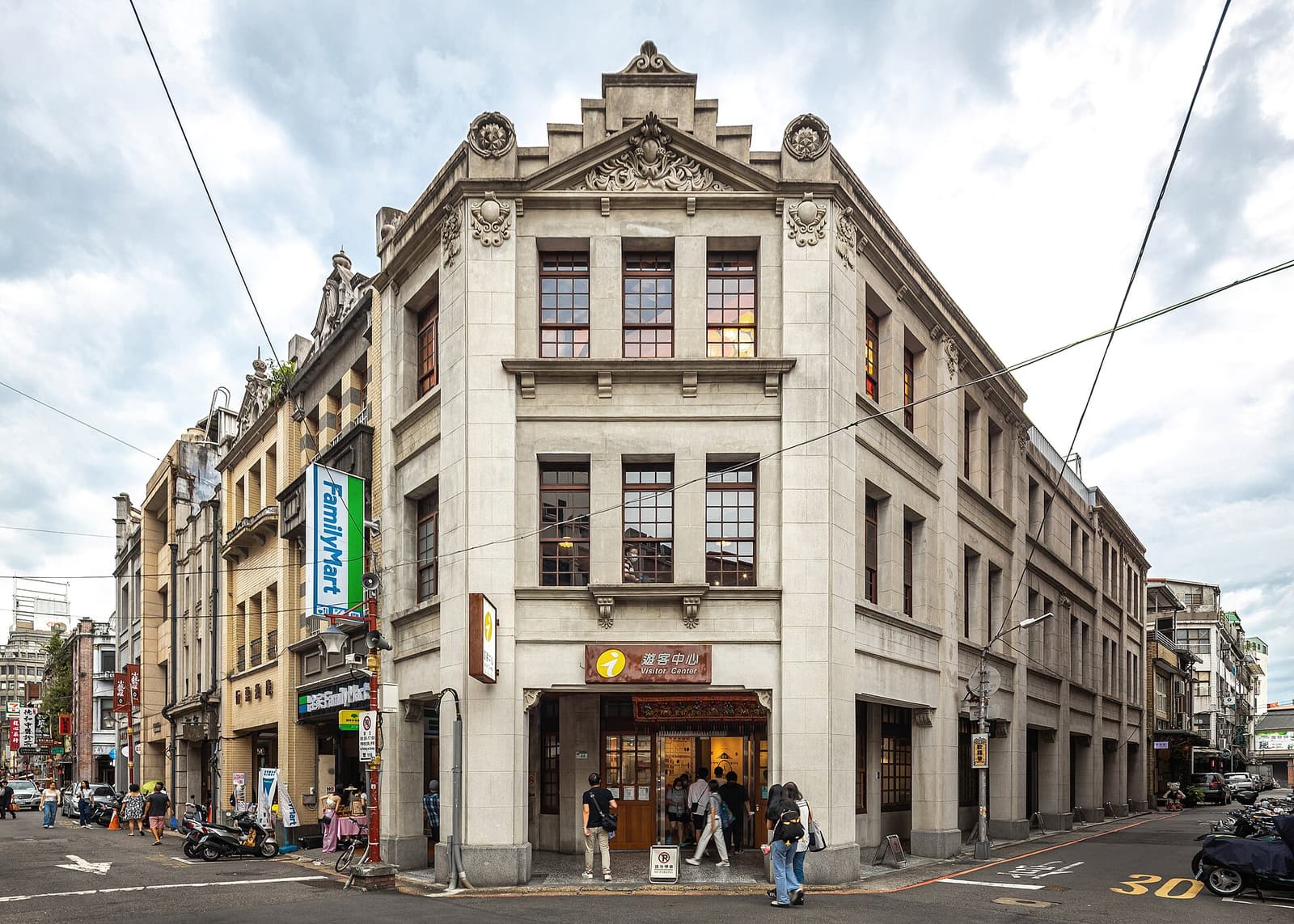
Do not make Dihua Street a snack crawl first. Make it a street-reading exercise, then decide what to buy.
The useful version is compact: Dadaocheng Visitor Center, the old storefronts of Dihua Street, Yongle Market, and, if the light is right, Dadaocheng Wharf as the river release. Taipei Travel frames the old storefront buildings as the physical memory of Dadaocheng's rise after the 1853 Bangka conflict, when Tongan immigrants settled here and the district grew into a major port and business quarter. The storefront houses became narrow, deep, mixed-use buildings: facade, shop, warehouse, factory, family economy [1]. That is why the walk works best when you keep the commercial spine visible.
The best first window is 15:30 to 18:30 on a weekday that is not a major festival day. You get active shops before closing, softer light on the facades, and enough time to end at the wharf after it opens. If you only want the street and not the river, go 10:30 to 12:00 before tour groups and lunch drift thicken the southern section. Dihua Street itself is public and listed as open 24 hours, but the point is not an empty road. The point is the shops, fabric counters, herb drawers, temple traffic, delivery rhythm, and arcaded storefronts [1][6].
Start by choosing the correct end. If you want the cleanest first-time route, use Beimen Station Exit 3 and walk north toward the Dadaocheng Visitor Center and Dihua Street's southern section; local guides put that approach at roughly 10 minutes from Beimen [6][7]. If you want the quieter end first, use Daqiaotou Station Exit 1 and walk about 3 minutes toward the northern end before coming down the street [6]. Do not split the difference by dropping a random pin in a taxi. One local guide notes that taxis and rideshare cannot simply enter the walking area of Dihua Old Street, so the better move is to let the MRT set the walking line [7].
The first local move is to spend 10 minutes outside the visitor center before going in. Look at the vertical shop signs, the FamilyMart sign under the older facade, the arcades, and the scooters squeezed against the curb. The photograph used for this article shows exactly the useful clue: Dihua Street is not a preserved stage set. It is an old commercial street still taking deliveries, selling goods, sheltering visitors from rain, and absorbing tourist attention at the same time [9].
Then walk slowly enough to see why the buildings are narrow and deep. Taipei Travel says Dadaocheng replaced inaccessible Bangka as a prosperous port and business district as trade between China and the West intensified; merchants built opulent houses with arcades adapted to rainy weather, and warehouses or factories sat behind the storefronts [1]. Another city audio guide makes the economic chain even clearer: tea, Chinese medicine, groceries, fabrics, and silk moved through the Dihua Commercial District and Dadaocheng Pier, making the area Taiwan's largest wholesale and retail market from the late 19th century into the mid-20th century [2]. This is the district's non-touristy texture: the pretty facades are the front edge of logistics.
Second move: do Yongle Market before you are tired. Taipei Travel identifies Yongle Market as a Dihua commercial-district landmark established in 1908, formerly tied to Yongle Town, and once Taiwan's biggest imported wholesale-fabric area [3]. Treat it like a working fabric market, not a souvenir hall. Go upstairs first, browse with your hands behind your back until a bolt or color genuinely stops you, and only then ask. If you need a small purchase, set a modest budget before entering: NT$200 to NT$600 is enough for small fabric, craft, or repair-adjacent finds, while a pure architecture-and-market visit can stay at NT$0. The local mistake is to rush through the ground-floor food and miss the cloth logic above.
Third move: keep one eye on closing friction. A recent Taipei guide notes that Yongle Fabric Market is usually a daytime stop, around 10:00 to 18:00, and often closed on Sundays, so do not leave it for after the wharf [8]. Verify specific stall hours if you are hunting a tailor or a particular fabric type. If you are just walking, the district forgives looseness. If you are shopping with a purpose, Dihua Street rewards early, weekday discipline.
Fourth move: let the street remain one kilometer. A local-born Taiwan guide describes Dihua Street as about one kilometer long with side alleys worth wandering, and that scale is the secret [6]. Do not keep adding Ningxia Night Market, Ximending, every temple, every cafe, and a river cruise until the walk becomes another Taipei checklist. One clean version is: visitor center facade, Dihua storefronts, Yongle fabric counters, one tea or herb stop, then wharf. If you want a seated pause, sit where you can still watch shop movement rather than hiding in the most Instagram-ready cafe.
Fifth move: buy light, not bulky. Dihua Street's historic trade categories are tea, medicine, dried goods, fabric, and New Year supplies [2][5]. Visitors often buy too early, then carry fragile jars or heavy dried goods through the rest of the walk. Better: take photos of shop names, finish the street, then loop back for one purchase. If you buy tea, ask for something you will actually drink in your hotel room. If you buy fabric, buy for a project you can name. If you buy dried fruit or snacks, keep it small enough to fit in the outside pocket of your bag.
Sixth move: read the calendar. Dihua Street is famous during the Lunar New Year shopping season, and Taipei Travel's attraction page describes Section 1 south of Taipei Bridge as the go-to place for New Year supplies, tea, Chinese medicinal herbs, and wholesale cloth [5]. That season is exciting, but it is not the easiest first reading of the street. In 2026, a separate summer crowd window also matters: Taipei Travel lists the 2026 Taipei Summer Festival at Yanping Riverside Park and Dadaocheng Wharf from July 15 to August 15, with waterfront lighting, fireworks, food, live music, and local shopping-district promotions [5]. During that period, the wharf becomes event space. Good if you want energy; bad if you came for a quiet river finish.
The wharf is the release valve, not the main attraction. Taipei Travel gives Dadaocheng Wharf's current regular hours as 16:00 to 22:00 Monday through Friday and 12:00 to 22:00 on weekends, and places it near Water Gate No. 5 on the Tamsui River [4]. Historically, it was where tea, cotton, and silk textiles moved through river trade; now it works as a bicycling spot, boat-tour departure point, and evening river edge [4]. A local travel guide says the wharf is an easy walk from Dihua Street and only really gets going in the evening beyond a few container cafes [8]. That matches the route: do the commercial street first, then let the river widen the room.
The non-local trapline is simple. Mistake one is arriving at noon in July and expecting romance. Better: shade, water, and a late-afternoon route. Mistake two is treating Dihua Street as food-first content. Better: read the facades, fabric, tea, medicine, and delivery geometry before eating. Mistake three is starting from the wrong MRT end and doubling back in heat. Better: Beimen for the southern visitor-center start, Daqiaotou for the quieter north-first walk [6]. Mistake four is assuming festival lights improve every visit. Better: check whether July 15 to August 15, 2026 event crowds are what you actually want [5].
For a focused first pass, budget 90 minutes for the street and market, then another 30 to 45 minutes for the wharf if it is open and the weather is kind. Carry an EasyCard, water, and a small bag with room for one purchase. Stand under the arcades when scooters and delivery carts compress the street. At Yongle, step aside before checking your phone. At the wharf, stand river-facing first, then decide whether you need a seat or a drink. The point is not to conquer old Taipei. It is to notice how the city keeps wholesale memory, fabric counters, temple traffic, tourist cameras, and a sunset river within one walkable spine.
Sources
- Taipei Travel, "Old storefront buildings on Dihua St." - official attraction page on Dadaocheng's port history, storefront architecture, arcades, warehouses, and nearby MRT context.
- Taipei Travel, "Dihua Commercial District" - official audio-guide text on Dihua Street, Dadaocheng Pier, tea, Chinese medicine, groceries, fabrics, silk, and the district's wholesale role.
- Taipei Travel, "Yongle Market" - official audio-guide text on the market's 1908 origin and fabric-wholesale history.
- Taipei Travel, "Dadaocheng Wharf" - official attraction page with current hours, Tamsui River trade history, transport context, and wharf uses.
- Taipei Travel, "2026 Taipei Summer Festival" - official event page for the July 15 to August 15, 2026 Dadaocheng Wharf/Yanping Riverside Park summer program.
- Graceful Chimes, "How To Explore Dihua Street: Best Things To See, Eat, and Do," updated May 18, 2026 - local-born walking guide with street length, MRT approaches, and route logic.
- Tiffy Cooks, "Beginner's Guide To Dihua Street, Dadaocheng Taipei," December 8, 2025 - Taiwan-born local guide with Beimen approach, taxi caveat, historic-street framing, and wharf finish.
- Taiwanderers, "Dihua Street in Dadaocheng, Taipei Guide + Photos," updated December 5, 2025 - local travel guide with MRT timing, Yongle Fabric Market notes, EasyCard tip, and evening-wharf observations.
- Wikimedia Commons, "File:Buildings along Dihua Street 07.23 (6).jpg" - file page for the real photographic image used as this article's cover.