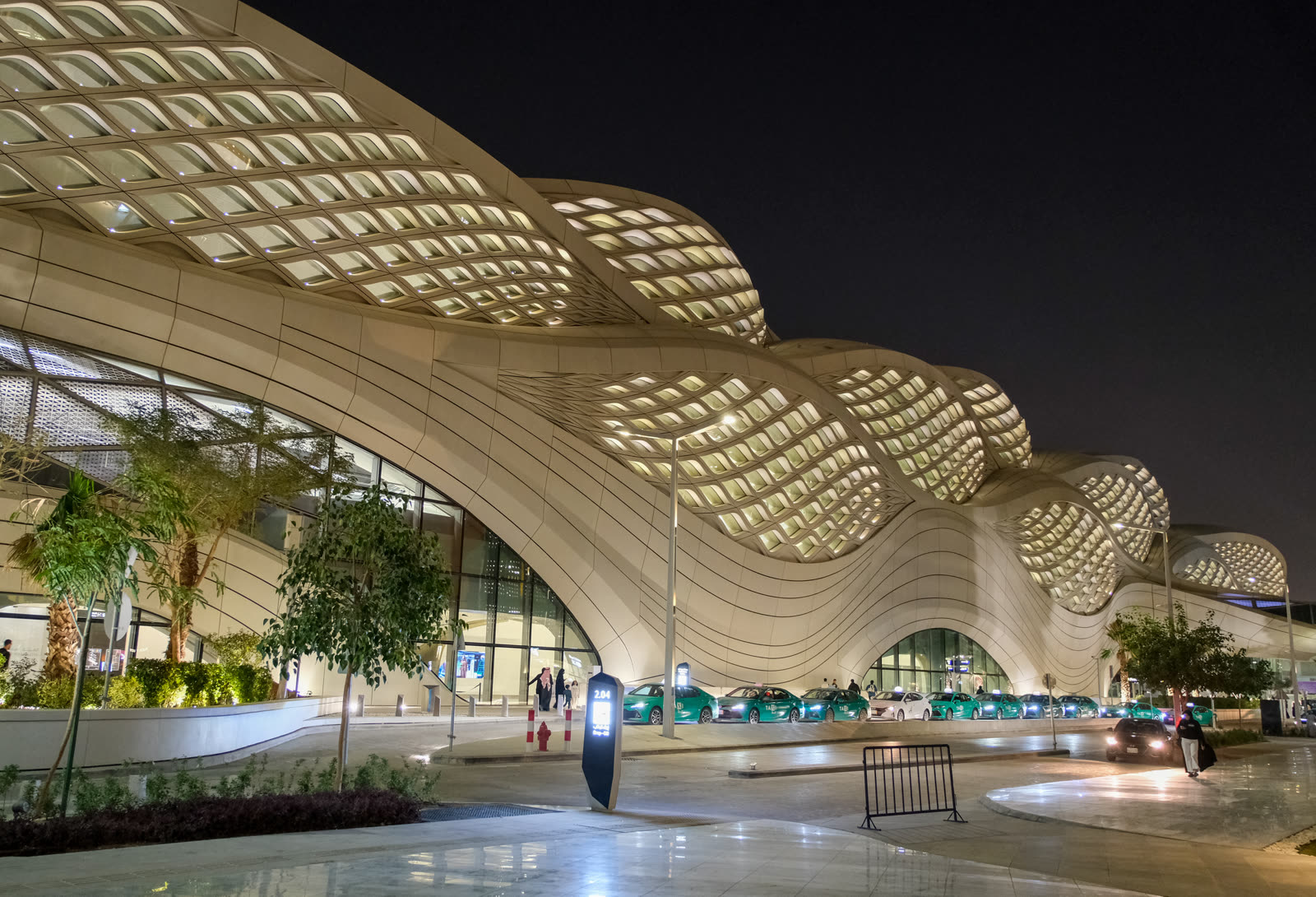
Do not visit KAFD at night as a taxi photo stop. Arrive by metro, let the station become the door, then walk the Wadi slowly enough for the district to stop looking like a render and start behaving like a room.
That difference matters in Riyadh. King Abdullah Financial District can look, from a car window, like a stack of finished glass objects separated by roads. The useful night visit is smaller and more physical: train, concourse, station facade, lowered public space, mosque plaza, return plan. KAFD's own landmarks page says Al Wadi is an open public space designed for pop-up activations and retail, lying 5.5 meters below street level so cooler airflow can draw people through it [1]. That is the anchor. The night is not just about lights on towers. It is about finding the lower pedestrian layer.
The clean window is 7:30-9:30 p.m. on a normal non-event evening. In the hot months, earlier still leaves too much stored heat in the paving; later can turn the return into a loose midnight gamble. The airport's official Riyadh Metro page gives the broad operating frame as 6:00 a.m. to 12:00 midnight, but the smarter local move is to check the Darb app before leaving because the app is built for line, station, bus, ticket, and live movement planning [3][4]. Treat midnight as the outer wall of the system, not as the moment to start making decisions.
Start with payment away from the gate. The official airport page lists regular metro and bus access from SAR 4 for a 2-hour pass, with 3-day, 7-day, and 30-day regular passes at SAR 20, SAR 40, and SAR 140; first-class starts at SAR 10 for a 2-hour pass and children under 6 ride free with a fare-paying adult [3]. It also says tickets can be handled through Darb, a card, contactless payment, or Apple Pay at the gate reader [3]. For this specific night, the practical spend is usually SAR 4 for regular class if you are already near the network, or SAR 8 if you are planning an out-and-back pair outside the same pass window. Keep more buffer if a car is needed afterward.
The local community warning is not that the metro is hard. It is that the gate is the wrong place to improvise. A r/Riyadh guide tells first-timers to download Darb, find the nearest station, and either buy a ticket at the station or through the app; the same thread includes rider comments about contactless cards and physical Darb cards as fallback behavior [5]. The Google Play listing for the official Darb app was updated on June 11, 2026, and its recent reviews are useful precisely because they are cranky: riders complain about login, route-selection, and gate friction [4]. The move is simple. Open the app or prepare your card before you are in the turnstile stream. If the app stalls, do not make people queue behind your phone.
Use regular class unless you know why you need first class. The official page describes regular cabins as comfortable for families, solo travelers, and groups, with dedicated women-only areas available [3]. That is enough for a short KAFD night run. The better luxury is not the premium cabin; it is arriving without a car.
KAFD Station is the first sight, not a shortcut. Zaha Hadid Architects describes it as the interchange for the Blue Line, the airport Yellow Line, and the Purple Line, with six platforms over four public levels, park-and-ride facilities, and integration with the district [2]. KAFD's own page says the station intersects three major lines, roughly 50% of the metro network, and links metro, buses, shuttles, and pedestrian walkways [1]. That means you should read the building as a machine for switching scales: city rail to district walk, road edge to sunken public space, airport line to evening stroll.
Give the station 10 minutes before you move on. Stand outside where the facade curves over the entrances and the taxi line passes the station. The pattern is not random spectacle. Zaha Hadid Architects says the facade and circulation logic draw on modeled rail, car, and pedestrian flows, with exterior patterning that reduces solar gain and echoes wind-shaped sand formations [2]. At night, the claim becomes legible without an architecture lecture. The building glows like a cooled piece of desert infrastructure. That is the non-food, non-mall texture Riyadh visitors often miss.
Then go down to Al Wadi before you choose a cafe or tower lobby. KAFD describes the Wadi as the district's open public space for pop-ups and retail, set below street level [1]. Wanderlog's Google-review-derived page gives the live visitor texture: people describe the area as clean, modern, well lit, calm, safe, and particularly good for a night walk, while also noting that some construction can still be visible around the district [6]. That is the right expectation. Go for a 20- to 30-minute loop, not a polished resort promenade.
The first local move in the Wadi is to keep walking until the grade change makes sense. If you only stand at the top, KAFD remains a skyline. At the lower level, the district behaves more like an urban canyon: facades above, planting at the edges, the mosque plaza as a pause, and the station behind you as the return anchor. The second move is to use the mosque area with restraint. Photograph architecture and light; do not point your phone into families, worshippers, or private gatherings. The third move is to avoid blocking narrow pedestrian flows for group shots. Riyadh night spaces are social rooms, not empty stages.
The fourth move is to keep the return visible. Before you descend too far into the Wadi, note the station entrance you used and whether your ticket, QR code, card, or phone is still ready. The Darb app listing says it supports trip planning, line detail, live bus tracking, bus-on-demand for first and last mile, park-and-ride, and QR e-tickets [4]. Good. Use it as a backup brain. But the article's bias is toward low-friction redundancy: one charged phone, one payment fallback, one return route, and no assumption that a business district will feel intuitive after you have wandered three levels away from the train.
The visitor trapline is predictable. Mistake one is driving to KAFD, getting dropped at the most photogenic edge, and leaving before using the station. The better version is to let the metro arrival do the work. Mistake two is treating Darb as the only possible payment path; official and community sources both point to station purchase, cards, and contactless options, so carry a fallback [3][5]. Mistake three is treating the Wadi as a finished food-and-photo strip. It is a public-space layer with retail energy, architecture, lingering construction signals, and mosque etiquette [1][6]. Mistake four is staying until the district feels empty and then figuring out the ride. Check the return before the last 30 minutes of the night.
If you want the compact version, ride to KAFD after 7:30 p.m., arrive with a ticket or contactless payment ready, spend 10 minutes reading the station, then walk Al Wadi for 20-30 minutes before committing to any cafe, tower lobby, or onward car. If the night is too hot, keep the loop shorter and stay in the lower pedestrian layer. If the app is unstable, use a card rather than turning the gate into a troubleshooting desk. If you want a photograph, take it from the station edge first; the facade, taxi stream, entrance, and palm planting tell a more honest story than another skyline crop.
KAFD works at night when the metro remains the door because the station changes the district's social physics. It turns a car-first financial skyline into a sequence a visitor can actually inhabit: platform, concourse, illuminated facade, lowered public space, return line. That is the local knowledge payload. Do not chase all of Riyadh in one evening. Let one station and one Wadi teach you how the new city wants to be entered.
Sources
- KAFD, "Landmarks" - official Al Wadi depth, public-space purpose, KAFD Metro Station role, line connections, and district mobility framing.
- Zaha Hadid Architects, "King Abdullah Financial District (KAFD) Metro Station" - official project page covering the station's lines, six platforms, four public levels, 176 km network context, and facade/circulation design.
- King Khalid International Airport, "Riyadh Metro" - official airport transport page with operating-hour frame, fare classes, pass durations, children-under-six rule, Yellow Line access, Darb card, and contactless payment details.
- Google Play, "Darb" by Royal Commission for Riyadh City - official app listing updated June 11, 2026, describing trip planning, line details, live bus tracking, first/last-mile tools, and QR e-tickets, with recent user-review signals.
- Reddit r/Riyadh, "Short Riyadh Metro Guide" - local community guide and rider comments on Darb, station tickets, fare range, children, cards, and gate behavior.
- Wanderlog, "KAFD Wadi, Riyadh" - live Google-review-derived community surface with night-walk, cleanliness, calmness, lighting, construction, and rating signals.
- Francisco Anzola, "KAFD metro station 2025.jpg," English Wikipedia file page - photographic source for the article image, showing KAFD Metro Station at night.