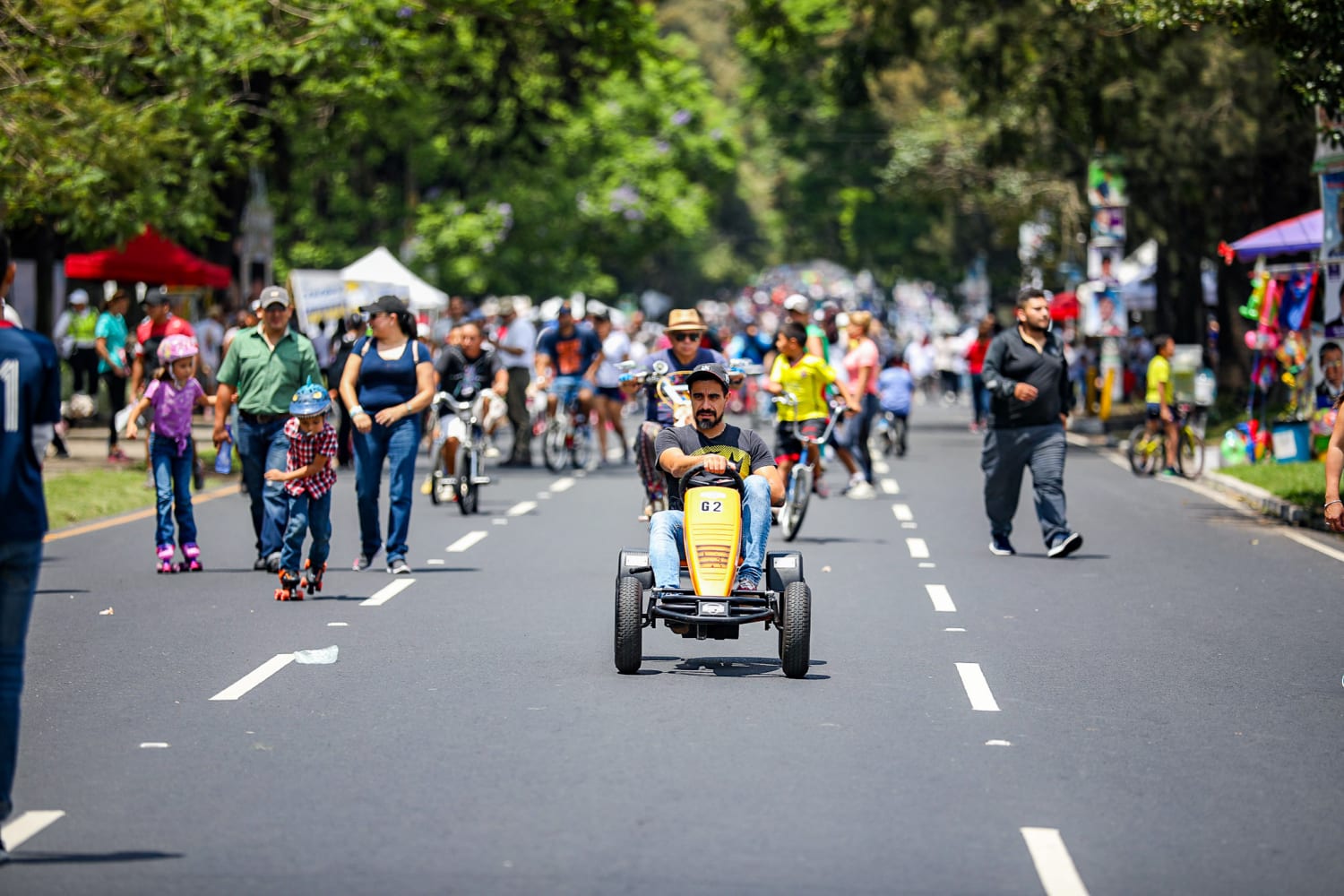
At 09:50 on Sunday, Avenida Las Américas may still ask to be read as a road. At 10:00, the published Pasos y Pedales window begins: selected lanes and phases become a four-hour public circuit for walking, running, skating, cycling, children, dogs and people who simply want to occupy the city without moving through it in a car [1][3]. The change is physical—barriers, municipal staff, wheels and feet—but it is also social. Nobody has bought the street. For a morning, everybody is borrowing it.
The most useful version of this ritual is not a heroic ride along every possible closure. It is one 75–100-minute out-and-back, entered beside Plaza Argentina and governed by the live phase you actually find. Walk for about 25 minutes, pause where the median opens into a plaza, then return before the outing becomes a mileage project. That tight loop preserves what makes Pasos y Pedales distinctive: a traffic corridor temporarily learning the manners of a neighborhood park.
The qualification “live phase” matters. Municipal material gives Avenidas Las Américas and Reforma a usual Sunday window of 10:00–14:00, while the current August 2026 city agenda specifically lists August 2, 9, 16 and 30—not August 23 [1][3]. A March special event shows why the general description is not enough: the usual Simeón Cañas and Mariscal phases were suspended while Obelisco and Las Américas hosted an extended festival [7]. The clock is stable enough to plan around; neither the date nor the exact footprint is stable enough to assume.
Check the Sunday before you choose a direction
The first local move is a same-week check of the municipal agenda and the program’s linked official social account. Look for the current date and the named avenue—not merely an old page saying Pasos y Pedales happens on Sundays. The August calendar’s missing August 23 entry is one warning [3]. The March festival is another: ordinary operations disappeared from two phases while activity at Obelisco and Las Américas extended until 18:00 [7]. Special programming can enlarge one circuit while removing another.
Treat the weekly notice as the route. If Obelisco/Av. Las Américas is enabled, use Plaza Argentina as the practical entry point. The municipal Line 13 guide names three stations that work for Pasos y Pedales—Hangares at 18 Calle, Plaza Argentina at 11 Calle and Los Arcos at 4 Calle—and places Plaza Argentina station on 15 Avenida, parallel to the plaza [2]. It is the cleanest middle entry because it avoids making the Obelisco traffic knot your first navigation problem.
Line 13 runs on weekends until 20:00 and costs Q1 per ride with a rechargeable card; the system also accepts contactless-enabled debit and credit cards [2]. That makes the transport floor Q2 for a simple return. A local visitor guide identifies Pasos y Pedales as a free activity, and the current municipal agenda lists no admission or registration [3][9]. Reload before Sunday if you use the municipal card. The official guide explicitly recommends doing so in advance to avoid a line [2]. There is no base ticket to budget for, though vendors and special activities can add optional costs or their own instructions.
The second move is to arrive at Plaza Argentina station around 09:50, but remain on ordinary pedestrian space until the active circuit is unmistakable. Published hours are not permission to step around a barrier crew or into a lane that has not yet closed. Cross at the controlled point you find, follow municipal staff and let the cones—not your phone’s route line—declare where cars stop that morning.
Let the lane set the pace
Once inside, the third move is to spend two minutes watching flow before joining it. The photograph above is the right primer: walkers, skaters, bicycles, children and a pedal cart share the same broad road [1]. This is not a sealed training course. It is a mixed public room with moving edges.
That mixture is not only a municipal description. A Tripadvisor reviewer records walkers, cyclists, skaters, dogs, vendors and a lively Sunday crowd, while a Guatemala City blog describes the weekly switch as a contrast between Saturday silence and Sunday bustle, with running, bicycles, dogs and families occupying the road [10][11]. Use those accounts for social texture, not for the current operating clock: community knowledge explains how the temporary park is inhabited, while this month’s official agenda determines when it exists.
If you are walking, hold a predictable line and look behind you before changing sides. If you are riding or skating, slow before children, dogs, stalls and activity clusters; pass with room and a voice or bell rather than threading a silent gap. These are not claims about a painted lane hierarchy. They are the courtesy required by the users the municipality itself invites—families, runners, cyclists, skaters and pets [1][8].
The fourth move is to keep the first pass continuous. Weekly services can include health points, hydration stations, animal-welfare activities, children’s games, workshops and local vendors, while the mix changes from Sunday to Sunday [1][8]. Notice what is present, but do not stop at the first table. Walk your outbound leg first, then choose one activity on the return. Otherwise a temporary park becomes another line of booths to consume.
Carry your own water and sun protection even when hydration points are advertised. A local Guatemala City guide recommends both and adds a practical pet rule: bring waste bags and water if a dog comes with you [8]. Keep the lead short in the moving lane, give other animals space and move to a plaza edge before stopping. The fifth move is simple: all pauses happen outside the stream.
That rule also improves photographs. Do not halt in the center of the carriageway for the symmetrical empty-road shot; the road is not empty. Frame the long perspective from an edge, or wait in the median until the people using the circuit become the picture. Ask before making a child, vendor or exerciser the subject. The ritual is public, but individual strangers are not props.
Read the median as a continental address book
The sixth move is to look sideways. Las Américas is not merely a convenient strip of asphalt with trees. The avenue extends the older Avenida Reforma southward, and its organizing idea came from the postwar language of continental unity. A recent local history dates the name to the creation of the Organization of American States on April 30, 1948 and describes the later municipal plan as a corridor of plazas dedicated to American countries [6].
Plaza Argentina makes that idea concrete. Its monument honors José de San Martín; farther along, other plazas invoke Mexico, Honduras, Nicaragua, Colombia, Cuba, Uruguay and more [1][6]. During the working week, the median can read as scenery glimpsed through traffic. On Sunday, the closure changes the viewing distance. A national hero, a family on skates, an adoption table and a runner can occupy the same urban sentence.
This is the city-specific detail worth carrying home. Pasos y Pedales does not create the avenue’s public meaning from nothing. It temporarily makes an existing diplomatic landscape legible at walking speed.
The seventh move is therefore to choose one plaza, not collect them all. At Plaza Argentina, step completely out of the moving lane, circle the monument once and watch how the road behaves from the median. Give that pause 10 minutes. Then resume in the direction confirmed by the live barriers. If an official activity has been assigned to another named plaza that week, let the announcement—not completionism—decide whether it belongs in your short loop [1][3].
Turn while the park still feels temporary
After roughly 25 minutes outbound, the eighth move is to turn around even if the enabled phase continues. An archived municipal description traces the traditional Américas–Reforma circuit through a much longer sequence of monuments and avenues [5]. Treat that as historical geometry, not a promise that every old endpoint is active now. An out-and-back keeps the crowd, station and closure cues within memory. Carry little, keep the phone away between checks and do not wander beyond the staffed circuit just because the road ahead shares the same name.
On the return, take the one stop you saved: a municipal activity, a plaza, or five minutes watching the mixture of speeds. Do not promise yourself a particular class or market. The official overview says programming varies, while the March 2026 festival added music, themed spaces and 55 entrepreneurs to the ordinary mix for one weekend [1][4]. The dependable attraction is the car-free public space; everything scheduled inside it is a bonus.
Aim to be back at Plaza Argentina by 11:20–11:40. That window catches the circuit after it has filled without pushing the visit toward the 14:00 reopening edge. If you stay later, watch for staff repositioning barriers and leave the carriageway when directed. A park made from a road ends by becoming a road again.
Four mistakes that break the ritual
Mistake one: taking a review-platform time as the barrier time. The Tripadvisor page still describes an 08:00 Sunday start, while the municipality’s current material puts Las Américas/Reforma at 10:00–14:00 [1][3][10]. Better: use reviews to understand the crowd, then use the live barriers and current agenda to decide when the public circuit begins.
Mistake two: planning from a permanent map. A visitor page can make the event sound like one fixed avenue-length attraction, but the current monthly agenda contains a Sunday exception and March reporting documents a festival substitution across phases [3][7][10]. Better: check the same-week update, then let the enabled section set your direction.
Mistake three: using the closure as a racecourse. Official and community accounts converge on walkers, runners, skaters, cyclists, pets, children, vendors and families [1][8][10][11]. Better: move at family speed, pass visibly and make every stop from a plaza or lane edge.
Mistake four: expecting one must-see payoff. The Tripadvisor reviewer values the avenue as a glimpse of local life rather than an extraordinary tourist sight, and the local blog’s central observation is simply the road filling with ordinary public life [10][11]. Better: enter at Plaza Argentina, walk for about 25 minutes, read one plaza and return; the temporary public room—not completion—is the attraction.
The go details
- Anchor: the enabled Obelisco/Av. Las Américas phase of Pasos y Pedales, entered beside Plaza Argentina; the plaza is the one secondary anchor.
- Best window: Sunday 10:00–11:40 within the usual 10:00–14:00 program. Verify the date and enabled phase during the same week [1][3][7].
- Time needed: 75–100 minutes, including a 25-minute outbound leg, one 10-minute plaza pause and the return.
- Expected spend: Q0 base admission. Line 13 is Q1 per ride, so budget Q2 for a basic out-and-back by transit, excluding card acquisition and anything optional [2][3][9].
- Queue and reservation reality: the base activity is free [9], and the current agenda lists no admission or registration [3]. Reload a transit card before arrival if needed; a weekly add-on may have its own line or instructions [1][2].
- Navigation cue: Line 13 Plaza Argentina station, 15 Avenida and 11 Calle. Hangares and Los Arcos are official alternatives when the live phase favors another entry [2].
- Where to pause: a plaza or median edge, fully outside the moving lane. Use the enabled barriers and municipal staff—not an old route screenshot—to choose direction.
- What to bring: water, sun protection, a compact rain layer and little else. For a dog, add water, waste bags and a short lead [8].
- Etiquette: keep a predictable line, slow for mixed users, ask before photographing people, clear the carriageway when staff begin reopening it and remember that “car-free” does not mean “attention-free” [1][8].
Guatemala City’s Sunday trick is not that a road disappears. The lane markings remain, the monuments remain and the afternoon traffic will return. What changes for four hours is the scale of permission. Enter after the barriers, move at the pace of the mixed crowd, stop where the median becomes a plaza, and Las Américas reads less like a route through the city than a room the city already had.
Sources
- Municipalidad de Guatemala, “Pasos y Pedales: Una tradición dominical desde hace 24 años” (May 16, 2025) — official program overview for Sunday hours, invited users, variable services, Las Américas monuments and the documentary hero photograph.
- Municipalidad de Guatemala, “Cómo moverte en la Línea 13 del TransMetro” (September 19, 2025) — official guide naming Hangares, Plaza Argentina and Los Arcos as Pasos y Pedales access stations, with weekend hours, Q1 fare and payment details.
- Visión de Ciudad, Agenda agosto 2026 — current municipal agenda listing Pasos y Pedales on August 2, 9, 16 and 30 from 10:00 to 14:00 on Avenidas Reforma and Las Américas.
- Municipalidad de Guatemala, “El Festival de Verano en Pasos y Pedales llenó de movimiento y convivencia la Avenida Las Américas” (March 17, 2026) — official follow-up documenting the car-free circuit’s mixed use and one weekend’s expanded programming.
- Municipalidad de Guatemala, “Pasos y Pedales, una alternativa dominical para la familia” (archived official post) — historical description of the long Américas–Reforma circuit and its former endpoints.
- Gabriela García, “Historia de la Avenida de las Américas en Guatemala.” Guatemala.com, June 26, 2026 — recent local account of the Reforma extension, 1948 OAS naming context and the avenue’s country plazas and monuments.
- Ilsie Rebolorio, “Pasos y Pedales estará cerrado este domingo.” Publinews, March 14, 2026 — local reporting on phase closures and the special Obelisco/Las Américas festival timetable.
- Jimena García, “Horarios y ubicaciones de Pasos y Pedales en Ciudad de Guatemala.” Guatemala.com, updated January 29, 2025 — local guide to mixed uses, changing activities, hydration, sun protection, pet etiquette and designated-area awareness.
- Guatemala.com, “Bicicletear en Pasos y Pedales” — local visitor guide identifying the Sunday program as a free activity and describing its mixed family use.
- Tripadvisor, “Avenida de las Américas” reviews — review-platform evidence for the mixed Sunday crowd, vendors and local-life atmosphere; its older 08:00 start claim is explicitly checked against current municipal hours in this article.
- GuateMola, “Pasos y pedales” — local city blog contrasting the avenue’s ordinary traffic condition with its Sunday occupation by runners, cyclists, dogs, children and families.