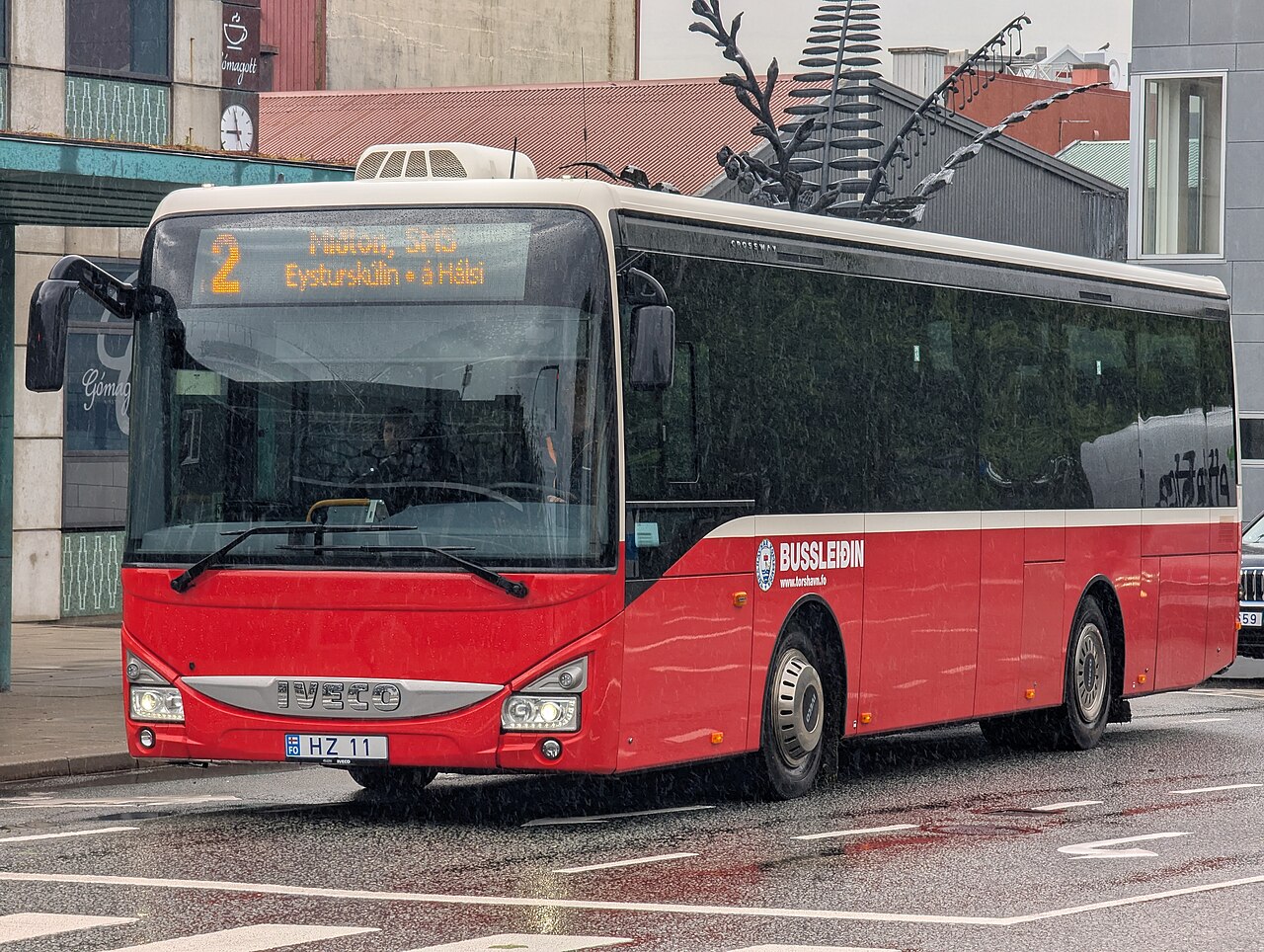
At Steinatún, the important gesture is almost too small to notice. A red bus approaches through Tórshavn's damp light; somebody at the curb raises a hand; the bus draws in. Nobody performs the familiar visitor's search for a ticket machine. The door opens, people board, and the city continues uphill.
That raised hand is the right way into Bussleiðin. The municipal buses are currently free to use, but the absence of a fare does not turn them into a free-form attraction. Tórshavn's own instructions ask passengers to make themselves visible as the bus approaches and to be ready to enter or leave when it stops.[1] The system rewards the person who has already chosen a route, a direction and an exit.
For a first encounter, keep the ritual deliberately small: take Route 1 from Steinatún's southbound side, ride its inner loop through SMS, Á Hálsi and Hoyvík, then step off when the bus returns to Steinatún on the northbound side about 21 minutes later.[1] Go alone or as a pair, use a normal weekday between 10:00 and 11:30, and verify the live service that morning. The point is not to collect the whole network. It is to borrow one working circuit long enough to understand what the bus connects.
Image context: the cover is a real May 2025 photograph of a red Bussleiðin vehicle on a wet Tórshavn street. Its display shows Route 2 rather than the Route 1 loop described here; that distinction is intentional and captioned. The image documents the shared network, while the prose gives the exact ride.[9]
One square, two sides, 21 minutes
Steinatún is less a terminal than a hinge. The municipality's English transport page says the local lines converge here, while the current route panel numbers services 1 through 7, including city and village work.[1][2] The square also holds Visit Tórshavn's information point, and lost objects from Bussleiðin are delivered there. That makes the stop unusually forgiving: you can confirm the pin, study the red buses for five minutes, and still ask a human if the words on the timetable have defeated you.[1][7]
Route 1 gives the cleanest short reading because it returns to the same hub without repeating the same streets. On the published timetable, a departure from Steinatún (suður) reaches Steinatún (norður) 21 minutes later. Between those labels, the bus touches SMS, Uppi á Hálsi, Berjabrekka, Hoyvíkar kirkja, two schools, Inni á Gøtu, the sports hall at Hálsi and SMS again.[1] Retail, worship, education, housing and sport appear not as separate sights but as ordinary reasons to move.
The weekday timetable's central pattern places south-side departures at :01, :16, :31 and :46 during its higher-frequency span. Outside that span, and especially on weekends, the service thins. The municipality expanded Route 1 in 2024 because it was Bussleiðin's most-used route: extra funding extended evening running, put two buses on the line for half-hour evening service, and doubled Saturday frequency to two trips an hour.[3][5] Those changes explain both the route's usefulness and the need to check the current clock rather than memorize a blog's old one.
This is also why 21 minutes is enough. A complete bus circuit can become passive sightseeing; the Steinatún-to-Steinatún inner loop has a beginning, an urban argument and a clean exit. You see how quickly the compact harbor centre gives way to schools, playing fields, church, mall and hillside housing, then you give the seat back.
The no-ticket moment has a history
Fare-free travel here was not invented as a visitor perk. In council records from 2006–07, the municipality considered a trial beginning 1 January 2007 as a way to shift private-car trips toward public transport. The minutes are strikingly specific about children: the aim included making it natural for them to take the bus to school, sport and leisure activities instead of being driven. The same discussion linked higher use to better frequency and fewer cars in the centre.[4]
That history changes the emotional temperature of the ride. No ticket is required because the payment has moved out of the doorway and into municipal policy. The quiet boarding is not evidence that the ride costs nothing; it shows that the city chose not to collect the cost passenger by passenger. In 2024, the council added DKK 2 million for more trips and longer hours, another reminder that frequency is purchased even when boarding is fare-free.[3][5]
Local debate has never vanished. A 2019 opinion published by Faroese outlet in.fo objected explicitly to taxpayers subsidizing tourists who ride around on the service.[6] That piece is an argument, not a rule, and the current municipal page still describes Bussleiðin as free.[1] But the complaint supplies useful etiquette: a visitor should use the bus purposefully, in a small party and outside obvious school or commuter pressure when possible. Fare status tells you what to pay. It does not tell you how much space to occupy.
The result is a genuinely local city ritual. A child, a hospital visitor, a shopper and a traveler can make the same raised-hand request at the same curb. The traveler fits best by learning the rhythm already there.
Eight moves that make the loop work
1. Pin Steinatún, not just “the bus station.” Tórshavn has two systems that are easy to merge in a visitor's mind. Bussleiðin's municipal buses are red and converge at Steinatún; the blue Bygdaleiðir regional buses are operated by Strandfaraskip Landsins, charge fares onboard and commonly use Farstøðin by the harbor.[2] Check the Steinatún pin and recent user photos before leaving your accommodation.[7]
2. Read the side label before the route number. For this loop, begin at Steinatún (suður) and finish at Steinatún (norður). Both names contain the same square, but the parenthetical direction is the difference between beginning the 21-minute arc and boarding another part of Route 1's larger circuit.[1]
3. Screenshot the timetable, then check the live layer. The municipality recommends Google Maps for the next departure and also publishes a live bus map, while warning that the digital display can fail or make a vehicle appear stationary or disappear.[1] The robust sequence is paper logic first, live data second, eyes on the red bus last.
4. Choose an ordinary weekday late morning. 10:00–11:30 is not an official quiet guarantee; it is the practical visitor window for this ritual. It avoids the opening school-and-work push, stays inside Route 1's stronger weekday pattern, and leaves room to recover if roadwork or weather disturbs one departure. On Ólavsøka and several public holidays, special or reduced schedules apply, so a festival-day ride is a different plan.[1]
5. Raise your hand before the bus reaches the curb. Do not assume standing near the pole is enough. The official instruction is to make yourself known as the bus approaches, then be ready to board or alight promptly.[1] The gesture is small, but it keeps the stop from becoming a negotiation.
6. Board without staging a fare conversation. The current municipal service is free, and the English explainer says the fare-free rule covers residents and visitors.[1][2] Have the route question settled before the door opens. If you still need help, use the visitor information point at Steinatún rather than asking the driver to design an itinerary while other riders wait.
7. Leave the flexible bay flexible. Bussleiðin states that a bus can take two prams, or one pram and one wheelchair, at a time. Bicycles are accepted only after 17:00 and only when space permits.[1] On this short loop, take a standard seat, keep bags off the adjacent place and leave the multipurpose area to the people for whom it changes whether the ride is possible.
8. Get off on the first return to Steinatún. The north-side arrival is the ritual's full stop. Do not stay aboard merely because the fare is zero. Step out, notice that the square now has two directions in your mind, and continue through the centre on foot. If you left something behind, the information office at Steinatún is also the municipal lost-property contact.[1]
Three visitor errors, and the better move
Mistaking red for blue
The error: boarding at the harbor because every bus looks like part of one island network, then discovering that the airport and intercity services are paid and follow different stop logic. The better move: for this ritual, look for a red Bussleiðin vehicle at Steinatún. Treat blue SSL buses at Farstøðin as a separate trip requiring a fare and its own schedule.[2]
Turning “free” into “all you can ride”
The error: loading a large group onto a working local bus for a complete sightseeing circuit. The better move: split up, ride off-peak and use the 21-minute inner loop once. The original policy emphasized everyday trips, especially children's journeys, and local criticism has focused directly on tourist use of a tax-funded service.[4][6] Respect does not require visitors to stay off the bus; it requires them to remain proportionate to it.
Trusting yesterday's path
The error: treating a screenshot as a promise. In March 2026, the municipality announced that Bussleiðin would return to Frælsið only after district-heating works finished and the road reopened. The current service page also carries holiday exceptions and special Ólavsøka information.[1][8] The better move is a three-part check: current municipal notice, live map or Google Maps, then the display on the approaching bus.
The compact go brief
Use one anchor—Steinatún—and one vehicle movement: Route 1 from the south side back to the north side. Allow 35–45 minutes total: five minutes to identify the correct curb, a buffer of up to one published 15-minute weekday interval, the 21-minute ride and a few minutes to reorient. The expected spend is DKK 0. There is no reservation and no fare queue; readiness replaces both.[1][2]
Your navigation cue is not a landmark skyline but the combination of the Steinatún name, the direction in parentheses and a red bus. Sit in a regular seat where you can see the stop display, leave the flexible bay open, and exit on the first return. If the weather is hard or the timetable is altered, abandon the loop without drama. Central Tórshavn is compact enough that the bus should clarify a walk, not hold the day hostage.
The best souvenir from Bussleiðin is therefore not a photograph taken through 46 minutes of windows. It is a learned piece of civic timing: check, choose, signal, board, make room, exit. Tórshavn's fare-free bus becomes memorable precisely when you stop treating “free” as the main fact. The main fact is that a public room arrived when you raised your hand—and kept moving after you left it.
Sources
- Tórshavnar kommuna, “Bussleiðin” — current Faroese service page with the 2026 Ólavsøka notice, routes 1–7, linked timetables, live-map caveat, boarding signal, pram/wheelchair capacity, bicycle rule, holiday exceptions and Steinatún lost property.
- Tórshavnar kommuna, “Tórshavn by bus” — English municipal explainer distinguishing red Bussleiðin from blue paid regional buses, identifying Steinatún as the local hub and confirming fare-free visitor access.
- Tórshavnar kommuna, “Eykakoyringin hjá Bussleiðini byrjar mánamorgunin 24. juni” (23 June 2024) — official account of Route 1 demand, DKK 2 million service expansion, weekday evening span and doubled Saturday frequency.
- Tórshavn City Council, minutes of 21 June 2007, pp. 6–7 — primary record of the fare-free trial, car-reduction rationale and goal of normalizing bus use for children's school, sport and leisure trips.
- Kringvarp Føroya, “Bussleiðin í Havn fer at koyra fleiri túrar” (3 June 2024) — Faroese public-broadcaster report on the council's DKK 2 million allocation, added operating hour and electric-bus negotiations.
- Sjúrður Skaale, “Bussleiðin í Havn dálkar ov illa og kostar ov nógv,” in.fo (23 July 2019) — local opinion illustrating the live civic debate over tourists using a tax-funded fare-free bus.
- Google Maps, “Steinatún, Tórshavn” — live navigation and community-photo surface for confirming the central stop's pin and current street context.
- Tórshavnar kommuna, “Koyrandi á Frælsinum aftur leygardagin 21. mars” (19 March 2026) — recent official confirmation of a Bussleiðin path resuming after district-heating roadworks.
- AleWi, “File:Bus, Torshavn - 20250527 - 07.jpg,” Wikimedia Commons — source page for the documentary cover photograph, taken 27 May 2025 and licensed CC BY-SA 4.0.