Kuwait City has plenty of objects that announce themselves from a distance. Al Shaheed Park works differently after sunset. The towers stay visible, but the foreground takes over: palms become silhouettes, fountains hold the light, joggers draw steady lines through the gardens, and families turn the edges of the paths into a public sitting room.
That change is the visit. Do not use the park as green filler between bigger attractions. Give it one deliberate 75–90-minute stay, beginning 25 minutes before sunset and ending after the water and paths have been fully lit. A recent r/Kuwait recommendation calls sunset the dream window for a stroll; another local thread describes the fountain at night as a place to sit, listen, and decompress, with weekdays quieter than the beach [9][10]. The useful plan is to follow that resident rhythm without pretending the park’s 2.5-kilometre longitudinal extent has to be conquered [3].
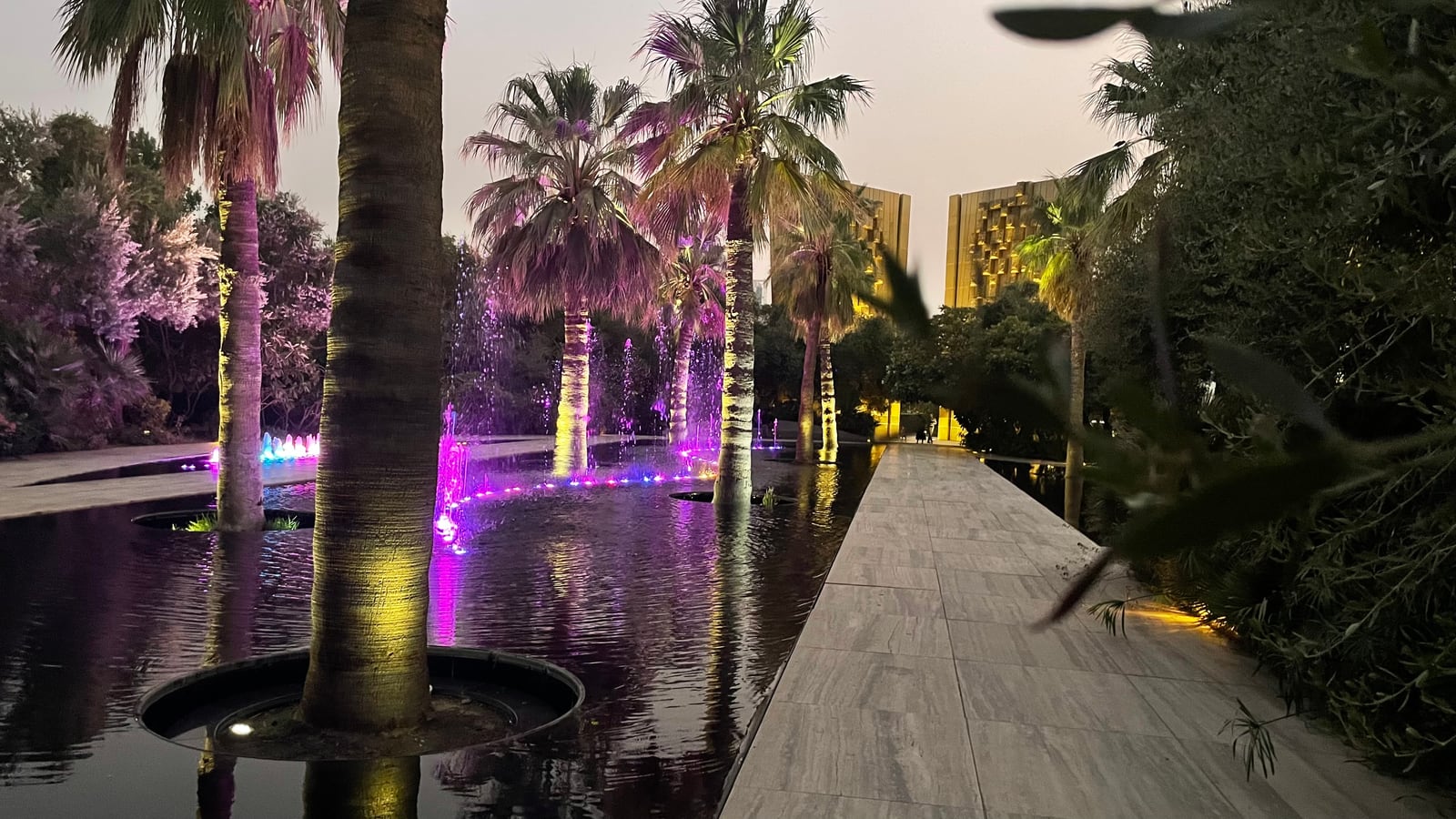
Image context: the cover is a real photograph made in the park in July 2025. Its fountains, palms, walkway, and low night lighting show the room this article is about, rather than reducing Al Shaheed to a skyline backdrop [11].
Before sunset: find the right edge
Before departure, check the park’s official @alshaheedpark account. Kuwait Government Online lists the park as an Amiri Diwan-affiliated entity and identifies that handle as an official contact channel [2]. Normal park hours, museum hours, Ramadan hours, and event hours are not interchangeable. A Kuwait-local guide listed 05:00–02:00 during Ramadan 2026, while the current List Kuwait page gives ordinary park hours as 05:00–00:00 [12][6]. Treat both as confirmation that the park has a long night life, not as permission to skip a same-day check.
Save Al Shaheed Park, Soor Street, opposite Al Tijaria Tower, the project address supplied by the landscape designers [3]. It identifies the correct side of the city, not a guaranteed gate. Ask a ride-hail driver for a currently marked public entrance, then photograph the posted park map before walking. That small pause corrects a recurring visitor mistake: Tripadvisor reviewers describe the western approach as difficult to read and note that maps inside the large grounds matter [8]. If driving, follow current parking signs rather than circling the perimeter. The 2015 design provided capacity for 900 cars underground, and recent community listings still report parking, but neither source guarantees that every entrance or bay is operating on the night you arrive [3][7][8].
Now use the sun as the clock. On a weekday evening, arrive 25 minutes before the date-specific sunset shown by a reliable weather app. That timing is advice, not a published entry slot. It gives enough light to identify the gate, water, museums, and main paths before the garden turns into reflections. It also avoids the worst version of a common tactic—coming at midday to “beat the crowd” and discovering that the exposed walk is the real opponent. Recent Google-review material describes mist stations helping on an August walk but still calls the heat sweltering; Tripadvisor visitors likewise warn that late-morning heat can cut a visit short [7][8].
There is no general timed reservation system advertised for an ordinary park walk. Entry is currently described as free by community listings, so the anchor can cost KD0 before transport or cafés [7][8]. Make the outdoor visit self-sufficient: arrive hydrated, use only the facilities that are open, and do not make a restaurant table or museum door the condition for a successful evening.
Blue hour: let the map narrow the park
The official visitor page describes roughly 200,000 square metres of greenery with botanical gardens, two museums, a visitor centre, lake, walking paths, and jogging tracks [1]. The design account calls the Green Belt conversion almost 20 hectares with a 2.5-kilometre longitudinal extent and three deliberately different lines: the Emir path, visitor path, and jogging track [3]. Those figures explain why a casual “wander around” can become shapeless.
Use the map you photographed at the gate to choose one connected sequence through the currently open established park: visitor path, lit water, memorial landscape, then back to the same marked entrance. Let the on-site order decide whether water or memorial comes first. If a barrier or the current map breaks that connection, keep the water section and return; do not improvise a route through a closed phase. Another visitor mistake is treating every facility as part of the same evening clock. The two museums belong to the park’s meaning, but they are not the night’s checklist. If either interior matters, verify its own hours and visit it separately; neither the government overview nor the general park listing promises that museum doors mirror the grounds [1][6][8].
Once the paths fill, walk predictably. The park was designed with a distinct jogging track, and current reviews still describe running as one of its ordinary uses [3][7]. Do not drift three abreast across a line that faster users have made obvious, stop on a bend for a photograph, or let children cut repeatedly across runners. Stay on the walking side, step completely off the flow before pausing, and cross a running line once rather than hovering in it.
After dark: sit where the water holds the light
Wait for the water to change before choosing a seat. In the last natural light, the fountains are landscape. After the lamps come on, they become the room’s hearth: movement, sound, and reflected towers gather around them. A recent r/Kuwait discussion is unusually specific about this habit—a commenter describes sitting by the fountain at night with headphones and finds weekdays especially calm [10]. Take the clue, not the exact pose. Choose a bench or clearly permitted seating edge, keep your audio private, and leave enough space that another person can sit without negotiating your bag.
Community listings are not perfectly consistent about picnics and lawn access, which is precisely why posted rules should decide. Current review digests describe designated picnic areas and restrictions on grills and wheeled recreation; a recent Tripadvisor review also warns against bringing outside food into the park [7][8]. Treat lawns as planted space unless signage explicitly invites use, keep bicycles and scooters off pedestrian routes, and let an on-site instruction replace anything remembered from a blog. The visitor trap here is assuming that “public park” means unrestricted picnic ground.
Make one photograph only after the lighting has settled. The Commons image used here gives the useful recognition set—fountains, palms, low paths, and architecture inside the garden [11]. Preserve that relationship rather than chasing a tower-only frame: stand where water and planting remain visible, move off the walking line, make the image, and put the phone away for the final ten minutes.
A wall line turned into evening space
Al Shaheed Park’s shape is not arbitrary. The design history traces it to the formal Green Belt built from 1961 to 1964 after Kuwait’s Third Wall, constructed in 1920, was demolished. The country’s first master plan, approved in 1952, reused that former defensive trajectory as the boundary between the old city and its expansion [3]. What feels at night like a long, protected interior is the afterlife of an urban edge.
The park’s later name adds another layer. After the Iraqi invasion, the garden was renamed in memory of Kuwait’s war martyrs; its 2015 reconversion joined a Memorial Museum and old city gate to gardens, a Constitution monument, visitor facilities, and public-event space [1][3]. This is why the best night walk should not collapse into “pretty fountains.” Water, planting, commemoration, and the city’s wall line have been asked to occupy the same ground.
The room can also change character without warning. In November 2025, an official government report recorded daily folkloric performances at Al Shaheed Park from 19:30 to 21:30 during the “Kuwait Unites Us” program [5]. A quiet bench on one night may be an event approach on another. That is not a planning failure; it is evidence that the park remains civic space. Check the calendar, and if a performance or run has taken possession of your intended circuit, either join on its terms or shorten the loop.
One newer confusion needs a hard boundary. A July 19, 2026 Kuwait-local report confirmed that Alshaheed Adventures had soft-launched selected paid attractions, but that Phase III itself remained closed and an Adventures booking did not grant access to the park [4]. Do not follow a Phase III pin, paid-parking instruction, or social-media snow-park clip as though it leads to the free night walk. The established park and the separately ticketed attraction are different plans.
Go details
- Time: choose a weekday, arrive 25 minutes before local sunset, and leave 50–65 minutes after it. Recheck
@alshaheedparkfor Ramadan changes, closures, and events [2][5][6][12]. - Cost and entry: the outdoor park is currently described as free, with no ordinary timed reservation listed. Transport and optional cafés are extra; a special event can still create a gate or parking queue [7][8].
- Navigation: use
Soor Street, opposite Al Tijaria Towerto reach the correct area, enter through a currently marked gate, photograph the posted map, and plan to return to that gate [3][8]. - Scope: keep to a mapped sequence of visitor path, lit water, and memorial landscape. Museums follow their own clocks; Phase III and ticketed Alshaheed Adventures are separate [1][4][6].
- Conduct: yield the jogging line, stop completely off the flow, sit only on a bench or clearly permitted edge, and let posted food, lawn, and wheel rules outrank old listings [3][7][8][10].
- Leave early when: same-day closure, dust, heat, an event crowd, or a closed-phase barrier changes the room. A shorter visit is better than inventing a route around operations.
Al Shaheed Park is strongest after sunset because it stops behaving like a collection of attractions. The old wall line holds the city at one edge. Water carries light through the gardens. Joggers, families, and solitary sitters give the paths a pace. For 90 minutes, Kuwait City’s green belt does not offer escape from the city. It becomes one of the city’s most convincing rooms.
Sources
- State of Kuwait, Kuwait Government Online, “Tourist Spots in Kuwait” — official overview of Al Shaheed Park’s area, gardens, two museums, visitor centre, lake, and walking and jogging paths.
- State of Kuwait, Kuwait Government Online, “Entities Affiliated with the Amiri Diwan” — official directory listing for Al Shaheed Park, including its contact details and
@alshaheedparksocial channels. - Landezine, “Al Shaheed Park” — design-team project account covering the Third Wall and Green Belt history, dimensions, three paths, museums, lake, parking, address, and 2015 reconversion.
- 2:48AM, “The Snow Park Has Quietly Soft Launched” (July 19, 2026) — recent Kuwait-local reporting on the current separation between closed Phase III and ticketed Alshaheed Adventures.
- State of Kuwait, Kuwait Government Online, “Minister of Information inaugurates ‘Kuwait Unites Us’ event” (November 13, 2025) — recent official confirmation of the park’s continuing night-event role and 19:30–21:30 performances.
- List Kuwait, “Al Shaheed Park” — Kuwait-local current listing for ordinary 05:00–00:00 park hours and the official Instagram handle.
- Wanderlog, “Al Shaheed Park” — Google and Tripadvisor community-review digest covering evening light, fountains, heat, mist stations, running, free entry, and current visitor-rule reports.
- Tripadvisor, “Al Shaheed Park” — a second community platform for visit duration, heat and parking friction, western-entrance confusion, free entry, lit paths, and outside-food reports.
- r/Kuwait, “Visiting Kuwait the first time, suggestions?” (May 2026) — recent local-community advice favoring an Al Shaheed Park stroll at sunset and noting the park’s spaciousness and art.
- r/Kuwait, “Where do you go to zone out?” (December 2025) — local-community discussion of sitting by the fountain at night and the calmer weekday rhythm.
- Zs.84, “Dazzling pictures of fountains and palm trees in Al Shaheed Park – July 2025,” Wikimedia Commons — catalogue page for the real 4,032 × 2,268 night photograph used as the article image.
- 2:48AM, “Your Guide to Ramadan Hours in Kuwait 2026” (February 18, 2026) — Kuwait-local documentation of the park’s 05:00–02:00 Ramadan schedule, illustrating why seasonal hours require a fresh check.