At Changlimithang, the object that organizes the whole field can be difficult to see. At the far end of a traditional Bhutanese range, a painted wooden target stands only about two and a half feet high and eleven inches wide. The archer is roughly 145 metres away. Between them sit flags, earth, safety walls, teammates, taunts, wind, and a silence that lasts only until the arrow lands [3].
That small board is the right object through which to read this part of Thimphu. It is not merely a bullseye. A hit can release a brief song and dance; a miss can draw gleeful commentary from the other team. Then everybody resets and the field stretches out again. The target turns accuracy into a public exchange [3].
Build the visit around one anchor only: Changlimithang Archery Ground. Do not pair it with a monument checklist or arrive expecting a guaranteed cultural performance. Ask whether a match is actually running, watch from the established spectator side, and give the rhythm 45 to 75 minutes if it is. A Saturday-morning discovery window of 09:00–11:00 offers better odds according to current visitor guidance, but it is not an official timetable [4][8][9]. The honest plan includes the possibility that no arrows will fly.
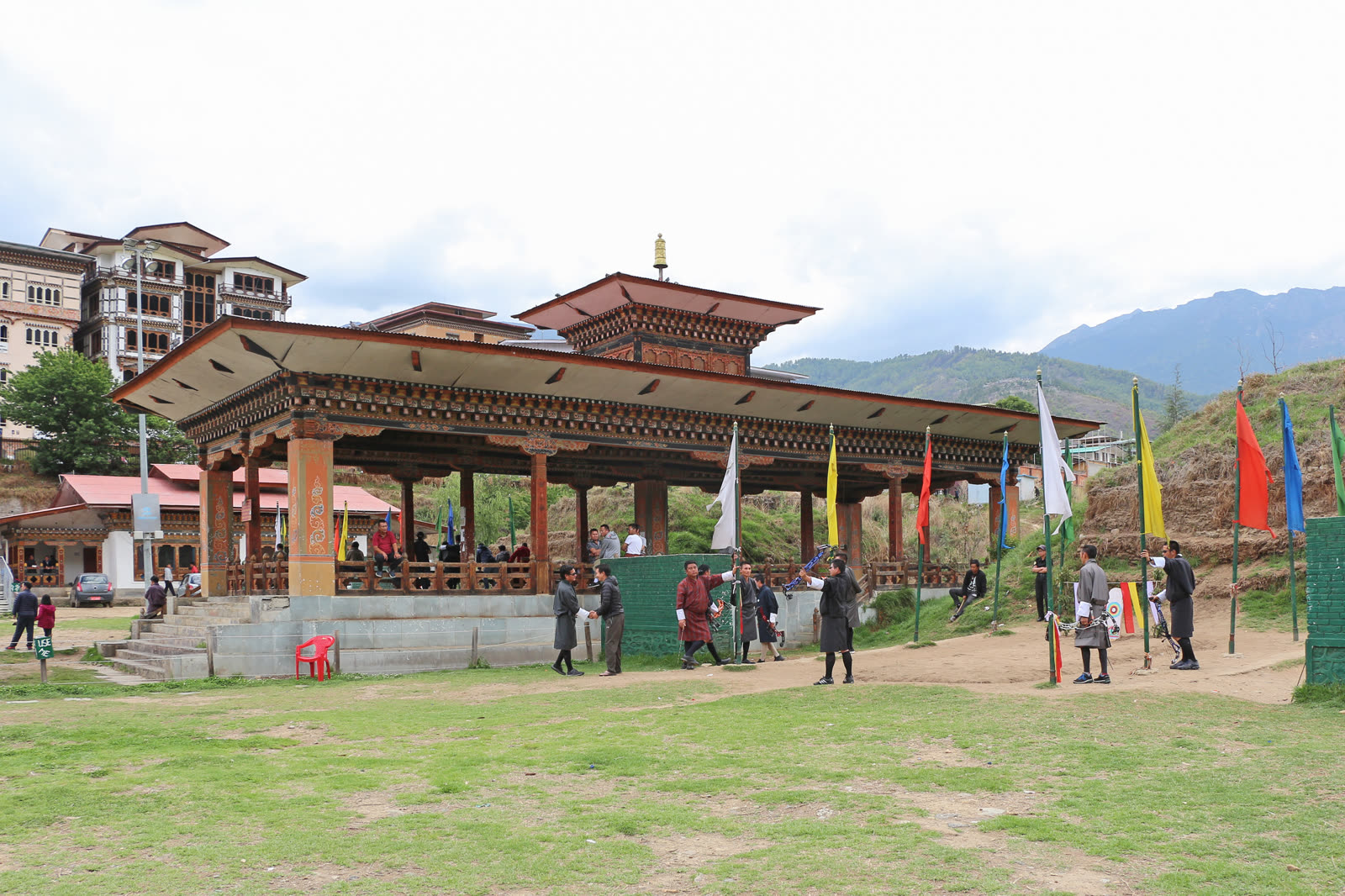
Image context: the cover is a real 2018 photograph of the ground. Its useful details are not just scenic: the pavilion, colored flags, earthen backstop, gho, and modern bows show how architecture, safety, dress, and contemporary equipment occupy the same field [10].
A small target on consequential ground
Changlimithang is not a sports parcel detached from the city’s history. The Bhutan Cultural Library records that the last major internal conflict, the 1885 Battle of Changlimithang, was fought on this ground; Ugyen Wangchuck’s victory helped end the struggle for power that preceded the monarchy. The site later became the national stadium complex, with the archery range and Bhutan Olympic Committee beside the football ground [6]. A place once organized around armed conflict is now organized around rules, scoring, spectatorship, and civic gathering.
The target keeps that history from becoming a grand abstraction. World Archery’s close report from Changlimithang describes two side-by-side 145-metre ranges, each with a target at either end and colored flags around the shooting and scoring areas. In the traditional format it observed, archers alternated ends, took two arrows per turn, and marked a hit with song and dance [3]. The person near the target also had work to do: read the arrow, communicate back across the distance, then clear the line before the next shot.
That last movement matters. A visitor can be tempted to read the people by the target as performers standing in a photo zone. They are participants operating inside a live projectile path. The first lesson of the object is distance: if the target looks small, the danger corridor is long.
The field’s current life is not frozen in that older format. A community directory updated in March 2026 still lists an active archery range inside the Changlimithang complex, while July 2026 football reporting confirms that the adjoining stadium remains busy with league fixtures [5][7]. Those sources confirm a live sports complex, not a match on demand. The range can be active, quiet, booked, restricted, or affected by another event. Let the day’s staff and barriers define access.
Modern equipment belongs inside the story
The easiest visitor mistake is to divide the field into “authentic” bamboo and “modern” compound bows, then value only the first. Changlimithang refuses that clean split. World Archery found traditional bamboo bows working on one range and compound bows on the other [3]. In 2025, Bhutan’s first National Archery Championship pushed the modern side further: about 420 archers across 84 teams competed, mechanical release triggers entered the national event, and teams could mix male and female archers [1].
That tournament did not replace Bhutanese archery with an imported spectacle. It made a visible argument about its future. Each five-person team could use up to two trigger shooters, while finger release remained part of the competition. Organizers framed the change as a way to improve consistency and prepare more athletes for regional and international competition [1]. The target therefore holds two time scales at once: the social grammar of Bhutanese play and the technical search for repeatable performance.
The 2025 championship also sharpened the safety grammar. Straight draws were required; sky draws and side draws were banned. Players not shooting had to remain behind safety walls, smoking and drinking were prohibited inside the range, and spectators could not enter the shooting area or cross the boundary flags [2]. These were formal tournament rules, not proof that every casual match uses identical enforcement. They are still the best visitor default: stay farther out, not farther in.
Eight moves for watching without taking over
1. Confirm a match before you build a morning around it. Check the Bhutan Olympic Committee’s current official updates, then ask your licensed guide, hotel, or a local contact that morning [9]. Community and operator guidance both point to weekends, particularly mornings, as the likelier window, but neither is a fixture list [4][5]. “Usually” is not a reservation.
2. Save the exact ground, not merely Changlimithang Stadium. Use the Google Maps result for Changlimithang Archery Ground / Bigsa Archery Gallery on Chang Lam SE and compare current user photos before setting out [8]. The football stadium, shooting facilities, parks, and archery range share one civic complex. Your recognition cues are the long earthen lane, decorated open pavilion, colored flags, and targets—not the largest gate.
3. Arrive 15 minutes before the window you were given. That buffer is for orientation, not front-row hunting. Stop outside the active edge, determine which direction is being shot, and locate the existing spectators. If you cannot identify the shooting line and safe side, do not advance. Ask.
4. Let ten minutes pass before using a camera. First watch who shoots, who signals near the target, where people wait, and what movement makes everyone else pause. The local rhythm becomes legible only as a sequence: draw, release, landing signal, reaction, retrieval, reset [3]. Photographing the first raised bow usually captures less than understanding the second complete cycle.
5. Use the boundary as a minimum, not a challenge. At the national championship, spectators were barred from the shooting area and the space inside the boundary flags [2]. Stand behind the safety wall or in the spectator area chosen by organizers. Never cross the range for a cleaner angle, lean around an earth barrier, or follow somebody toward the target without an explicit instruction.
6. Stay through reactions, not through an entire match. Traditional sets can be expansive, and formal events run to their own competition clock [1][3]. For a first visit, 45–75 minutes is enough to see several shots, misses, hits, conversations, and resets without turning a working social day into your all-day observation post. If the range is crowded, shorten the visit.
7. Treat song, dance, and teasing as communication. They are not interludes placed between the “real” sporting action. At Changlimithang, the reaction tells you that an arrow has altered the team relationship and the score [3]. Do not ask anyone to repeat a celebration, step into it, or pose beside the target. Watch what the match produces on its own.
8. Keep playing separate from watching. A current commercial listing offers a prearranged archery experience from US$75, with a guide-mediated format; that is a different product from quietly observing a live local match [4]. Do not ask an active team for “one try,” handle a bow, or assume a spectator area is a walk-in lesson. If participation matters, book it explicitly and ask where the instruction will occur.
Four visitor traps, and the better move
Trap one: treating Saturday at 09:00 as a showtime. Weekend mornings are a useful search window, not a published curtain time [4][5]. Better: verify the day before and again that morning, then keep a no-match fallback elsewhere in Thimphu. Do not pressure a guide or range user to manufacture activity.
Trap two: calling every compound bow inauthentic. The 2025 national championship used compound bows, sights, and limited mechanical releases as part of Bhutan’s own development debate [1]. Better: notice which equipment and release style are being used, and avoid assigning a date or cultural rank from appearance alone.
Trap three: moving toward the tiny target for a better photograph. Local review surfaces emphasize how hard the target is to see, which can tempt a visitor downrange [5][8]. Better: accept the scale. The target’s smallness at 145 metres is the point, and official tournament rules put spectators outside the flags and shooting area [2][3].
Trap four: assuming friendliness cancels weapon safety. The songs and teasing can make the field feel informal, but the 2025 rules were strict because arrows, draw direction, and unsanctioned movement carry real risk [2]. Better: follow the most conservative visible boundary, keep children close, and leave if you cannot determine where it is safe to stand.
The compact go brief
- Anchor: Changlimithang Archery Ground only.
- Best discovery window: Saturday 09:00–11:00, after same-day confirmation; Sunday morning is a secondary possibility, not a guarantee [4][5][9].
- Time on site: allow 15 minutes to orient, then 45–75 minutes if a match is active.
- Expected spend: ordinary observation has no spectator price published in the sources used here. Plan Nu 0 at the ground unless a live event posts a gate, and keep up to Nu 500 as an editorial transport-and-water buffer. A listed US$75 participation package is a separate booked activity, not an admission fee [4].
- Reservation reality: there is no dependable walk-up spectator reservation or daily match calendar. Verify access; pre-book only if you want instruction or participation [4][9].
- Queue reality: a regular practice may have no queue at all; a tournament or adjacent stadium event may bring a checkpoint and crowd. The larger risk is arriving to no match, not waiting too long [5][7].
- Navigation cue:
Chang Lam SE → Changlimithang sports complex → archery ground / Bigsa Archery Gallery → decorated pavilion and colored range flags[8][10]. - Where to stand: wherever organizers place spectators, behind the relevant safety wall and outside every boundary flag [2].
- Abort condition: no clear safe side, no identifiable official or organizer, a closed boundary, or a request to move. Leave immediately and return only with confirmed access.
The most useful thing to carry away is not the fiction that Bhutanese archery has survived unchanged. It is the opposite: one very small target can hold old social forms, modern equipment, formal safety rules, local argument, and individual nerve at the same time. From the correct side of the boundary, wait for the field to go quiet. The target will tell you when the city begins speaking again.
Sources
- Bhutan Broadcasting Service, “Mechanical triggers make debut in Bhutan’s first National Archery Championship” (July 11, 2025) — local reporting from Changlimithang on 84 teams, roughly 420 archers, five-person teams, limited trigger use, mixed-gender eligibility, and the league-knockout format.
- Bhutan Broadcasting Service, “Bhutan National Archery Championship enforces strict rules to boost safety and fair play” (July 30, 2025) — local report on straight-draw rules, safety walls, boundary flags, spectator exclusion, smoking and drinking bans, and disciplinary cards.
- World Archery, “Archery is in our blood: In the Land of the Thunder Dragon” — field report from Changlimithang covering the two 145-metre ranges, traditional target dimensions, end-to-end shooting, flags, scoring, bamboo and compound bows, songs, dances, and teasing.
- LocalHi, “Archery Match with Locals” — current booking page used to distinguish a US$75 arranged participation product from observation, and for its practical weekend-morning and visit-duration guidance.
- BhutanWiki Directory, “Changlimithang Stadium” — community-maintained local directory entry, updated March 25, 2026, identifying the active archery range within the central sports complex and providing a current location reference.
- University of Virginia Bhutan Cultural Library, “Chang Lingmeythang” — institutional place record for the 1885 battle, the ground’s later national-stadium role, the archery range, the Bhutan Olympic Committee, coordinates, and the Dzongkha place name.
- Bhutan Broadcasting Service, “Paro FC lead Bhutan Premier League as second round begins” (July 17, 2026) — recent local confirmation that the adjoining Changlimithang Stadium complex remains under an active sports calendar.
- Google Maps, “Changlimithang Archery Ground, Thimphu” — live navigation and community-photo surface for confirming the exact ground rather than the wider stadium complex.
- Bhutan Olympic Committee — official current-update channel to check before relying on a community report or an old tournament schedule.
- Bernard Gagnon, “File:Changlimithang Archery Ground, Thimphu 01.jpg,” Wikimedia Commons — source page for the real photograph made at the ground on May 20, 2018, used as the cover image.