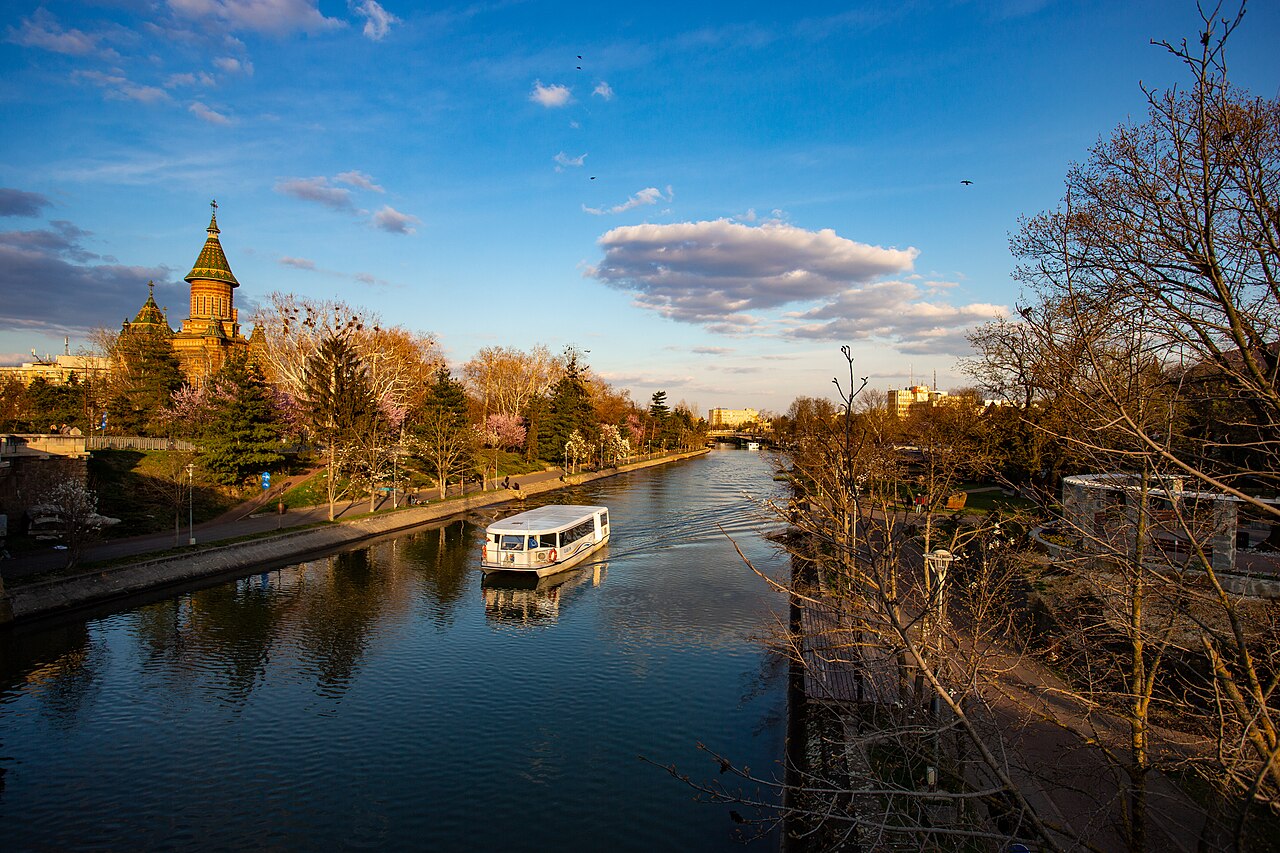
In January, when ice covered the Bega, a Timișoara resident asked online whether the vaporetto was running. Another replied that it had been put into hibernation [8]. The joke names a real civic season. The canal remains in place through winter while passenger service goes dormant.
On April 1, 2026, the boats returned. Timișoara's transport operator relaunched line V1 after the cold-season pause; six of its seven vessels were expected to serve nine floating stops in both directions [2][3]. By summer, the Bega once again has day-specific timetables, named directions, boarding intervals and interruptions. The revealing visit is not a survey of the whole line. It is one short ride that shows how a passenger season is assembled at water level.
Use Catedrala Mitropolitană as the observation point. Verify one weekday departure between 16:30 and 17:30, arrive 10 minutes early, board toward Mihai Viteazul, and leave at the next stop, Vasile Pârvan. The current fare is 5 lei. Allow 45–60 minutes for the pontoon wait, the one-stop passage and a slow walk back beside the water. No reservation is needed for the ordinary line; payment happens aboard [2][6].
Confirm this season's service before going
The first local move is to open STPT's current V1 page on the morning of the ride. Select the direction and read the graph for the correct day type. The operator separates working days from non-working days and explicitly recommends clearing the browser cache so the newest timetable appears [1]. Refresh it. A saved screenshot can preserve an obsolete schedule long after the operator has changed it.
The second move is to read STPT's latest notices as carefully as the timetable. Navigation space is shared. On June 6, an ecological boat race suspended V1 on part of the canal from 08:00 to 17:00, after which the operator named the exact departures that would restart service [4]. Summer does not mean uninterrupted operation; it means boats, races, repairs and public events all negotiate the same strip of water.
Choose a working day for this compact reading. That is the third move: commit to one published late-afternoon departure rather than carrying a vague plan to “take the boat sometime.” Weekday service makes the transport logic easiest to see, while the 16:30–17:30 window softens the light and leaves enough day for a failed sailing to become a canal walk. If the notice board and website disagree, follow the current on-site instruction or abandon the ride. Do not improvise around a closed pontoon.
The season's boundaries deserve the same respect. A January community thread supplies the vivid phrase “hibernation,” but STPT's dated March announcement supplies the decision-grade fact: service was scheduled to restart on April 1 after functional tests from March 28 to 31 [2][8]. In another year, those dates may move. Treat April 1, 2026 as confirmation of this season, not a perpetual opening day.
Wait below the spire
Pin Stație Vaporetto Catedrala Mitropolitană on Splaiul Tudor Vladimirescu [6]. The cathedral is the recognition cue, not the boarding door. From the central squares, descend toward the Bega and find the signed floating pontoon on the bank. The fourth move is to arrive at water level rather than waiting near the cathedral steps or on the bridge above.
This landing is part of the seasonal story. In July, local reporting said STPT had completed new timber work at four pontoons, including Catedrala Mitropolitană and Vasile Pârvan [5]. The useful detail is not that a visitor should admire fresh boards. It is that the line only exists through small maintained interfaces between fixed city and moving water: ramp, handrail, gate, schedule case.
Stand to one side of that interface. The fifth move is to keep the ramp clear, let arriving passengers leave, and stay out of the canal-side bicycle flow while waiting. There is normally no advance-booking line for V1; passengers reach a pontoon, wait for the scheduled craft and pay aboard [2][6]. Ten minutes is a sensible margin, not a guarantee. If the cabin fills, step back and use the bank instead of compressing the boarding lane.
The view from the pontoon joins two versions of Timișoara. The cathedral's tiled towers turn the location into a postcard, while the timetable case insists on operations. Under both lies a much older intervention. The city's historical timeline dates regulation of the use of the Bega and Timiș rivers to 1728 and describes the Bega as Romania's only navigable inland canal until 1988, as well as the first of its kind in southeastern Europe [9]. The summer line is another layer of management on water that has been managed for centuries.
Ride exactly one stop
When the boat arrives, make the sixth move explicit: ask the crew, Vasile Pârvan, spre Mihai Viteazul? The official V1 page presents two endpoint directions, while the metropolitan transport program confirms the Cathedral-to-Vasile Pârvan sequence toward Mihai Viteazul [1][11]. The stop names are more useful than an intuitive guess about upstream or downstream. Board only after the answer is clear.
Pay the current fare aboard. STPT's 2026 announcement says cash and bank card through the onboard POS are accepted; a general subscription or day pass is also valid [2]. Carry a small cash note even if you expect to use a card. Older community conversation still preserves a 4-lei price [7]. That discussion is useful for describing the enclosed, seated character of the ride, but the current operator notice governs what you pay. The seventh move is to keep those evidence roles separate.
Choose an unclaimed window and keep the aisle and door clear. The cabin feels closer to a small bus than an observation deck: passengers sit, the banks move sideways and the next pontoon arrives without a narrated reveal [7]. One stop is enough. A current Romanian family-activity guide makes the same practical point, recommending a central start and a ride of only one or two stops with the exit decided in advance [6].
That short scale is the eighth move. Get off at Vasile Pârvan instead of remaining aboard to make the fare feel bigger. Clear the ramp before orienting yourself. Then walk back toward the cathedral on the same side of the Bega, keeping the canal on your right and the spire ahead when it becomes visible. Allow roughly 15–20 minutes at an easy pace; treat that as a planning range, not a transport promise.
The return is useful because it repeats one small piece of city at a different speed. From the cabin, the pontoon sequence makes the bank look modular: stop, bridge, trees, stop. On foot, the same distance fills with benches, bicycles, shade and gaps in the river view. The boat compresses the bank into a stop sequence; the walk restores its texture.
What returns with the boats
Timișoara's 2026 summer programming makes this reactivation larger than V1 without requiring a second attraction. The local Ecluze pe Bega project has organized walks, workshops and an exhibition around the canal's hydraulic heritage, biodiversity and regional connections [10]. On July 25, its restored vessel Pelican reached Zrenjanin for the first time, where four public sailings were fully booked; the project had turned the city reach of the Bega into a cross-border route rather than merely describing it as one [13].
The ordinary pontoon is where that grand frame becomes credible. A navigable corridor is not made by calling water a connection. It requires a season, maintained landings, working vessels, published directions and enough institutional attention to announce when a race interrupts the line. Watching one arrival and moving one stop is a close reading of that system.
This is why the best time window is precise but the plan remains disposable. Go in the 16:30–17:30 band, spend 5 lei, and allow an hour. Yet if the refreshed graph, an event notice, weather or a barrier says no, keep walking. The seasonal moment is not one indispensable sailing. It is the return of a maintained passenger system to the water.
Four mistakes that miss the season
Mistake one: treating the 2026 restart date as an annual guarantee. The boats have a real winter pause, and residents speak of it as hibernation [2][8]. Better: verify the current year's restart and operating notices before building a visit around V1.
Mistake two: reading the right line for the wrong day type. Working and non-working days have different graphs, while a cached page may conceal the newest version [1]. Better: refresh V1 that morning, choose the day type and save only the departure you intend to use.
Mistake three: waiting at the landmark instead of the landing. The cathedral identifies the area but does not board passengers [6]. Better: pin the pontoon on Splaiul Tudor Vladimirescu, descend to the bank, arrive 10 minutes early and leave the ramp clear.
Mistake four: maximizing distance after the useful observation is complete. A whole-line ride adds return risk and turns a close city lens into timetable management. Better: confirm Vasile Pârvan, spre Mihai Viteazul?, pay the current 5 lei, travel one stop and recover the same stretch on foot [1][2][6].
In winter, the Bega has banks, bridges and memory but no passenger service. In summer, a boat noses toward a floating stop beneath the cathedral and the ramp becomes useful again. Timișoara has not changed the river into something else. It has made a season visible through the small acts that let passengers meet the water.
Sources
- Societatea de Transport Public Timișoara, "V1" — official current direction selector and working/non-working-day timetable, including the cache-refresh warning.
- Societatea de Transport Public Timișoara via AGERPRES, "Vaporașele revin pe Bega! Reluăm transportul public pe apă din 1 aprilie" (March 10, 2026) — season restart, functional-test dates, onboard payment, fare and pass validity.
- Radio România Timișoara, "Vaporașele revin pe Bega. Cât costă o călătorie și cum pot fi plătite biletele" (April 1, 2026) — nine-stop service and six-boat operating confirmation.
- Societatea de Transport Public Timișoara, "Circulația vaporetto suspendată temporar în data de 6 iunie" (2026) — primary example of an event-related partial-day service suspension and specified restart departures.
- Buletin de Timișoara, "STPT modernizează pontoanele stațiilor de vaporetto de pe Bega" (July 2, 2026) — recent local confirmation of completed timber work at the Cathedral and Vasile Pârvan pontoons.
- Luderio, "Vaporetto (transport pe Canalul Bega) – Timișoara" — Romanian family-activity platform on the Cathedral pontoon, stop-based use and planning a short ride with a known exit.
- r/timisoara, "Vizitez Timișoara, ce îmi recomandă timișorenii?" (June 2025) — local community discussion of the enclosed, seated ride; older fare claims treated as historical rather than current.
- r/timisoara, "Bega înzăpezită" (January 2026) — recent local community texture on the frozen canal and a resident's winter “hibernation” shorthand.
- Visit Timișoara, "Timișoara, o scurtă istorie" — local historical timeline for the 1728 regulation of river use and the canal's navigation context.
- Tion, "Bega prinde din nou viață" (July 9, 2026) — recent local reporting on the summer 2026 Ecluze pe Bega program, river heritage and cross-border navigation.
- Societatea Metropolitană de Transport Timișoara, "Program Vaporetto" — current V1 endpoint relations, stop set and service-day categories, including Catedrala Mitropolitană to Vasile Pârvan toward Mihai Viteazul.
- Wikimedia Commons, "Vaporetto on the Bega River" — Radu Simionoff's March 26, 2019 real photograph near the Metropolitan Cathedral, original dimensions and CC BY-SA 4.0 provenance.
- Telegraf, "Istorijski brod Pelikan stigao u Zrenjanin" (July 25, 2026) — same-day reporting on the vessel's completed first arrival, four fully booked public sailings and the cross-border project's continuation.