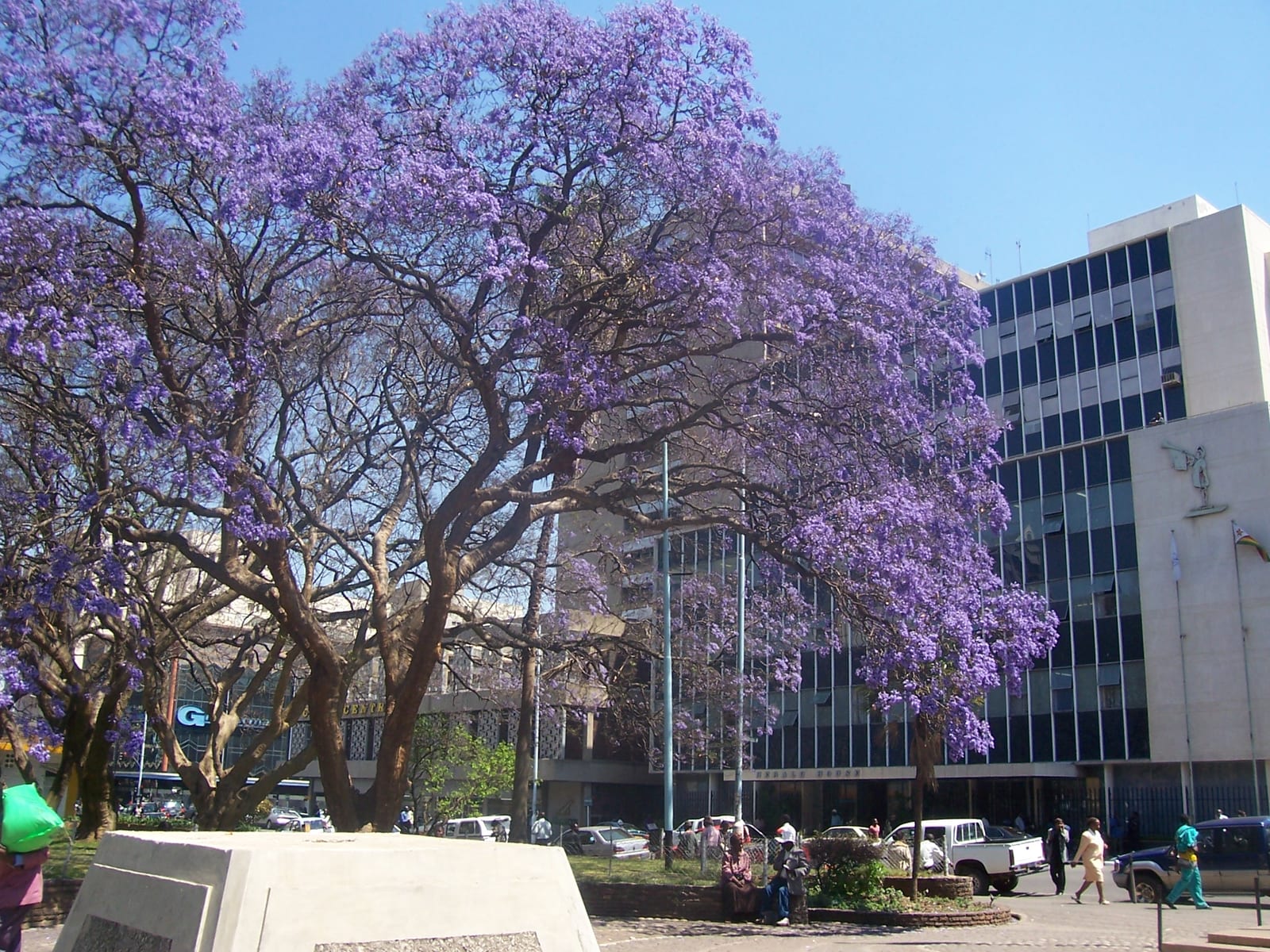
For a few spring weeks, Harare flowers in two directions. Jacaranda crowns hold a lilac ceiling above the road; spent bells collect below, softening the pavement into what one local guide calls “purple snow.” Along Leopold Takawira Street, the color does not suspend ordinary life. Hospital traffic moves, people wait for transport, bees work the blossom and photographers search for the familiar tunnel of branches [3][6][7].
That last search is where a visitor can get the season wrong. This is not a ticketed garden with a published peak day, and the most symmetrical view is often the one that tempts a camera into the road. Treat the bloom as a seasonal condition on a working street, not a photo set.
Keep the anchor to one corridor: Leopold Takawira Street opposite Parirenyatwa Group of Hospitals, then north toward Avondale for only the best-looking three or four blocks [3][6][9]. Use September 20 to October 20 as a planning bracket, not a promise. Check current Harare photographs 24–48 hours before going, arrive in full daylight between 06:30 and 08:30, and allow 45–60 minutes. If a storm has thinned the crowns or traffic has swallowed the pavement, let the walk be smaller.
Image context: the cover is a real September 2006 photograph made in central Harare, not on the precise section of Leopold Takawira described here. Its value is the combination of blossom, mature trunks, offices, pedestrians and vehicles: the same tension between seasonal spectacle and working street that defines this walk [10].
A bloom that keeps its own calendar
The Meteorological Services Department of Zimbabwe placed jacarandas in its September 2025 newsletter as a phenological signal: their flowering marked the close of the cool, dry season and the approach of the rains, alongside rising temperatures, longer days and increasing moisture [1]. That is a more useful way to understand the bloom than treating October as an appointment. A living signal responds to the year it receives.
The 2025 evidence gives a practical bracket. On October 6, The Herald reported purple pavements in Harare and named Leopold Takawira—from Parirenyatwa toward Avondale—as one of the streets transformed by spring [3]. On October 14, a Zimbabwean photographer posted a strong Leopold Takawira bloom and contrasted it with the weaker display after the previous year's poor rains [6]. The Tree Society of Zimbabwe calls October the usual peak, while a locally written Harare guide begins the broader display in mid-September [4][7]. Together, those sources support a late-September-to-mid-October search. They do not guarantee that next year's fullest canopy will obey it.
The local move is therefore to verify the bloom, the weather and the street as one condition. Look at images posted that week, then check the day's wind and rain. Flowers that were dense on Monday may be a carpet by Friday. Strong wind also matters around century-old urban trees: Harare's environmental officials have warned that internal or root decay can bring down branches [3]. If gusts are moving the larger limbs, admire the season from somewhere else.
The small seasonal nuisance is part of the same ecology. The 2025 community thread mentions bees as the downside of the vivid display [6]. Do not shake branches, climb a verge, or stand under a low flowering limb to manufacture a shower of petals. Give insects their working distance and use what the season has already dropped.
Purple, iconic—and introduced
Harare's canopy is beautiful without being innocent or timeless. The city's 2025–2045 Master Plan describes jacarandas as prominent along streets and in parks, an iconic part of the urban landscape, and non-native trees originally from South America [2]. The Tree Society identifies the familiar species as Jacaranda mimosifolia; the EPPO Global Database records its range as northern Argentina, Bolivia and Paraguay [4][11]. Calling this an indigenous African forest would erase the route by which it arrived.
That route runs directly through the colonial making of the city. Local tree histories date Harare's first small group of jacarandas to about 1899–1900. A first tree stood on what was then Cape Avenue, later Montague Avenue and now Josiah Chinamano Avenue; it collapsed in 1998. The longer Josiah Chinamano corridor was planted on both sides in the 1902–03 rainy season, extending roughly two kilometres [4][5]. Leopold Takawira's canopy belongs to that same planned culture of shade trees and avenues.
The names now complicate the planting plan. Montague and Moffat have given way to Josiah Chinamano and Leopold Takawira. The introduced tree survived while the colonial street labels did not. That is Harare-specific texture worth keeping in the frame: a purple canopy inherited from an unequal city-making project, maintained along streets whose present names interrupt the old map.
The trees also remain urban infrastructure rather than heritage ornaments sealed behind a fence. The Herald records the City Council's environmental staff discussing air pollution, replanting, ageing roots, falling branches, litter and a municipal nursery holding 15,000 trees [3]. The master plan calls exotic vegetation a mixed presence [2]. Appreciate the flowering, but do not flatten that live maintenance argument into “the city has always been purple.”
Before the bloom: verify, arrive, and let the street decide
The walk really begins a day or two before the camera comes out. Search current Harare posts for Leopold Takawira, not generic jacaranda images from Pretoria or an old travel gallery, and repeat the check after hard rain. Protecting a two- or three-day Harare window is wiser than booking one supposed “peak bloom” morning months ahead. The 2025 sequence—September flowering, an October 6 local report and an October 14 community confirmation—shows a useful range, not a permanent timetable [1][3][6]. A season can be present across the city while this block is already past its cleanest display.
On the chosen morning, pin Parirenyatwa Group of Hospitals on Leopold Takawira and ask to be left on the safe pavement side opposite the complex [3][6][9]. Agree on the destination before the vehicle stops; do not make the driver idle in a live traffic lane while you compare trees. Begin between 06:30 and 08:30, an editorial window rather than an official quiet period. It offers softer light, full daylight and an exit before October heat builds; local guidance identifies October as Harare's hottest month [7]. If commuters already leave little usable pavement, let the street overrule the schedule and shorten the walk.
Under the canopy: pavement, people, and the frame
Let the pavement determine the photograph. The centered canopy view is seductive enough that local photographers joke about risking the roadway to get it [6]. Refuse the viral centerline: use a side angle and cross only where conditions clearly permit. Deep potholes, failed signals and poorly marked roads are documented hazards, not texture to step around while looking through a viewfinder [8]. Then follow the bloom rather than the map. Walk only the best three or four blocks toward Avondale, pausing where petals, trunks and ordinary street activity meet. If that takes 20 minutes, the smaller walk has done its job.
Before making any portrait, apply a broader caution. Official guidance warns that Zimbabwean authorities may treat photography, interviews, blogging or photo-sharing as journalism, which is illegal without accreditation; assess that risk before taking or posting images [8]. If you do proceed, ask before making an identifiable pedestrian, vendor or worker the subject, and agree on any portrait fee first. A wide scene can show how the avenue works without turning one passerby into unpaid atmosphere.
Some subjects are never incidental. Government offices, embassies, police or military personnel, demonstrations and other sensitive sites must stay outside the frame [7][8]. A flower photograph can accidentally include a guarded building or official convoy; do not take the shot. If security personnel instruct you, comply immediately and leave without arguing. End the walk if a political gathering appears.
The same restraint applies to the trees themselves. Do not enter a garden for a closer branch, climb a verge, or shake flowers loose. Harare's rare white-flowering specimens may be visible from public roads, but they belong to a separate, carefully verified walk—not an excuse to treat every flowering tree as public access [4]. And keep the history straight: the canopy can be inseparable from Harare's identity while the species remains introduced, the product of colonial-era planting rather than indigenous woodland [2][4][5][11].
When the street says stop
The end is a condition, not a landmark. Leave when the crowns thin, when the pavement pinches, or after 45–60 minutes—before waiting for the road to empty turns a seasonal walk into a contest with traffic. Hard wind, rain, an unsafe crossing, a gathering or convoy, a security instruction, or a break in the public pavement ends the attempt immediately. Flowers that survive for weeks do not require this particular morning.
Carry water, a copy of your passport's photo page and visa if applicable, and small-denomination US-dollar notes. Current official guidance says US dollars remain legal tender but change can be scarce [8]. The walk itself needs no purchase; the cash is a modest transport-and-water buffer, not an invitation to display a wallet or expensive equipment.
Go details
- Route: opposite Parirenyatwa Group of Hospitals, then north on Leopold Takawira toward Avondale [3][9].
- Window: September 20–October 20; favor early October, then check bloom and weather 24–48 hours ahead [1][3][4][6][7].
- Morning: 06:30–08:30 in full daylight; allow 45–60 minutes for the best three or four blocks.
- Spend and access: US$0 to walk; no ticket, gate, queue or reservation. Carry an editorial US$5–15 transport-and-water buffer in small notes [8].
- Position: public pavement only—never the centerline, a planted verge, private property or a controlled entrance [6][8].
- Navigation:
Parirenyatwa Group of Hospitals → Leopold Takawira Street → north toward Avondale; confirm the pin before departure [9].
Harare's jacaranda moment is richer when it remains attached to the avenue. Above you is an introduced canopy that has outlived several street names. Below is the fallen second bloom. Between them, the present city keeps moving. The right visit does not clear that movement from the picture; it learns where to stand inside it.
Sources
- Meteorological Services Department of Zimbabwe, Newsletter: September 2025 — official account of jacaranda flowering as a phenological signal at the transition from the cool, dry season toward the rains.
- City of Harare, Harare Master Plan 2025–2045: Report of Study (June 2025) — official planning document describing jacarandas as prominent, iconic and non-native elements of Harare's streets and parks.
- Caroline Washaya-Moyo, “Of spring, purple jacaranda plumage,” The Herald (October 6, 2025) — recent local report naming Leopold Takawira and documenting the bloom, city-tree policy, maintenance concerns and the council nursery.
- Tree Society of Zimbabwe, “White Jacarandas” — local botanical guide to October peak flowering, South American origin, the first Harare planting story and white-flowering trees visible from public roads.
- Tree Society of Zimbabwe, “October—Jacaranda month,” Tree Life 351 — local history of the first plantings and the two-kilometre, 1902–03 jacaranda line on Josiah Chinamano Avenue.
- Tatejinya, “The most classic (cliché) Jacaranda shot in Zim?”
r/Zimbabwe(October 14, 2025) — recent community confirmation of the Leopold Takawira bloom, rainfall variation, bees, the Parirenyatwa cue and the risky centerline-photo habit. - Great Zimbabwe Guide, “Harare travel guide: Everything you need to know” — locally written practical context for the mid-September-to-October display, October heat, daylight safety, photography boundaries, cash and street conditions.
- UK Foreign, Commonwealth & Development Office, “Zimbabwe: Safety and security” — current stabilizer source for city-centre precautions, small-note cash, camera restrictions and road hazards.
- Google Maps, “Parirenyatwa Group of Hospitals, Leopold Takawira Street, Harare” — live navigation and community-photo surface for confirming the start cue and current street context.
- Damien Farrell, “2006 Harare Zimbabwe 279073454.jpg,” Wikimedia Commons — source page for the real September 2006 central-Harare jacaranda photograph used as the cover image.
- European and Mediterranean Plant Protection Organization, “Jacaranda mimosifolia (IACMI),” EPPO Global Database — accepted name and range in northern Argentina, Bolivia and Paraguay.