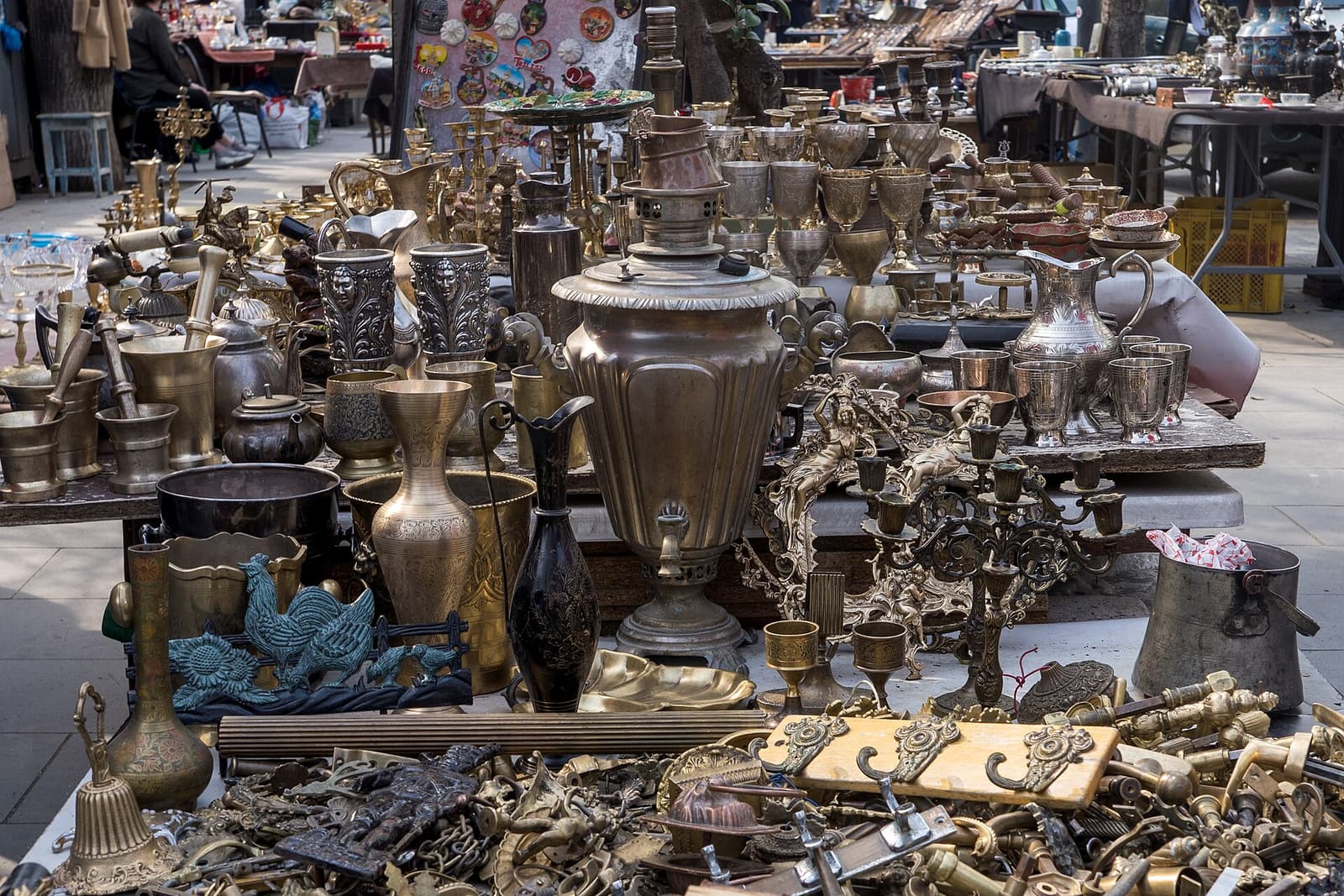
Dry Bridge Market is easy to visit badly. You show up at the edge of the bridge, see Soviet badges, old cameras, carpets, paintings, chess sets, enamel, coins, and a few suspiciously fresh souvenirs, then either overpay in ten minutes or leave because it feels too touristy. The better version is slower and less acquisitive: treat the market as a small street microcosm, not as a shopping errand.
The scope is tight: one bridge, the park edges around it, and a browsing loop of about 60-90 minutes. The market's own current visitor page says it is maintained by Tbilisi City Hall, gives the address as PR23+96X, lists daily recommended hours of 11:00 a.m.-6:00 p.m., says admission is free, and points to weekends for the strongest vendor atmosphere.[1] Georgia's national tourism site supplies the older story: Dry Bridge became an informal marketplace in the Soviet and post-Soviet city, with vintage goods, antique coins, Soviet kitsch, and contemporary Georgian art all sharing the same public ground.[2] That mix is why the place deserves more patience than a souvenir stop.
Local move one: arrive after the first setup but before the heat and tour-bus dawdle. The practical window is 11:00 a.m.-1:30 p.m. on a dry Saturday or Sunday. A 2025 visiting guide gives 10:00 a.m.-5:00 p.m. as a common working day and says 11:00 a.m.-2:00 p.m. is the liveliest browsing period; the market's own 2026 page stretches the recommended window to 11:00 a.m.-6:00 p.m.[1][8] Use that overlap. Too early and half the blankets are still becoming stalls. Too late and the good object-looking has turned into fatigue.
Local move two: start on the bridge, then drop into the park sections instead of walking a straight line and calling it done. Where Is The Market describes the market as daily antique, flea, and craft selling on the bridge and in the parks beneath it, with the spread continuing into 9 March Park and Dedaena Park.[7] That geography matters. The bridge tables tend to feel like the hard edge: coins, cameras, medals, tools, old household pieces. The park sections soften into paintings, textiles, craft objects, and longer conversations. If you only scan the bridge rail, you miss the market's second register.
Local move three: bring small GEL notes and decide your ceiling before you touch the object. For casual browsing, plan 20-50 GEL for small finds, 50-150 GEL for cameras, silver, textiles, or better vintage pieces, and more only if you know the category. This is not a fixed-price museum shop. Recent Tripadvisor reviews from May and June 2026 still describe a market where bargaining is expected, prices can start ambitiously, and some sellers value their objects highly.[3] The useful rule is not "haggle hard." It is "bargain softly, then leave cleanly." If the first number is silly, smile, counter once or twice, and walk away without making the seller perform.
Local move four: do not treat Soviet objects as neutral props. Georgia Travel's description of the market's Soviet memorabilia and older goods is accurate, but the objects sit inside a country with its own Soviet history, wars, family archives, and post-Soviet economic improvisations.[2] A medal, school pin, gas mask, camera, or propaganda booklet is not just quirky decor. Ask what the item is if language allows; if it carries military, political, or family meaning, handle it like an artifact rather than a costume accessory.
Local move five: use the art-market edge before buying the obvious badge. A local r/Sakartvelo answer makes a useful distinction: Dry Bridge has plenty of old Soviet material, but there is also an adjacent art market that may be more interesting depending on what you want.[5] That is the better visitor path. Look at paintings and prints first, especially if you want something tied to Tbilisi rather than a portable Cold War punchline. Local guide pages also emphasize handmade crafts, jewelry, paintings, textiles, and Georgian artifacts alongside antiques.[6][7]
Local move six: assume the market is weather-sensitive even when listings say daily. It is open-air. Rain, snow, high wind, public holidays, and seller energy change the room. The 2025 guide explicitly warns that bad weather means fewer stalls, and Reddit's older local-market thread frames Dry Bridge as generally reliable but still subject to holiday logic.[5][8] If this is your only Tbilisi morning, check the sky before spending a taxi ride on a thin weekday version.
Local move seven: make the approach on foot if you are already near Rustaveli, Freedom Square, or the river. Tbilisi public transport is inexpensive, but the best first read of this market comes from arriving at street speed. If you do need transit, a current Tbilisi transport guide puts metro, buses, and minibuses around 1 GEL per ride, with most services running from early morning to midnight; a local guide also notes common 3 GEL day-card and 20 GEL week-card options.[4][9] Those numbers matter less than the practical cue: do not burn time optimizing transport for a central market. Walk if the map says 10-20 minutes and the weather is kind.
Local move eight: keep your phone in map mode, not photo-hunt mode. The image overload is real: chess pieces on velvet, watch faces, brass samovars, portraits, books, cameras, enamel signs, religious icons, carpets folded into shade. Photograph sparingly, ask before shooting faces or a close stall, and do not block a blanket with your shadow while someone else is negotiating. The market rewards looking with your hands behind your back first.
The non-local trapline is short. Mistake one is coming only for "authentic local life" and then being disappointed that visitors are there. A recent r/tbilisi thread is blunt on this point: Dry Bridge is touristy, while other public markets such as Samgori, Didube, or Dezerter feel more everyday.[10] Better: accept Dry Bridge as a tourist-facing, object-rich public market and judge it on that basis. Mistake two is paying the first price because the object seems cheap compared with Western flea markets. Better: know your ceiling and negotiate with a smile.[3] Mistake three is hunting only Soviet souvenirs. Better: look for Georgian painting, enamel, books, silver, textiles, and handwork too.[6][7] Mistake four is treating every old thing as a bargain. Better: if provenance, authenticity, or export rules would matter to you, do not buy unless you can verify more than the seller's story.
Concrete go details: aim for 11:00 a.m. on a dry weekend, give it 60-90 minutes, and do not book anything timed immediately afterward. There is no reservation, ticket, or queue to manage; the pressure is browsing discipline. Carry cash in small notes, leave room in your bag, and wear shoes that can handle uneven pavement and park dust. If you want a purchase memory without buyer's remorse, buy one object you can explain in a sentence: a postcard with a real Tbilisi scene, a small enamel piece, a book you can identify, a print from a working artist, or a camera only if you understand old-camera risk.
The city-specific texture is in the name. The bridge is "dry" because a branch of the Mtkvari that once ran under it was later redirected, leaving a bridge whose original water logic had vanished; Georgia Travel places that nickname in the 1940s after the river branch was changed.[2] That is exactly why the market fits here. It occupies leftover infrastructure, turns absence into public room, and lets objects from apartments, workshops, studios, and family drawers re-enter city life. Dry Bridge is not Tbilisi's whole local truth. It is a very specific one: a place where memory becomes negotiable, but not weightless.
Sources
- Dry Bridge Market, "Dry Bridge Market - Tbilisi" - current market page with City Hall maintenance note, address, free admission, recommended hours, weekend guidance, 2026 update, and recent visitor-review signals.
- Georgia Travel, "Dry Bridge Flea Market" - national tourism overview of the market's vintage goods, Soviet memorabilia, Georgian art, and Dry Bridge history.
- Tripadvisor, "Dry Bridge Market" - recent visitor-review surface, including May/June 2026 reports on bargaining, local art, Soviet-era goods, and price variability.
- Wander-Lush, "Tbilisi Public Transport Guide: Fares, Travel Cards & Tips" - recent transport cross-check for metro, bus, minibus, fare, and operating-hour basics.
- Reddit
r/Sakartvelo, "Flea markets in Tbilisi" - local/community discussion distinguishing Dry Bridge's older Soviet-material stalls from the adjacent art market and noting the market's regularity. - Tbilisi Local Guide, "Dry Bridge Flea Market" - local guide overview of the market's antiques, vintage goods, handmade crafts, jewelry, paintings, textiles, and bargaining atmosphere.
- Where Is The Market, "Dry Bridge Market, Tbilisi" - market layout and hours reference covering Saarbrucken/Dry Bridge, 9 March Park, Dedaena Park, and daily 11 a.m.-4 p.m. listings.
- Wandering Mindfully, "How to Visit the Dry Bridge Market in Tbilisi, Georgia" (2025-08-15) - recent planning note for daily hours, best time window, weekend activity, and weather sensitivity.
- Tbilisi Local Guide, "Public Transport in Tbilisi" - local transport reference for bus, metro, card, one-ride fare, day/week pass, and station purchase details.
- Reddit
r/tbilisi, "Going to Tbilisi for 2 days. Want to escape the tourist bubble" - recent community discussion placing Dry Bridge in relation to more everyday Tbilisi markets. - Wikimedia Commons, "2025-03-30 Dry Bridge Market, Tbilisi 5.jpg" - real photographic source used for the article image.