The mistake is treating the Detroit People Mover as either a joke transit system or a complete sightseeing loop. The better version is narrower: use it as a free, elevated downtown hinge, then spend the real time on foot along the riverfront and, if the weather is right, down the Dequindre Cut.
This is not a full Detroit itinerary. It is a two-anchor move: People Mover first, RiverWalk/Dequindre Cut second. The train solves the awkward downtown approach, gives you a quick skyline-and-street read, and drops you near the water. The riverfront does the slowing down. That order matters because the People Mover's official schedule currently lists free rides, average train arrivals in less than eight minutes, weekday service from 6:30 a.m. to midnight, Saturday service from 10:00 a.m. to midnight, and Sunday service from 10:00 a.m. to 10:00 p.m.[1] In other words, it works best when you stop asking it to be the whole city and start using it as a precise connector.
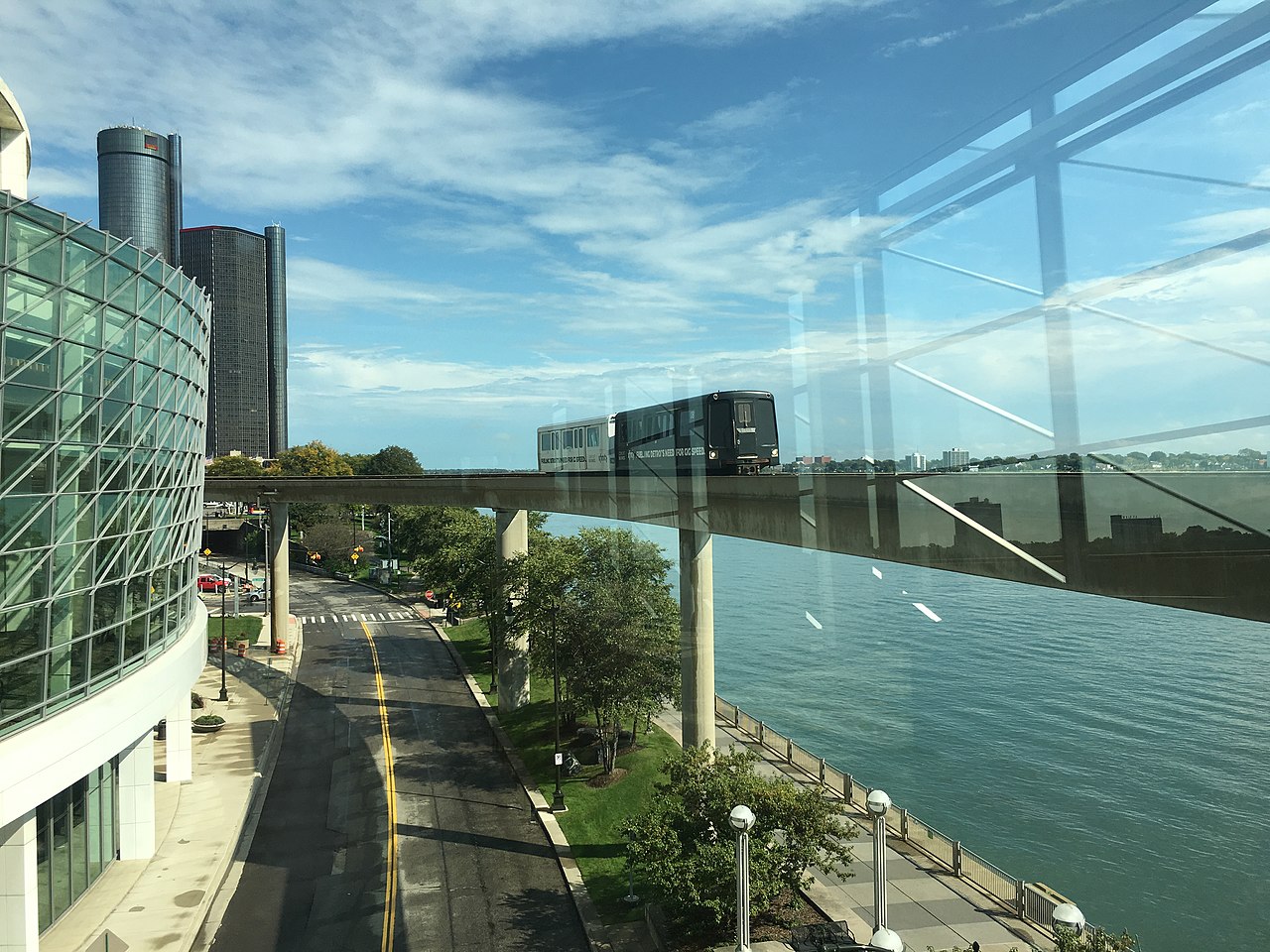
Start at any convenient downtown station, but make the Renaissance Center or Millender Center your mental exit, not just "the river." The People Mover station guide says the Renaissance Center station sits inside Tower 200, Level 2, near the GM HQ Winter Garden, Detroit RiverWalk, and Port of Detroit; the Millender Center station sits inside the Millender Center and connects toward the Renaissance Center by bridge.[2] That is the useful local move: do not wander to the waterfront from a random downtown corner because the map looks close. Ride the loop until the building gives you the cleanest handoff, then drop to Jefferson and Atwater with your route already chosen.
Local move one: check the station constraint before you commit to a late exit. The official schedule page notes that Huntington Place station closes at 10:00 p.m. on non-event nights, with Financial District as the after-hours alternative; it also says Millender Center's Randolph Street outdoor entrance and Level 2 pedestrian crosswalk lock nightly after 8:00 p.m., while Renaissance Center building hours run to 10:00 p.m. for non-hotel access.[1] That sounds like small print until you are trying to reverse a riverfront walk after dinner. For this route, the cleanest window is late afternoon into early evening: enough light for the elevated ride, enough people on the water, and not so late that building doors turn the station geography into a puzzle.
Local move two: ride the train as a loop, not as a subway line. The official station guide gives the system logic, while the live Google Maps surface is the practical sanity check for the exact station pin you are using, especially around event days, garage entrances, and building-linked stations.[2][6] That is the boundary. Do one loop if you want the orientation, but do not keep orbiting because it feels like a tour. Pick a station, descend, and let the street level take over.
Local move three: if you want the riverfront, aim for the walkable edge, not a single photo spot. Detroit Riverfront Conservancy visitor information lists the RiverWalk, parks, and greenways as open daily from 6:00 a.m. to 10:00 p.m., with security monitoring throughout the riverfront, parks, plazas, and greenways.[4] A Michigan-based visitor guide describes the RiverWalk as more than four miles today, with plans to extend beyond that, which is the right mental model: it is a system, not a single viewing deck.[8] The official Dequindre Cut page describes the Cut as a nearly two-mile below-grade pedestrian path connecting Eastern Market to the riverfront, with a 20-foot-wide paved pathway and separate pedestrian and bicycle lanes.[3] That is your second anchor: a linear room, not a scenic overlook.
Local move four: enter the Dequindre Cut from Atwater if you are pairing it with the river. The Conservancy lists entrance ramps at Atwater, Franklin, Woodbridge, Lafayette, Gratiot, Wilkins, and Mack.[3] For a first visit, Atwater is the clean hinge because it keeps the riverfront and Cut in one continuous move. Walk the RiverWalk first if the light is low and the water is the point; go into the Cut first if it is hot and you want the cooler below-grade path and mural walls before the evening crowd collects near the river.
Local move five: keep to your lane and keep stopping off the lane. The Cut's separated lanes are part of why it works.[3] Visitors often stand in the path to photograph murals, then act surprised when bikes appear at commuter speed. Step onto the edge before taking photos, look both ways at underpasses, and avoid making a group wall. The Dequindre Cut's live map and community-review surface is useful for checking the current pin, nearby entrances, and recent visitor-flow comments, but the behavior rule is simpler than any review: locals use this as infrastructure, not only as decoration.[7]
Local move six: treat events as a feature and a friction point. The Conservancy calendar for late June 2026 shows active programming on and around the riverfront, including a June 28 Detroit House Collective Sunday on the Dequindre Cut, plus walking, yoga, drumming, running, volleyball, and meetup events across the same riverfront system.[5] That is recent confirmation that the area is alive, but it also means a quiet path can become a programmed room. Check the calendar before assuming solitude.
The non-local trapline is predictable. Mistake one is boarding the People Mover as if it will show you Detroit in full. Better: use it for downtown elevation, station art, weather protection, and a short transfer; the rest of Detroit needs other transit, bikes, cars, or longer walks.[2][6] Mistake two is ignoring station hours and then trying to re-enter through a locked building edge after 8:00 or 10:00 p.m. Better: make Renaissance Center, Financial District, or another open station your exit plan before you leave the river.[1] Mistake three is treating the RiverWalk as one uninterrupted boardwalk mood. Better: decide whether you want river, park, event space, or Cut, because the system changes character every few blocks.[3][4][5] Mistake four is walking the Cut like a gallery corridor. Better: use it like a shared path, with quick mural pauses and clear lane etiquette.[3][7]
Concrete go details: allow 60-90 minutes if you are doing one People Mover orientation loop plus a focused riverfront segment, and two to two-and-a-half hours if you add a meaningful stretch of the Dequindre Cut. Start around 4:30-5:30 p.m. in warm weather for the best balance of light, activity, and station access. Bring water, because the official Dequindre Cut FAQ notes there are no permanent restrooms on the Cut itself, with seasonal port-a-johns near Campbell Terrace from April through October.[3] Use the People Mover's free fare period to avoid parking gymnastics downtown, but do not let "free" become "aimless." The win is a clean hinge: train, station, river, Cut, exit.
The city-specific detail that makes the route feel like Detroit is the vertical switch. On the People Mover, downtown reads as skywalks, elevated track, office backs, garages, towers, and glimpses of the river. On the RiverWalk, the same city drops to water level. In the Dequindre Cut, it drops again into a former railroad trench turned greenway, with murals under the bridges and a path that connects the river to Eastern Market.[3] Those layers are the point. Detroit is not giving you one polished postcard; it is giving you a working stack of movement systems. Use the small train to find the stack, then get off.
Sources
- Detroit People Mover, "Schedule" - current operating hours, free fare, average arrival interval, and station-access notices.
- Detroit People Mover, "Stations Guide" - official station locations and nearby connections including Renaissance Center, Millender Center, and RiverWalk access.
- Detroit Riverfront Conservancy, "Dequindre Cut" - official greenway length, path design, entrances, amenities, history, and restroom FAQ.
- Detroit Riverfront Conservancy, "Visitor Info" - official RiverWalk, parks, and greenway hours, parking, accessibility, and security information.
- Detroit Riverfront Conservancy, "Calendar" - June 2026 riverfront and Dequindre Cut programming used for recent activity confirmation.
- Google Maps, "Detroit People Mover Detroit MI" - local navigation and community-review surface used for live station pin and access checks.
- Google Maps, "Dequindre Cut Detroit MI" - local navigation and community-review surface used for entrance, pin, and recent visitor-flow checks.
- Awesome Mitten, "2026 Awesome Guide to the Award-Winning Detroit Riverwalk" - Michigan-based visitor guide used as a secondary planning cross-check for RiverWalk length and access framing.
- Wikimedia Commons, "Detroit People Mover at Cobo Center.jpg" - real photographic source used for the article image.