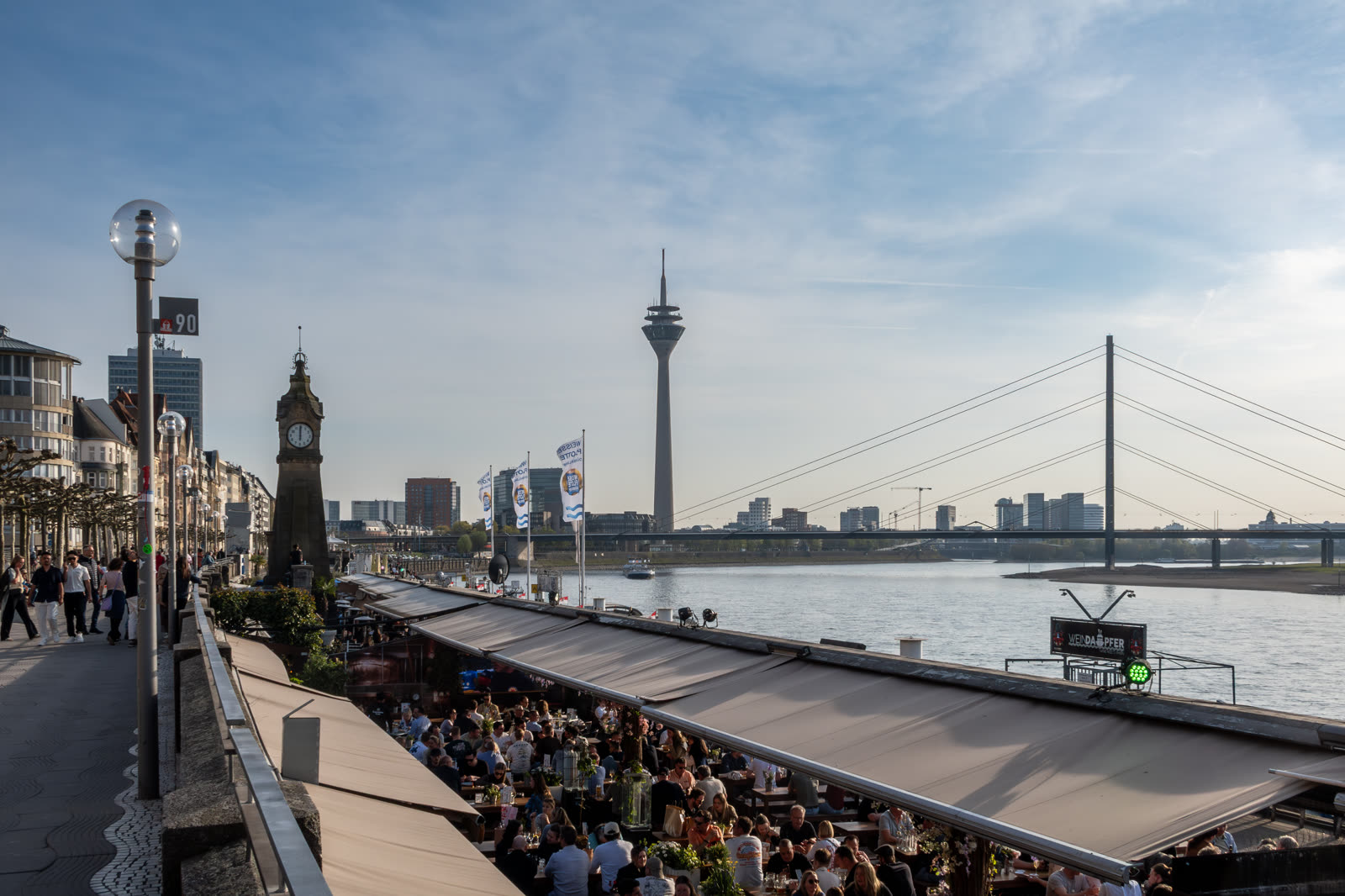
Dusseldorf is easy to misread at the Rhine. Visitors see the Altstadt behind them, the Kasematten terraces ahead, the Rheinturm downriver, and the Oberkassel bank across the water, then try to collect all of it at once. The better evening is smaller: hold the Rheinuferpromenade first, walk south slowly, and let the Rheinturm wait until the light has changed.
This is a two-anchor night room, not a full city itinerary. Anchor one is the promenade between the old town and the river. Visit Dusseldorf dates its current design to 1990-1997, credits architect Niklaus Fritschi, and explains the key urban trick: the Rheinufertunnel moved traffic underground so the riverbank could become about 1.5 kilometers of public flaneur space instead of a road edge.[1] Anchor two is the Rheinturm, the 240.5-meter telecommunications tower at Stromstrasse 20, with the observation/bar level around 168 meters and the restaurant higher at 172.5 meters.[2][3] The route works because those two anchors explain each other. The promenade gives the tower a room; the tower gives the promenade a vertical marker.
Start at Burgplatz or the Rheintreppe, not at the tower. That is local move one. If you begin at the Rheinturm, you make the evening about admission, elevators, and panorama. If you begin at the old-town steps, you understand why the promenade matters. Visit Dusseldorf's official page says the river edge is known for breezes, sunsets, the Kasematten, the steps, summer river beaches, and the way locals still remember the pre-1990 traffic condition.[1] Stand there for a few minutes before walking. The city is telling you the route logic: this public room exists because a car problem was buried.
Local move two: walk south on the lower river level before deciding where to sit. Do not take the first open table at the Kasematten just because it has a view. Use the first 10-15 minutes as a scan. On a warm weekend, the best seat may be the step, wall, or rail position that lets you leave cleanly when the sky starts to improve. Tripadvisor's current Rheinuferpromenade surface still presents it as a classic walking, jogging, sitting, and river-view place rather than a ticketed attraction, which is the point: the best part is free and movable.[6]
Local move three: aim the walk for the water gauge and the Rheinkniebrucke view, then let the tower enter from the side. The Wikimedia source photo for this post, taken in April 2025, shows why: gauge, promenade, bridge, tower, and river line up in one documentary frame.[8] If you only stare at the tower, you miss the urban composition. If you only sit in the old-town crowd, you miss the southern pull toward MedienHafen and the bridge.
Local move four: save the tower for the late window if you plan to go up. The official Rheinturm ticket page lists the observation deck and M168 hours as 10:00 a.m.-12:00 a.m., an adult admission of EUR12.50, and specials at EUR8 for Early Bird until noon and Late Night from 8:00 p.m.[2] For this route, the late ticket is the natural one. Walk first, climb second. In summer, start the promenade around 20:00, enter the tower after 21:00 if the sky is clear, and keep the whole evening to 75-120 minutes. In winter, shift earlier and treat the tower as weather-dependent.
Local move five: if you want the rotating experience, know what rotates. The city tourism page describes the restaurant at 172.5 meters as revolving once per hour, and the municipal page notes technical rotation directions in the afternoon and evening.[3][4] That is not the same as assuming every public viewpoint rotates. Recent traveler reviews also distinguish the viewing level, bar, and restaurant experience, with one September 2025 review praising the city views but describing the port walk nearby as part of the pleasure.[5] The clean plan is either simple observation deck plus river walk, or a deliberate restaurant booking. Do not drift into the tower hungry and expect a casual public deck to solve dinner.
Local move six: buy the tower ticket online or arrive ready for card logic, but carry a small backup plan. The official ticket page says tickets may be bought online or on site and that cash payment is no longer available.[2] Tripadvisor reviews from 2024-2025 include complaints about payment and parking confusion, including a December 2024 report that practice did not match expectation and a February 2025 complaint about queueing and payment friction.[5] That does not mean the official rule is wrong. It means the visitor move is simple: buy ahead if the tower matters, do not make parking part of the plan, and keep the promenade as the fallback if the tower queue feels wrong.
Local move seven: use the light clock as your exit cue, not just as trivia. The municipal Dusseldorf page says 39 of the tower's 62 circular portholes form a decimal clock across three height bands on the tower shaft.[4] After dark, this is one of the most city-specific details in the route. You can stand below, read the tower as communications infrastructure, civic landmark, and clock, then leave without needing one more viewpoint. That is more Dusseldorf than a generic skyline shot.
Local move eight: cross-check the evening against actual local behavior. A city-specific r/duesseldorf thread recommends Rheinturm for the city view, Stadtstrand or the promenade/Rheintreppe as an alternative hangout, and QOMO for the restaurant version of the tower experience.[7] The practical message is not that strangers online should plan your trip. It is that locals separate the uses: steps for hanging out, promenade for river time, tower for the high view, restaurant for a booked occasion. Keep those categories separate and the evening stays smooth.
The non-local trapline is short. Mistake one is driving to the tower because it looks like the anchor. Better: arrive on foot from Altstadt, Heinrich-Heine-Allee, Burgplatz, or MedienHafen, then decide whether the tower is worth the elevator. Mistake two is going straight up at sunset and spending the best color in a queue. Better: hold the river edge first, then use the 8 p.m. late-ticket window if conditions still justify it.[2] Mistake three is treating the Kasematten as mandatory. Better: sit there only if it gives you control over timing; otherwise keep walking. Mistake four is confusing the tower restaurant with a casual observation stop. Better: decide before you arrive whether this is a public-view evening or a reservation evening.[2][3][7]
Concrete go details: the promenade itself costs EUR0 and has no reservation or queue. The tower, if used, is the only paid component. Budget EUR8-12.50 per adult for the observation deck depending on timing, more only if you add drinks or QOMO. Best window in late spring and summer is 20:00-22:00; in colder months, use the last hour before sunset plus the first dark hour. Navigation cue: Burgplatz or Rheintreppe -> lower Rheinuferpromenade -> water gauge and Rheinkniebrucke view -> Rheinturm base -> optional M168 ascent -> exit toward MedienHafen or back to Altstadt. If you have only 45 minutes, skip the tower and hold the walk. If you have 90 minutes and clear weather, add the tower after the river has done its work.
The city-specific texture is the buried road. Many riverfronts sell themselves as naturally scenic; this one is more interesting because it is engineered urban relief. The official promenade page is explicit that today's public ease depended on the tunnel and that people who knew the old traffic pattern still congratulate themselves on the change.[1] That is the whole reason to let the tower wait. Dusseldorf's best Rhine evening is not simply a tall view. It is a short lesson in how a city turns infrastructure into public time, then marks it with a 240.5-meter clock that glows after the sun is gone.
Sources
- Visit Dusseldorf, "Rheinuferpromenade" - official tourism page covering the 1990-1997 promenade design, Rheinufertunnel context, 1.5-kilometer river edge, steps, sunsets, Kasematten, and old traffic condition.
- Rheinturm Dusseldorf, "Tickets for the Rhine Tower" - official ticket, pricing, payment, address, observation deck, M168, QOMO, and opening-hours reference.
- Visit Dusseldorf, "Rheinturm (Rhine tower)" - official tourism page for height, address, construction period, observation view, restaurant altitude, and 72-minute panorama note.
- Landeshauptstadt Dusseldorf, "The Rheinturm" - municipal page for construction period, 240.5-meter height, 172.5-meter restaurant, rotation details, view geography, and decimal light-clock explanation.
- Tripadvisor, "Rheinturm" - current visitor-review surface with recent 2024-2025 reports on views, payment friction, queues, and tower/bar/restaurant distinctions.
- Tripadvisor, "Rheinuferpromenade" - current visitor-review surface for the promenade as a walking, sitting, jogging, and river-view public space.
- Reddit
r/duesseldorf, "Where to go in Dusseldorf?" - city-specific community discussion mentioning Rheinturm, Stadtstrand, promenade/Rheintreppe, and QOMO use cases. - Wikimedia Commons, "File:Dusseldorf, Rheinuferpromenade -- 2025 -- 2566.jpg" - real April 2025 photographic source used for the article image.