Kosmonavtlar works best when you treat it as a real station first. It sits on Tashkent Metro's O'zbekiston Line, open in local listings from 05:00 to 24:00, with exits toward Afrasiyob Street, Yunus Rajabiy Street, the puppet theater, the Interior Ministry area, and nearby central-city landmarks.[2] The useful move is small: ride there on purpose, step clear of the platform flow, look up before photographing, then leave by train so the place stays connected to daily Tashkent rather than becoming a detached Instagram room.
That restraint matters because the station is visually generous. AramcoWorld describes Tashkent Metro as an underground system where stations operate like symbolic public rooms, and it singles out Kosmonavtlar for its space-programmed imagery, beginning with Mirza Ulugbek and continuing through cosmonaut portraits and celestial references.[3] The official metro site now presents the system as a 70-plus-kilometer, 50-station network with more than 1 million daily passengers in late 2024, while its passenger FAQ gives the normal station day as 05:00-00:00.[1] Those two facts belong together. The art is not hidden from transit pressure. It lives inside it.
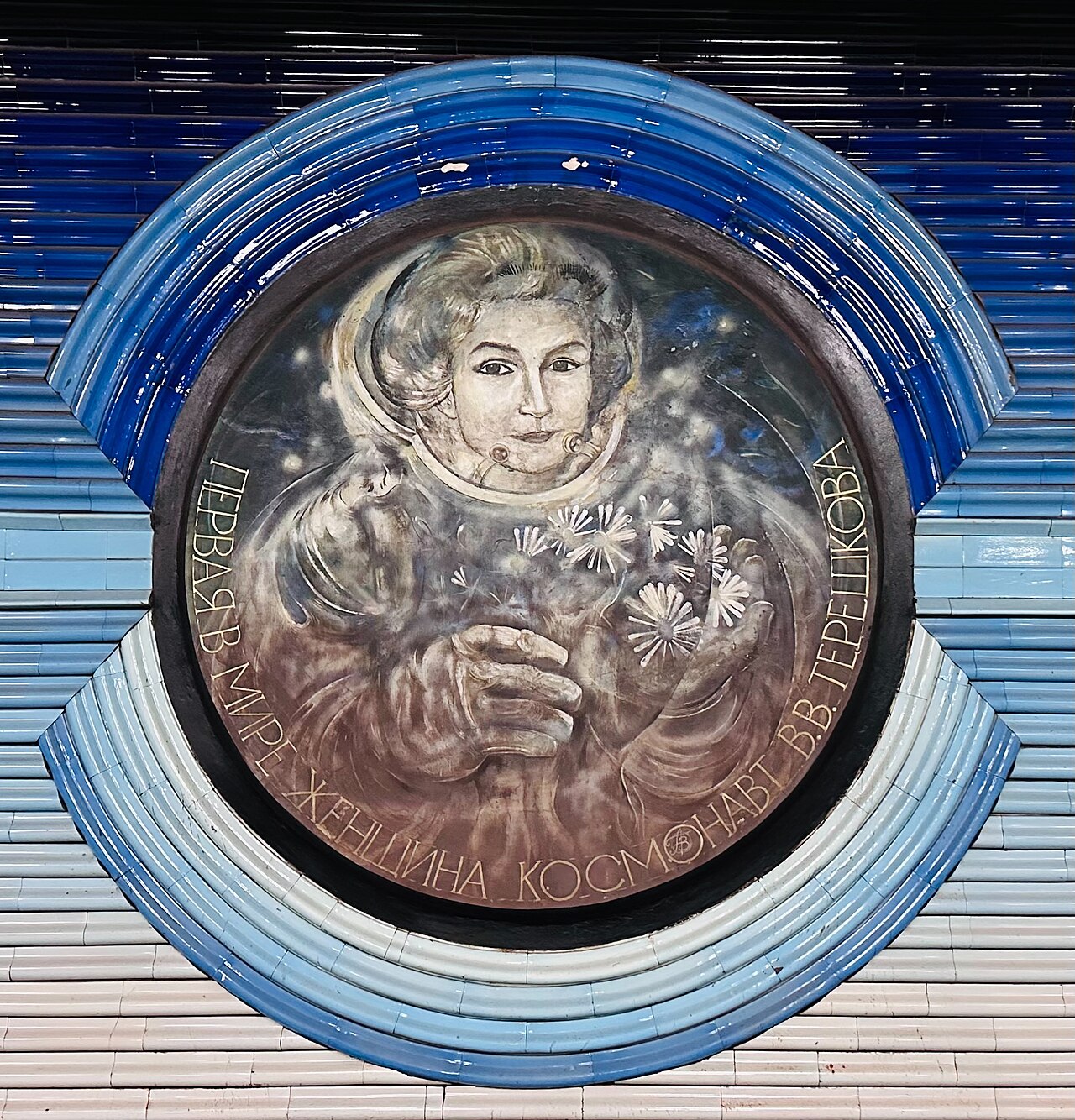
The city texture is the mix. Tashkent rebuilt much of its modern urban identity after the 1966 earthquake, and the metro became one of the places where Soviet infrastructure, Uzbek cultural references, and everyday mobility met. Kosmonavtlar opened in 1984, and the space theme is not generic futurism. It folds Ulugbek, the Timurid astronomer, into a Soviet-era cosmos and makes the platform feel like a local argument about science, memory, and public progress.[3][6]
Do not arrive as if you are entering a museum. The platform is the room. The train sound, the polished floor, the blue ceramic medallions, and the exits to ordinary streets are all part of the portrait. Local and traveler communities keep recommending Kosmonavtlar because it is beautiful, but the best comments also reveal the danger: people rank stations, hunt the "must see" list, then rush from platform to platform.[4][5] Kosmonavtlar rewards a slower urban grammar.
The Better Station Move
Start with the O'zbekiston Line, not a taxi drop. If you are already near Alisher Navoiy, Toshkent, Oybek, or Ming O'rik, ride one or two stops instead of surfacing and re-entering. The point is to feel the station arrive as part of the network. 2GIS places Kosmonavtlar on the O'zbekiston Line and lists adjacent central exits, which makes it easy to connect with the surrounding city rather than treating the platform as a sealed attraction.[2]
Go outside the heaviest commuting bands when possible. The official site's FAQ names 07:00-09:00 and 17:00-19:00 as peak passenger hours.[1] That is your etiquette clock. Late morning gives you enough bodies to keep the station alive without making your looking intrusive. Early afternoon is usually the easiest self-guided window. Night can be atmospheric, but it is less useful for first-time orientation unless you already know your exit.
Stand at the side, not at the landing. The first visitor trap is stopping where the escalator or platform mouth releases people. Move along the platform edge, keep bags close, wait through one train cycle, and look back across the hall. The photo improves because the room opens; the station improves because you are no longer in the way.
Use the platform as a 15- to 25-minute visit, not a two-minute proof shot. One train cycle shows how the station resets. Two cycles let you see which spots are genuinely clear. Three cycles are enough unless you are sketching, filming carefully, or comparing details. The best detail is not one portrait or one blue wall. It is the way the whole room makes space travel feel civic rather than cinematic.
If you want a second station, choose one continuation, not a crawl. Alisher Navoiy is the obvious companion if you want literary ornament and a transfer context, while Toshkent gives a rail-station connection. But do not turn the ride into seven stops and a dead phone battery. The local community threads that recommend Kosmonavtlar often mention other stations too; use that as a second act, not as pressure to collect everything.[4][5]
Local Moves
- Pay electronically if you can. The official FAQ says metro tokens are no longer used and payment is currently through ATTO cards; the site also lists card and mobile payment systems.[1]
- Use 2GIS before Google-only routing. In Tashkent, 2GIS has a detailed Kosmonavtlar listing, exits, station status, and line context.[2]
- Avoid the 07:00-09:00 and 17:00-19:00 peaks if your goal is looking, not commuting. Those are the operator's stated peak windows.[1]
- Enter by metro, leave by metro. This keeps the station legible as transport and saves you from making the street grid do unnecessary work.
- Wait one train cycle before taking photos. The room changes after boarding, and your angle will be cleaner.
- Keep security and commuters out of your frame when possible. Photography is part of the modern visitor pattern, but courtesy matters in a working system.
- Use the exit names, not just "Kosmonavtlar." Afrasiyob, Yunus Rajabiy, and the listed institutional exits help you surface on the correct side.[2]
- Carry small cash only as backup. The station visit itself is cheap, but electronic payment is the practical default.[1]
- Treat the space theme as local public art, not Soviet kitsch. Ulugbek's presence is the clue: the station joins Uzbek scientific memory to the space-age iconography.[3]
Visitor Trapline
Mistake 1: arriving only for the photo. The better alternative is to ride in, wait, look, then photograph. The station's force comes from public use. If you remove the trains and commuters from your attention, the blue room becomes wallpaper.
Mistake 2: blocking the platform throat. The better alternative is wall-side looking. Stand clear of escalators, platform pinches, and boarding zones. The rule is simple: if people are routing around you, you are in the wrong place.
Mistake 3: making a metro-art marathon. The better alternative is one anchor plus one optional continuation. Community lists can help you choose, but Tashkent's underground rooms lose their individual character when treated as a scavenger hunt.[4][5]
Mistake 4: assuming the station is separate from the city above. The better alternative is to surface deliberately. The 2GIS listing makes the surrounding exits concrete: Afrasiyob Street, Yunus Rajabiy Street, the puppet theater, the Interior Ministry side, and nearby civic institutions.[2] Pick the exit that matches your next move.
Concrete Go Details
Best window: late morning or early afternoon on a weekday. Avoid the operator's 07:00-09:00 and 17:00-19:00 peak periods if you want time to look.[1]
Expected spend: low, essentially the cost of a metro ride. Use ATTO or accepted card/mobile payment rather than expecting old tokens.[1]
Queue or reservation reality: no reservation and no attraction line. The friction is platform crowding, payment readiness, and choosing the correct exit.
Navigation cue: O'zbekiston Line -> Kosmonavtlar -> step off and move away from the landing -> wait one train cycle -> look along the blue-white platform -> choose Afrasiyob / Yunus Rajabiy / puppet-theater-side exit or continue by train.[2]
Time budget: 15-25 minutes for Kosmonavtlar alone, 45-60 minutes if you add one nearby station and still keep the visit sane.
Numeric anchors to keep: 05:00-00:00 normal operating span, 07:00-09:00 and 17:00-19:00 peak periods, 50 stations across the current network, more than 1 million daily passengers in the cited late-2024 operator snapshot, 1984 for Kosmonavtlar's opening, and roughly 15-25 minutes for a respectful platform visit.[1][2][6]
The right memory of Kosmonavtlar is not "Tashkent has a pretty metro." It is sharper than that. The city placed a cosmic room under ordinary streets and let daily life keep passing through it. See it that way and the station stops being a backdrop. It becomes one of Tashkent's cleanest explanations of itself: practical, ornate, public, and still moving.
Sources
- Toshkent Metropoliteni, official English site and passenger FAQ (official map, payment notes, station hours, peak passenger windows, and current system description).
- 2GIS Tashkent, "Kosmonavtlar" metro station listing (local map listing for line, exits, station status, and daily 05:00-24:00 hours).
- AramcoWorld, "Tashkent's Underground Masterpieces" (reported feature on Tashkent Metro station design, Kosmonavtlar iconography, Ulugbek, and station-as-public-history context).
- Reddit r/Uzbekistan, "What is the most beautiful metro station in your opinion?" (recent local/community thread naming Kosmonavtlar among favored stations).
- Reddit r/Uzbekistan, "List of best metro stations to see in Tashkent?" (recent community thread where Kosmonavtlar is recommended in station-selection context).
- Wikipedia, "Kosmonavtlar (Tashkent Metro)" (station background, 1984 opening, O'zbekiston Line context, and summarized design references).
- Wikimedia Commons, "File:Tashkent Metro, Kosmonavtlar Station.jpeg" (documentary photographic source page for the lead image by Kagansky, photographed March 31, 2024).