Stockholm's easiest art ritual costs the same as a metro ride: SEK 43 for a 75-minute SL single ticket, if all you want is the Blue Line platform at T-Centralen and enough time to look without pretending you are not also in a working interchange.[4] The move is deliberately small. Do not try to "do" the whole subway gallery in one sweep. Start with the station where the visitor confusion is highest, the commuter pressure is real, and the blue-and-white cave ceiling makes the city briefly feel less like transport and more like a room.
That scale is important. Region Stockholm says public art is spread through the transport system, with permanent works at 94 metro stations and rotating exhibitions at 7 more.[1] Visit Stockholm packages the wider network as a 110-kilometer underground exhibition and notes that artists have been part of metro construction since 1957.[2] Those numbers are tempting, but they can flatten the experience into collection behavior. T-Centralen works better as a ritual lens: one descent, one platform, one reset in how you move through the city.
The local texture begins before the art. T-Centralen is not the same thing as Stockholm Central, and it is not the same thing as Stockholm City, even though the three names sit on top of one another in the central station complex. A recent r/stockholm thread turns that naming tangle into exactly the kind of local correction visitors need: T-Centralen is the underground metro station, while Stockholm Central and Stockholm City are different pieces of the rail complex.[6] The better visitor move is to stop using the map pin as the destination. Follow the blue-line signs down until the station changes mood.
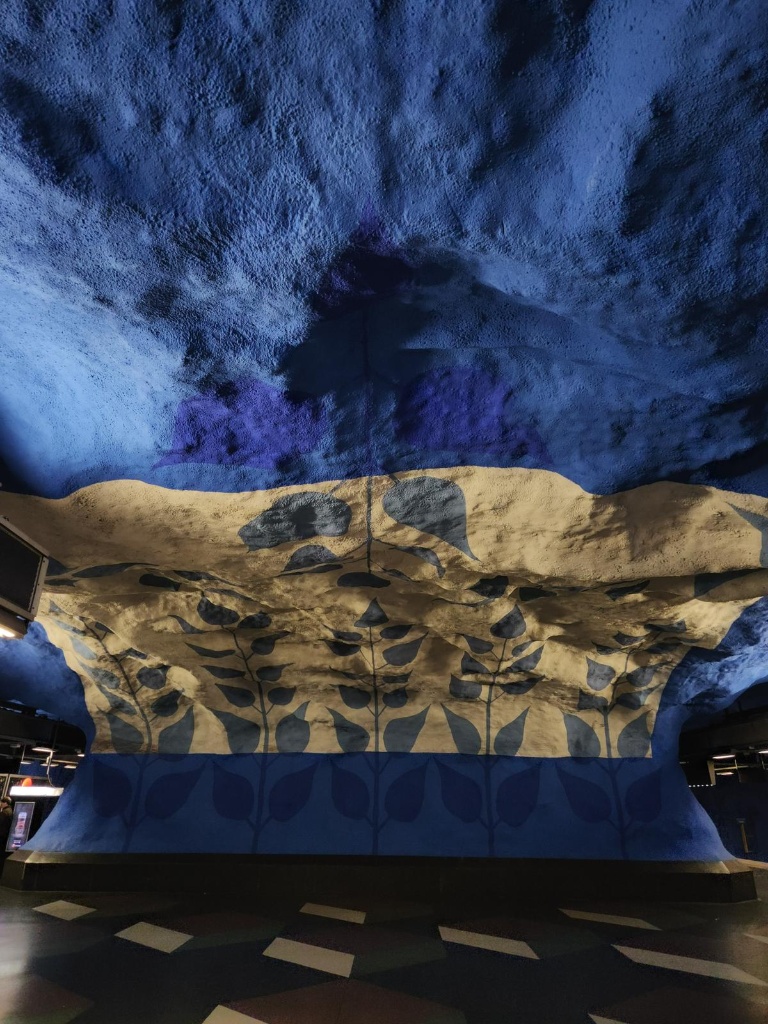
On the Blue Line platform, the ceiling does the opposite of most central-station design. It lowers the tempo. Stockholm Art Walk identifies the Blue Line's T-Centralen design with Per Olof Ultvedt, places the line's opening in 1975, and describes Stockholm's cave stations as settings rather than isolated artworks.[5] That is the key. The blue vines are not a mural you stand in front of. They are a spatial instruction: look up, step to the side, let commuters pass, and give the station one full minute before reaching for the camera.
The 75-Minute Ritual
Tap in with a contactless card or mobile ticket, because SL says single tickets can be bought that way and are valid for unlimited travel until the ticket expires after 75 minutes.[4] Then do less than the ticket allows.
First, enter through whichever central access is natural for your day, but do not stop in the first concourse and call it done. Keep following blue-line signs. The common visitor mistake is to arrive at the station complex, see trains, escalators, and crowds, then assume the art must be wherever the crowd is thickest. It is lower and more specific than that.
Second, arrive outside the sharpest commute windows if you can. The art is inside a real interchange, not a museum wing. The sweet spot is a late morning or early afternoon pause, or the hour before a guided-art-tour start if you want a more structured version. SL's 2026 art-walk page lists Blue Line tours on Thursdays from 15:00 to 16:00, May to mid-September, starting at T-Centralen, with a separate valid SL ticket still required.[3]
Third, treat the escalator descent as part of the visit. The recognition cue is not only the painted vines; it is the way the rough station volume appears after the ordinary ticketing logic. Visitors often photograph from the first open angle and block the flow. The better move is to step past the landing, find a wall-side position, and look back into the curve of the ceiling.
Fourth, stay longer than your impatience wants. One minute looking up changes the room; five minutes lets you see the station working underneath the art. The strongest detail is not that the vines are blue. It is that they soften bedrock without hiding it.
Fifth, if you do take a photo, take it after you have already looked. A local metro-art thread on r/stockholm calls the Blue Line platform at T-Centralen a rightful photo spot and also warns that it can be busy.[7] That is the whole etiquette lesson. The image is worth having, but the platform cannot become your tripod.
Sixth, leave by train rather than surfacing immediately. Even if your next stop is only one station away, the ritual works because it restores the subway to use. The point is not to extract art from transit; it is to notice that Stockholm put art inside transit and expects it to survive daily movement.
Visitor Trapline
Mistake 1: treating T-Centralen as one obvious place. The better alternative is to distinguish the underground metro station from Stockholm Central and Stockholm City before you navigate. The local complaint about the three names exists for a reason.[6] If you meet someone, name the line color or the access point, not just "Central."
Mistake 2: trying to cover too many stations on one ticket. The better alternative is to let one station be enough. Yes, the broader metro-art system is huge, and official tourism pages rightly present it as a network-wide attraction.[1][2] But first-time visitors often turn the subway into a scavenger hunt. T-Centralen rewards the opposite: slow one transfer until the city reveals its design habit.
Mistake 3: standing where commuters need to move. The better alternative is wall-side looking. This is local etiquette more than a rule. The platform is still a platform, especially around peak hours and tour starts. If you pause at an escalator mouth or platform pinch point, the room stops working for everyone else.
Mistake 4: assuming the guided tour replaces the ticket. SL is explicit that the art tour ticket and the travel ticket are separate.[3] If you join the Thursday Blue Line tour, budget for both: SEK 150 for the tour plus the valid SL fare, currently SEK 43 for an adult single ticket.[3][4]
Concrete Go Details
Best window: late morning, early afternoon, or a deliberate Thursday 15:00-16:00 tour slot from May to mid-September if you want interpretation rather than a self-guided pause.[3]
Expected spend: SEK 43 for a standard adult single journey if self-guided; about SEK 193 if you add the 2026 guided Blue Line tour and still need the separate SL ticket.[3][4]
Queue or reservation reality: no reservation is needed for the platform itself. The official art walks are scheduled, ticketed events, so treat those as a separate plan.[3]
Navigation cue: Stockholm Central / city center -> signs for T-bana -> follow Blue Line / T10-T11 signs downward -> step away from escalator mouths -> look back at the blue-and-white cave ceiling -> leave by train before the 75-minute ticket window expires.[4][5][6]
Where to stand: not in the first landing view. Move to the side, let people pass, then look up across the vault. If the platform is busy, wait for the next train cycle; the room often opens for a few seconds after boarding.
Local moves to keep: use contactless or the SL app; name the Blue Line when navigating inside the station complex; avoid rush-hour platform gawking; look before photographing; keep bags close on escalators and platforms; use the Thursday tour only if you actually want a guided hour; leave by train so the art stays connected to transit; and if you continue the art route, do it as a second act, not as the reason to rush T-Centralen.
The city-specific fact that matters is not just that Stockholm has an art-filled metro. It is that the art is embedded in daily public movement. T-Centralen is the best first lesson because it refuses to be precious. The station is confusing, useful, crowded, beautiful, and ordinary all at once. That is why the right ritual is so simple: tap in, descend, step aside, look up, and let the subway be a gallery only after it has remained a subway.
Sources
- Region Stockholm, "Public art" (official overview of public art in transport spaces, the one-percent principle, and the 94 permanent metro art stations plus 7 rotating exhibition stations).
- Visit Stockholm, "Art in the Subway: Explore 14 Beautiful Stations" (official tourism guide, published November 27, 2025, on the 110-kilometer metro-art system, 100 stations, and artist involvement since 1957).
- SL, "Guided Art Tours in the Stockholm Metro" (2026 schedule note for English Blue Line tours on Thursdays, 15:00-16:00, May to mid-September, starting at T-Centralen, with separate SL ticket requirement).
- SL, "Single journey tickets" (official fare page for 75-minute single tickets, contactless purchase, transfer validity, and SEK 43 adult fare).
- Stockholm Art Walk, "The History of the art at T-Centralen - Blue line metro station" (local guide to T-Centralen's Blue Line artwork, Per Olof Ultvedt, cave-station context, and the 1975 Blue Line opening).
- Reddit r/stockholm, "T-Centralen" (recent local/community thread clarifying the difference between T-Centralen, Stockholm Central, and Stockholm City).
- Reddit r/stockholm, "Tourist: Killing a day and a half with metro art. What things should I look for?" (community thread noting that T-Centralen's Blue Line platform is a major photo spot and can be busy).
- Wikimedia Commons, "File:Artwork Depicting Blue Vines at T-Centralen Metro Station.jpg" (documentary photographic source page for the lead image, showing the cave-like ceiling artwork at T-Centralen).