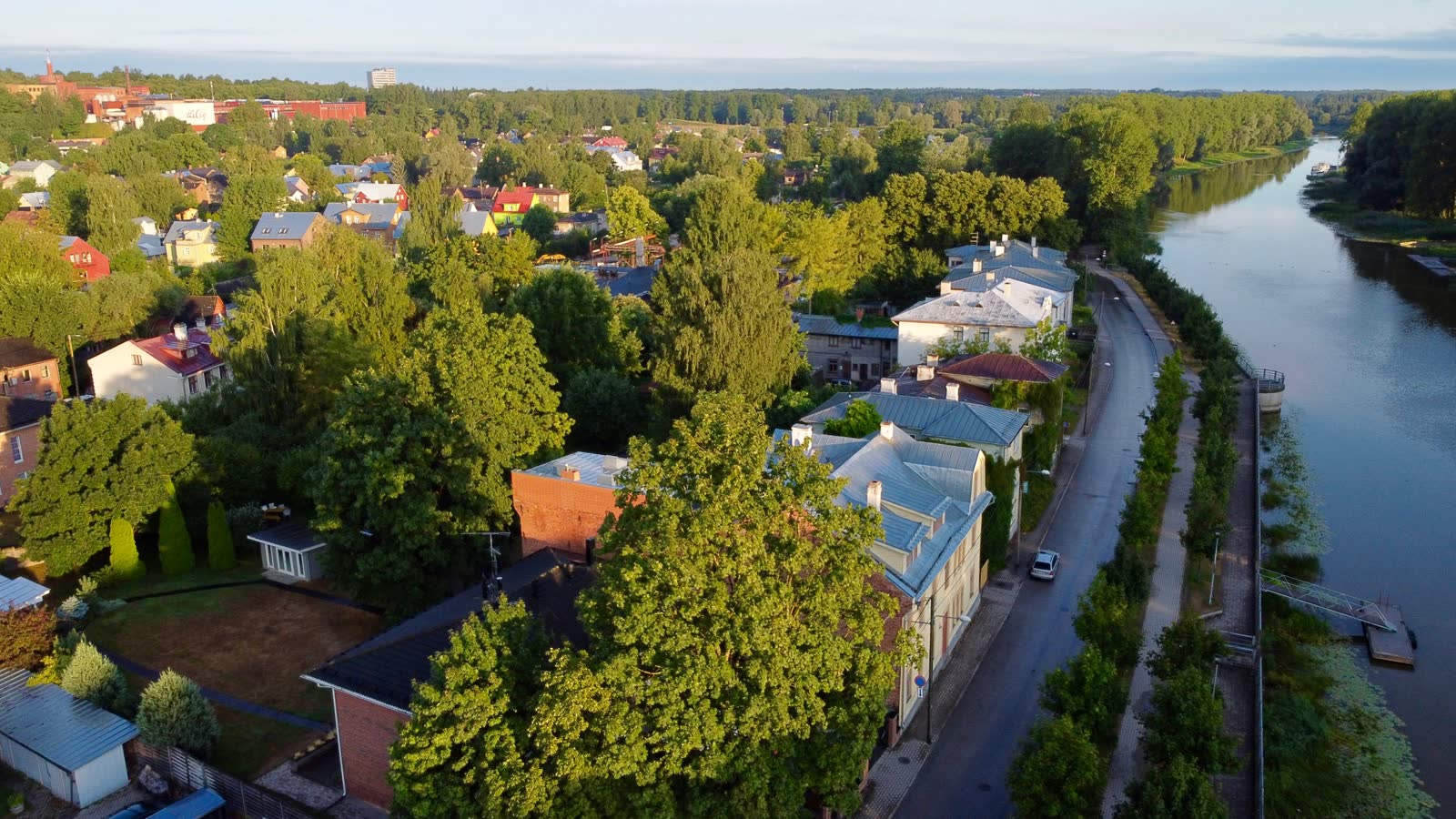
Tartu is easy to over-schedule because everything looks close. The old town, the university, Toome Hill, the museums, the cafes, and the river all seem to ask for one more stop. The cleaner move is narrower: start at Kaarsild, let the Emajogi set the pace, then follow the Supilinna promenade until the city stops presenting itself as a postcard and starts behaving like a neighborhood.[1][2]
This is not a greatest-hits route. It is a short river-room read. Kaarsild gives the hinge, the central Emajogi promenade gives the city-center edge, and Supilinn gives the local texture: wooden houses, garden corners, old poplars, cyclists, bench-swings, runners, fishermen, and the small Konnatiik pond. Visit Tartu describes the Supilinna promenade as a 1.3 km quay-side route lined with old poplars, passing the village swing, Konnatiik, and Tähtvere Sports Park; Visit Estonia frames Supilinn itself as a bohemian district where wooden houses, courtyards, street art, and the Emajogi bank belong to the same walk.[1][2]
The first local move is to resist the immediate museum turn. Start near Kaarsild, look both ways along the river, and commit to the bank before you commit to another indoor stop. Tartu's 2024 riverside work matters here: the city announced that the Emajogi promenade section from Kaarsild toward Atlantis had been rebuilt with stair seating, viewing terraces, platforms, a cafe area, and a higher pedestrian and cycle track on the left bank.[3] That is not just beautification. It changes how a visitor should move. The river is no longer a thing to glance at between Town Hall Square and the next attraction. It is the route.
The second move is timing. Go in the long evening if you want Tartu to feel social, or in the first quiet hour of the morning if you want the promenade before bikes and runners thicken. Visit Estonia calls the Emajoe Riviera one of the favorite warm-weather river places for locals and visitors, especially when people come to read, meet friends, watch boats, and stay near the evening lights.[4] That is your clue: do not arrive with a checklist tempo. Give the walk 45-60 minutes if you are doing Kaarsild plus the Supilinn edge; give it 75-90 minutes if you continue toward the beach or pause on the swings.
The third move is to choose the Supilinn side before you choose a destination. A recent local r/Tartu thread about dog-friendly ideas says the river works on either side, but one commenter usually chooses the Supilinn side and continues toward the beach and Jänesematka trail.[5] That is useful even if you are not traveling with a dog. It tells you the local map is not only "old town versus museums." It is riverbank, beachward path, and neighborhood edge. If you keep going forever, the walk becomes a hike. For a city-travel route, turn around before that. The point is to let Supilinn enter the day, not to leave Tartu behind.
The fourth move is to stay narrow on purpose. Watch the poplar avenue, then the village swing, then Konnatiik, then the way small streets and back gardens press close to the water.[1] Supilinn's name is often translated as "Soup Town" because its streets carry vegetable names, but the better fact is physical rather than cute: a low wooden district sits next to the university city without behaving like a preserved open-air museum.[2] Doors are still doors, yards are still yards, and the best visitor behavior is to keep to public paths and streets rather than treating every courtyard as a photo invitation.
The fifth move is traffic etiquette. This is a walking route, but it is also a daily-use strip. Leave the middle of the path open for bikes, runners, dogs, strollers, and people who are not on vacation. Stop at the bench-swings or river edge, not in the moving lane.[1] The sixth move is to bring one layer more than you think you need. The river corridor can feel cooler than Town Hall Square, and the wind matters more once you stop moving. The seventh move is to make the route free unless you intentionally add a cafe, boat, museum, or guided walk. There is no reservation, no ticket, and no queue for the basic river sequence.[1][2]
There are three visitor mistakes worth avoiding. The first is treating Kaarsild as the whole river experience. The bridge is the start, not the trophy. Cross, pause, and then keep walking until the bank has time to show daily life. The second is collapsing Supilinn into one "quirky district" label. The better read is slower: wooden houses, courtyards, street art, frog pond, sports park, and poplars are not separate charms; they are the way Tartu lets a village-scale edge survive beside a compact university city.[1][2] The third mistake is turning the river into a casual swimming dare. Local Reddit advice is relaxed about river walks, but separate local comments about swimming stress judgment around safety and condition, especially in town.[5][6] If swimming is the goal, use the recognized beachward areas and current local conditions rather than improvising from the central embankment.
The route's best version is simple. Start at Kaarsild. Spend 5 minutes reading the river direction and the old-town side. Walk the rebuilt central edge without rushing the stair seating. Continue onto the Supilinna promenade for the 1.3 km poplar-lined section. Pause at one bench-swing or near Konnatiik. Turn back before the walk becomes a full trail day. If you want a loop, cross back later by a practical bridge rather than retracing every meter; if you want the cleanest read, return the same way and notice how the river changes when it is now leading you back into town.[1][3][5]
Concrete go details: best window is 7:30-9:00 in the morning for quiet, or the last 90 minutes before sunset for the local social version. Time needed is 45-60 minutes for the compact river-and-Supilinn read, 75-90 minutes if you keep walking toward the beach edge. Spend is 0 euros unless you add food, a boat, or a guided tour. Queue reality is none, but warm evenings can make the central promenade feel busy. Navigation cue: find Kaarsild first, then aim for the Supilinn-side river path rather than wandering randomly through the old town.[1][3][4]
This is why Tartu works best here. The river does not compete with the old town; it quietly edits it. Kaarsild gives you the formal crossing. The new central promenade gives you the civic riverfront. Supilinn gives you the lived edge, where poplars, wooden houses, garden fences, dogs, bikes, and amateur fishermen make the city feel smaller in the useful way. Do this before the museums, or after them when your attention is tired. The Emajogi will put the city back into walking speed.[1][2][4]
Sources
- Visit Tartu, "Supilinna promenade" - official tourism page for the 1.3 km promenade, poplar avenue, Konnatiik, bench-swings, and Emajogi river-bank use.
- Visit Estonia, "Supilinn - Tartu's historic neighborhood of wooden homes" - official destination page on Supilinn's wooden houses, courtyards, river edge, street art, and round-the-clock access.
- Visit Tartu, "The Emajogi River promenade is ready and open to all," January 22, 2024 - city tourism news on the rebuilt Kaarsild-to-Atlantis riverfront, seating, terraces, and cycle/pedestrian track.
- Visit Estonia, "Emajoe Riviera promenade" - official destination page on the central Emajogi promenade as a warm-weather local and visitor gathering place.
- Reddit / r/Tartu, "One full day in Tartu, dog friendly ideas needed" - recent local/community thread recommending the Supilinn-side river walk toward the beach and Jänesematka trail.
- Reddit / r/Eesti, "Trip to Tartu" - local/community discussion that recommends long walks along the Emajogi from Ihaste toward Supilinn as a way to see Tartu.
- Wikimedia Commons, "File:Aerial view of Supilinn, Emajoe street and the river Emajogi in Tartu, Estonia.jpg" - photographic image source used for the article image.