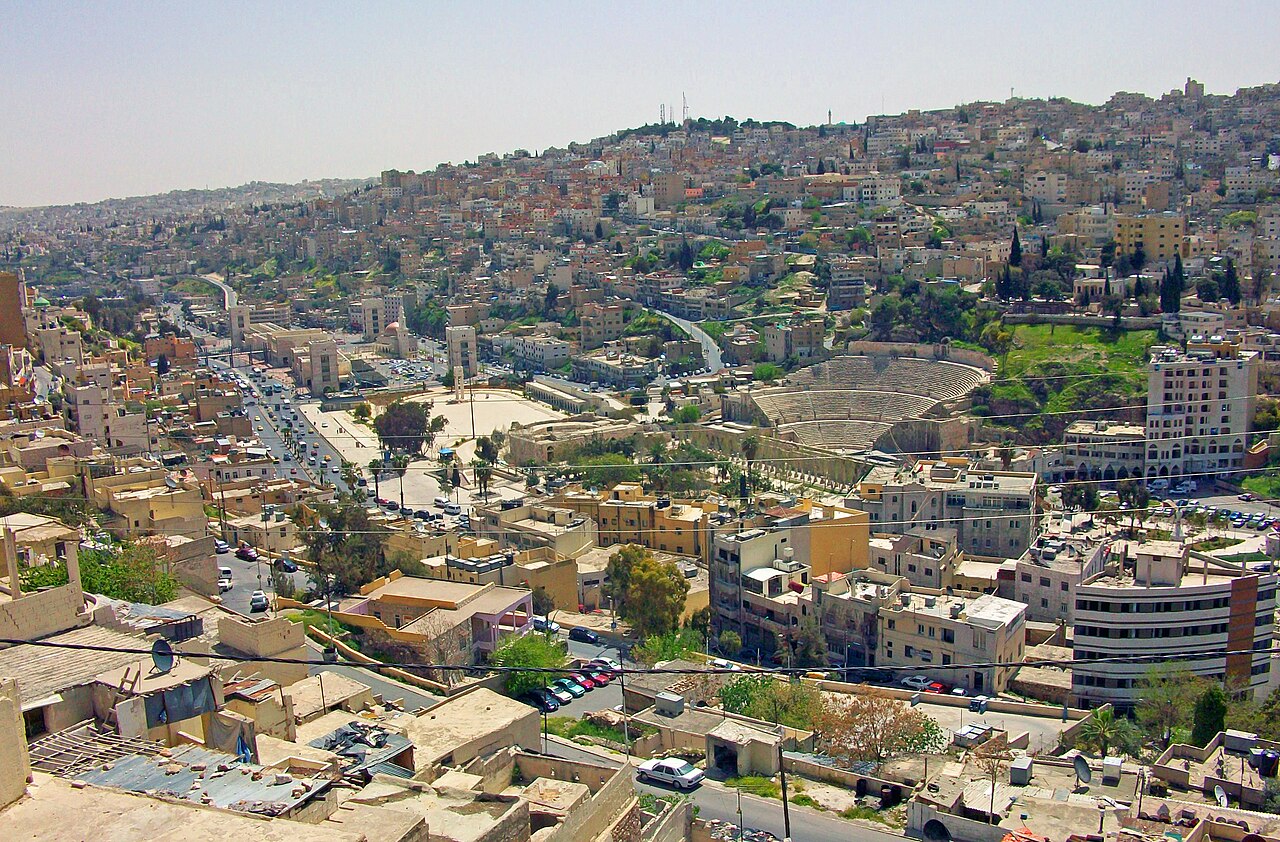
Amman rewards a small piece of choreography: go up first, then come down. Start at the Citadel on Jabal al-Qal'a in the late afternoon, let the hill explain the city, and only then drop toward the Roman Theatre and Hashemite Plaza. The mistake is to treat both sites as separate ruins. The better ritual is a vertical reading of Amman: hilltop, skyline, columns, theatre bowl, downtown street noise.
This is a two-anchor route, not a full-day archaeology crawl. The official tourism board frames Citadel Hill as the high point above modern Amman and places the Roman Theatre at its foot, carved in the 2nd century for about 6,000 spectators.[1] That spatial fact is the whole trick. If you begin below, the theatre is impressive but self-contained. If you begin above, the theatre becomes a marker inside a working capital: a stone bowl pressed into a valley of traffic, shops, stairs, calls to prayer, apartment blocks, and evening light.
The cleanest move is to take a taxi or ride-hail up to the Citadel gate, not to prove yourself on the hill. A Jordan-based WowJordan listing places the Citadel high above Downtown, describes it as an easy 60- to 90-minute loop with open views and uneven surfaces, and notes straightforward taxi access from K. Ali Ben Al-Hussein Street.[4] Save the walking for the controlled descent, where looking matters more than climbing. If the driver wants to drop you slightly below the entrance because of traffic, accept it only if the last segment is obvious. Amman streets can fold quickly; this is not the moment to improvise through steep lanes with weak sidewalks.
Use the money math to keep the route simple. The official entrance-fee page lists the Amman Citadel at 3 JOD for foreign visitors and the Roman Theater, including the Museum of Popular Life and popular-costume artifacts, at 2 JOD; Jordanian resident prices are much lower.[2] That makes the core pair a modest 5 JOD before transport. A local guide is optional, not mandatory, but recent guide-oriented travel notes put a Citadel guide in the rough 20-30 JOD range for a 1-2 hour walk, depending on group size.[7] If you are arriving tired, spend the money on the ride up before you spend it on extra interpretation.
The best window is late afternoon, with discipline. Aim to reach the Citadel about 75 to 90 minutes before the posted closing time on the day you visit. That gives you enough space to see the Temple of Hercules area, the Umayyad Palace gate, the archaeological museum zone, and the west-facing views without rushing the last light. Recent Amman travel guidance keeps returning to the same practical advice: the Citadel is strongest in late-afternoon golden light, when heat and crowds ease.[7] Treat that as a timing principle, not a guarantee. Hours shift by season and holiday, so confirm the day's closing time before you commit.
Eight local moves make the sequence work. First, ride up and walk down, because the hill is for orientation and the descent is for texture. Second, enter the Citadel with water already in hand; the site is exposed, and the useful shade is not where you want it when the light is best. Third, do not spend the first 10 minutes photographing the columns. Walk to the edge and locate the theatre below. Once you have that bowl in your mental map, the whole route tightens.
Fourth, keep the Citadel loop slow but bounded. The site can absorb an hour easily, but this route is not trying to exhaust every label. Fifth, if you hire a guide at the entrance, agree on time before the walk begins: 45 to 60 minutes is enough for this city-reading version unless you are making the Citadel the day's main subject.[7] Sixth, save your knees for the Roman Theatre. The theatre steps are steep, and Simsem's local-guide page notes that the ticket normally includes the heritage museums in the complex, with hours that may vary by season.[5] Good shoes matter more here than a better camera.
Seventh, at the theatre, sit high enough to feel the rake but not so high that the descent becomes your second workout. The upper rows give the strongest sense of the cavea as urban architecture, but the useful pause is often in the upper third, where Downtown is audible and the site still feels connected to the plaza. Eighth, leave through Hashemite Plaza slowly. The official and community descriptions both stress that the theatre is still a civic landmark rather than a sealed antiquity; one recent Local Guides Connect post by an Amman-based contributor calls it the heart of the city on Al-Hashimi Street and notes its continuing cultural-event role.[6]
The first visitor mistake is doing the Roman Theatre first because it is more visible from the road. That order makes the hill feel like an add-on. Reverse it. From the Citadel edge, the theatre below becomes your navigation target, and the valley stops looking like traffic clutter. The descent can be by taxi if the heat is heavy, but the mental movement should still be downward: hill memory first, downtown contact second.
The second mistake is arriving at the Citadel at noon. In summer, that turns the plateau into a glare test; in winter, it flattens the drama of the city view. Late afternoon is not only prettier. It is operationally better because you need attention for uneven stone, low walls, dust, and the way tour groups bunch near the most obvious column shots. A two-hour window before dinner is enough; a rushed 25-minute stop is not.
The third mistake is treating the theatre as a photo backdrop from the plaza. Buy the ticket if it is open, climb carefully, and sit. The 6,000-seat scale is hard to feel from the pavement because Hashemite Plaza spreads the view wide.[1][5] Inside the bowl, the grade does the work. You understand why the structure was cut into the hillside and why a performance space can become a city landmark for people who are not there for archaeology at all.
The fourth mistake is assuming the museums are filler. The Jordan Museums listing identifies the Jordan Folklore Museum on the western side of the Roman Theater, established by the Department of Antiquities in 1975 to collect and preserve Jordanian traditional heritage.[3] You do not need to make it a long stop, but five to ten minutes inside changes the theatre from Roman spectacle into a layered civic complex. The route starts with ancient altitude and ends with urban continuity.
The local trapline is simple. Do not walk up from Downtown unless heat, footwear, and navigation are all on your side; ride up and spend the saved effort on looking. Do not schedule the Citadel after an overlong lunch; arrive with light left and a clear exit plan. Do not block the theatre's stair lanes for photos; sit to the side, let people pass, and climb only as far as you can descend comfortably. Do not treat Downtown only as the place where the ruins happen to be. The route works because the modern city is not background. It is the frame.
Concrete plan: start around 16:30 in long-day months, earlier when closing times contract. Carry water and small cash even if you expect to use cards. Budget about 5 JOD for the two archaeological entries, plus transport; add 20-30 JOD only if you want a short guide at the Citadel.[2][7] Hold 60 minutes for the Citadel, 15 to 25 minutes for the move down depending on taxi versus walking, and 45 minutes for the theatre, Odeon, and small museums. If the theatre is hosting an event or access is restricted, keep Hashemite Plaza as the landing and read the bowl from outside rather than forcing the plan.[6]
The reason this small route works is that Amman is a city of levels. The Citadel gives you the grammar: ridges, valleys, limestone color, and the shock of an ancient platform still exposed to the present. The Roman Theatre gives you the sentence: a 2nd-century form still sitting in the downtown bloodstream. Start above it, come down with enough time, and Amman stops being a list of sights. It becomes a city you can read in one controlled descent.
Sources
- Visit Jordan, "Amman" - official tourism page describing Citadel Hill, the Roman Theatre at its foot, and the theatre's 2nd-century, 6,000-seat scale.
- Visit Jordan, "Jordan Entrance Fees" - official fee table listing Amman Citadel and Roman Theater visitor prices.
- Jordan Museums, "Jordan Folklore Museum" - official museum listing for the folklore museum on the western side of the Roman Theater, established in 1975.
- WowJordan, "Amman Citadel" - Jordan-based local tourism listing with Google-review stream, practical timing, taxi-access note, and 60- to 90-minute loop guidance.
- Simsem, "Roman Theater Amman Tour with Jordan Tour Guide" - local-guide page covering typical Roman Theater hours, 2 JOD tourist fee, included heritage museums, transport, and event caveats.
- Local Guides Connect, "The Magnificent Roman Theatre: The Heart of Amman at Al-Hashimi Street" - recent local-guide community post on the theatre's street setting, 6,000-seat scale, and civic role.
- Brooke Beyond, "Amman City Guide" - recent travel guide with practical late-afternoon Citadel timing, Jordan Pass note, and guide-cost range.
- Wikimedia Commons, "File:View of Amman and amphitheatre from Citadel Hill.jpg" - real photograph by Daniel Case used as the article image.