Tallinn's Old Town gives visitors the postcard, but the more useful first local seam sits just beyond the railway station: Balti Jaama Turg, the station market at Kopli 1, and Telliskivi Creative City, the former industrial complex a few minutes farther west.[1][2] Treat them as one short rail-side microcosm rather than two attractions. The move is to arrive after commuters have cleared, read the market's entrances and courtyards, then drift into Telliskivi before the evening version of the district takes over.[1][3][4]
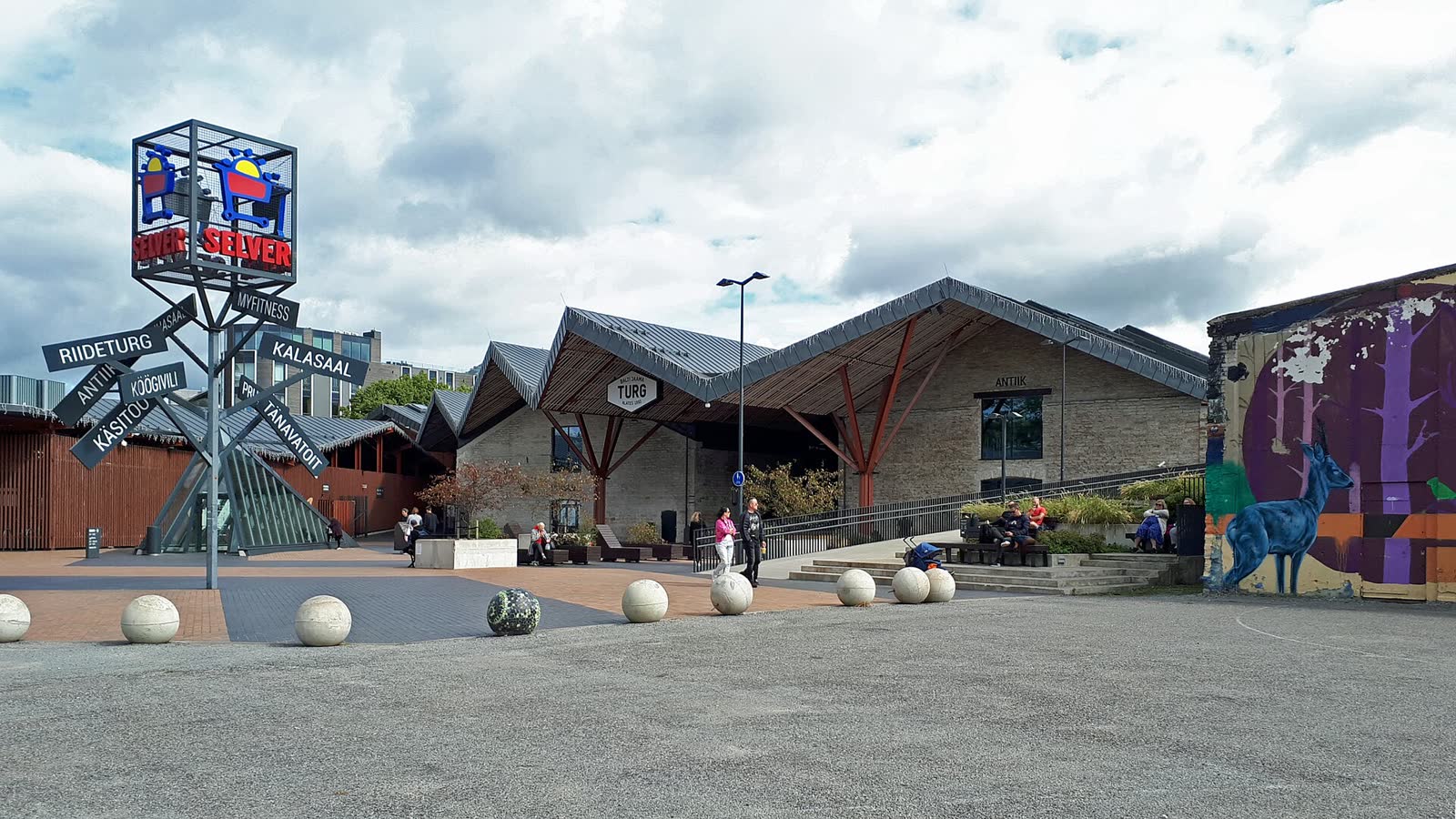
This is a non-food route even though food is everywhere. The market hall, flea layer, second floor, design shops, photo spaces, murals, and reused factory buildings matter more than any single stall. Visit Tallinn frames the Balti Jaama and Telliskivi area through the railway that once connected Tallinn and St. Petersburg, and that rail logic is still visible in the way people move: station, market, courtyard, creative yard, back toward tram or Old Town.[3] The cover image shows why the place reads quickly: the sawtooth roofs, direction signs, open paving, benches, and mural give a visitor enough recognition cues to slow down without losing orientation.[8]
Start at the market, not inside the crowd
The cleanest window is 10:15-11:30 a.m. on a weekday or Saturday. Balti Jaama Turg's main market areas open Mon-Sat 09:00-19:00 and Sun 09:00-17:00, while the second floor opens 10:00-19:00 on Monday-Saturday and 10:00-17:00 on Sunday.[1] That matters because arriving right at 9:00 puts you into supply-and-errand motion, while arriving after 10:00 lets the building become readable. The better first ten minutes are outside and at the edges: find the Balti Jaam side, the courtyard signs, the Evening Square direction toward Telliskivi, and the tram return points before choosing what to enter.[1][4]
Do not begin by deciding where to eat. Begin by deciding how much of the place you want to absorb. The market's official transit note says it sits in the transport hub between the railway station, DEPOO, and Telliskivi Creative City; it also names trams 1 and 2, the Balti Jaam or Telliskivi stops, multiple buses, trolley links, and 3 bicycle parking areas.[1] Those details are not filler. They explain why the market behaves like a hinge: people pass through it for groceries, lunch, antiques, errands, design browsing, and station transfers. If you walk in hungry, you will reduce it to a food court. If you walk in oriented, the food becomes one layer of a working urban room.
The first local move is to use the market as a loop, not a line. Take one circuit through the ground-floor market, one pause outside in the courtyard, then one slower look upstairs. Community and review surfaces are useful here because the strongest experience changes by day: Google Maps is better for checking whether a stall, shop, or route edge is active right now, while recent local Reddit travel threads keep pushing visitors toward the Balti Jaam-Telliskivi pairing as a compact Tallinn move rather than a long itinerary.[4][6]
Let Telliskivi widen the route
From the market, Telliskivi is close enough that it should feel like a continuation, not a transfer. Cestee places Telliskivi Creative City about 350 meters from Balti Jaama Turg, and the practical walk is usually 5-7 minutes if you are not stopping for photographs.[7] The mistake is to open a map and start collecting pins. The better move is to leave the market by the Telliskivi-side courtyard, keep the rail and former industrial fabric in your peripheral vision, and let the district widen gradually.
Telliskivi's official story says the complex grew from a former factory area into a creative city with over 300 creative-industry companies and NGOs, 2,000 people, and over 800 cultural events each year.[2] Visit Tallinn adds the visitor-facing layer: galleries, small shops, creative companies, start-ups, restaurants, Fotografiska Tallinn, the Juhan Kuus Documentary Photo Centre, Sõltumatu Tantsu Lava, and more than twenty street-art works.[3] Those numbers can make the place sound larger than the visitor route needs to be. For a first pass, you only need one slow lap: shop street, mural wall, event posters, courtyard seating, then one interior stop if something actually catches.
The second local move is restraint. Telliskivi rewards looking before buying, checking event doors before assuming they are open, and reading the courtyard as an evening-capable space even if you are there at midday. The district is a nightlife and culture magnet, but a daytime visitor who arrives around 11:30 a.m.-1:00 p.m. sees the mechanics better: staff moving between doors, parents cutting through, office workers stepping out, design shops opening fully, and photographers using the industrial walls before the bar layer thickens.[2][3][5]
8 local moves for this seam
- Arrive after 10:00 a.m. The second floor is open by then, the market has settled, and the route is less likely to become a breakfast hunt.[1]
- Stand outside before entering. Use the market sign tower, sawtooth roof, station edge, and Telliskivi direction signs as your map.[1][8]
- Make one loop before buying anything. The point is to learn the room: groceries, flea goods, prepared food, upstairs shops, courtyard exits.[1][4]
- Use Google Maps as a status layer, not as an itinerary engine. Check whether a specific shop, stall, or gallery is open, then go back to walking the short seam.[4][5]
- Budget 60-90 minutes, not a half day. The route is compact; dragging it out turns useful neighborhood texture into pin-chasing.[3][7]
- Walk the 350-meter market-to-Telliskivi link instead of calling a car. The transition is the point, and trams 1 and 2 are there for the return.[1][7]
- Keep the spend light until you know your anchor. A coffee, pastry, small lunch, or design object can sit around EUR 3-15; the stronger choice is the one that follows your loop, not the first display case.[4][6]
- Leave before the evening bar logic if this is your first visit. A 1:30-2:30 p.m. exit keeps the route in market-and-creative-city mode; come back separately for nightlife if that is the plan.[2][3][5]
Non-local trapline
Mistake 1: treating Balti Jaama Turg as only a food hall
Better move: give the market one full spatial read before ordering. The official page describes a transport-hub market with station, DEPOO, Telliskivi, bicycle parking, tram stops, market halls, second-floor uses, and street-food areas; food is important, but it is not the whole operating system.[1]
Mistake 2: skipping Telliskivi because it looks close on the map
Better move: take the short walk precisely because it is close. That 350-meter transition is where the route changes from market threshold to reused industrial yard.[2][7]
Mistake 3: arriving at night and calling it local
Better move: start in late morning first. Telliskivi has bars and event spaces, but the daytime pass shows how the district works as a mixed creative campus before it becomes an evening destination.[2][3][5]
Mistake 4: entering with a fixed shopping list
Better move: let the first loop decide the errand. Recent local/community advice tends to pair Balti Jaama Turg and Telliskivi as a compact area to browse, shop, and look around, which works better than treating either place as a single-purpose stop.[4][6]
Concrete go details
- Best window: 10:15 a.m.-1:30 p.m. on a weekday or Saturday; Sunday works, but the main market closes at 17:00 rather than 19:00.[1]
- Expected spend: EUR 0 if you only walk and look; EUR 3-15 covers a modest coffee, snack, or small market/design purchase before larger shopping decisions.[4][6]
- Queue and reservation reality: no reservation is needed for the route; check individual restaurants, exhibitions, or events separately because Telliskivi hosts a heavy cultural calendar.[2][3][5]
- Where to stand: pause outside the market by the sign tower and courtyard, not in a narrow aisle; in Telliskivi, use the open yards and poster walls before entering shops or galleries.[1][3][8]
- Navigation cue:
Balti Jaam station edge -> Balti Jaama Turg sign tower -> ground-floor loop -> second-floor look -> Telliskivi-side courtyard -> 350-meter walk -> Telliskivi shop street / mural walls -> tram 1 or 2 return.[1][3][7] - Recent confirmation: the route uses current official opening/transit pages, Google Maps community-review surfaces accessed April 22, 2026, and recent Reddit local-travel threads from January-March 2026 that keep pointing visitors toward the Balti Jaam-Telliskivi pairing.[1][4][5][6]
The route is small enough to seem obvious and layered enough to punish speed. Tallinn is doing several things here at once: railway city, post-industrial reuse, market errand, creative-campus branding, local lunch, tourist browse. The trick is to let the seam stay short, because the shortness is what makes the city legible.
Sources
- Astri Grupp, "How to Get Here | Balti Jaama Turg" (official market location, transit, parking, and opening-hours page for Kopli 1, trams 1 and 2, bicycle parking, and market-hour details).
- Telliskivi Creative City, "The Loomelinnak story" (official history and scale note on the former factory area, 300-plus creative companies/NGOs, 2,000 people, and 800-plus annual cultural events).
- Visit Tallinn, "Telliskivi and Balti Jaama Market Area - Food, Leisure, and Culture" (city tourism guide to the rail-side area, Telliskivi institutions, street art, and Balti Jaama context).
- Google Maps search, "Balti Jaama Turg Tallinn" (current community-review and navigation surface for market status, entrances, and route checks; accessed April 22, 2026).
- Google Maps search, "Telliskivi Creative City Tallinn" (current community-review and navigation surface for Telliskivi shop, event, gallery, and return-route checks; accessed April 22, 2026).
- Reddit / r/Eesti, "Tips for experiencing Tallinn to the fullest" (January 2026 local/community travel thread mentioning Balti Jaama Turg, Telliskivi, local design shops, and compact Tallinn movement).
- Cestee, "Balti Jaama Turg, Tallinn - all you need to know" (recent visitor guide placing Telliskivi Creative City about 350 meters from Balti Jaama Turg).
- Wikimedia Commons, "File:Balti Jaama Turg 2021.jpg" (documentary photograph used as the article image, showing Balti Jaama Turg's exterior signage, courtyard, and market architecture).