Oslo gives you many handsome waterfront walks, but Bjørvika gets misread most often when people stop at the first photograph. The cleaner move is tighter and more local in its order: climb the Opera House roof first, then carry the night south to Sukkerbiten.[1][2][3] One anchor gives you Oslo's most deliberate piece of public architecture, built to be walked rather than only admired. The second gives you the social use that keeps the district from hardening into a showroom: steam, towels, dock edges, and people dropping in and out of the fjord.[1][3][4][5]
That pairing matters because Bjørvika itself is a city-editing story. VisitOSLO's neighborhood guide is blunt about the transformation: this used to be a container port and a major highway junction, and now the waterfront is open to the public for visitors and locals alike.[1] The Opera House was designed for exactly that public logic. The Norwegian National Opera & Ballet says Snøhetta wanted the roof to be accessible to all and to create a new public space in central Oslo, with Carrara marble giving the whole slope its pale, gliding surface.[2] Once you know that, the roof stops being a novelty and starts reading as the opening room in a sequence.
Sukkerbiten completes the sequence because it gives Bjørvika a body, not only a skyline. VisitOSLO's Bjørvika guide calls it the small islet south of the Opera where Oslo Badstuforening has built an "ever-growing" and "incredibly popular" sauna village.[1] The city's own day plan for Bjørvika pushes the same logic even harder: walk the Opera roof, then keep going toward Sukkerbiten, where floating saunas and fjord dips turn the district from an architecture stop into a usable evening habit.[3] That is the part first-timers miss. Bjørvika is not interesting because it is polished. It is interesting because Oslo took a polished redevelopment zone and kept putting ordinary public behavior back into it.
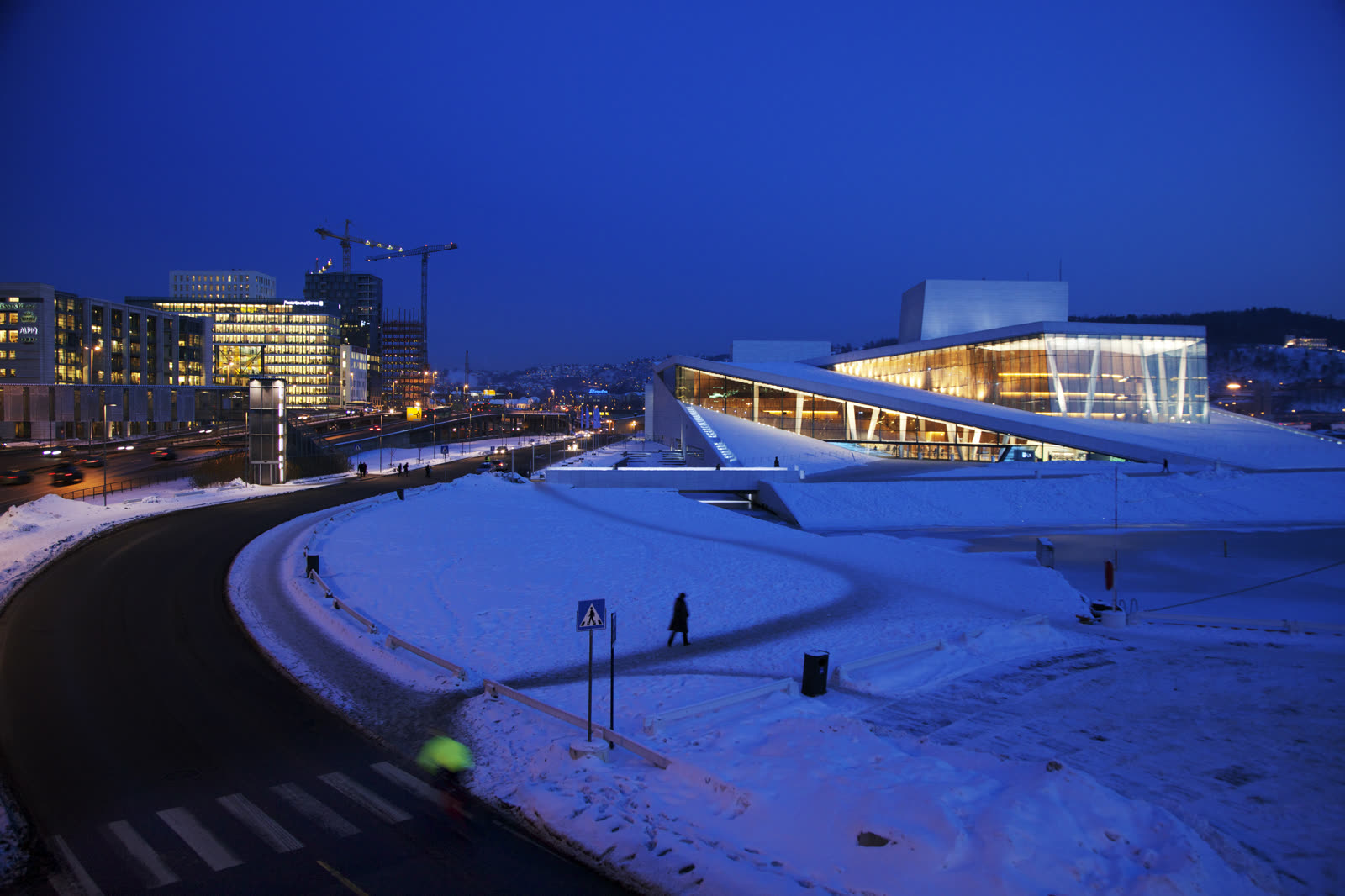
Image context: the cover uses a real Wikimedia Commons night photograph of the Oslo Opera House. For this route, the building itself is the correct recognition cue because the whole sequence begins with the white roof touching the water before the walk loosens into steam and dock life.[10]
Why this Bjørvika sequence works better than ending at the roof
The first advantage is that the roof gives you the district as a diagram. VisitOSLO's Bjørvika day plan says plainly that you are encouraged to walk on the roof and that from there you get the fjord, the skyline, and Monica Bonvicini's She Lies in one frame.[3] That overhead read matters. If you start at Sukkerbiten or drift straight into the lower harbor edge, the district can flatten into "nice new waterfront." If you start on the roof, the waterline, piers, Opera, MUNCH side, and southern fjord edge already sit in your head before you descend.
The second advantage is that Sukkerbiten changes the emotional temperature of the route. The Opera House is white, controlled, and almost too complete. Sukkerbiten is messier in the best Oslo way: Oslo Badstuforening's own Sukkerbiten page describes a floating sauna village with 13 saunas, capacities ranging from 4 to 25 people, and a location just 7-8 minutes on foot from Oslo Central Station.[4] That is not museum behavior. It is civic bathing culture plugged straight into new waterfront real estate.
The third advantage is that the district only feels local when you let the body into it. Oslo Badstuforening's shared-ticket page says entry is valid for 1.5 hours, recommends pre-ordering because sessions can fill up, and asks you to bring two towels and swimwear.[5] Oslo municipality's Sukkerbiten bathing page adds a second local rule with real consequences: bathing is discouraged for 24 hours after heavy rain.[6] Those details are useful because they move Bjørvika out of postcard language. This is a place where people sweat, plunge, dry off, talk, and head home.
Use the roof as the first room
The Opera House is strongest in this route when you treat it as an opening chamber, not the whole night. The architecture page explains why: the roof was conceived as a public platform, a man-made landscape between city and fjord rather than a sealed cultural object.[2] That is the right way to arrive. Come up the slope while the sky still has some color left in it, take the harbor read, and do not overstay the first view. The roof is meant to orient you, not trap you.
That order also protects the route from one of Bjørvika's main distortions. The district is young enough, photogenic enough, and clean-lined enough that it tempts visitors into static behavior: stand, shoot, leave. But VisitOSLO's own neighborhood guide keeps insisting on the opposite vocabulary, one built around leisure, beaches, saunas, and public access.[1] The roof therefore works best when it is brief and directional. Once you have the fjord line, go south.
The local texture here sits underneath the design. Bjørvika may look futuristic, but the whole project is really about making Oslo's waterfront behave like Oslo again. The highway went underground, the containers left, and the shore re-entered daily city use.[1] The Opera roof is the ceremonial expression of that decision. The more ordinary proof comes afterward.
Let Sukkerbiten carry the second half
Sukkerbiten is where the route stops being architectural and becomes social. VisitOSLO's Bjørvika guide calls the sauna village "incredibly popular," and the Bjørvika day plan says outright that another popular activity by the fjord is sitting in a steaming hot floating sauna there.[1][3] A recent r/oslo thread from March 2026 treats the place the same way: one local says they go there a couple of times every month, all year, and calls the Sukkerbiten setup great.[7] This is where the district's polish finally loosens. Towels appear. People wait on the dock. Someone is always deciding whether they are brave enough for the plunge.
The practical side matters. Oslo Badstuforening's shared-ticket page says non-members pay NOK 165 on weekday daytime bands and NOK 195 before 10:00, after 14:30, and on weekends and public holidays, with each entrance valid for 1.5 hours.[5] The same page says the shared sauna runs every day from 07:00-19:00, with some days extended to 22:00.[5] These are exactly the sorts of small mechanics that separate a workable Oslo night from a romantic but badly equipped one.
The non-booked version still works. Google Maps community surfaces for both the Opera House and Sukkerbiten show that these are not dead prestige objects but living evening stops with active review traffic and current place use.[8][9] If you do not want the sauna session, keep Sukkerbiten anyway. Stand on the edge, watch the floating cabins, and let someone else's plunge supply the last note. A night room does not need to become a full program to feel right.
8 local moves that make this Oslo night room read correctly
First, do the white roof before the steam. The Opera House gives you the district as a legible whole; Sukkerbiten gives you the human temperature afterward.[1][2][3]
Second, arrive while there is still some sky left. The route gets strongest when the marble still catches light and Sukkerbiten takes over after the district starts glowing rather than before.
Third, keep the roof concise. One proper climb and one fjord-facing pause are enough. The whole point is to carry that view south instead of exhausting it in place.[2][3]
Fourth, if you want the sauna, book ahead. VisitOSLO's own Bjørvika day plan advises advance booking, and Oslo Badstuforening's shared-ticket page says outright that it can get fully booked.[3][5]
Fifth, pack like the operator page tells you, not like a generic spa ad. Bring swimwear, 2 towels, and water. The point here is a working fjord routine, not a luxury-spa fantasy.[4][5]
Sixth, treat the no-alcohol rule as part of the place, not an annoying footnote. The floating-sauna culture here is social and relaxed, but it is not built as a party boat.[4][5]
Seventh, if you are skipping the sauna, still walk all the way to Sukkerbiten. Stopping at the Opera turns Bjørvika into architecture only; going south lets you see how the reclaimed shore actually gets used.[1][3][9]
Eighth, budget the route in layers rather than one block. The roof can be a short opening. The Sukkerbiten half can be a dock-edge linger or a full 1.5-hour sauna session. Oslo gives you both versions.[3][5]
Non-local trapline: 4 common mistakes and the better move
Mistake 1: treating the Opera roof as the whole destination
Better alternative: take the roof as orientation, then carry the walk south to Sukkerbiten, where Bjørvika stops being a design object and starts behaving like a public waterfront.[1][2][3]
Mistake 2: doing Sukkerbiten first and turning the roof into recap
Better alternative: protect the order. The route works because the roof supplies the diagram and the sauna edge supplies the body.[1][3]
Mistake 3: assuming a shared sauna will be available whenever you wander over
Better alternative: treat the sauna as a timed system. Book ahead if you care about getting in, because shared sessions last 1.5 hours and can fill up.[3][5]
Mistake 4: showing up with no gear and ignoring the rain rule
Better alternative: bring what the operator asks for, and respect the water. Pack swimwear, 2 towels, and water, and wait out the 24-hour post-rain caution if the city has had heavy weather.[5][6][7]
Concrete go details
- Best window: the last light into early dark, with the Opera roof first and Sukkerbiten second.
- Expected spend: NOK 0 if you do the roof and dock edge only; from NOK 165 for a non-member weekday shared-sauna session, or NOK 195 in the higher non-member bands.[5]
- Queue and reservation reality: no ticketing layer for the roof; sauna access is the part worth booking ahead.[3][5]
- Where to stand or sit: take your first pause on the fjord-facing slope of the Opera roof, then keep your longer second stop for the Sukkerbiten edge or your booked sauna dock.
- Navigation cue:
Oslo S / Bjørvika side -> Opera House roof -> waterfront walk south -> Sukkerbiten. - Numeric anchors worth keeping: 13 saunas, 7-8 minutes, 1.5 hours, 07:00-19:00, 22:00, NOK 165, NOK 195, 24 hours, 2 towels.[4][5][6]
Oslo has other pretty nights. This one is better because it moves from statement to use. The Opera House gives you the city's clean public gesture, Sukkerbiten gives you the steam and hesitation and dock-edge nerve that make the fjord feel lived rather than displayed, and the walk between them is short enough that both still belong to the same room.
Sources
- VisitOSLO, "Guide to Bjørvika" (official neighborhood guide describing Bjørvika's shift from container port and highway junction to open public waterfront, and identifying Sukkerbiten as the home of Oslo Badstuforening's sauna village).
- The Norwegian National Opera & Ballet, "About the Oslo Opera House" (official architecture page on Snøhetta's roof as a public platform accessible to all, the Carrara marble surface, and the waterfront sculpture She Lies).
- VisitOSLO, "A day in Bjørvika" (local city-guide itinerary encouraging visitors to walk on the Opera roof, then continue toward Sukkerbiten and book a sauna session in advance).
- Oslo Badstuforening, "Sukkerbiten" (official location page covering the 13-sauna village, 7-8 minute walk from Oslo Central Station, locker/changing setup, year-round fjord swimming, and public-sauna pricing).
- Oslo Badstuforening, "Single ticket" (official shared-sauna page covering 1.5-hour validity, booking-ahead advice, current ticket bands, daily operating window, and the two-towel / swimwear rule).
- Oslo kommune, "Badstuene på Sukkerbiten" (official bathing page noting year-round sauna use and the recommendation to avoid swimming for one day after heavy rain).
- Reddit / r/oslo, "Recs for Sauna + jumping into the ocean in April!" (published March 2026; local user comments describing Sukkerbiten as an all-year sea-swimming and sauna setup, with practical water-quality caution after heavy rain).
- Google Maps community listing, "Oslo Opera House."
- Google Maps community listing, "Sukkerbiten Oslo."
- Wikimedia Commons, "File:Den norske opera, Oslo, Karin Beate Nosterud.jpg" (documentary night photograph used for the cover image).