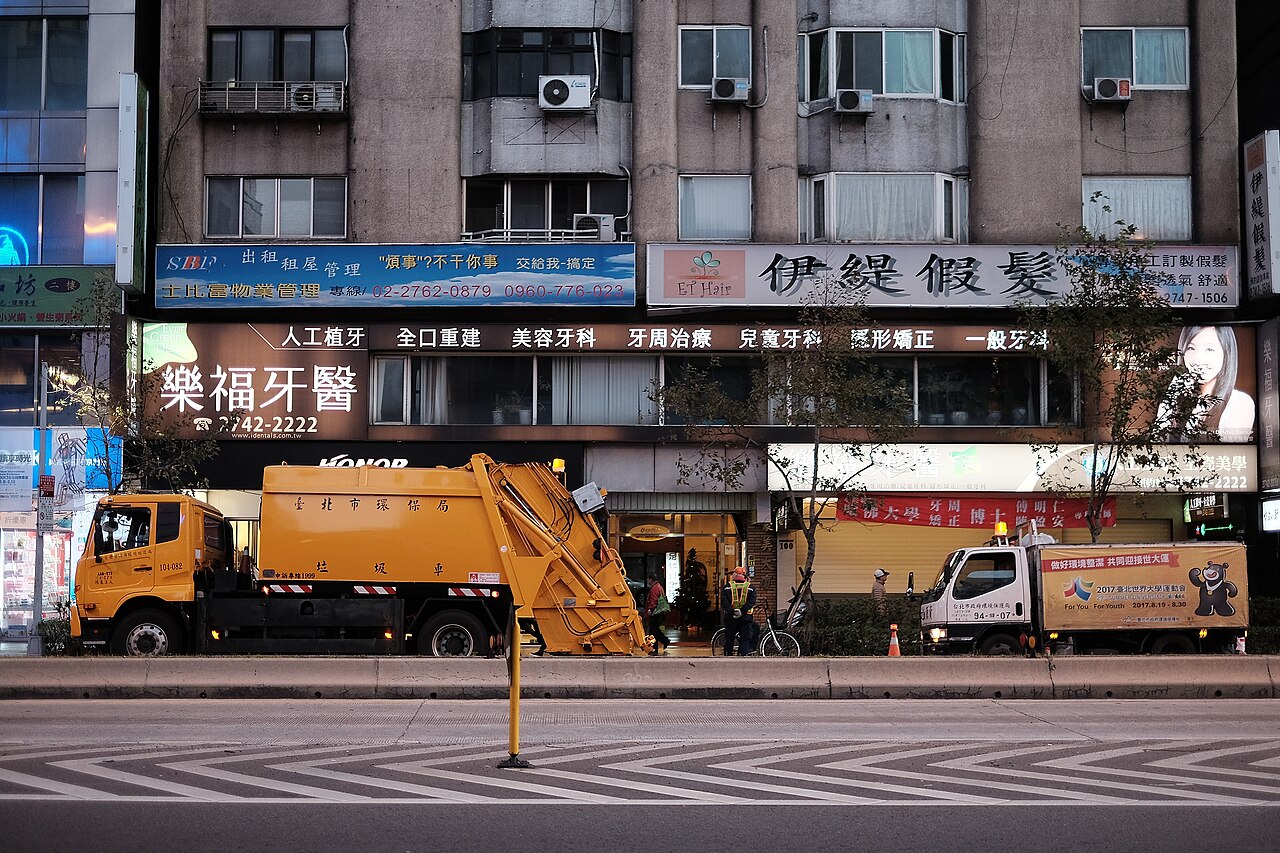
The melody is not the beginning. The beginning is five minutes earlier, when someone closes a small blue city bag, checks two other containers, and walks downstairs. Then a few neighbors appear at the same corner. Beethoven's Für Elise or Tekla Bądarzewska-Baranowska's A Maiden's Prayer comes around the block, a yellow compactor stops, and the private problem of household waste becomes a brief public appointment [11].
For a visitor staying in a serviced hotel, this is background sound: let the building handle its own waste. For someone in an apartment whose host has made them responsible for disposal, it is practical local knowledge. Give the ritual 10–15 minutes and only one official collection point. Its two working objects are the yellow garbage truck and the separate recycling vehicle. This is not a sightseeing performance, and there is no reason to carry rubbish across the city to find a prettier backdrop.
Taipei collects household garbage at fixed times and places five days a week, with routine pauses on Wednesday and Sunday. General waste, recycling and kitchen waste are handed over rather than abandoned at the curb [2][3]. The best window is therefore not “sometime in the evening.” It is the five minutes before the listed arrival at the stop nearest your door.
Make one address do the work
The first move is to ask who owns the handoff. Ask your host or front desk, “Does the building collect this, or do I meet the truck?” Many buildings use their own arrangements. If the answer is building collection, stop there. Joining a neighborhood line merely to hear the music turns somebody else's routine into theater.
If the bag is yours to deliver, the second move is to choose one precise stop before choosing a time. Taipei's official route page publishes schedules for all 12 districts, while the city's open dataset supplies the underlying vehicle, arrival time, departure time, street description and coordinates [1][2]. The dataset was refreshed on August 25, 2026 [2]. Copy the written address as well as the map pin. “Outside No. 96” or “opposite the lane entrance” is more useful on a dense block than a dot that seems to sit in the middle of a building.
The third move is to check the day, not only the clock. The ordinary pattern is Monday, Tuesday, Thursday, Friday and Saturday; there is no routine collection on the other two days [3]. Public holidays normally keep that pattern, but Lunar New Year, severe weather and other exceptional conditions can alter service, so reopen the official notice on the day rather than treating a saved screenshot as a contract [7][10]. Taipei City is also not the same sanitation jurisdiction as New Taipei City. Confirm which municipality your address belongs to before applying any of these instructions.
The fee is the bag
The fourth move happens at the shop counter. Ask for a 臺北市專用垃圾袋—a Taipei City designated garbage bag—and show the characters if pronunciation fails. Do not buy an anonymous blue bag and assume the color is the rule. The current official table lists a 20-pack of 3-liter bags at NT$21 and a 20-pack of 5-liter bags at NT$36; a 3-liter dual-use checkout bag adds NT$1 to a qualifying shop purchase and is not sold alone [4][16]. For a short apartment stay, ask your host whether one spare bag is available before buying a pack. Standard designated bags are sold through chain convenience stores and other marked retailers [17].
That tiny purchase explains more than the truck music does. Taipei's current fee is NT$0.36 per liter, collected through the price of the designated bag: container and fee instrument become the same object [4]. Recyclables and kitchen waste do not belong inside it; the city's current instructions require residents to present general waste, resources and food scraps as separate streams [3].
The fifth move is therefore to sort upstairs, where there is light and room. Tie general refuse inside the official bag. Drain kitchen scraps, remove packaging, tissues and utensils, and carry the scraps in a container you can empty. Since January 1, 2026, Taipei has used one household food-waste stream: acceptable raw and cooked scraps go loose into the blue bucket at the rear of the garbage truck. If a plastic bag carried them downstairs, empty it and dispose of the dirty bag separately [12]. Keep recycling separate and clean enough to handle. Do not arrive at the truck with one leaking mystery sack and ask a sanitation worker to perform your sorting at the roadway.
Recycling has a preferred five-day rhythm. Flat material such as paper, books, clean plastic bags and clean old clothes is scheduled for Monday and Friday; bottles, cans, containers and other three-dimensional material are scheduled for Tuesday, Thursday and Saturday [5]. Taipei's current FAQ also says crews should not refuse properly sorted recycling presented on another collection day [5]. Match the preferred day when you can, but ask your host or the crew when an object does not fit the categories; the useful distinction is orderly separation, not a visitor policing the calendar.
Wait for the convoy, not the soundtrack
The sixth move is to treat digital timing as an aid, not permission to sprint after a moving truck. The independent Taipei Garbage app now offers stop search, map locations, saved points, navigation and custom reminders—features shaped around residents trying not to miss a narrow slot [7]. Taipei's official open data contains scheduled stops, not a verified live-GPS field [2], so treat any third-party moving marker or arrival prediction as advisory. A recent Wanhua thread on the local PTT forum gives the more useful correction: try the listed time in practice, and know an officially listed fallback when work makes the appointment impossible [6][8]. An older Nangang thread records the lived version of that mismatch: a renter waited 20 minutes at a stop whose remembered arrival no longer matched the posted time [9].
Arrive five minutes early with everything already separated. Stand on the building side of the pavement at the official address, behind any residents who were there first. Keep the curb ramp, scooter path and roadway clear. If an app suggests the vehicle is one stop away, stay put; do not run down the carriageway toward the music. A listed departure is a boundary, not a challenge.
The seventh move is to read the vehicles before moving. The photograph above shows a common recognition cue: yellow compactor on one side, recycling truck on the other [15]. In current service, general refuse goes into the stopped compactor, drained food scraps into its rear blue bucket, and presorted recycling to the recycling crew or vehicle [11][12]. The precise layout and vehicle order can vary, so follow the crew's gesture rather than the photograph. Hold onto each stream until its opening is clear, make one controlled handoff, and never throw across another person.
The eighth move is to let the stop become ordinary again. Longtime residents may arrive early to exchange a few words; others experience the same fixed appointment as an inconvenience when work runs late [11]. Both readings belong to the ritual. A visitor's courtesy is simple: no flash in faces, no close portrait without consent, no commentary on somebody else's waste, and no lingering in the crew's working line after your containers are empty.
Why this melody belongs to the block
Taiwan's musical garbage-truck tradition reaches back to the 1960s. An archival newsreel record dates 21 sealed collection trucks and the replacement of handbell alerts with recorded music to January 18, 1968 [13]. The familiar origin stories do not line up neatly. A Taipei environmental official told Taipei Times that German trucks arrived programmed with Für Elise [11]; a recent archival reconstruction instead points to Japanese equipment playing A Maiden's Prayer in 1968 and says Für Elise may have entered the system much later [14]. Treat the exact first tune as unsettled. A civic sound can become local without a polished origin myth.
The music's real job is temporal. Fixed-point collection removes the permanent curb pile, but it also asks households to meet a moving service. The loudspeaker gives that appointment a radius. Doors open; lifts descend; a cluster forms; three waste streams disappear; the corner clears. In a city usually read through transit chimes, temple sound, scooters and rain, this melody is another piece of infrastructure you hear before you see.
Do not romanticize the bargain. The same system that produces a neighborly pause can be awkward for shift workers, older residents or anyone who misses a narrow slot. Taipei maintains appointed collection alternatives, and a September 2025 local report counted 30 limited-hour receiving points while reiterating the Wednesday and Sunday pause [6][10]. Use the current official list, not an old forum comment, because locations, hours and accepted streams can change—and not every point accepts food waste [6]. The ritual is revealing precisely because it joins civic order to household inconvenience; the music does not erase either side.
Four ways visitors get the handoff wrong
Mistake one: following the melody as if it were an ice-cream truck. The sound carries farther than the service point, so chasing it can put you behind the vehicle or on the wrong road. Local threads show how quickly a missed or remembered time sends residents searching for another stop [8][9]. Better: select the official address first, arrive five minutes early and let the truck come to the stop [1][2].
Mistake two: leaving a normal bag on the curb or feeding household waste into a pedestrian bin. Taipei's “garbage off the ground” model requires a direct, timed handoff, and general refuse needs an approved bag [3][4]. The Nangang community thread explicitly reminds a new renter to use Taipei's blue designated bag [9]. Better: obtain the correct bag from the host, through a qualifying checkout purchase or in a standard pack, and keep it indoors until collection time [16][17].
Mistake three: mixing every kind of recycling because the companion truck looks universal. A Taipei household discussion shows how the Monday/Friday flat-material and Tuesday/Thursday/Saturday three-dimensional split produces exactly this uncertainty [18]. Better: presort the two groups, use the preferred weekday split, and ask the crew when an object does not fit the categories. Properly sorted off-day recycling should still be accepted; separation matters more than pretending the timetable is a refusal rule [5].
Mistake four: treating the timetable as either perfectly exact or merely suggestive. Residents use apps because timing matters, yet local discussions still advise testing the stop rather than trusting an old memory [7][8][9]. Better: save one stop, arrive early, and use an officially listed receiving point if you miss it—never an unattended corner [6][10].
The pocket handoff
- Anchors: one official stop near your accommodation; one two-vehicle sanitation convoy.
- Best window: from five minutes before the stop's current listed arrival until its listed departure. Late afternoon and evening are common, but the address-level schedule outranks a generic time [1][2][11].
- Time needed: 10–15 minutes, including the early wait and the handoff.
- Expected spend: a NT$1 added bag charge with a qualifying shop purchase, or NT$21 for the smallest standard 20-pack. The dual-use bag is not a standalone sale, so ask the host for one spare before buying a full pack. Recycling and food waste do not require that bag [3][4][16].
- Queue and reservation: no booking and no formal queue. Fall in behind the residents already waiting and move at the crew's pace.
- Bring: tied general waste in the designated bag, drained and unpackaged food scraps ready for the rear blue bucket, presorted recycling, and the exact stop address on your phone [3][5][12].
- Where to stand: on the building side of the pavement at the address description—not behind the truck, in a curb ramp or out in the lane.
- Recognition cue: listen for one of the two familiar piano melodies, then look for the yellow compactor and the recycling crew or vehicle; the 2017 photograph is a recognition aid, not a promise of today's convoy order [11][15].
- Fallback: consult the current appointed-location list if the household stop is impossible; confirm that point's day, hours and accepted streams before carrying anything there [6][10].
Taipei's garbage melody is memorable because it seems whimsical. The better memory is quieter: the blue bag bought in the right city, the address checked twice, cardboard held for the correct night, neighbors waiting without blocking the lane. By the time the music reaches the corner, the real work has already been done.
Sources
- Taipei City Department of Environmental Protection, “Garbage Collection Routes in Taipei City” (updated August 26, 2026) — official route schedules for all 12 city districts.
- Taipei City Open Data Portal, “Taipei City Garbage Truck Stop and Route Information” — official stop-level dataset with route, vehicle, arrival/departure time, address and coordinates, refreshed August 25, 2026.
- Taipei City Department of Environmental Protection, “How should citizens dispose of garbage and recyclables?” (updated July 20, 2026) — current primary instructions for five-day, fixed-time/fixed-place collection and the three waste streams.
- Taipei City Department of Environmental Protection, “Prices and quantities of designated garbage bags” (updated August 20, 2026) — current official sizes, pack prices, dual-use bag prices and NT$0.36-per-liter fee.
- Taipei City Department of Environmental Protection, “Are recyclables limited to certain collection days?” (updated August 4, 2026) — current primary guidance on the preferred flat/three-dimensional weekday split and acceptance of properly sorted material on other days.
- Taipei City Department of Environmental Protection, “Limited-hour garbage receiving points” (updated April 24, 2026) — current primary list of 30 alternatives, with point-specific times and accepted streams.
- Apple App Store Taiwan, “台北倒垃圾” — local platform listing, version history and user reviews for a community-built map integrating official stop, route and timing data.
- PTT Wanhua board, “Question: Wanhua garbage-truck time and route download?” (October 31–November 3, 2025) — recent local-community discussion of trying app times in practice and using a sanitation-team fallback.
- PTT Nangang board, “Recently rented near Academia Sinica” (April 2016) — local-community account of a 20-minute timing mismatch, later stop options and the Taipei blue-bag reminder.
- Central News Agency, “Taipei garbage collection continues on national holidays” (September 25, 2025) — local reporting on the Wednesday/Sunday exception and 30 limited-hour receiving points.
- Allison Jackson and Akio Wang, “Taiwan's garbage trucks offer classical music and a catch-up,” Taipei Times (July 29, 2025) — reporting on the two melodies, five-day rhythm, vehicle roles, resident social life and scheduling tradeoff.
- Taipei City Department of Environmental Protection, “Taipei unifies household food-waste collection from January 1, 2026” — current instructions to drain scraps, remove non-food material and empty acceptable raw or cooked waste into the rear blue bucket.
- Taiwan Cultural Memory Bank, “Sealed garbage trucks begin service” — archival record of 21 vehicles entering service on January 18, 1968 and recorded music replacing handbell alerts.
- Nancy Guy, “From Musical Garbage Trucks to Garbage Consciousness in Taiwan,” Taiwan Insight (December 5, 2025) — archival reconstruction of the disputed vehicle and melody origin stories.
- Hsu Luke, “DEPTC waste collection truck and recycling truck 20170127,” Wikimedia Commons — CC BY-SA 2.0 documentary photograph of the two Taipei vehicles on Nanjing East Road used as the cover image.
- Taipei City Department of Environmental Protection, “May dual-use bags be sold separately?” — current primary clarification that retailers supply these checkout bags with a purchase rather than selling them alone or by the pack.
- Taipei City Department of Environmental Protection, “Designated garbage-bag retailers” (updated August 17, 2026) — current primary confirmation of chain convenience stores and shops carrying the official sales mark.
- PTT homemaker board, “Taipei City resource recycling” (May 22, 2012) — local household discussion of separating flat Monday/Friday material from three-dimensional Tuesday/Thursday/Saturday material.