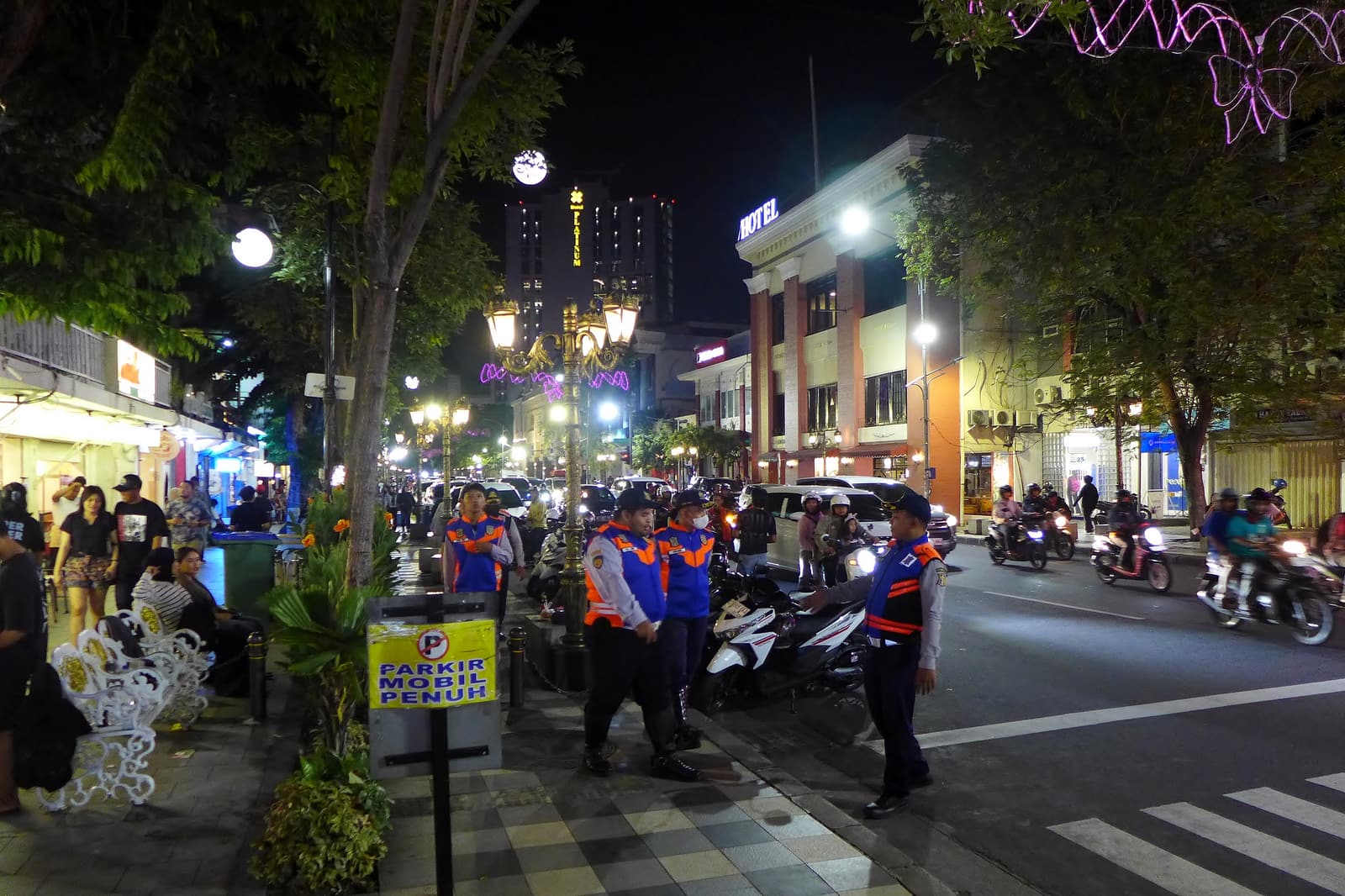
At 16:45, the most instructive thing on Jalan Tunjungan is an absence. There is no legal row of motorcycles and cars claiming the curb. Shopfronts meet a clearer pavement; traffic keeps moving beside it; people begin arriving for the evening. Surabaya removed public curb parking from the corridor on August 1, 2025, after congestion and unofficial parking had made the edge difficult to manage [2]. The result is not a pedestrian street. It is a better place to watch a working road negotiate with a night out.
That distinction is the whole walk. Start at Siola, continue toward Hotel Majapahit, and give the one corridor 60–75 minutes. Come on an ordinary Tuesday, Wednesday or Thursday from roughly 16:45 to 18:15. A recent local recommendation favors either morning or sunset; the latter lets the old commercial facades change under warm street light without requiring a late-night finish [6][7]. The street itself costs Rp0, needs no reservation and has no entrance queue [14].
The tourism name, Tunjungan Romansa, can sound like a sealed entertainment precinct. Do not let it erase Jalan Tunjungan. Cars still run through; side streets still feed it; workers, residents, customers and photographers share the edge. A 2023 field study recorded three vehicle lanes, one bicycle lane, signalized crossing points and pedestrian space about 3 metres wide [9]. Details can change as the city rebuilds the corridor, but the operating principle survives: this is public circulation first, atmosphere second.
Use Siola as the door
The first local move is small and consequential: pin Siola, Jalan Tunjungan 1–3, not “Tunjungan Plaza.” The mall carries the famous name but sits beyond the most legible start of the heritage corridor. Siola's pale corner facade is the recognition cue. The municipal heritage record identifies it as the former Whiteaway Laidlaw department store and later the locally remembered Siola store; today the building is used by the city [1]. Begin outside. Its long commercial history prepares the eye for a street that has repeatedly changed owners and uses without losing its address.
Arrive without asking the curb to solve your transport. Surabaya's current public-transport notice lists a standard adult fare of Rp5,000 and service windows that generally run from about 05:30 to 21:00 for Suroboyo Bus and WiraWiri; a 2023 city access notice said that both served Siola [4][5]. Confirm the current route before boarding, ask the onboard helper for Siola and name your destination before paying. If you plan to leave by bus, turn toward your return stop by 20:30 rather than treating 21:00 as a promised departure from this particular halt.
If you drive, the second local move is to use an official pocket and read its gate before entering. The city names Siola, Tunjungan Electronic Center, Tanjung Anom, Genteng Besar and Pasar Tunjungan among the alternatives to curb parking [2]. On August 14, 2026, Tanjung Anom gained a portal accepting QRIS and electronic-money cards. In its August 14 notice, the city described Rp2,000 for motorcycles and Rp5,000 for cars as temporary rates, with planned tourism-zone rates of Rp5,000 and Rp10,000 respectively [3]. That is a live-change warning, not a price promise. Bring a cashless method, inspect the posted tariff, keep the ticket, and do not pay someone merely waving you toward the forbidden curb.
Let one side of the street tell the story
From Siola, choose one pavement and resist zigzagging for every bright facade. This is the third local move. The old corridor grew from a route visible on a 1787 map into a major commercial street after the turn of the twentieth century; malls helped drain that role in the 1990s, and the city began opening the old shopfronts and improving the pavement again from 2015 [1]. Seen in sequence, those layers make more sense than they do as isolated photo backgrounds.
Look above the modern sign line. Some buildings still place shade, columns or an upper facade between the pavement and Surabaya's dense commercial core. A local C2O walking group noticed the same useful feature in 2012: older buildings had covered “feet” that protected pedestrians from sun and rain [10]. The group's phrase, mlaku-mlaku nang Tunjungan—walking around Tunjungan—also gets closer to the local scale than a checklist of monuments. The action is ordinary; the street earns attention by making an ordinary walk hold several eras at once.
The fourth move is to stop on the building side of the pavement, not at a curb cut or in the bicycle lane. Pull fully out of the walking line before looking up or taking a photograph. The road's warm lighting and broad pedestrian edge were deliberate ingredients in its revival, but the same field study that records those choices also records an active one-way carriageway [9]. A beautiful frame is not evidence that the road has closed.
Cross once, at a signalized crossing, when the opposite facade offers a genuinely different reading. Do not step into a traffic lane for symmetry. Current review aggregation emphasizes evening lights, food and live performance; it also warns that parking can be difficult [7]. Read that as evidence of popularity, not permission to occupy the roadway. The most revealing position is often oblique: traffic in the foreground, older shop volume above, and people using the cleared edge between them.
Around sunset, the corridor changes by accumulation rather than by switch. Office movement overlaps with arriving groups. Interior light begins to pull details from the facades. Food and music may appear, but neither is guaranteed at a particular doorway or minute [7][9]. This is why 16:45–18:15 works: the fifth move is to catch the handover, then leave before the street becomes only a crowd scene. If you want the denser nightlife instead, arrive later and accept a weaker view of the street's operating transition.
Decide whether you want a street or an event
Jalan Tunjungan can become a different room on event days. In May 2026, Surabaya Vaganza routed a night parade past Siola, along Tunjungan and in front of Hotel Majapahit; full road closures began around 12:00, six hours before the announced 18:00 start. A local traffic thread described the resulting detours and an almost two-hour journey [11][13]. The sixth local move is therefore a same-day check of Surabaya government and transport notices. A parade evening may be excellent, but it is not the ordinary street described here.
No self-guided booking is required. A researched walking tour can add stories—Airlangga University's March 2026 report describes a local Tunjungan Romansa route built around Siola, Hotel Majapahit and the corridor's surviving buildings—but that is a separate, scheduled product [8]. For this walk, the only “queue” is the flow at crossings and popular doorways. Do not join a restaurant line merely because it looks like part of the street ritual; step aside, decide whether that venue is actually your destination, and keep the non-food anchor intact.
Near Hotel Majapahit, slow down without turning the hotel into a second visit. Its former life as Hotel Oranje and its place in Surabaya's 1945 flag episode give the southern end historical weight [1][8]. The seventh move is to read it from the public pavement, then look back toward Siola once. The view compresses department store, hotel, commerce, traffic and evening leisure into one line. There is no need for a second full traversal.
Four ways visitors misread Tunjungan
Mistake one: starting inside Tunjungan Plaza because the names match. That makes the mall the frame and the old corridor an afterthought. Better: set Siola as the arrival pin and walk toward Hotel Majapahit; local heritage walks use those buildings to make the street intelligible [1][8][10].
Mistake two: circling for curb parking or paying an unofficial attendant. Public curb parking along Jalan Tunjungan has been prohibited since August 2025, while current community reviews still flag parking as difficult. Better: arrive by bus or use a named pocket such as Tanjung Anom, take the gate's tariff as current, and carry QRIS or an electronic-money card [2][3][5][7].
Mistake three: treating “Romansa” as a pedestrian-zone guarantee. Traffic remains part of the scene, and community reviews prize the same night atmosphere that draws more people to the edge [7][9]. Better: keep to one pavement, stop against the building side, and cross only where the road tells you to.
Mistake four: choosing a major festival night for an ordinary-street walk. Event closures can begin hours before the spectacle and remake the whole route; the local account of Surabaya Vaganza traffic shows how far the disruption can spread [11][13]. Better: check live notices. Choose the event deliberately, or choose a plain weekday and watch Tunjungan produce an evening without a stage manager.
The go details
- Anchor: Jalan Tunjungan only, from Siola toward Hotel Majapahit. The two buildings are recognition cues, not separate admissions [1][8].
- Best window: 16:45–18:15 on Tuesday–Thursday. This editorial window applies the recent local preference for sunset to an ordinary weekday; it is not an official operating period [6][7].
- Time needed: 60–75 minutes, including one deliberate crossing and several facade stops.
- Expected spend: Rp0 for the street; roughly Rp10,000 for two standard adult transit rides. If parking at Tanjung Anom, budget up to the city's announced Rp10,000 car / Rp5,000 motorcycle tourism-zone level and confirm the live gate tariff because the August 2026 notice still described a transition [3][4][14]. Food, a guided walk and interior visits are optional extras.
- Queue and reservation reality: no ticket, gate or reservation for the public street. Guided walks and individual venues keep their own schedules [7][8][14].
- Arrival cue:
Siola, Jl. Tunjungan No. 1–3; the city said in 2023 that Suroboyo Bus and WiraWiri served Siola, but confirm the current route and ask a transit helper for the stop rather than relying only on the broader Tunjungan name [1][4][5]. - On-foot rule: use one pavement, pause on the building side, and make at most one purposeful crossing at a signal [9].
- Live check: confirm event diversions, the return service and any parking tariff on the day. A normal road, a parade route and a late-night gathering are three different versions of Tunjungan [3][4][11].
The cleared curb is not the romance promised by the district's name. It is the mechanism that lets the romance happen: a little more room to walk, a little less friction at the edge, and a clearer view of buildings that have watched the street become a shopping address, a through-road and a public evening room. Begin before the lights win. Tunjungan is most specific in the half-hour when it is still doing all three jobs at once.
Sources
- Surabaya Department of Culture, Youth, Sports and Tourism, “Koridor Jalan Tunjungan” — official heritage record on the 1787 route, commercial growth, post-1990 decline, 2015 streetscape work and the corridor's key buildings.
- Surabaya City Government, “Public curb parking on Jalan Tunjungan abolished; Transport Department conducts outreach and enforcement” (August 2, 2025) — primary notice of the curb-parking ban, official alternative lots and enforcement against unofficial attendants.
- Surabaya City Government, “City implements portal and cashless parking in the Tunjungan Romansa tourism area” (August 14, 2026) — recent primary confirmation of Tanjung Anom's gate, QRIS/e-money payment, temporary tariffs and announced tourism-zone rates.
- Surabaya Transportation Department, “Surabaya Public Transportation Services” (checked September 3, 2026) — current official operating windows, standard fares and boarding/payment instructions for Suroboyo Bus, WiraWiri and Trans Semanggi.
- Surabaya City Government, “Surabaya Kriya Gallery Siola–MERR becomes a visitor destination” (July 15, 2023) — official access note confirming that Suroboyo Bus and WiraWiri serve Siola.
- r/surabaya, “What to explore in Surabaya?” (August 2026) — recent local-community recommendation identifying Jalan Tunjungan as an iconic walk and favoring morning or sunset.
- Wanderlog, “Tunjungan Romansa” — current platform aggregation of Google reviews used to check evening atmosphere, pedestrian popularity, lighting, live activity and recurring parking difficulty.
- Airlangga University Vocational Faculty, “Tracing Tunjungan's history through professional walking-tour standards” (March 4, 2026) — recent local account of the Tunjungan Romansa route, its Siola–Hotel Majapahit heritage anchors and the value of researched interpretation.
- Keisha Amabel Saputra Sutikno et al., “The Tunjungan Street's Physical Evidence That Attract the Visitor in Surabaya,” AKSEN 8, no. 3 (2024) — local field observations on lanes, crossings, pedestrian width, lighting, tenants and the corridor's revived public life.
- C2O Library & Collabtive, “Report: Manic Street Walkers #5 — Mlaku-mlaku nang Tunjungan” (February 2012) — Surabaya community account of walking the corridor, its shaded building edges and the local-language frame for the practice.
- Surabaya City Government, “Surabaya Vaganza 2026: 15 parking locations and traffic engineering” (May 15, 2026) — recent primary notice of the parade's Tunjungan route, noon road closure and 18:00 start.
- Bahnfrend, “Tunjungan, 2025 (02),” Wikimedia Commons — Tuesday-night photograph licensed CC BY-SA 4.0 and source for the resized article image.
- r/surabaya, “Traffic around Surabaya Vaganza 2026” (May 2026) — recent local-community account of event-night detours and an almost two-hour trip around the Tunjungan parade route.
- Surabaya Tourism, Historical and Heritage guide — official listing for Jalan Tunjungan confirming free, 24-hour public-street access while describing its heritage buildings and evening activity.