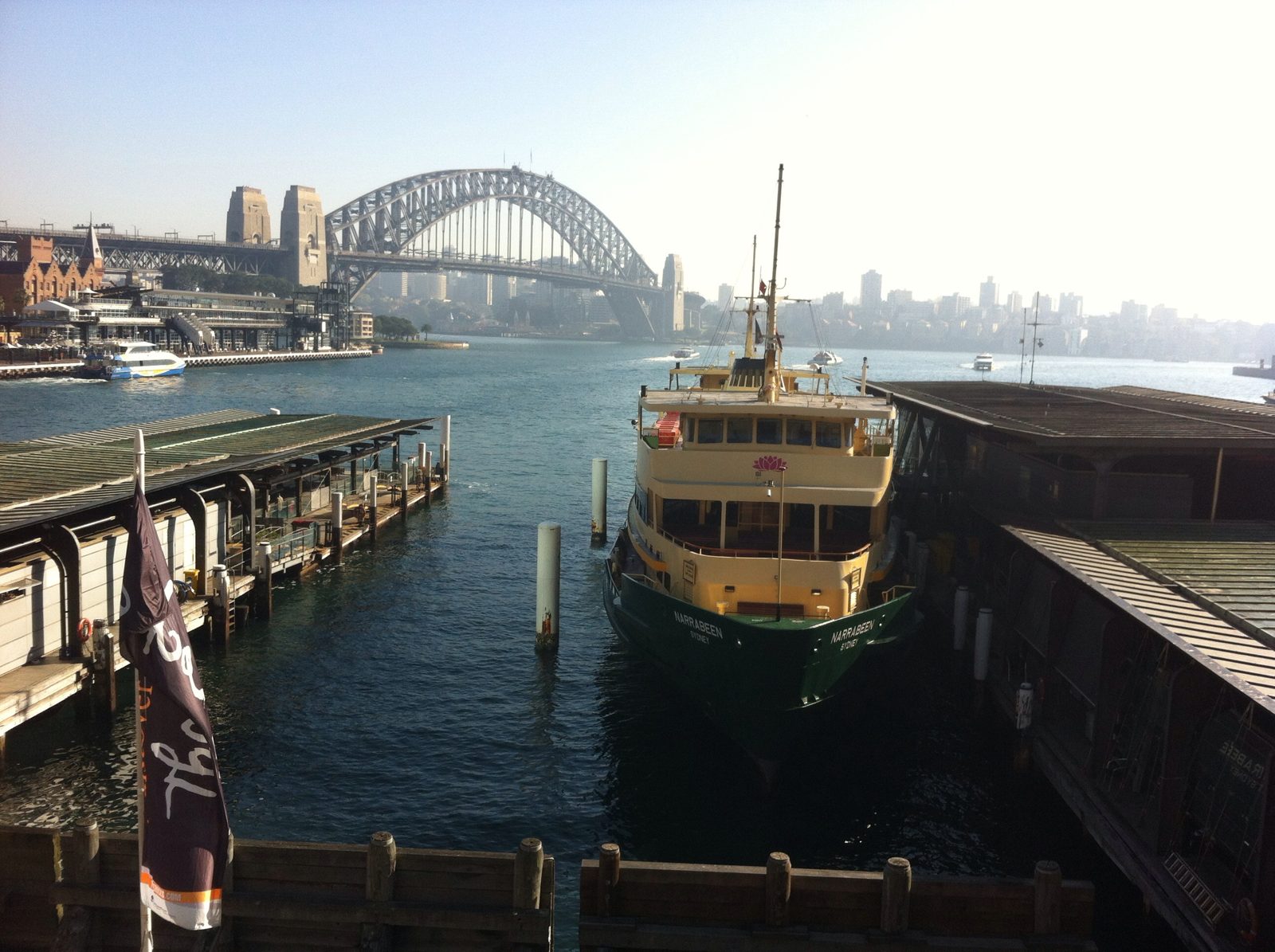
If you want one Sydney move that changes outcomes rather than just producing a photo, make it this: take the public F1 Manly ferry in the 18:00 hour, and treat it as a commuting ritual with scenery attached, not as a random sightseeing cruise.
That framing matters because the line is both ordinary and spectacular. The crossing has linked the city and Manly since 1855.[6] It still works best when you use it the way the city does: by reading cadence, boards, gates, and return timing correctly.
This guide keeps a strict two-anchor scope:
- Circular Quay: the decision point where wharf discipline and gate timing decide whether the ride feels smooth or sloppy.
- Manly Wharf: the decision point where you either preserve the harbor rhythm or let the crossing dissolve into unplanned drift.
Why the 18:00 hour works
The useful Sydney version of this ride is not "whenever you get to Circular Quay." It is the early-evening band where the line is still running at working-city frequency, but the day has already started to soften visually.
The current F1 timetable gives you a clean weekday ladder out of Circular Quay at 17:30, 17:50, 18:10, 18:30, 18:50, and 19:20.[2] The return ladder from Manly stays equally usable: 18:10, 18:30, 18:50, 19:10, 19:30, and 19:50 are all there.[2] Depending on the boat pattern, the crossing itself lands around 22 to 30 minutes; the local Manly guide rounds the run to about 30 minutes, which is the right mental envelope for planning.[2][6]
This is why the 18:00 hour beats the lazy midday version. You get multiple departure chances inside a 110-minute window, enough daylight on the outbound leg, enough city light on the way back, and no need to pin the whole experience on a single perfect sunset minute. Just as importantly, the repeated departures mean a slightly late arrival does not destroy the whole plan. For a first run, weekday evening is the most forgiving shape.[2][6]
Anchor 1: Circular Quay — boards first, photos second
The biggest Circular Quay mistake is joining the first queue you see and assuming the rest will sort itself out.
Transport for NSW explicitly warns that departure or arrival wharf may change at short notice at Circular Quay, and the route detail page shows why: the F1 can use Wharf 3, Side B, Wharf 4, Side A, or Wharf 4, Side B on the Circular Quay end.[1][2] In practice, the first local move is simple: look at the indicator boards first, then walk to the correct gate.
The second move is timing discipline. The official timetable notes that Manly Ferry gates close two minutes before scheduled departure.[2] That means arriving at exactly 18:10 for an 18:10 boat is functionally late. The clean window is to be at the wharf zone 8 to 10 minutes early, with payment ready and board checked.
The third move is to keep the payment logic simple. Use one Opal card or one contactless device consistently, tap on once, and stop thinking about readers at the far end. Transport for NSW's tap rules carve out a specific exception here: on the F1 Manly Ferry, you do not need to tap off.[4] Visitors who hover around the Manly wharf reader bank at the end of the ride waste time for no gain.
One more local detail from the timetable is worth knowing: some services are marked FW, meaning Freshwater Ferry.[2] If you happen to catch one, you get the older green-and-cream boat and often a roomier open-deck feel. If you do not, keep moving. Waiting an extra cycle solely for a particular vessel shape is usually the wrong trade unless you have spare time.
Anchor 2: Manly Wharf — keep the landing on a clock
At Manly, the mistake flips. People arrive correctly and then let the return become vague.
The route detail page is precise about the landing: Manly departures use Wharf 1.[1] A local Sydney guide describes the default first-timer move clearly: people step off the ferry and keep walking down the Corso toward the beach.[7] If your goal is the ritual itself rather than a half-day beach session, the cleanest version is to land, stretch the legs briefly, read the next departure, and decide immediately whether you are taking the next boat or the one after. That keeps the crossing as a harbor sequence rather than turning it into a stranded wait.
The return choices are good precisely because the timetable remains dense into the evening. A weekday arrival on the 18:40 or 18:52 services from Circular Quay can be turned into a 19:10 or 19:30 return without stress.[2] That is the sweet spot: enough time to breathe at the wharf, no pressure to sprint, and a back-to-city run that usually gives you a better skyline read than the outbound leg.
The local guide is useful here because it describes the ferry as both transport and one of Sydney's defining harbor experiences.[6] That double identity is the entire point. If you schedule it like transport, you get the experience for free; if you treat it like a vague attraction, you often get queues, guesswork, and avoidable dead time instead.
8 local moves that make the crossing better
First, use the 17:50 to 18:50 Circular Quay band as your default weekday window, because it gives you five departures without the late-evening taper.[2]
Second, check the indicator board before you commit to a queue. Circular Quay wharf assignment is operational, not decorative.[1][2]
Third, be through the gate area early; the two-minute close rule is real and catches people who arrive "on time."[2]
Fourth, tap on with one card or device and keep it away after boarding. On this line, the return-side tap-off dance is unnecessary.[4]
Fifth, if you see FW beside your service, treat it as a bonus, not a reason to delay the whole ritual.[2]
Sixth, let passengers disembark first and follow the wharf staff flow. The ferry safety guidance sounds basic, but it is exactly how boarding stays quick at busy wharves.[5]
Seventh, for a first ride, stay with the public F1 rather than swapping to a private fast ferry. Local guides frame the public line as the core harbor experience, and the slower cadence is exactly what makes the ritual legible.[6][7]
Eighth, once at Manly, lock the return departure before you start wandering. A scheduled harbor run stays elegant only when the second half is chosen early.[2]
Non-local trapline: 3 mistakes and the better alternative
Mistake 1: treating Circular Quay as one fixed wharf
Better alternative: read the board first. The F1 uses more than one Circular Quay wharf position, and the assignment can shift.[1][2]
Mistake 2: arriving at the gate exactly at departure time
Better alternative: work backward from the timetable and give yourself a genuine 8 to 10 minute pre-boarding buffer, because the gate closes 2 minutes early.[2]
Mistake 3: assuming the return can be improvised later
Better alternative: at Manly, check the next one or two departures immediately and choose your return before the easy Corso-to-beach drift turns the harbor run into dead time.[2][7]
Pocket route card
- Best window: weekday 17:50-18:50 out of Circular Quay; return from Manly around 19:10-19:50.[2]
- Expected spend: adult Opal ferry fares are A$7.35 for 0-9 km and A$9.20 for 9+ km; by the published F1 route geometry this run sits in the higher band, so budget about A$18.40 return before caps.[1][3]
- Queue reality: Circular Quay wharf assignment can change; gates close 2 minutes before departure.[1][2]
- Reservation reality: none. This is a turn-up-and-go public ferry, not a booked harbor cruise.[2][6]
- Where to stand or sit: if you want the harbor reveal, board early enough to claim outer-deck space; if wind matters more than views, sit inside and keep the rhythm instead of chasing position.
- Navigation cue: on the city side, follow the board to the correct Wharf 3/4 assignment; on the Manly side, the public return leaves from Wharf 1.[1]
- One city-specific texture detail: the ferry is still the cleanest way to feel Sydney's old city-to-beach axis in one movement, which is why locals keep using it as transport more than as theater.[6]
Sources
- Transport for NSW, F1 Manly route detail page; confirms Circular Quay wharf assignments and Manly Wharf 1.
- Transport for NSW, F1 Manly timetable PDF, valid from 2 March 2026; includes weekday evening departure ladders,
FWmarkings, the wharf-change warning, and the two-minute gate-close note. - Transport for NSW, Adult Opal fares; lists public-ferry fares of A$7.35 for 0-9 km and A$9.20 for 9+ km, plus current caps.
- Transport for NSW, tapping on and tapping off; notes that you do not need to tap off on the F1 Manly Ferry.
- Transport for NSW, safety when travelling by ferry; boarding and disembarking guidance for busy wharves.
- Manly & Northern Beaches Australia, "Manly Ferry"; local guide covering the line's 1855 history, roughly 30-minute crossing, and day/night usefulness.
- Sydney Expert, "What to Do in Manly" (updated 5 January 2026); local guide describing the ferry-wharf-to-Corso-to-beach pattern and distinguishing the public Manly ferry from faster private options.
- Wikimedia Commons, "Manly ferry at Circular Quay.jpg" (hero image source).