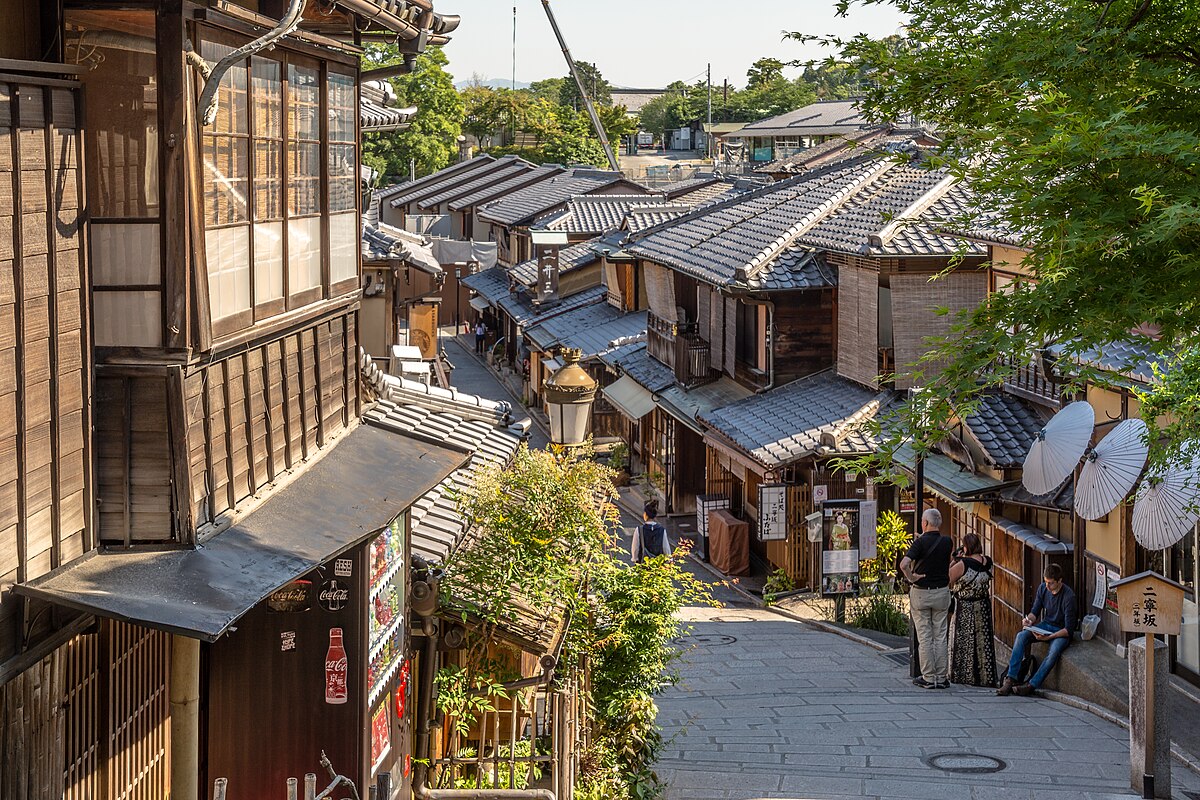
The logic of Higashiyama is not complicated: it is a narrow strip of preserved Edo-period city, roughly two kilometers long, running between Kiyomizudera in the south and Shoren-in in the north, and it works best when you assign each section of the day to a specific part of that strip rather than trying to cover everything at once.
Most first-time visitors arrive at Kiyomizudera, spend the whole morning on the temple platform, and then find that by the time they reach the Ninenzaka stone lanes the afternoon heat has peaked, the snack stalls are all open, and the path is at its most photographed and its least navigable. That is not wrong, exactly, but it is the day structure that produces the most crowded version of the neighborhood.
This guide treats Higashiyama as three phases: the middle stone lanes in the afternoon, the Yasaka Pagoda view at dusk, and the Hanamikoji corridor into the early evening. Each phase has a distinct light quality, a distinct crowd density, and a distinct reason to be there. They build on each other.
Phase 1 — Afternoon: the stone lanes (13:00–16:00)
The entry point that makes most sense for this three-phase shape is not Kiyomizudera but the midpoint — the junction where Ninenzaka meets Sannenzaka, roughly in the middle of the preserved district. This is reachable by Kyoto City Bus routes 100 or 206 (alight at Kiyomizudera-michi or Gojo-zaka, then walk uphill ten minutes).[1]
Ninenzaka (二年坂, also written Ninen-zaka, meaning "two-year slope") and Sannenzaka (三年坂, "three-year slope") are the two interconnected stone-paved lanes that form the structural core of historic Higashiyama.[2] They are part of the Sanneizaka Traditional Buildings Preservation District, a designation that protects their wooden machiya townhouse facades from modern commercial alteration.[1] The preservation district covers roughly 75 hectares and includes approximately 250 historic structures, making it one of the most intact pedestrian streetscapes surviving in any major Japanese city.[1]
The afternoon window between 13:00 and 16:00 is not the quietest — mornings are quieter — but it is the most practical for a three-phase day, because it leaves the best light for later. In the early afternoon, the stone path runs through a soft filtered light under the eaves of the machiya. The shops are fully open: glazed pottery, pickled vegetable shops, green tea confectionery, textile goods. The pace is slow and lateral rather than vertical, which makes the lane feel like a working neighborhood rather than a monument.
The walk from the lower end of Sannenzaka to the upper end of Ninenzaka is roughly 600 meters. A useful trick is to walk it south-to-north — the path gently rises toward Yasaka Pagoda, meaning the pagoda appears progressively as you ascend rather than revealing itself all at once. [2][3]
At the top of Ninenzaka, a short staircase cuts left onto a smaller lane that connects to the Yasaka Pagoda viewpoint. Note the time when you reach it in the afternoon — this exact spot is where you will return for the dusk phase.
One practical note: Kiyomizudera itself is worth the visit but is a separate commitment. [4] The main hall viewing deck requires paid entry (¥500 as of 2025), and the uphill approach from Gojo-zaka is about 15 to 20 minutes of walking. If you are doing the full three-phase walk, consider visiting Kiyomizudera on a separate morning rather than stacking it into this loop — it expands the afternoon well beyond the comfortable pace.
Phase 2 — Dusk: the pagoda view (16:30–18:30)
The Yasaka Pagoda is formally the five-story tower of Hokan-ji Temple (法観寺), built in its current form in the mid-15th century.[3] At 46 meters tall, it is the single vertical landmark of Higashiyama visible from multiple points in the district, and it is the element that the Ninenzaka walking path is implicitly oriented toward as you ascend.
The dusk window is the phase when this orientation pays off. From roughly 16:30 to sunset — which in late March falls around 18:00 in Kyoto — the pagoda shifts through three distinct light states: the warm afternoon side-lit phase, the brief golden saturation period, and then the transition into illuminated blue-hour silhouette. The best static viewpoint is from the small rise on the lane immediately below and west of the pagoda, from which the entire five-story structure frames against the eastern hills.[3]
This is also the phase when the number of people on the lane begins to drop. The tour buses that park near Kiyomizudera typically finish their scheduled stops by 16:00 and leave; the daytime snack crowd thins; and the lane takes on a calmer texture. The machiya shops begin to shut their wooden shutters one by one, which paradoxically makes the lane more photogenic: the closed shopfronts read as a continuous wooden facade rather than a sequence of open commercial fronts.
If you timed the afternoon phase correctly and know the Yasaka Pagoda approach already, you do not need to rush. The golden hour at this latitude in late March lasts roughly 40 minutes. A useful move is to make one slow pass on the approach lane, find the viewpoint, wait for the light, and then continue north rather than backtracking.
Ishibe Koji (石塀小路) is a short, exceptionally narrow stone-walled lane just north of the pagoda viewpoint, connecting toward Kodaiji Temple.[3] It is one of the few lanes in the district where traditional ochaya (teahouse) structures are visible at close range. The lane is quiet at dusk precisely because it is off the main axis — most visitors follow the wider path and miss it. In terms of light quality at the 17:00–17:30 hour, it is one of the better spots in the district.
Phase 3 — Night: Hanamikoji (18:30–21:00)
The third phase moves north, into the Gion district proper, and the logic shifts from stone-path walking to corridor walking.
Hanamikoji (花見小路, "flower-viewing path") is the main north-south street of the Gion geiko and maiko district.[1][3] The southern stretch, below Shijo-dori, is where the traditional ochaya line both sides of the street. These are not restaurants open to drop-in visitors — most operate exclusively by referral or prior relationship — but the architecture and the lantern-lit frontages constitute one of the most intact traditional-entertainment-district streetscapes in the country.
The evening function of Hanamikoji is partly visual and partly about timing. Between 18:30 and 20:00, it is possible to see ozashiki-bound maiko and geiko moving between engagements — identifiable by full dress, lacquered wooden sandals on the stone, and professional composure through any photographer attention. This is a working district, not a performance, so the standard local rule applies: do not block the path, do not call out, do not approach for photographs.[1][5]
The wider Gion neighborhood extends east to Yasaka Shrine (八坂神社), which is free to enter and stays lit through the evening with lanterns along the stone approach path.[3] After Hanamikoji, a short walk east brings you to the shrine's western entrance and a different texture of Kyoto night: denser trees, stone lanterns, the shrine complex itself, and then the open eastern edge where the path meets Maruyama Park beyond.
For food after the walk, the zone around Shijo-Gion has options at multiple price points, from standing soba counters to kaiseki if you planned ahead. The standard guidance is to avoid the tourist-facing restaurants on the Gion main drag in favor of the smaller side streets one block west or east.[1][5]
Pocket logistics
- Walk length: Kiyomizudera to Yasaka Shrine is roughly 2.5 km on the Higashiyama walking path; the three-phase version without Kiyomizudera entry cuts that to about 1.8 km of active walking.[2]
- Getting there: Kyoto City Bus 100 (Kiyomizudera-michi or Gojo-zaka stops) or Bus 206 (Kiyomizudera-michi); buses run frequently from Kyoto Station. Alternatively, Keihan Kiyomizu-Gojo Station is a 15-minute walk uphill.[1]
- Getting out: Hankyu Kawaramachi Station or Keihan Gion-Shijo Station are both near the Gion end of the walk; either gives good onward access. Bus 201 or 203 back toward Kyoto Station from Gion-Shijo-dori.[1]
- Crowd rhythm: Kiyomizudera peaks between 10:00 and 14:00; the stone lanes thin after 16:00; Hanamikoji is walkable by evening but still draws visitors.[3]
- Late March specifics: Late March marks the start of cherry blossom season. Maruyama Park (at the northern end of the walk, immediately east of Yasaka Shrine) has a famous weeping cherry that draws large crowds at peak bloom. If timing aligns with full bloom, add 30–40 minutes and expect the park area to be busy until 20:00 or later; the walk itself is still navigable if you stay on the stone-lane axis rather than the park.[1][3]
- Evening dress: The district is entirely walkable in ordinary clothes. The stone lanes are uneven and the approach to Kiyomizudera involves steps; avoid impractical footwear.
- Photography rule in Gion: Photographing inside machiya, ochaya, or into private yards is not permitted. The standard photography notice posted at the Hanamikoji entrance has been there since at least 2015 and is enforced by local neighborhood association staff in busy periods.[5]
Sources
- Japan Guide, "Higashiyama" (Kyoto); overview of the district, preservation area, transport options, and general visitor guidance.
- Japan Guide, "Ninenzaka and Sannenzaka"; detailed description of the two stone-paved lanes, walk length, and connections to Yasaka Pagoda.
- Japan Guide, "Gion"; coverage of Hanamikoji, Yasaka Shrine, Ishibe Koji, and the Hokan-ji Yasaka Pagoda.
- Kiyomizudera Temple, official visitor information page; current entry fees, opening hours, and directions.
- Japan National Tourism Organization (JNTO), "Gion"; cultural notes on the ochaya district, maiko/geiko etiquette, and neighborhood access.
- Wikimedia Commons, "Gion — Nineizaka (Ninenzaka), Kyoto, Japan" (source for article cover photograph).