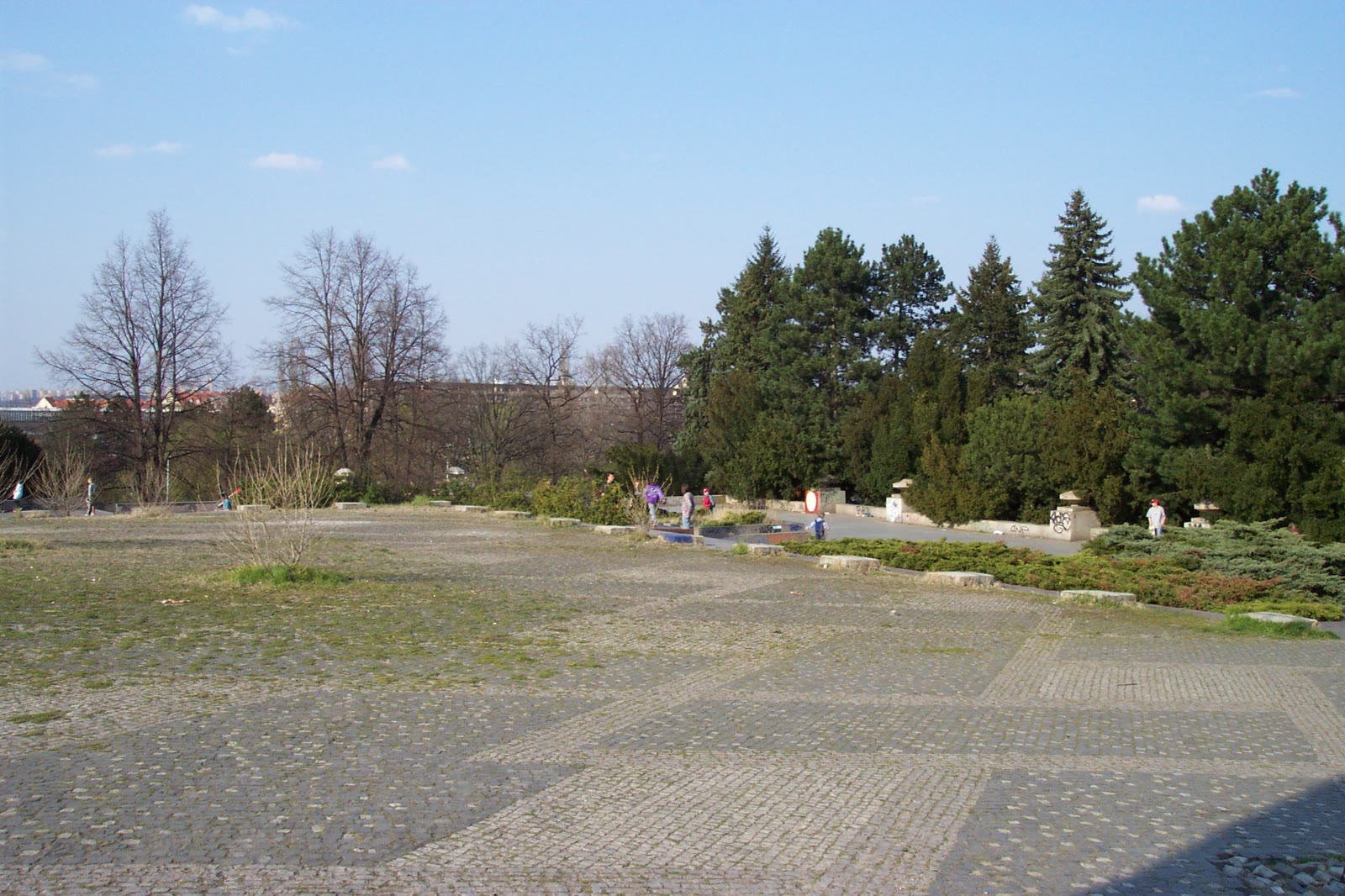
Prague has grander monuments than the Letna Metronome, but few places explain the city faster. The platform works as an elevated public room: skaters crossing one side, river air on the other, and a long bluff edge that turns the center into something readable rather than merely scenic. Keep the scope tight to two micro-anchors inside one place: the skate deck directly under the metronome, then the river bluff westward toward the Hanavsky view line. That is enough for a strong Prague stop if you run it in the right order.[1][2][3]
This is a non-food city-travel plan. The first anchor is movement and surface. The second is release and distance. The official city pages matter here because they explain why the place feels loaded even before you arrive: Letna Park grew out of nineteenth-century park-making on a hill that once held military and memorial functions; the Stalin monument was blasted away in 1962; the current metronome first moved on 15 May 1991; it stands nearly 25 metres high, weighs 7 tons, and was set in place by helicopter because the platform could not safely take a land installation.[1][2] Under that same platform sits roughly 10,000 m2 of interior space, one reason the site still feels oversized for an ordinary viewpoint.[2]
The most useful recent update is practical rather than symbolic. After two years of repairs, the metronome was running again by 24 August 2025, which means the site is no longer one of those half-broken landmarks you have to mentally excuse.[5] Put together, the historical weight and the repaired mechanism give Letna the right kind of tension: it is serious without being solemn, lively without needing an event to justify itself.
Anchor 1: the skate deck - read the platform before you read the skyline
Start with the deck immediately under the metronome. Prague City Tourism's own listing calls the area around it a "paradise for skateboarders," and that is operationally the right way to understand the first minutes here.[1] This is not a neutral plaza. It has live traffic, preferred lines, spectators who know where not to stand, and a constant distinction between people moving through the deck and people trying to convert it into a static lookout.
That difference changes behavior. If you stop dead in the center for a hero photo, you are reading the place as a monument forecourt and you will feel in the way almost immediately. If you hold the edge first and let the movement field reveal itself, the platform starts making sense. The metronome is the obvious object, but the real local knowledge is spatial: use the object to orient, use the deck to understand the social rhythm, then earn the panorama afterward.[1][7]
There is also a seasonal secondary program under the platform that matters without needing to dominate the visit. The current Stalin Letna page says the open-air cultural center operates from spring to September, with local-youth-oriented programming from Wednesday to Sunday. It lists Mon-Fri 14:00-0:00 and Sat-Sun 12:00-0:00 during the April-September season, and notes that selected events ask for a CZK 50 contribution with the first bar order.[4] The clean local move is to treat that venue as bonus atmosphere, not as the backbone of the stop. If the program is on, good. If it is quiet, the platform still works.
Anchor 2: the river bluff - let the city separate into layers
Only after the deck becomes legible should you drift west toward the bluff edge and the Hanavsky view line. Prague's own Letna material is unusually clear on why: the park is valued for its long, plane-tree-lined structure and for the unparalleled views across the center, with the terrace in front of Hanavsky Pavilion singled out in the accessible route guide as one of the most beautiful lookouts from the park.[2][3]
This is the point where Letna stops being one object and becomes a spatial argument. On the deck, Prague is compressed into motion and surface. On the bluff, the city separates: bridges, embankments, Old Town mass, Lesser Town lift, castle ridge, then the river doing the simplest possible job of holding them together. The bluff is not for arrival theater. It is for the second read.[2][3]
The timing logic is better than it first appears. If you want the platform as a quieter public room, arrive before the Stalin Letna operating window begins; if you want the place to feel socially charged, come later in the day while the seasonal program is alive.[4] If you are choosing August dates, add one more filter. Prague City Tourism's accessible Letna guide notes that the Marian-walls section of the park is quiet for most of the year but fills during the Summer Letna circus run every August, while Prague Morning's 2025 Prague Pride preview notes that the Saturday parade finishes in Letna Park after drawing 60,000 people the prior year.[3][6] That is enough to justify a hard local rule: do not assume an August Saturday will behave like a normal bluff stop.
8 local moves that materially improve the stop
First, enter from the plateau side, not from the river below, if this is your first visit. The accessible Prague route is built around Letenske Square and the upper park structure for a reason: the place reads better when you arrive flat and save the downhill reveal for later.[3]
Second, use the deck edge on first contact. The city listing's skateboarder warning is effectively a positioning note: center space is for movement, edges are for reading the place.[1][7]
Third, split the stop into deck first, bluff second. Letna gets stronger when the panorama comes after the social surface rather than before it.[1][2][3]
Fourth, treat Stalin Letna as a seasonal overlay. The official page makes clear that its real operating window is April-September, with activity clustered Wednesday-Sunday.[4] Build the stop so it still succeeds if the bar or cinema layer is not the thing carrying it.
Fifth, use two different time bands depending on intent. For a cleaner architectural read, arrive before the seasonal venue opens. For a more lived-in atmosphere, use late afternoon or early evening inside the operating window.[4][7]
Sixth, watch August calendars before you go. Summer Letna and Prague Pride can change the park from open bluff to event ground.[3][6]
Seventh, budget the stop correctly. A pure bluff-and-deck read costs CZK 0. Only selected Stalin Letna events add a CZK 50 first-order contribution.[4]
Eighth, let the repaired metronome matter. PSN's 2025 repair note is not just maintenance trivia; it means the landmark is again functioning as a moving civic object rather than a dead prop.[5]
Non-local trapline: 3 common mistakes and cleaner alternatives
Mistake 1: using Letna as a five-minute photo stop
Better move: stay long enough to read both surfaces: first the skate deck, then the bluff. The place is built on sequence, not one postcard angle.[1][2][3]
Mistake 2: walking straight into the center of the platform and planting yourself there
Better move: enter from the side and let the movement lines show themselves. Locals treat the central deck as active space, not neutral ground.[1][7]
Mistake 3: assuming every summer evening behaves the same
Better move: check the August event context, then decide whether you want a quiet bluff, a seasonal culture stop, or a full festival-adjacent crowd field.[3][4][6]
Concrete go details
- Primary anchor: Letna Metronome platform in Letna Park / Letenske sady.[1][2]
- Best quiet-read window: before the Stalin Letna program opens, especially outside major August event periods.[4][6][7]
- Best social-atmosphere window: inside the April-September operating season when Stalin Letna is active.[4]
- Seasonal venue hours: Mon-Fri 14:00-0:00, Sat-Sun 12:00-0:00.[4]
- Expected spend: CZK 0 for a pure platform-and-bluff visit; CZK 50 only at selected events with the first bar order.[4]
- Queue/reservation reality: none for the bluff itself; the real friction is event load, not ticketing.[3][4][6]
- Navigation cue: arrive from the upper Letna side first, then let the bluff and river edge become the exit logic.[3]
- Historic anchors: Stalin memorial removed in 1962; metronome first moved on 15 May 1991; height nearly 25 m; weight 7 tons.[1][2]
Portable takeaway artifact: the 45-75 minute Letna card
| Segment | Target window | Time budget | Decision rule | Why it works |
|---|---|---|---|---|
| Skate deck first read | Any dry day; strongest before or just after venue opening | 15-25 min | Stay off the center line and let the platform reveal its movement pattern | The deck gives the place its local logic.[1][4][7] |
| Bluff / Hanavsky view line | Immediately after the deck | 15-25 min | Move west only after the platform stops feeling like anonymous concrete | The panorama lands harder as a second read.[2][3] |
| Optional Stalin Letna linger | April-September, Wed-Sun emphasis | 15-25 min | Use only if the seasonal program fits your mood | The venue is additive atmosphere, not required structure.[4] |
Prague has higher towers and quieter gardens. Letna Metronome still does a rarer job. It turns civic memory, youth culture, and topography into one usable room. Run it flat-in and sequence it correctly, and the stop starts behaving like local knowledge instead of sightseeing residue.
Sources
- Prague City Tourism, "Metronome" (former Stalin-monument site; installed in 1991; seven-ton object; skateboarder-heavy platform).
- Prague City Tourism, "Letna Parks" (park context, Hanavsky views, metronome first moved on 15 May 1991, nearly 25 metres high, 7 tons, helicopter installation, 10,000 m2 under-platform space).
- Prague City Tourism, "Letna - Holding Prague in the palm of your hand" (upper-park route logic, Hanavsky terrace as a prime lookout, quiet-for-most-of-the-year Marian walls, Summer Letna every August).
- Prague City Tourism, "Stalin Letna" (spring-September season, Wed-Sun culture programming, April-September hours, selected-event CZK 50 contribution).
- PSN, "The Letna Metronome Ticks Again" (repairs completed and metronome running again on 24 August 2025 after two years of repairs).
- Prague Morning, "Mark Your Calendar: Prague Pride Returns in July for Its 15th Year" (2025 parade finishes in Letna Park; prior-year turnout of 60,000).
- Google Maps search, "Prague Metronome Prague" (recent visitor review stream used for crowd-timing and platform-behavior cross-checks; accessed 2026-03-26).
- Wikimedia Commons, "File:Praha, Letna, prostranstvi u metronomu.JPG" (documentary photograph used for the cover image).