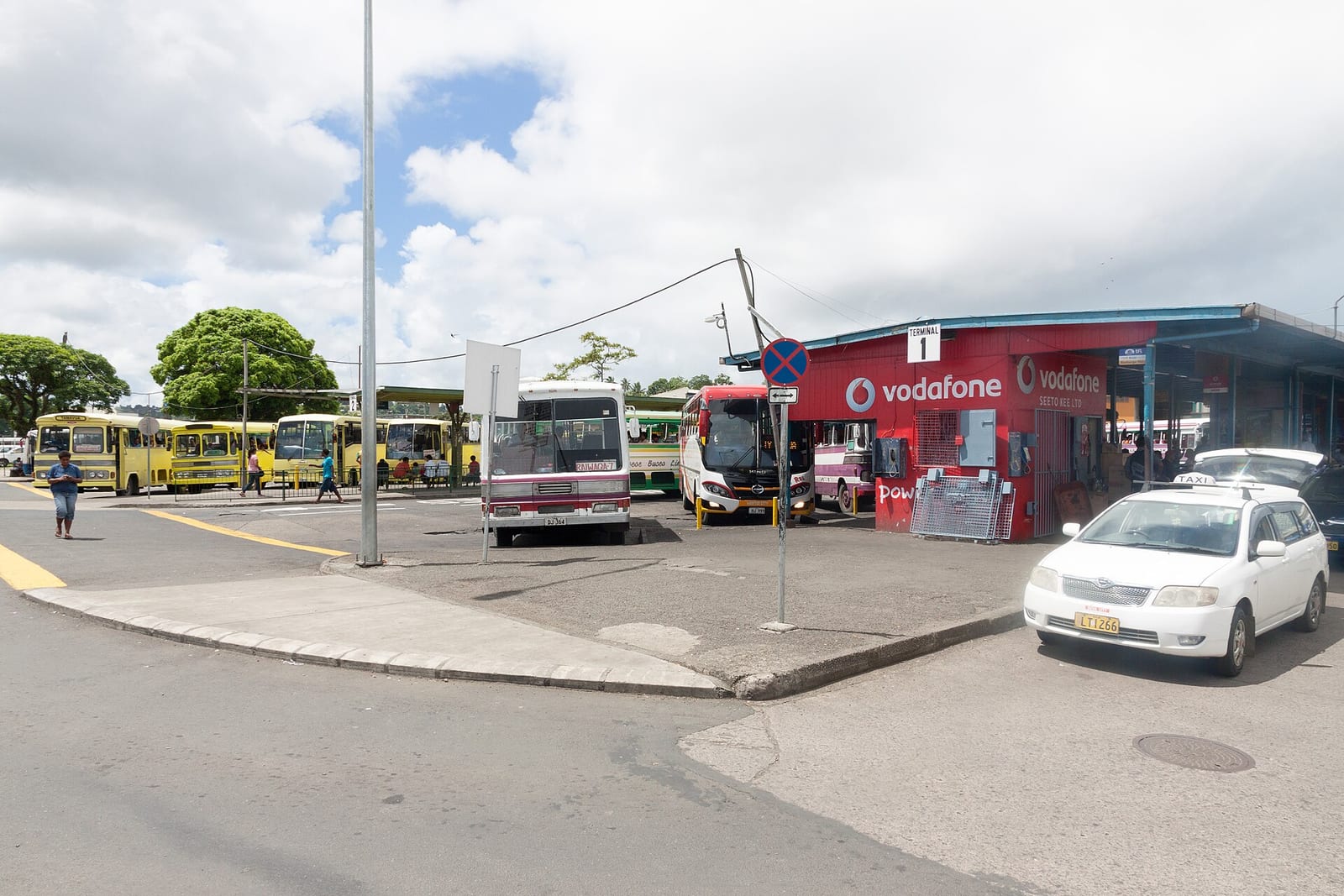
The useful question at Suva bus stand is not “Which bus goes there?” It is “Will this bus pass my landmark?”
That small change reveals how the station works. A destination board can name the far end of a service without explaining every street between. There is no dependable live route layer to settle the matter for you. The missing piece is supplied aloud: by a driver, a checker, a passenger already waiting at the window. A local community discussion gives the same advice repeatedly—ask whether the bus passes the place you need, and describe that place by a recognizable landmark rather than assuming a street name will do all the work [4].
Build one 60–90 minute city reading around that exchange. Keep Suva Bus Station as the primary anchor and the adjoining Suva Municipal Market edge as the second. Do not turn it into a market-food crawl. The story is movement: buses entering marked bays, passengers sorting themselves by partial information, wheelbarrows taking over where engines stop, and goods making the short transfer from regional transport to a city stall.
The best first pass is Thursday from about 08:00 to 10:00. Extra market tents begin appearing on Thursday, but the block has not yet reached the Friday–Saturday maximum described by local reporting [7]. Observation costs FJ$0. Board only if you already have a registered, topped-up eTransport card; the payment system is the one part of this social journey that cannot be improvised with a friendly question [5][6].
First, let one departure wave finish
Start on Rodwell Road at the bus-station side of the block. In February 2026, after a roughly FJ$1 million refurbishment, local reporting described clearer pedestrian paths, new signage, resealed surfaces, cleaned drains and surveillance cameras. It estimated that about 20,000 people use the facility each day [1]. Those numbers explain why this is not a picturesque collection of vintage buses. It is metropolitan machinery.
The photograph above predates that work by more than a decade [12]. Do not use its paint, terminal labels or curb layout as a current diagram. Use it for a more durable recognition cue: buses face different directions, operator colors overlap, a taxi rank occupies an edge, and a terminal number is easier to see than a complete journey. The 2026 works improved the physical grammar; they did not turn the station into an app.
The first local move is to use the marked pedestrian path and crossing, even if somebody else takes a shorter line. Stop where you are not narrowing a boarding queue or standing in a bus’s turning path. The old surface was rebuilt partly to make pedestrian movement more legible; treating the new markings as optional wastes the most useful part of the upgrade [1][2].
The second move is to watch one full cycle before asking anything. Give it 15 minutes: a bus enters, people identify it, a loose queue becomes a boarding line, parcels find space, the engine leaves and the bay resets. Fifteen minutes is an observation window, not a promised headway. In the local route discussion, one resident estimated 15–20 minutes on more populated routes at peak times and as much as an hour off-peak, but explicitly framed the system as something learned by timing and asking, not by consulting a complete map [4].
Now make the third move. Pick a modest city landmark, ask a driver or waiting passenger whether the bus passes it, and listen for the route between origin and destination. Do this before joining the queue. The question is the experiment; riding is optional. If two answers conflict, ask the driver rather than conducting a vote at the window.
At the market edge, engines hand work to hands
Walk the few steps toward Harris Road and the Municipal Market, but remain attentive to the station rather than surrendering to a list of tropical produce. The adjacency is not an accident. A University of the South Pacific history project records that Suva’s market moved twice before the present building opened in 1949, beside the newly constructed Rodwell Road and bus station. Its two open-air courtyards were later roofed, and a two-storey rotunda was added [3]. The market and terminal were designed into the same transfer point.
That history is still performed at pavement level. Vendors arrive from beyond central Suva; bags and bundles leave vehicles; wheelbarrow men carry loads through the distance a bus cannot cover. The fourth move is to follow one handoff with your eyes—from bay, to curb, to barrow, to market threshold—without tailing a worker or planting yourself in the line of travel. The important unit is not a commodity. It is the change in transport mode.
If you have something genuinely heavy, the fifth move is to hire rather than photograph the labor. A 2023 report on Suva’s wheelbarrow workers counted 100 men across four bases and quoted charges of FJ$3 within the market area and FJ$4 outside, varying with load and distance [8]. Treat those figures as a dated baseline, not a tariff: agree on today’s price before the barrow moves. If you have no load, keep the lane clear and let people work.
The sixth move is to circle part of the exterior before entering. A January 2026 account by a regular market shopper describes tarped kiosks selling practical services—phone top-ups, shoe and bag repairs—and layers of fringe stalls around a whole city block [9]. This outer belt is the hinge between terminal and hall. It is where a passenger can repair, recharge, carry and continue without turning the block into a curated visitor attraction.
Use the flower frontage as a recognition cue. Local reporting counted 42 florists at the market in 2024—23 permanent and 19 temporary—making bouquets, wreaths and special orders [10]. Flowers keep this non-food reading honest: they show that the transfer system carries ceremony and family obligation as well as household supply. The seventh move is to pause outside the working frontage, ask before making a close portrait, and keep any conversation short if an order is being assembled.
Only then step into the hall for 10–15 minutes. The eighth move is to look at the building’s logistics rather than inventory: narrow irregular aisles, reused containers lifting displays, hand-lettered signs, ground-floor stalls and the stair toward the upper-level spice and yaqona sellers [3][7][9]. In 2026, a UNDP pilot with 50 women vendors was testing a system that records each day’s float, sales, expenses and profit—an unusually clear reminder that what looks like informal abundance from the aisle is also a set of businesses trying to make cash income legible [11].
Route knowledge is flexible; payment is not
Old Fiji travel pages can create exactly the wrong expectation here. Disposable tourist cards once provided a one-off way to board. By November 2025, however, Fiji’s prime minister said the upgraded machines could not accept disposable cards and passengers needed registered cards [13]. From 15 December 2025, bus operators announced “no card, no ride”: no cash and no boarding without a topped-up eTransport card [6].
The ninth move, if you genuinely intend to ride, therefore happens before the station visit. Vodafone’s current guidance says new cards are issued through Vodafone and Valuefone outlets, first-time registration accepts a passport among other valid IDs, and the first registered card is free. Top up before arriving; the stored balance behaves like cash and is not recoverable for most lost cards [5]. Do not rely on a stranger tapping you aboard, and do not arrive with only a FJ$2 note because an old FAQ said a disposable card would be sold on the bus.
This is a real tradeoff. Registering a card can make sense for several bus journeys; it is disproportionate if you only want this one street portrait. In that case, watch the station, complete the market-edge loop and use another legitimate transport mode afterward. The article does not need a token ride to prove that the system exists.
Four visitor mistakes, corrected at the curb
Mistake one: treating a destination board as a route map. It tells you where the bus ends, not necessarily whether it passes your intermediate stop. Better: name a landmark and ask before queueing [4].
Mistake two: arriving at the Friday–Saturday peak, then stopping for photographs in a narrow aisle. The City Council says the market can hold about 3,500 vendors on those busy days, and local reporting notes that extra tents appear from Thursday [2][7]. Better: use Thursday 08:00–10:00 for readable flow, or go very early on Friday or Saturday if maximum intensity matters more than ease.
Mistake three: treating wheelbarrow workers as atmosphere. Their labor is the transfer mechanism that makes the two anchors function as one block. Better: hire one when you have a load, agree on the price first, or give the handoff lane space [8].
Mistake four: carrying cash but no topped-up card. Conversation can solve a routing gap; it cannot override the boarding rule. Better: register and top up in advance, or leave the bus ride out [5][6].
The compact go brief
- Anchors: Suva Bus Station first; the Municipal Market exterior and threshold second. No third stop is needed.
- Best window: Thursday, 08:00–10:00. For the fullest version, choose Friday or Saturday early morning and accept heavier pedestrian flow [2][7]. Verify holiday access with Suva City Council; current visitor listings disagree on exact closing hours.
- Time: 60–90 minutes total—about 20 minutes reading a departure wave, 25–40 minutes around the exterior handoff, and no more than 15 minutes inside.
- Expected spend: FJ$0 to observe. Use FJ$3–4 only as a 2023 wheelbarrow-service baseline and confirm the price; any bus fare and card balance are additional [8].
- Reservation and queue reality: no reservation. Allow at least 15 minutes to locate the right departure and ask about the route. Community headway estimates are anecdotal, not a timetable [4].
- Where to stand: behind marked pedestrian lines at the terminal; outside the wheelbarrow path at the market; never in a bay, turning lane or narrow aisle [1][2][9].
- Navigation cue:
Rodwell Road bus station → marked pedestrian crossing → Harris Road market edge → flower frontage → two-level hall threshold → return to the terminal[3][7][10]. - Boarding condition: a registered, topped-up eTransport card obtained before arrival. Cash and disposable tourist cards are not the current fallback [5][6].
- Weather move: carry a compact rain shell rather than opening a wide umbrella in the flow. Even after refurbishment, commuters told local media that more shelter from strong wind and rain was still needed [1].
Suva’s bus stand is readable once you stop demanding that it behave like a diagram. Its intelligence is distributed across signs, paint, habit and people willing to answer one precise question. At the market edge, that spoken route becomes physical labor: a bus opens, a wheelbarrow rolls, a stall receives. Watch one complete handoff and the block stops looking chaotic. It becomes a city explaining itself in verbs.
Sources
- Fijian Broadcasting Corporation, “Terminal upgrade boosts safety and commuter experience” (20 February 2026) — current refurbishment scope, FJ$1 million value, daily-use estimate and remaining shelter concern.
- Suva City Council, “Suva’s Municipal Market” — official account of the market’s national scale, Friday–Saturday capacity and role as a livelihood and supply center.
- Fijian History / University of the South Pacific, “Suva Municipal Market” (updated 14 July 2026) — 1892–1949 site chronology, bus-station adjacency and building evolution.
- r/Fijian, “Busses in Suva” (30 August 2025) — local community guidance on asking drivers or passengers, landmark-based directions and anecdotal frequency ranges.
- Vodafone Fiji, “eTransport App FAQs” — current card registration, accepted ID, outlet, top-up, fee and stored-balance rules.
- The Fiji Times, “‘No card, no ride’ — Bus industry to go cashless from Monday” (13 December 2025; updated 15 March 2026) — current topped-up-card-only boarding rule.
- Fiji Sun, “Inside the bustling Suva Market where Fiji comes to life” (6 August 2025) — two-level layout, Thursday tent setup, weekend rhythm and bus-stand proximity.
- Fiji Sun, “Wheelbarrow Boys Hustle for Survival on Suva Street” (20 September 2023) — workers’ own accounts, four-base headcount and dated FJ$3–4 service charges.
- Linda Jackson, “Tour the Chaos of Suva Municipal Market,” Shellphone Chronicles (25 January 2026) — recent regular-shopper account of exterior service kiosks, aisle geometry, family labor and the two-storey hall.
- Fijian Broadcasting Corporation, “Floriculture, a box of treasure” (25 July 2024) — florist count, permanent/temporary split and women’s enterprise at the market frontage.
- United Nations Development Programme Pacific Office, “Every Day Counts: Women Vendors in Suva Market Embrace SEDE” (8 June 2026) — 50-vendor pilot and daily cash-record workflow.
- Wikimedia Commons, “BusStation Suva MatthiasSuessen-8162.jpg” — source, date, authorship, license and original dimensions for Matthias Süßen’s real 2015 station photograph.
- Fijian Broadcasting Corporation, “PM responds to e-ticketing chaos” (3 November 2025) — government confirmation that upgraded machines do not accept the discontinued disposable cards.