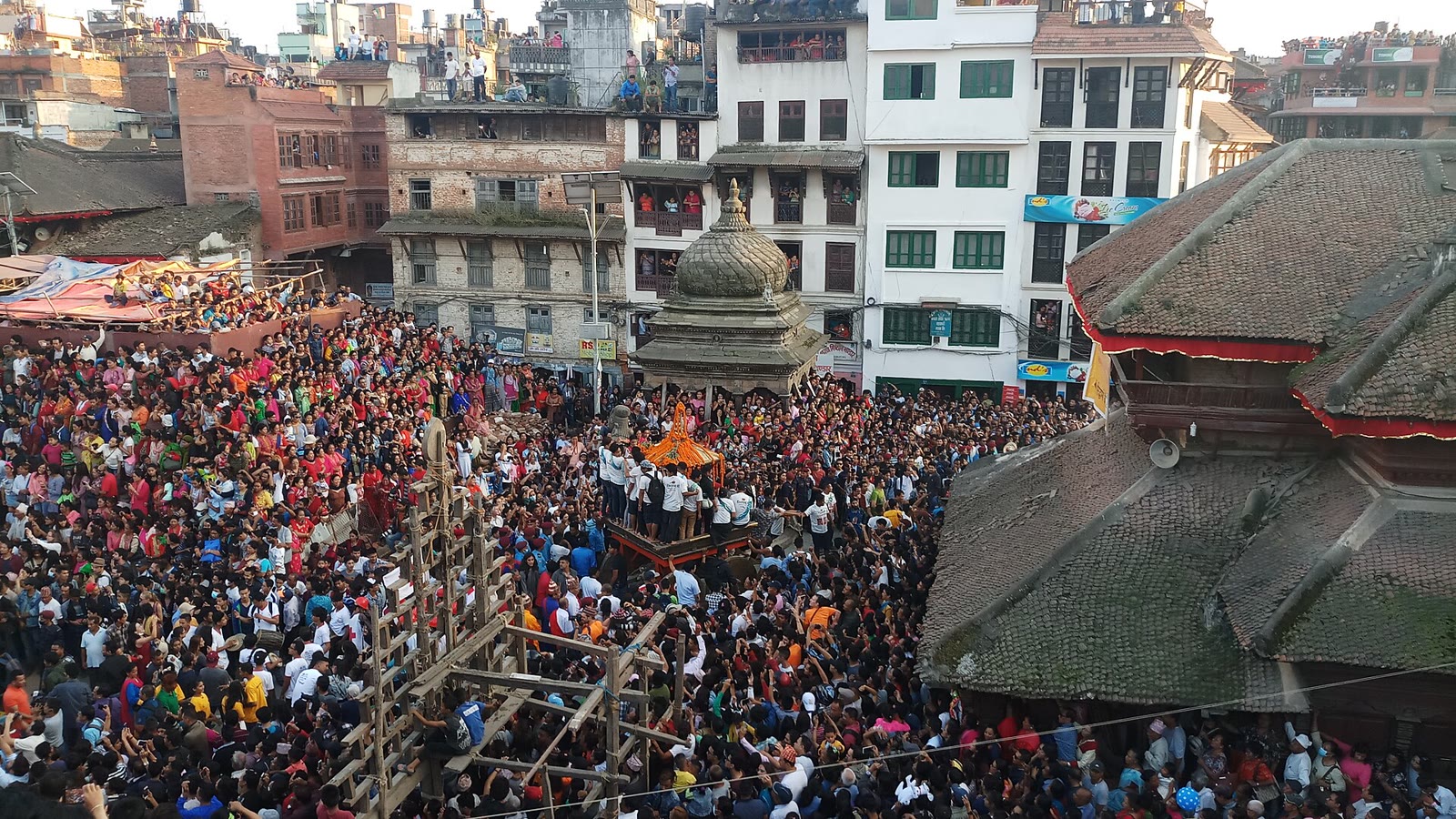
At Basantapur, the most useful decision is made before the ropes tighten: do not try to follow the chariot everywhere. See the living square before the pull, hold one respectful position as the three chariots leave, and let them come back to you. You will trade a dozen obstructed phone shots for the full transformation of Kathmandu Durbar Square—from waiting room, to ritual threshold, to homecoming.
For 2026, Nepal's official aviation calendar marks Friday, September 25 as the Indra Jatra holiday in Kathmandu Valley.[1] That date is a planning anchor, not a guaranteed start time. The festival follows a ritual calendar, and the pull proceeds on local instructions rather than a tourist timetable. Confirm the day's program through Kathmandu Metropolitan City and same-day Nepali reporting before leaving your hotel; a saved calendar date is not operational information.
One square, an eight-day city
Indra Jatra—also called Yenya—is not simply the afternoon when the Kumari's chariot appears. Across eight days, the ceremonial pole rises in front of Hanuman Dhoka, masks and deities normally kept from view enter public space, drums announce dances, and the chariots of Kumari, Ganesh, and Bhairav travel through the old city.[2][3] Recent images show why the scale matters: in September 2025, tens of thousands of devotees filled the palace square and the narrow streets around it.[9]
The processional geography is precise. The first pull, Kwoneyaa, leaves the Kumari house at Basantapur for the lower city and returns through Maru; Thaneyaa takes the upper-city route; Nanichayaa closes the cycle through the central lanes. Kathmandu Post's detailed account also describes Upaku, an earlier route along which bereaved families light lamps at shrines and communities display Bhairav masks that may appear only once a year.[4] That is the city-specific texture to hold onto: Yenya temporarily makes Kathmandu's ritual boundary visible. The chariot is spectacular, but it is moving inside a much larger act of remembrance and neighborhood stewardship.
This is why Basantapur works as the single anchor. Every chariot route begins and ends here.[3][4] Staying put does not mean seeing less; it means seeing departure and return as different moments.
Arrive for the waiting, not the published hour
For a first visit, aim to reach the square between 12:30 and 14:00, then expect to wait two to three hours—but adjust immediately if that year's official notice says otherwise. A local report from an earlier festival found the monument plinths occupied by noon, several hours before the procession began.[5] In a 2024 r/Nepal discussion, local commenters likewise placed that year's movement in the late afternoon and shared different neighborhood routes.[6] These are crowd signals, not a 2026 schedule.
Make the last approach on foot. Ask a taxi to stop at New Road Gate, then allow roughly 10–15 minutes for the ordinary walk toward Kathmandu Durbar Square and longer once police barriers and festival traffic reshape the streets.[7] Do not ask a driver to force a way to “Basantapur entrance.” The final vehicle bottleneck is precisely where you do not want to begin a dense public event.
Your recognition cue is the broad square opening beyond the old-city lanes, with Kumari Ghar's carved timber facade on its southern side. Choose an edge position with a clear route behind you, not a monument plinth and not the mouth of a lane. Keep the open strip in front of the chariots, volunteers, musicians, and worshippers clear. If police or route stewards shift the crowd, move early; a hard-won view is not a claim on sacred or emergency space.
There is no reservation and no seat to buy. The procession itself is public, but the Nepal Tourism Board currently lists normal Kathmandu Durbar Square admission at NPR 1,000 for most foreign nationals and NPR 500 for SAARC/BIMSTEC nationals; Nepalese visitors enter free, and children under 10 are exempt.[8] Treat that fee as a possible heritage-zone cost, not as a festival ticket or access guarantee. A sensible on-foot budget is the applicable admission plus NPR 300–600 for water and a simple snack away from the route.
Nine small moves that keep the moment intact
First, verify the pull on the morning itself. Second, finish the journey on foot from New Road rather than negotiating a road closure from the back seat. Third, arrive before the square looks “ready”; the waiting reveals chariot preparation, neighborhood arrivals, and the way drums gather attention before the wheels move.[3][5]
Fourth, stand with an exit behind you and resist the false elevation of temple steps or plinths. Fifth, carry only what you can keep in front of your body—closed shoes, one small bottle, a phone on a wrist strap, and no loose camera bag. Sixth, stay behind every rope, barrier, and steward. The traction ropes are working ritual equipment, not a visitor participation prop.
Seventh, follow the Nepal Tourism Board's baseline: ask permission before photographing people or religious ceremonies. In a dense public scene, keep frames wide, avoid intrusive close-ups or flash, and follow posted or steward instructions.[11] Eighth, when the chariots leave for the lower-city route, let them go. The lanes toward Maru, Chikanmugal, and Lagan are part of the procession, not a moving shortcut for spectators.[3][4] Remain in the square, watch how the space exhales, and be there when sound announces the return.
Ninth, wait 20–30 minutes after the return before attempting the same exit as everyone else. This is especially important if the crowd has tightened around Makhan or the New Road approach. If sustained crowd pressure, long standing, loud percussion, or an uncertain exit would be unsafe for you or a companion, choose one of the festival's quieter non-procession moments instead. Missing the pull is better than discovering your limit inside a narrow lane.
Three visitor mistakes—and the better alternative
The first mistake is arriving at the rumored start time. Local accounts show that useful positions disappear hours earlier, while ceremonial timing can vary.[5][6] Arrive for the build-up and treat delay as part of the event.
The second is chasing the chariot to collect every route. All three processional circuits return to Basantapur, and the streets between are working neighborhood space.[3][4] Pick one square, understand one departure, and wait for one return.
The third is assuming an annual festival cannot change. In 2025, political unrest and curfew forced the final chariot procession to be postponed and the close to be shortened.[10] The lesson is not to travel anxiously; it is to keep plans reversible. Check local reporting, obey closures, and never substitute an old route graphic for a live safety decision.
The cover photograph shows the choice clearly: the chariot is not isolated against a clean backdrop; it is held inside a field of people, brick, carved timber, and attention.[12] Indra Jatra is most legible when you stop trying to extract the chariot from that field. Let Kathmandu carry it away. Then let Kathmandu bring it home.
Sources
- Government of Nepal Ministry of Home Affairs, “Government and Public Holidays in 2083” — official notice. Pradhan Law, “List of Public Holidays, 2083” (10 March 2026) — English conversion listing Indra Jatra on 25 September in Kathmandu Valley.
- Nepal Tourism Board, “Indra Jatra” — official overview of the eight-day festival, Basantapur pole raising, masked dances, and Kumari procession.
- Sangita Shrestha, “Of Gods and Goddesses: Kathmandu readies for the spectacle of Indra Jatra.” OnlineKhabar, 3 September 2025 — recent local account of the ritual sequence and three chariot routes.
- Asmita Manandhar, “Here’s what happens on each day of Indra Jatra.” The Kathmandu Post, 10 September 2019 — local explanation of Upaku, Kwoneyaa, Thaneyaa, and Nanichayaa.
- “Indra Jatra celebrated.” Republica — local reporting from Basantapur on noon arrivals, preparations, and the lower-city return route.
- r/Nepal, “Indrajatra Celebrations in Ktm valley” (17 September 2024) — local community discussion of route choices, crowd participation, and that year's late-afternoon timing.
- Google Maps, “Kathmandu Durbar Square” — current place listing, pedestrian approach, and community access reports.
- Nepal Tourism Board, “Heritage site entry fees” — official Kathmandu Durbar Square admission categories and current listed prices.
- Associated Press, “Nepal’s festival season starts with a parade for a living goddess” (6 September 2025) — recent on-site confirmation of crowd scale and the festival's seasonal setting.
- Sanskriti Pokharel, “Nepal’s political turmoil puts heritage at risk.” The Kathmandu Post, 12 September 2025 — local reporting on the postponed final procession and curfew-driven changes.
- Nepal Tourism Board Trade, “Cultural Etiquette” — official visitor guidance on photography permission and conduct around religious places.
- Shadow Ayush, “Indra Jatra, Kathmandu Durbar Square” (24 September 2018). Wikimedia Commons — cover photograph source.