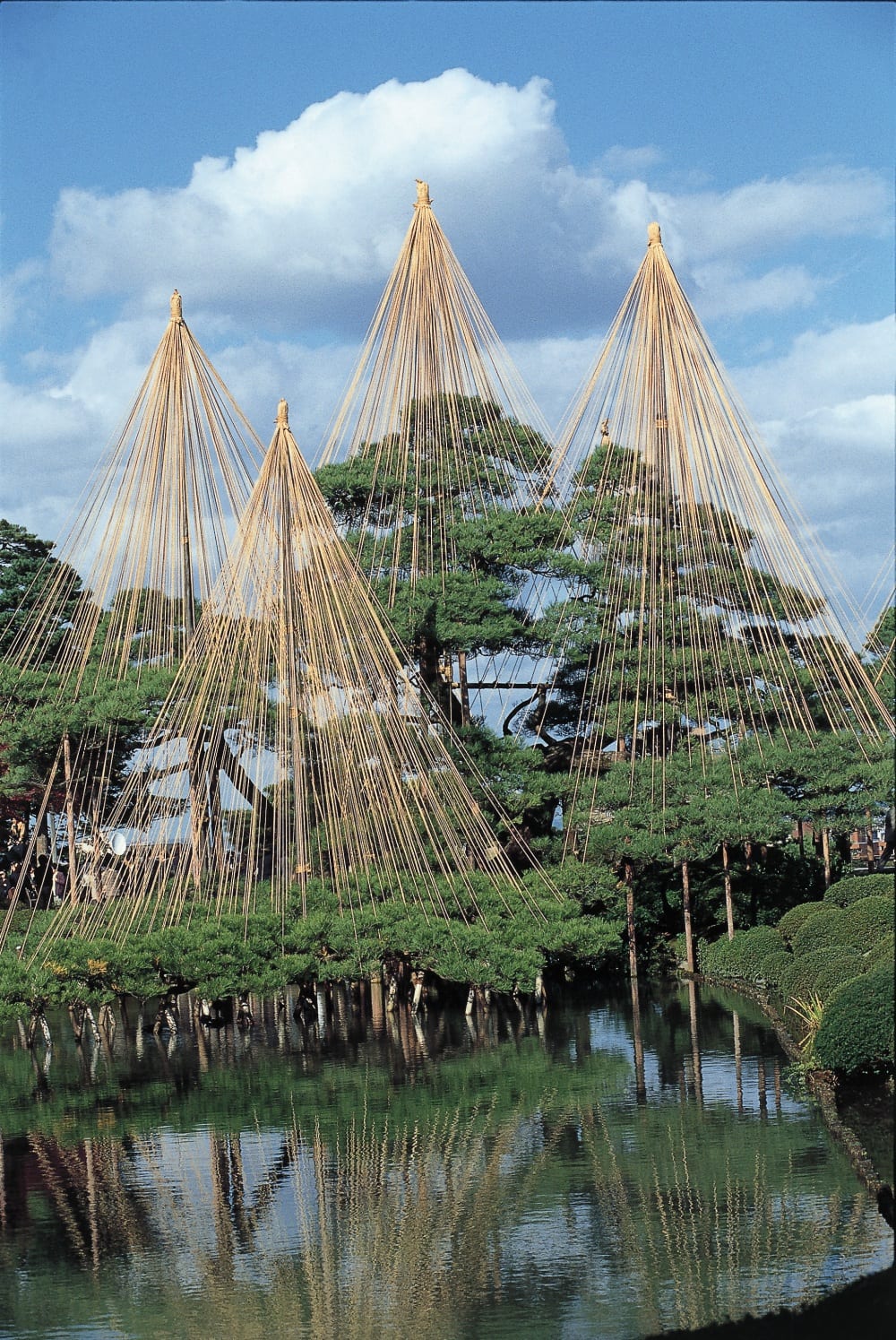
Kanazawa's winter begins as a vertical line. Before snow settles on Kenrokuen, gardeners raise a tall core pole through the Karasaki Pine, climb it, cast ropes outward and fasten them one by one to the spreading crown. When the work is complete, five poles and roughly 800 ropes hold one tree. From the front, the rope fans can look like four separate pines. That visual mistake is the best reason to slow down [1][6].
This is not a festival performance with a fixed curtain time. The annual baseline is November 1, but weather and worker safety decide the actual day. In 2025, heavy rain pushed the Karasaki Pine work to November 4, while crews began on lower trees first [3][6][10]. For a 2026 visit, treat November 1 as a prompt to check, not an appointment. The useful seasonal moment is the verified weekday when the garden is visibly becoming ready for winter.
Keep the visit to one non-food anchor: Karasaki Pine beside Kasumigaike Pond. Allow 60–75 minutes, spend ¥320 for adult admission during ordinary hours, and use 09:30–11:00 on a confirmed workday as an editorial target rather than a promised demonstration time [2][4][10]. The garden is larger than this encounter—11.4 hectares—but the point today is to watch maintenance turn into landscape [5].
Catch the making, not just the postcard
Begin with Kenrokuen's official notice or garden diary on the morning you go. The most recent documented season is a useful warning: an official November 1 notice postponed the high-pole work because conditions were unsafe, even though smaller installations continued [3]. Rain does not merely spoil a photograph here. Wet rope can tangle, and a gardener is working at roughly fourth-storey height on the tallest pole [1]. If the diary does not confirm the Karasaki Pine work, go only if the completed garden still interests you.
Next, choose the correct opening window for the thing you want. From November through February, Kenrokuen offers free early entry from 06:00, using only the Renchimon and Zuishinzaka entrances; early visitors must leave 15 minutes before the regular 08:00 opening [4]. That window is excellent for quiet reflections after the ropes are installed. It is a poor bet for seeing a working crew. If installation is the purpose, enter during paid hours on a weekday after a live check. Official garden reporting says the wider yukitsuri work proceeds on weekdays until about mid-December [2].
Before boarding, save the exact return stop. From the “Kenrokuen Garden・Kanazawa Castle Park” bus stop, the garden is about a 3-minute walk [5]. During ordinary hours, follow the signed entrance and ask for Karasaki Pine or Karasaki-no-matsu if the internal route is unclear. Do not save only “Kenrokuen” as a broad pin: the garden has multiple gates, while early admission narrows the usable pair [4].
Five cones, one imported name
Once inside, go to Kasumigaike before committing to a full garden circuit. Kenrokuen's official standard route is 1,300 metres and about 90 minutes; it places the Karasaki Pine immediately beside the pond sequence [8]. On a workday, a complete loop can put you at the pine after a crew has paused or moved. Find it first, then decide how much garden to add.
Its name carries another landscape inside this one. A local guide traces the tree to a specimen obtained at Karasaki in present-day Shiga by the 13th Maeda lord, Nariyasu. The tree is now about 190 years old, with a crown spreading roughly 26 metres [1][6]. Kanazawa did not simply import a specimen. It kept reshaping that specimen until a Shiga place-name became one of the city's clearest winter recognition cues.
The five cones are a response to that width. One central pole could make a handsome silhouette, but it would not distribute support across the whole lateral crown. At Karasaki Pine, the crew uses five poles and about 800 individual ropes. The gardener above reads the balance; colleagues below receive, place and tension each line [1]. The result looks graphic from a distance, but it is not a diagram imposed on the tree. It is a temporary load path fitted branch by branch.
From the public path, study the unfinished side rather than only the finished cone. Stay outside any barrier. Compare a pole whose ropes have already reached the branches with one still carrying loose vertical lines. Look for three things: whether the pole stands straight, how the ropes spread around the crown, and how the lowest branches reach over the water. The official photograph used for this article records the completed geometry clearly, without pretending that the making and the snow happen at the same time [9].
Let one work pause improve the visit
The wider operation is easy to underestimate. Kenrokuen uses yukitsuri at more than 800 points, in several forms rather than one repeated cone. Seven dedicated prefectural gardeners coordinate an effort totaling roughly 500 worker-days; across the garden, about 4 tonnes of locally braided straw rope would stretch approximately 120 kilometres if joined end to end [1][2]. The famous ringo-zuri cone is only one technique alongside trunk suspension, bamboo-fork support and binding [2].
That scale explains why the work is not choreographed around a visitor's arrival. When the crew pauses, give the tree 20–30 minutes before deciding the work is over. Make a short pond-side circuit without leaving the anchor, then return once. A 2025 local eyewitness did exactly that and found the crew back on the second pole after the circuit [10]. A current review aggregation treats Karasaki Pine as a destination in its own right and repeatedly emphasizes the long branches over water and the winter supports [7]. The local guide's 2025 account adds the more useful correction: although the pine is normally first, bad weather can invert the sequence and put lower trees ahead of it [6].
Do not ask workers to restart, look up or clear a frame. Their task joins height, wet material and public foot traffic. Treat the edge of the working space like a local public boundary: keep moving when the path narrows, take the photograph from an established stopping point, and let staff sightlines outrank yours. A good image shows the work as work; it does not require entering it.
Finally, choose one season rather than demand two. Installation runs from November into mid-December, while the completed supports remain through roughly mid-March [1][2][6]. Snow is possible, not included. If you want hands, ropes and an unfinished pole, target the confirmed installation period. If you want snow resting on the completed structure, return in winter and accept that weather may still give you blue sky.
Four visitor mistakes, retied
Mistake one: booking November 1 as though it were a ticketed show. The date is a working baseline, not a weather guarantee; 2025's main installation slipped by three days [3][6]. Better: check the official diary, then keep a completed-garden fallback.
Mistake two: using the free 06:00 entry to hunt for active gardeners. Early admission is a separate access window with only two gates and a mandatory exit before ordinary opening [4]. Better: use early entry for quiet, or enter during paid hours on a confirmed weekday for a chance of seeing work; one 2025 local observer reached the pine at about 10:00 [2][10].
Mistake three: photographing four “trees” and leaving. The local guide notes that four rope fans are most visible head-on, but all five support a single pine [6]. Better: shift along the public path until the crown reads continuously across the poles.
Mistake four: treating rope and snow as one guaranteed scene. Local accounts show the installation happening under clear November skies after rain altered the work sequence; it begins before winter has delivered its postcard because more than 800 supports take weeks to finish [1][2][6][10]. Better: decide whether your subject is the making or the weather, and let the other be a bonus.
The go details
- Anchor: Karasaki Pine at Kasumigaike Pond inside Kenrokuen Garden; no second attraction is needed [5][8].
- Best work-viewing target: 09:30–11:00 on a weekday, only after the official diary confirms that installation is proceeding. This practical window includes the roughly 10:00 arrival documented by a local eyewitness; it is not an official performance schedule [2][3][10].
- Quiet completed-view target: 06:00–07:30 from November through February, entering only at Renchimon or Zuishinzaka and leaving before the required early-entry cutoff [4].
- Time needed: 60–75 minutes for the pine, one short pond circuit and one return. The official full standard garden route is 90 minutes / 1,300 metres [8].
- Expected spend: ¥320 per adult during regular hours; early admission is free. Bring cash: the official English guidance says admission fees are cash-only. Transit and optional tea are separate [4].
- Queue and reservation reality: there is no reserved viewing slot for the work. The constraint is a shifting public-path cluster, weather and the crew's operating boundary—not a seat inventory [2][3][7].
- Navigation cue:
Kanazawa Station-area bus → Kenrokuen Garden・Kanazawa Castle Park stop → roughly 3-minute signed walk → Kasumigaike Pond → one wide pine under several tall rope cones[5][8]. - Recognition cue: from the frontal view, four rope fans may dominate, but the complete system uses five poles around one 26-metre crown [1][6].
- Live check: confirm the date, weather, open gate and current work location separately. A normal garden opening does not confirm that gardeners will be on Karasaki Pine [2][3][4].
At Karasaki Pine, the seasonal change is not the first flake. It is the moment a gardener makes a straight line stand inside an old, horizontal tree. Hundreds of ropes follow, and a practical defense against wet snow becomes Kanazawa's winter silhouette. Come for the labor rather than a guaranteed postcard, and five poles will show you something one cone cannot: this garden survives by being remade in public.
Sources
- Ishikawa Prefecture, “4 tons of rope and 500 artisans: how Kenrokuen's yukitsuri is made” (November 7, 2025) — recent official account of the Karasaki Pine's age, 26-metre spread, five poles, roughly 800 ropes, staffing, rope volume and installation sequence.
- Ishikawa Prefecture Kanazawa Castle and Kenrokuen Management Office, “Yukitsuri work is underway” (November 15, 2025) — recent official field update on weekday work through mid-December, more than 800 installation points and the four support methods used in the garden.
- Ishikawa Prefecture Kanazawa Castle and Kenrokuen Management Office, “Postponement of Karasaki Pine yukitsuri” (November 1, 2025) — primary notice moving the high-pole work to November 4 or later for worker safety while lower-tree work continued.
- Kenrokuen, “Guidance” — official seasonal opening hours, ¥320 adult admission, free early-entry windows, the two early gates, required exit cutoff and park-use rules.
- Visit Kanazawa, “Kenrokuen Garden” — official city guide to the 11.4-hectare garden, Kasumigaike, winter supports, address and 3-minute walk from the named bus stops.
- Takeshi Minami, “Kenrokuen's winter tradition, yukitsuri, appears three days late,” Kanazawa o Kankō Shite Mitai Kamo (November 8, 2025) — recent local guide account of the weather delay, one-tree/five-pole reading, Karasaki origin, seasonal sequence and work across the city.
- Wanderlog, “Karasaki Matsu (Pine Tree)” — current Google-review aggregation used as the community platform check for the tree as a distinct waypoint, its over-water branches and visitor emphasis on the winter supports.
- Kenrokuen, “Stroll Map” — official clockwise route map locating Karasaki Pine beside Kasumigaike and giving the standard garden circuit as 90 minutes and 1,300 metres.
- Ishikawa Tourism Federation, “Kenrokuen: Karasaki Pine (yukitsuri)” — official source page for the real vertical photograph used as the article image.
- N-shi, “Watching the Karasaki Pine yukitsuri work,” N-shi's Kanazawa Stroll Diary (November 13, 2025) — recent local eyewitness account of the heavy-rain postponement, an arrival at about 10:00 and work resuming after a 20–30-minute pond circuit.