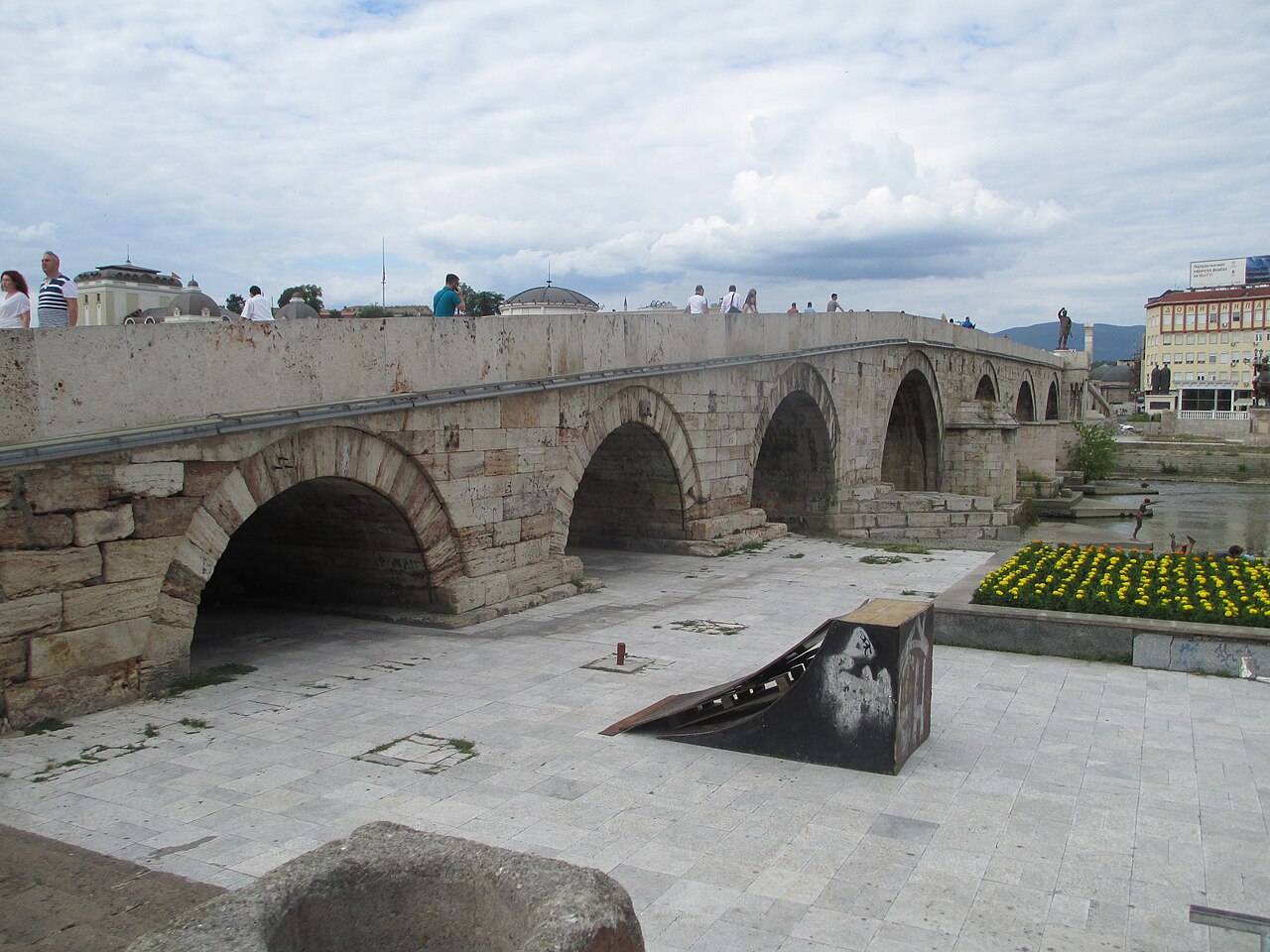
Do not start Skopje by trying to see everything. Start with the Stone Bridge and let it do one job well: make the city change sides under your feet. The bridge crosses the Vardar between Macedonia Square and the Old Bazaar, and the official city portal goes so far as to put the Stone Bridge, the Vardar, Kale fortress and the Sar mountains inside the city's coat-of-arms description [1]. That is the first clue. This is not a scenic add-on. It is the civic hinge.
The route is compact enough to sound too obvious: Macedonia Square, Stone Bridge, the first bazaar lanes, then a slow drift toward the craft-shop streets rather than a sprint to the next landmark. But Skopje punishes the visitor who treats the bridge as a two-minute photo stop. North Macedonia Timeless frames the Old Bazaar as lying over the bridge on the left side of the Vardar, a part of the city where economy, trade, culture and tradition still overlap in functional streets rather than in a sealed museum quarter [2]. The point is to cross slowly enough that the river, square, stone, shops and older Ottoman fabric register as one threshold.
The best window is 08:30 to 10:30, before tour groups and souvenir browsing flatten the bazaar into one noise level. A second good window is 17:30 to sunset, when the bridge is still legible but the shopfront rhythm has softened. Midday works only if you accept glare, harder pavement, and a more transactional feel. Budget 60 to 75 minutes for the tight version: 10 minutes around Macedonia Square, 10 minutes on and around the bridge, 35 to 45 minutes inside the bazaar, and another few minutes to turn back toward the river before leaving.
There is no reservation reality here, which is part of the appeal. The bridge is a pedestrian crossing, and Visit Skopje describes the bazaar itself as open 24 hours, while noting that individual shops usually open around 9 a.m., close around sunset, and may take afternoon breaks [4]. That means the place is physically available even when its commercial life is not. If you care about craft shops, go after 9 a.m. If you care about atmosphere, go earlier and let the shutters, stone lanes and call-to-prayer soundscape do more of the work. If you care about photos, wait on the square side until the bridge has a gap rather than stepping backward into other people's path.
The first local move is to stand before crossing, not in the middle of the bridge. Use the Macedonia Square side to orient: river below, bazaar ahead, fortress above and slightly left. Then cross at walking pace without stopping every ten steps. North Macedonia Timeless gives the bridge's traditional measurements as 213.85 metres long, 6.33 metres wide, with 13 semicircular arches and 329 steps in its older description [3]. You do not need to recite those numbers on site, but you should feel the narrowness. It is a public artery, not a private viewing platform.
The second move is to let the bridge finish before the bazaar begins. Many visitors hit the far bank, see the first shop line, and start browsing immediately. Better: keep moving just long enough to feel the street grain tighten. The Old Bazaar is not one stall row. North Macedonia Timeless names preserved Ottoman-period structures including Kapan An, Suli An, Kurshumli An, Daut Pasha Hamam, Chifte Hamam, churches, museums and craft streets, and says the bazaar's strongest development ran from the 15th to the 19th century [2]. That density is why rushing makes it feel smaller than it is.
The third move is to shop by looping, not by entering the first glittering doorway. A local r/mkd discussion about whether the Old Bazaar is a tourist trap is useful because the advice is not "avoid it." Residents push a subtler line: for jewellery and craft browsing, the bazaar can still be the right place, but compare several shops, feel the prices, and avoid assuming every newish or fancy-looking place is the best local choice [6]. That is the difference between local patience and visitor panic. If you want a small object, do one scouting pass before buying.
The fourth move is to treat food and coffee as pauses, not the mission. This is a non-food route. Sit only after you have walked enough of the lane network to know whether you want the main drag or a quieter side. Tripadvisor's Old Bazaar page is useful as a community signal, with more than 2,000 reviews and recent visitor comments continuing to emphasize coffee, shops, antique browsing, restaurants and cafe life [5]. Use that as a reminder that the bazaar supports lingering. It is not a command to turn the first hour into a restaurant search.
The trapline is straightforward. Trap one: crossing the bridge only to prove you were there. Better alternative: cross once slowly, then turn back from the bazaar side for the reverse view before committing to the lanes. Trap two: assuming "bazaar" means cheap by default. Better alternative: compare prices across several shops and let the seller's pace matter as much as the object [6]. Trap three: arriving late and being surprised that the commercial texture has thinned. Better alternative: use the 9 a.m. to late-morning window if shops matter, or choose early/evening if the street room matters more [4]. Trap four: treating the river as empty space between attractions. Better alternative: use the Vardar as the orientation line that keeps you from reading old and new Skopje as disconnected postcards.
Expected spend can be zero. Add money only for coffee, a small craft purchase, museum entry, or food later. Cash is useful for small transactions, but do not use that as an excuse to buy before you have looked around. The practical navigation cue is simple: from Macedonia Square, aim for the Stone Bridge, cross toward the Old Bazaar, then let the first wider bazaar lane carry you inward before choosing a side street. If you lose the river in your head, step back toward the bridge or toward Kale's slope until the city resets.
What makes this micro-walk specific to Skopje is the refusal of one clean story. The city official page treats the bridge as a symbol. The tourism pages treat it as the connection between centre and bazaar. Community reviews treat the bazaar as alive enough to argue about: good, touristy, affordable, expensive, atmospheric, crowded, worth it, easy to mishandle [1][3][5][6]. All of those can be true because the route is not a museum corridor. It is a working threshold where national symbol, pedestrian crossing, inherited trade district and visitor economy all share the same short walk.
End by returning to the bridge after the bazaar has changed your eye. Macedonia Square will look more theatrical from this direction, and the bazaar will feel less like a backdrop behind you. That is the whole reason to keep the route short. In 60 minutes, Skopje can teach you how to cross it: not by collecting landmarks, but by noticing where the city asks you to slow down.
Sources
- City of Skopje, "Facts and symbols of the City of Skopje" - official city page describing the capital, the Vardar setting, and the Stone Bridge in the city coat of arms.
- North Macedonia Timeless, "Old Bazaar" - official tourism page on the bazaar's location, Ottoman-period structures, craft streets, green market and historical development.
- North Macedonia Timeless, "Stone Bridge" - official tourism page on the bridge's role between Macedonia Square and the Old Bazaar, history, pedestrian access and measurements.
- Visit Skopje, "Old Bazaar Skopje - Historic Market and Cultural Heart of Skopje" - local guide updated May 16, 2026, with location, opening pattern and visitor context.
- Tripadvisor, "Old Bazaar - Skopje" - community review page with current attraction ranking, review volume and recent visitor signals about shops, cafes and browsing.
- Reddit r/mkd, "Is the Skopje Old Bazaar a tourist trap?" - local/community discussion on craft shopping, price comparison and how to avoid the rushed souvenir version of the bazaar.
- Avi1111, "Stone Bridge (Skopje).JPG," Wikimedia Commons - photographic source for the article image.