Start under the city, at Serdika, not in front of the cathedral. Sofia's most useful first walk is not a monument hunt. It is a short civic axis where Roman street, socialist state architecture, yellow paving, church square and mountain-facing boulevards all touch without fully agreeing. If you begin at Alexander Nevsky, you get the postcard first and spend the rest of the hour filling in context. If you begin at Serdika, the city explains itself in layers.
The route is simple: surface at Serdika, stand long enough to read the Largo and the exposed ancient Serdica remains, then follow the yellow-pavement line east toward St. Sofia Church and Alexander Nevsky Square. The official city guide places Alexander Nevsky Square, the National Assembly and the surrounding monumental core together in the same civic frame, while the cathedral's own site fixes the practical anchor at Alexander Nevsky Square, Sofia 1000 [1][2]. This is a small walk, but it is not a lightweight one. It is Sofia's habit of putting old, imperial, religious and administrative claims in the same camera frame.
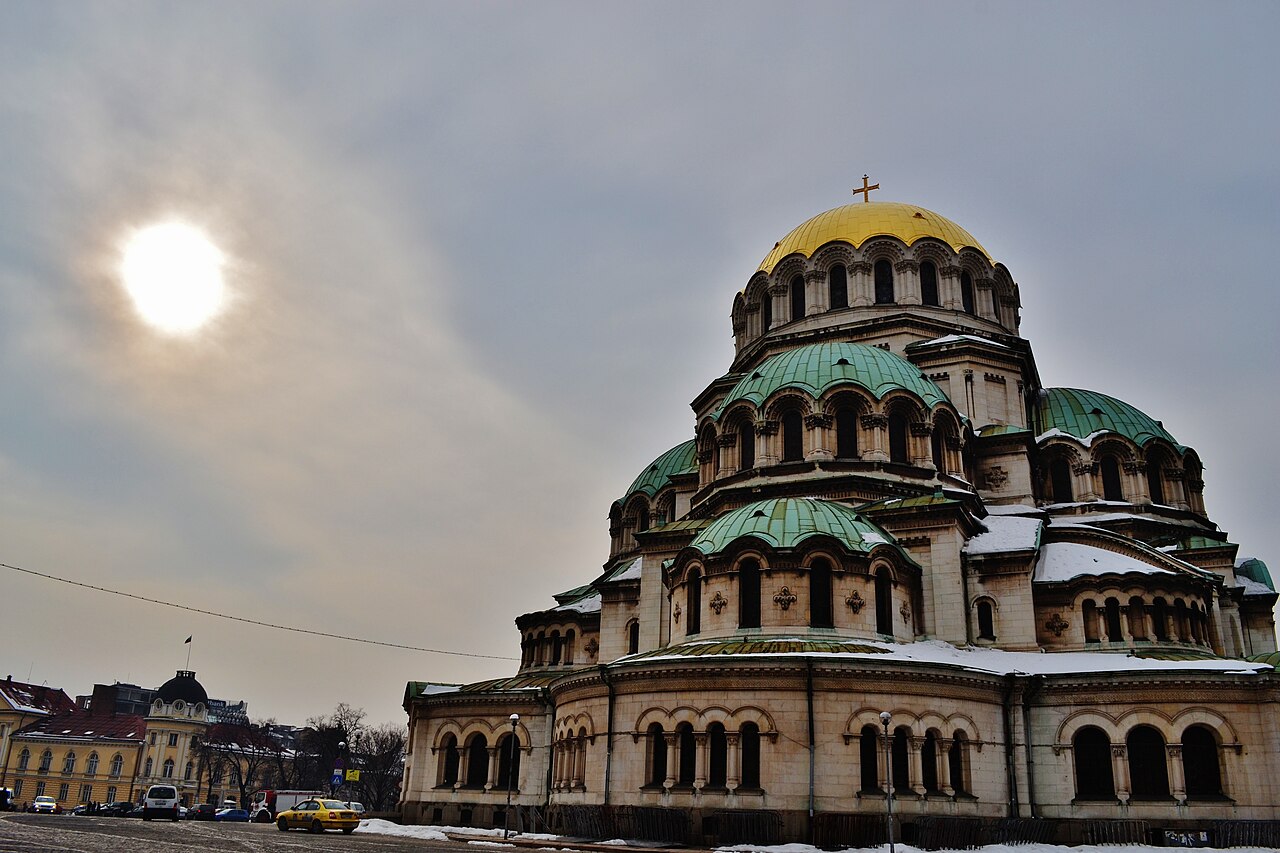
The best window is 08:30 to 10:30 if you want the pavement and cathedral square before the center hardens into traffic and tour groups. The second-best window is after 17:30, when the domes begin to warm and office movement thins. Midday is not fatal, but it makes the axis feel more like an errand corridor. The local move is to treat the walk as a sequence of pauses rather than a straight transfer: five minutes at the Roman remains, two minutes looking back at the Largo, ten slow minutes along the yellow pavement, then a full loop around the cathedral before deciding whether to go inside.
Getting there should be boring. Use the metro to Serdika and tap a contactless card at the barrier if you are only doing occasional travel. Metropolitan Sofia lists 2026 transport documents with a 0.80 euro / 1.86 BGN Ticket 30 Plus for trips with transfers in the first 30 minutes, and a 3 euro / 5.87 BGN 24-hour card if you are stacking rides [3]. The key visitor rule is not the price. It is validation. If you use a transferable ticket, validate on each vehicle; if you use a bank card, keep using the same card so the system can read the trip pattern correctly [3].
Once above ground, resist the fastest map line. The first non-local trap is diving straight east because the cathedral dome is the only thing you came to see. The better alternative is to let the Largo do its strange work. A recent downtown walking guide usefully describes central Sofia as a compact, mostly walkable core of roughly 1.2 kilometers around Serdika, Alexander Nevsky, Slaveykov Square and the synagogue, with Roman Serdica visible inside the metro-station landscape [5]. That compactness is exactly why people rush. Do not. Sofia's center rewards the visitor who lets distances stay short but attention stay slow.
The second trap is treating the yellow paving as a decorative quirk. Local threads keep returning to it because it is one of the center's identity markers, not just a photogenic surface. In one r/Sofia discussion, a resident points a visitor toward the Free Sofia Tour explanation of the yellow paving; in another recent local audio-walk thread, the creator frames Alexander Nevsky, St. Sofia Church and the Rotunda as a 90-minute route where the pavement and overlooked church matter as much as the headline cathedral [6][7]. The useful takeaway is practical: keep your eyes down as well as up. The pavement is uneven in places, slicker after rain, and easiest to read when you are not walking in the road to photograph it.
There are eight small moves that make this walk work. First, start at Serdika even if your hotel is nearer Vitosha Boulevard; the underground-to-square reveal gives the route its logic. Second, step aside before photographing the ruins, because the archaeological passages also function as daily movement space. Third, use the north edge of the Largo to orient rather than standing in the middle of crossings. Fourth, follow Tsar Osvoboditel east without assuming every yellow-paved lane is pedestrian-first. Fifth, circle Alexander Nevsky from the outside before entering so the building reads as an object in a square, not only as an interior.
Sixth, if you enter the cathedral, lower the whole pace. This is a working Orthodox cathedral, not a museum lobby; the official cathedral site identifies it as directly subordinated to the Holy Synod, and the city guide notes major service times, including Saturday evening and Sunday morning services [1][2]. Seventh, keep small cash if you plan to tip a guide or enter smaller paid spaces; Free Sofia Tour says its main sightseeing walk runs daily and is donation-supported [4]. Eighth, if you join that tour, arrive ten minutes early and treat it as orientation rather than outsourcing the whole city. The tour is a good first pass; the best version of the route still needs your own second look.
The third trap is making Vitosha Boulevard the automatic finish. It is convenient, and the mountain view from the shopping street can be satisfying on a clear day, but this particular walk should end at Alexander Nevsky or St. Sofia Church, not in a cafe strip. The whole point is to understand Sofia as a civic plateau. If you need a sit-down afterward, choose the garden and theater side later. For this hour, keep the axis intact: Serdika, Largo, yellow pavement, St. Sofia, Alexander Nevsky.
Expected spend can be zero if you only walk and enter free public spaces. Add 0.80 euro for a single metro ride if you arrive by transit, a guide donation if you join a walking tour, and small entry fees only if you choose the cathedral crypt or other interiors mentioned by current local guides [3][4][5]. Queue pressure is modest compared with larger European capitals, but do not mistake that for full access at all times. Services, restoration work, official events, rain, and traffic can change the feel of the square faster than a static itinerary admits.
The most Sofia-specific detail is that the city refuses to arrange itself into one clean era. Ancient Serdica is not sealed away in a remote museum. The Largo does not disappear because the Roman layer is older. Alexander Nevsky does not make St. Sofia irrelevant; in fact, the smaller church is the reason the route has a name problem worth noticing. That is why the walk is strongest when it stays short. In roughly 60 to 90 minutes, it lets you feel Sofia as a city of adjacent claims: underground and ceremonial, Orthodox and administrative, monumental and worn underfoot.
End by turning back once from Alexander Nevsky Square toward the direction you came. The domes will still dominate, but the view changes after the walk has taught you what lies behind them. Sofia's best first hour is not the photo of the cathedral. It is the approach that makes the photo less lonely.
Sources
- Patriarchal Cathedral St. Alexander Nevsky, "Visit us" - official cathedral page giving institutional status, address and contact information for the Sofia cathedral.
- Visit Sofia, Discover Sofia Travel Guide PDF - official Sofia Municipality guide covering Alexander Nevsky Square, the cathedral context, the crypt, service-time notes and the surrounding civic core.
- Metropolitan Sofia, "Trip tickets of the Sofia Metro" - official 2026 transport-document page for metro ticket prices, Ticket 30 Plus, Ticket 60 Plus, 24-hour and 72-hour cards, and validation rules.
- Free Sofia Tour, official homepage - local walking-tour operator page with current daily tour schedule, meeting logic, donation model, and Sofia landmark coverage.
- Tours Bulgaria, "Downtown Sofia: Walkable Things to Do in the City Center (2026)" - recent local walking guide with Serdika/Largo, Alexander Nevsky, walking distances, free-entry notes, and downtown route timing.
- Reddit r/Sofia, "I noticed a lot of streets from the city center are paved..." - local/community discussion pointing visitors toward the yellow-pavement explanation and treating the paving as a distinctive central-city feature.
- Reddit r/Sofia, "I built a free audio walking tour of Sofia..." - recent local/community route discussion linking Alexander Nevsky, St. Sofia Church, the Rotunda, yellow pavement and the tendency to over-photograph the cathedral.
- MrPanyGoff, "St. Alexander Nevsky Cathedral, Sofia.jpg," Wikimedia Commons - photographic source for the article image.