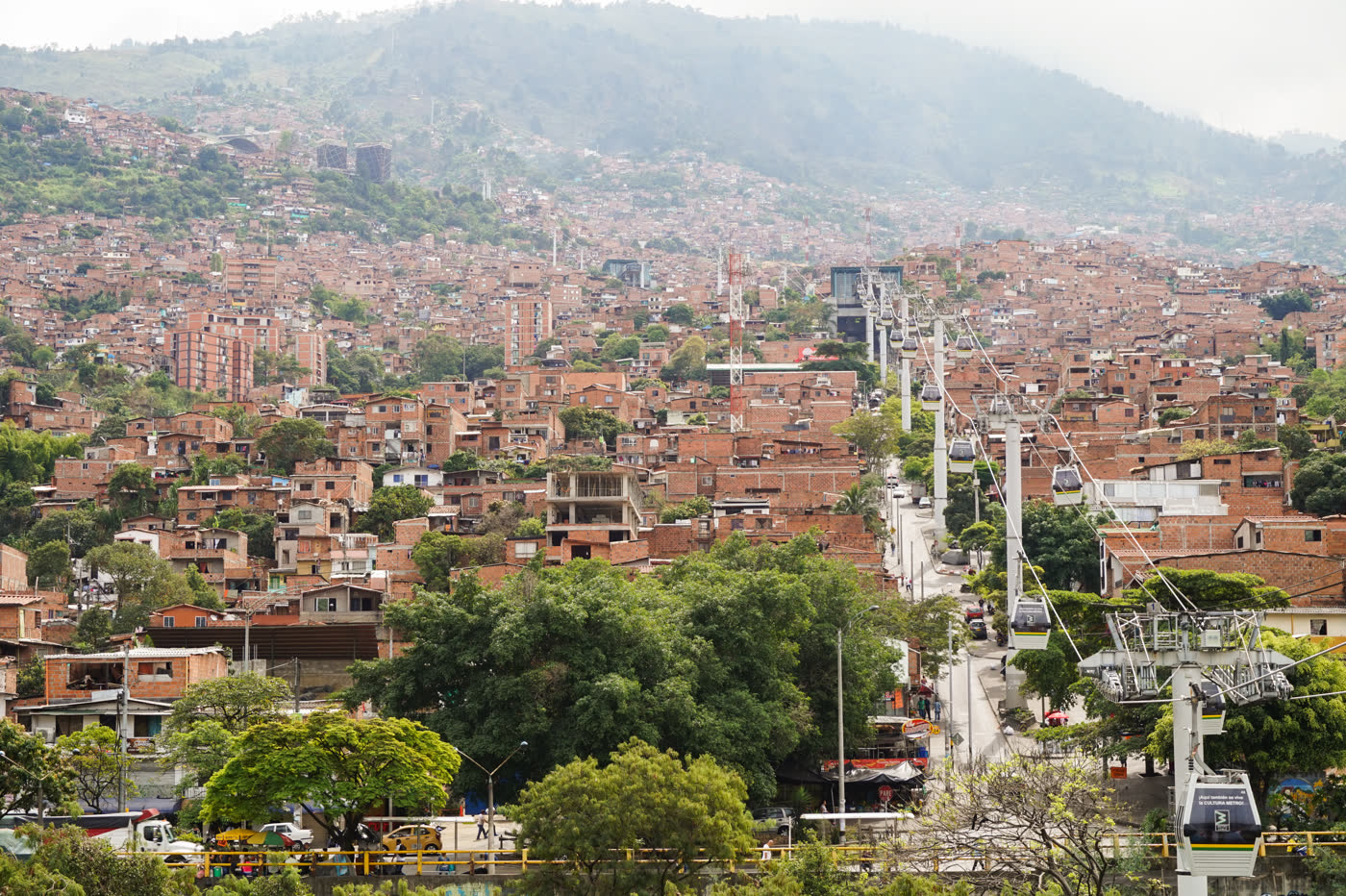
Do not ride Medellin's Line K Metrocable as if it were an observation wheel. Ride it as a transfer that happens to lift you into the shape of the city. The useful version starts at Acevedo, follows the cable through Andalucia and Popular, and ends at Santo Domingo before you decide whether to turn back or pay separately for Line L toward Parque Arvi. The Metro's own Line K page gives the route's plain facts: Santo Domingo to Acevedo, four stations, 2 kilometers of cable, 93 gondolas, 20 pylons, 10 people per cabin, and a listed 9-minute end-to-end ride [1]. That is the first clue. The experience is short. The point is not to fill an afternoon. The point is to understand why Medellin needed the air.
The best visitor window is 09:15 to 11:00 on a weekday, after the first heavy commute has loosened but before lunch errands and tour-group stacking begin. The second workable window is 14:00 to 15:45, as long as you are back down before the 16:30-18:30 crush that local discussion still treats as the uncomfortable part of crossing the city by metro [7]. Weekends are simpler if you go early, but Sunday changes the clock: Metro lists Line K running 08:30 to 22:00 on Sundays and holidays, while Monday to Saturday service runs 04:30 to 23:00 [2]. If you want this to feel like Medellin rather than a queue with scenery, avoid rush hour, do not block cabin doors, and let commuters have the normal rhythm.
The navigation cue is Acevedo's upper transfer. Arrive on Line A, follow the signs up to Line K, and do not exit the paid system unless you mean to leave. A recent route guide notes the same practical move: at Acevedo, go upstairs for the cable transfer rather than tapping out and trying to re-enter [4]. Your base spend is modest: Metro's 2026 fare table lists COP 3,820 for a frequent-user integrated metro/cable trip and COP 4,400 for an occasional or bearer fare in the basic integration band [2]. Keep extra money only if you plan to continue to Arvi, because Line L is a separate decision with separate pricing and a different operating pattern [2][3].
There are nine small moves that make the ride better. First, start from Acevedo, not from a taxi dropped vaguely near Santo Domingo; the metro-to-cable transfer is the whole lesson. Second, load your card or ticket before you reach the turnstiles, because the people behind you are not on vacation. Third, if the cabin is crowded, stand away from the door and take the view in fragments rather than trying to own the window. Fourth, ride uphill first; the city opens more legibly when the valley drops behind you. Fifth, watch for the shift after Andalucia, where the cable stops feeling like a novelty line and starts feeling like a street above streets.
Sixth, do not narrate poverty into every rooftop. The hillside is not a theme park of "transformation"; it is a residential commute with schools, shops, roofs, buses, churches, and errands below you. The official tourism guide frames the Metro as part of the integrated public-transport system that connects many of Medellin's representative places, including the Line A transfer at Acevedo to Line K and onward to Santo Domingo [3]. That wording matters. Locals are not using an attraction that tourists discovered. Tourists are borrowing a public system locals already know how to use.
Seventh, decide at Santo Domingo before you drift. The station is a transfer point and a viewpoint, not a license to wander without a plan. Google Maps is useful here not because it replaces local judgment, but because the station listings and review layer give you a live orientation check for the exact names "Acevedo" and "Santo Domingo Savio MetroCable" when your map app starts offering generic neighborhood pins [6]. Eighth, if you are continuing to Arvi, buy Line L deliberately and check the Tuesday closure and 18:00 end of Line L service before you commit [2]. Ninth, if you are not continuing, ride back down immediately after a short station-adjacent pause; the downhill ride is not redundant because it shows how tightly the cable plugs back into the valley line.
The first non-local mistake is treating Line K as a cheap substitute for a guided barrio tour. The better alternative is simpler and more respectful: use the cable as transport, stay inside the station logic unless you have a specific local plan, and let the ride teach the topography without turning residents into scenery. The second mistake is stacking Line K and Arvi automatically. Arvi is a different outing: a forest park connection, a longer cable, separate fare, and stricter timing. Medellin.Travel describes the Line K transfer to Santo Domingo and the further Line L ride over 17,000 hectares of forest, which is exactly why it should not be an afterthought tacked onto a late-afternoon cable ride [3].
The third mistake is chasing the "best cabin" when the smarter move is timing. Line K's real advantage is frequency and integration, not one perfect photograph. The official page lists a high peak capacity of 3,000 passengers per hour per direction and a 9-minute ride time; that is a working-capacity statement, not a scenic-promenade promise [1]. The fourth mistake is ignoring disruption risk because the system looks continuous from below. Local Colombian press reported a February 18, 2026 technical interruption that closed Line K for about three hours before service resumed between Acevedo and Santo Domingo, with contingency bus links activated around Santo Domingo, Andalucia, Popular, Tricentenario, and Acevedo [5]. That does not make the ride unsafe to plan around. It means you should check the official Metro channels before building a tight airport-day itinerary around it.
What changes once you ride it correctly is the mental map. Medellin is often described through the valley, the spring weather, nightlife zones, and the visible north-south Metro line. Line K adds the missing vertical grammar. From the cabin, streets stop behaving like flat map lines. They become switchbacks, stair edges, roof terraces, and short links between grades. The repeated brick color of the northeast hills is not just atmosphere; it is a reminder that the city expanded into slopes where ordinary bus geometry was never going to be enough. The cable does not erase distance. It changes what counts as a reachable distance.
That is the local-specific texture worth carrying away: Medellin's most famous transit image is also a civic habit. The city turned a hillside problem into a routine transfer, then normalized the view so thoroughly that a visitor has to work not to over-romanticize it. You can feel that at Acevedo when the cabin comes in and people sort themselves quickly. You can feel it when the gondola clears the station and conversation continues as if the ground had not dropped away. You can feel it at Santo Domingo when some people transfer, some people exit, and the tourist question, "Should I keep going?" is only one of many reasons anyone is there.
For a tight first ride, budget 45 to 60 minutes from Acevedo back to Acevedo if you are not adding Arvi: 9 minutes up, a short pause at Santo Domingo, 9 minutes down, and enough slack for platform waits, photos, and a missed cabin. If you are riding from El Poblado or Laureles, add the Line A/B approach honestly instead of pretending the cable is the whole trip. Keep the route small, keep the camera low-friction, and keep the return plan visible. Medellin becomes clearer when Line K is not consumed as a view. It becomes clearer when the view is allowed to stay public transport.
Sources
- Metro de Medellin, "Linea K" - official Line K page with route endpoints, station list, 2 km length, 9-minute ride time, cabin capacity, pylons, gondola count and service details.
- Metro de Medellin, "Usuarios Metro de Medellin" - official 2026 fare and service-hour page for Metro, cable lines, Line K Sunday/holiday hours and Cable Arvi pricing/hours.
- Medellin.Travel, "A un metro de distancia" - official city tourism guide explaining the Metro as an integrated system and the Acevedo-Line K-Santo Domingo-Line L visitor connection.
- Nomadic Niko, "Metrocable Line K" (last updated April 25, 2026) - recent route guide covering the Acevedo transfer, stations, ride logic and Line L option.
- El Colombiano, "Atencion: Metrocable Linea K restablece su servicio tras inconveniente tecnico" (February 18, 2026) - local press confirmation of a recent Line K service interruption, restoration and contingency routes.
- Google Maps, "Estacion Santo Domingo Savio MetroCable" - local map and review layer for station naming, navigation checks and visitor orientation around the Santo Domingo terminal.
- Reddit r/medellin, "Visiting Medellin in February" - local/community discussion with recent travel advice, including caution about the 4:30-6:30 p.m. metro rush period.
- Bernard Gagnon, "Linea K (Medellin Metrocable) 01.jpg," Wikimedia Commons - photographic source for the article image.