Seoul gets flattened at night when visitors keep choosing only the loudest options. They go straight to N Seoul Tower, stack Ikseon-dong onto Euljiro, or treat every evening as a test of how many neighborhoods can be consumed before the subway closes. The cleaner move is smaller. Start at Hyehwamun, climb onto the Naksan wall after 7 p.m., and let one lit fortress path do the night's work for you.[1][2][3][4][5]
This route is strong because its scale stays honest. Hyehwamun Gate is open 24 hours and sits only 3 minutes on foot from Hansung University Station Exit 5 or about 10 minutes from Hyehwa Station Exit 1.[2] Naksan Park is also open 24 hours, lies 491 meters from Hyehwa Station Exit 2, and carries a fortress-wall walking line of about 2 kilometers from Hyehwamun to Heunginjimun.[1] The broader Naksan trail still takes less than an hour to walk, and the hill itself rises to just over 100 meters, which is exactly why it works so well for an evening city reset rather than a full hike.[1][4]
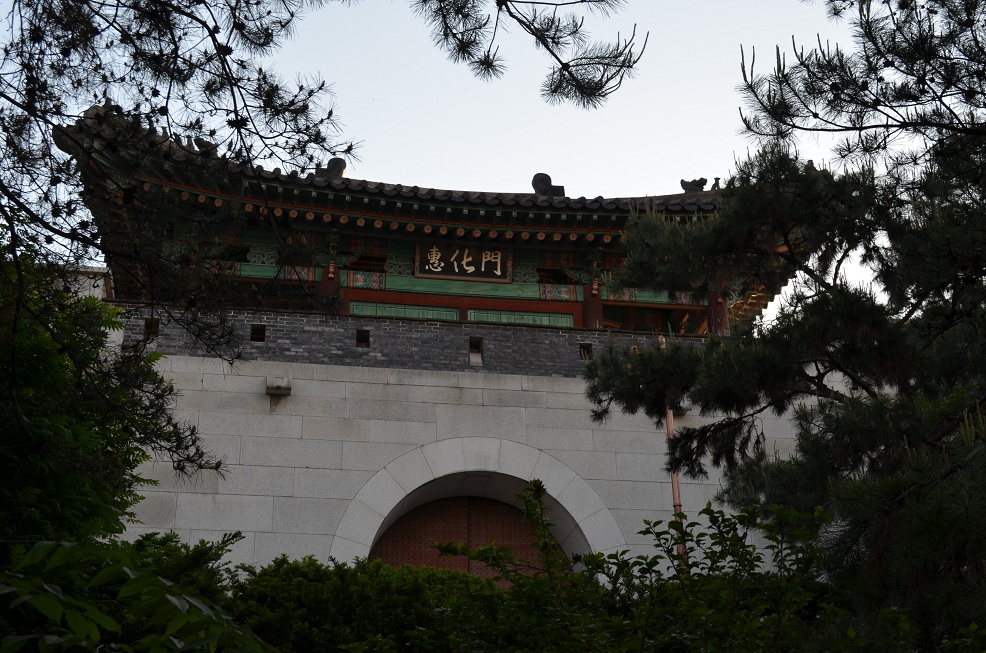
Image context: the cover uses a real Wikimedia Commons photograph of Hyehwamun Gate. The article depends on the gate as the route's first physical correction. You do not begin by chasing skyline drama. You begin by entering one small historic threshold and letting the wall carry the mood upward from there.[9]
Why the small-gate entry gives Seoul a better evening ratio
The first advantage is that Hyehwamun starts the route in the right register. The official walking-tour page on the Naksan course calls the path from Hyehwamun Gate to Naksan Park especially scenic and notes that both the gate and the park stay open all day.[2] That matters because Seoul's evenings often become formless precisely when the opening move is too soft. If you start from Daehak-ro and drift through cafes before climbing, the night can dissolve into campus-adjacent wandering. If you start at the gate, the route commits immediately to stone, grade, and wall.
The second advantage is that the infrastructure is already tuned for night use. The Seoul Metropolitan Government's Naksan feature says weekend evenings draw visitors, especially couples, onto the excursion trail from Hyehwa to Dongdaemun along Hanyangdoseong, and it repeatedly frames the park through sunset and nightscape use.[3] Time Out Seoul sharpens the texture further by describing the top stretch as a winding fortress wall wrapped in yellow lights, and by treating the climb as worth doing specifically for the nighttime city view.[5] This is useful local evidence because it tells you Naksan is not an accidental after-dark option. The night use is part of the place's current life.
The third advantage is that the route explains old Seoul without becoming a museum exercise. The same official city-wall material that gives the Naksan trail's evening and sunset value also places it inside the larger 18.6-kilometer Hanyangdoseong system, with wall heights around 5 to 8 meters.[3][4] You feel that scale physically on Naksan. The route does not bury you in isolated monuments. It lets the wall stay continuous long enough for the old-city logic to become bodily legible: gate, climb, parapet, overlook, descent, neon edge.
Why this works better after 7 p.m. than in the middle of the day
By day, Naksan can behave like a scenic obligation. People arrive in bright light, photograph the wall, then start hunting for what comes next. At night the path gets simpler. The city falls away into light fields, the fortress line becomes the real visual spine, and the amount of route you need shrinks. A night room does not have to be long to feel complete.
The official Naksan trail page says the section from Hansung University Station and Hyehwamun down toward Dongdaemun takes less than an hour and offers especially strong views at sunset.[4] That gives the right timing logic. The best version is not "get there exactly at sunset and fight everybody else for the same pause." The better version is to let sunset happen first, then use the lit wall once the sky has already softened and the path stops feeling like a checklist lookout. By 7 p.m. in warmer months, the trail has usually settled into its proper after-work speed.
KoreaToDo's access notes make the approach unusually simple for Seoul: from Hyehwa Station Exit 2 it is about a 10-minute walk, with signs guiding you uphill; from the park side you can continue easily along the wall toward Dongdaemun.[6] But the smarter compact version is even cleaner than that. Use Hansung University Station if you want the shortest gate-first entry, climb from Hyehwamun, hold the wall until the city fully opens, then decide whether to continue south or turn back once the room has done its job.[2][4]
8 local moves that make this Seoul night room actually work
- Use Hyehwamun as the true start, not just a landmark you pass on the way somewhere else. The route gets its shape from the small gate first and the skyline second.[2][8]
- Start after 7 p.m. rather than treating sunset itself as the target. The wall reads more cleanly once the lights are already doing some of the visual work.[3][4][5]
- If you want the shortest, least-distracted entry, come from Hansung University Station Exit 5. It is only about 3 minutes to the gate and avoids some of the Daehak-ro drift.[2]
- If you are already in Hyehwa, use Exit 2 or Exit 1 and accept the uphill as part of the mood-setting. The official and local guide layers place the approach at roughly 491 meters or around 9 to 10 minutes on foot.[1][2][6]
- Keep the wall as the spine. Do not immediately break off into every side alley once the first view appears; the route strengthens when the parapet remains continuous for a while.[1][4]
- Wear actual walking shoes. Time Out's sneaker advice is correct because the route is short but still stair-and-slope heavy.[5]
- Treat the park as a hold, not as a mission. You do not need to clear the whole 2-kilometer wall section for the outing to succeed.[1][4]
- Let the return be the release. Once the wall line has done its work, you can drop toward Hyehwa or continue toward Dongdaemun, but make that a second decision rather than the main event.[4][6]
Non-local trapline: 4 common mistakes and the better alternative
Mistake 1: starting in Daehak-ro and letting the evening dissolve into cafe drift before the climb even begins
Better alternative: start at Hyehwamun or arrive via Hansung University Station. The small gate gives the route an immediate historic edge and removes the soft, indecisive opening.[2][8]
Mistake 2: doing Naksan only in daylight and then wondering why it feels like "just another uphill park"
Better alternative: go when the wall lights are active and the city has already flattened into nighttime depth. This route is strongest as a night room, not as a noon errand.[3][5]
Mistake 3: treating the first overlook as the finish
Better alternative: keep walking until the wall has had time to become the night's real structure. The article's main claim is that continuity matters more than the first photograph.[1][4]
Mistake 4: dropping straight into every mural-side alley the moment the route loosens toward Ihwa
Better alternative: hold the wall a little longer. Side streets can come later; the cleaner sequence is gate first, parapet second, neighborhood spillover third.[4][7]
Concrete go details
- Best window: aim for a 7:00-8:30 p.m. start in the warmer months, or simply any fully dark but not too-late window when the wall lights are on and the route still feels sociable.[3][5]
- Expected spend: KRW 0 once you are there. Hyehwamun, Naksan Park, and the wall walk are all free.[1][2][5]
- Queue and reservation reality: none. This is public city infrastructure, not a ticketed skyline product.[1][2]
- Best entry choice: Hansung University Station Exit 5 if you want the shortest gate-first approach; Hyehwa Station Exit 2 if you are already using Daehangno as the wider evening district.[1][2][6]
- Route scale: the full Hyehwamun-to-Heunginjimun wall section is about 2 kilometers, and the broader Naksan trail is under 1 hour on foot.[1][4]
- Navigation cue:
Hansung Univ. Station Exit 5 -> Hyehwamun Gate -> climb south along the lit Naksan wall -> hold one or two overlooks -> decide whether to descend back toward Hyehwa or continue toward Dongdaemun.[2][4] - Numeric anchors worth remembering: 24 hours, 3 minutes, 10 minutes, 491 meters, 2 kilometers, less than an hour, 18.6 kilometers, 5-8 meters, and just over 100 meters.[1][2][3][4][6]
Seoul does not always need another major night plan. Sometimes it only needs one gate, one climb, and one wall long enough to reset your sense of the city. Hyehwamun to Naksan works because it keeps that promise small. The night stays structured, the history stays visible, and the skyline arrives without making you queue for it.
Sources
- The Official Travel Guide to Seoul, "Naksan Park" (edited April 28, 2026; used for the 24-hour park access, the 2-kilometer Hyehwamun-to-Heunginjimun wall stretch, the 491-meter Hyehwa Station approach, the park's just-over-100-meter height, and free admission details).
- The Official Travel Guide to Seoul, "Seoul City Walking Tour around Naksan Park" (edited November 21, 2025; used for the Hyehwamun gate hours, Hansung University Station Exit 5 in 3 minutes, Hyehwa Station Exit 1 in 10 minutes, and the route's scenic gate-first framing).
- Seoul Metropolitan Government, "Naksan Park" (used for the weekend-evening local-use pattern, the Hyehwa-to-Dongdaemun excursion trail note, and the recurring emphasis on night views and the lit wall path).
- Seoul Metropolitan Government, "SEOUL CITY WALL - NAKSAN MOUNTAIN TRAIL" (used for the less-than-an-hour walking time, sunset-view note, Hansung University / Dongdaemun access points, and the trail's southbound route logic).
- Time Out Seoul, "Naksan Park" (local city-guide note used for the sneaker advice, the yellow-lit fortress-wall description, the Hyehwa Station Exit 2 access cue, and the 24-hour / free-entry local framing).
- KoreaToDo, "Naksan Park & getting there" (local practical guide used for the 10-minute Hyehwa approach, turn-by-turn uphill directions, and the simple continuation from Naksan toward Dongdaemun).
- Google Maps community listing, "Naksan Park Seoul" (live place-status and community-review surface used as a current local check on the park as an active evening stop).
- Google Maps community listing, "Hyehwamun Gate Seoul" (live place-status and community-review surface used as a current local check on the gate as a practical starting point rather than a sealed monument).
- Wikimedia Commons, "File:Hyehwamun Gate, Seoul, Korea.jpg" (documentary photographic source for the article image).