Bergen is one of those cities where tourists often make themselves work harder than the locals do. They either walk straight uphill from the fish market with no plan, or they buy the default Fløibanen return ticket, snap the summit panorama, and come back down the same way they went up. The cleaner Bergen move is more precise than that. Use Fløibanen as a lift, not as a loop: ride up outside the late-morning crush, step off at Fløyen, and let the mountain give you back to the city on foot through Skansemyren and Skansen.[1][2][3][4][5][7][8]
That change sounds small, but it fixes almost every avoidable mistake in one stroke. Fløibanen is not some remote excursion. The lower station sits about 150 metres from Fisketorget and Bryggen, the line reaches Fløyen in 5-8 minutes, and the upper station lands you 320 metres above sea level with three intermediate stations on the way: Promsgate, Fjellveien, and Skansemyren.[1] The railway has been operating since 1918, which matters because it helps explain how Bergeners use it. This is not just a mountain ride for outsiders; it is a long-running piece of mountainside infrastructure attached directly to the old centre.[1]
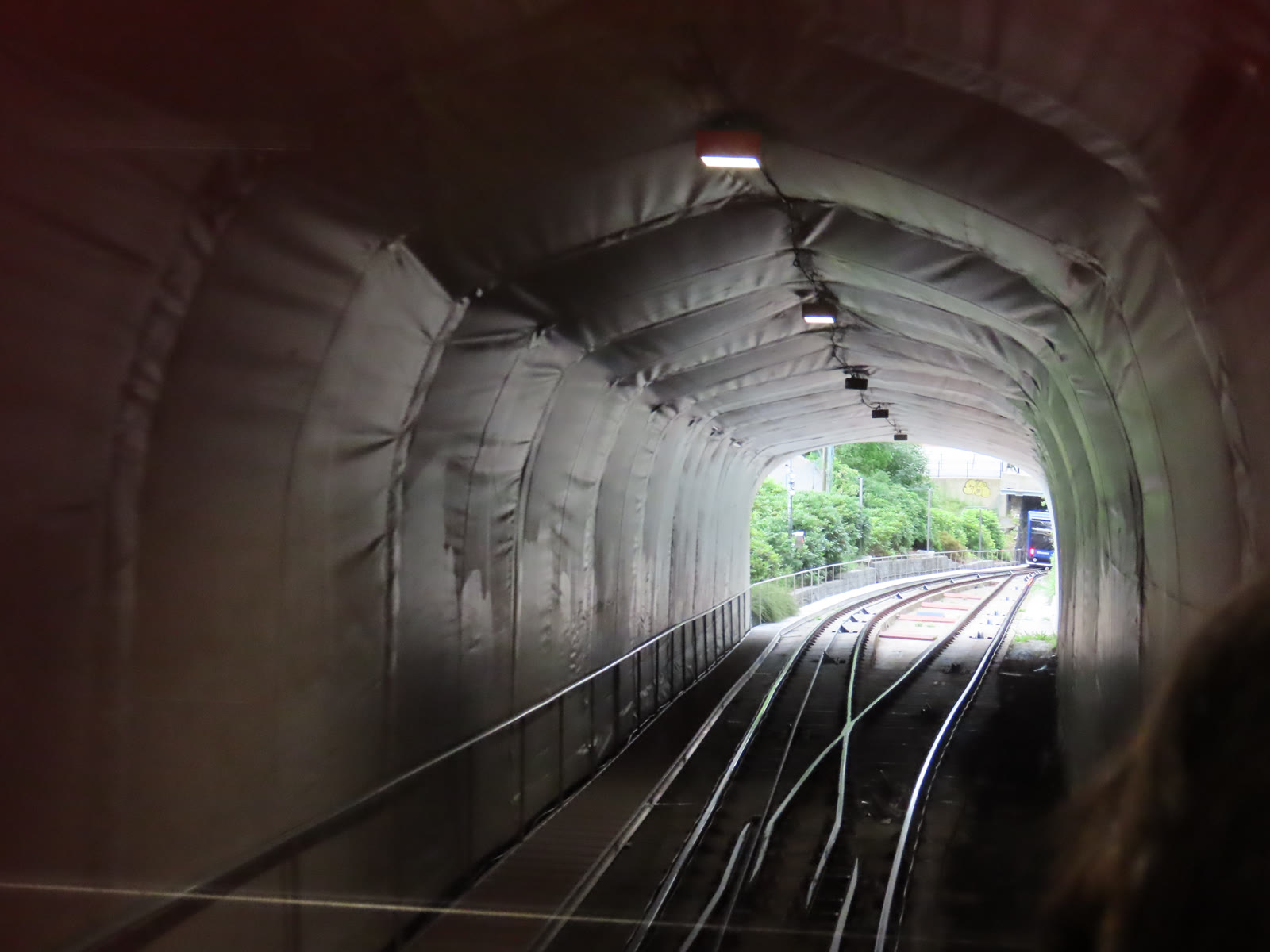
Image context: the cover uses a real Wikimedia Commons photograph of a Fløibanen car above Bergen. That is the right lead image because the article is about one exact urban mechanism, a steep rail line that lets the return walk become the real experience.[9]
Why the one-way version is the stronger Bergen ritual
The first reason is timing. Fløibanen's official timetable says cars run every 15 minutes, with departures every whole and half hour before 10:00 and after 19:00; the last departure from both the city station and Fløyen is at midnight.[2] The same page says the busiest period is 10:00-14:00, when waits of about 15-20 minutes are normal.[2] A recent Bergen By Billy local guide sharpens the why: cruise ships tend to push extra pressure into that same late-morning window, so early and late rides feel materially calmer.[6] That is already enough to change the outcome. If you ride before the ships and the day-trippers fully stack, Bergen still feels like a city with a mountain attached. If you join the noon crush, it behaves like a queue machine.
The second reason is ticket logic. Fløibanen's official prices page lists an adult one-way city-centre-to-Fløyen ticket at NOK 105 if bought in the app, on the web, or at a machine, and NOK 120 at the ticket office in the April-September season.[3] That same page quietly exposes the trap: the Bergen Card discount only applies to return tickets, not one-way tickets.[3] Many visitors therefore default to round-trip thinking because the discount looks tidy. For this ritual, that is exactly backward. The smarter purchase is the ticket that forces you to finish the route on your feet.
The third reason is that the descent is not filler. Fløibanen's FAQ puts the core number plainly: it takes about 45 minutes and 3 kilometres to walk up or down between Mount Fløyen and the city centre.[4] A Bergen local in r/Bergen compresses the same idea into practical advice: either walk up from the city in 30-60 minutes or take Fløibanen one way and use the mountain properly instead of treating the summit as a dead end.[7] Another local thread fills in the exact geometry from the lower station side: from Fløibanen you can follow the path behind the station, climb first toward Skansen firestation, then keep following signs upward; if your window is shorter, you can even ride only as far as Skansemyren on an intermediate-stations ticket and continue from there.[8] Put together, those sources describe a city habit rather than an attraction. The railway removes the dullest vertical work; the walk returns texture, neighborhood edge, and the right speed.
Why Skansen matters even when Fløyen gets the postcard
The top gives you the famous panorama, but Skansen explains the city more gently. Bergen By Billy's Skansen page calls it a "mini version of Fløyen," notes that it is only a 6-minute walk from the Fløibanen entrance, warns that the climb is steep, and says locals often use it as a quieter place to sit with views over the fish market area.[5] That is the right second anchor for this article because it teaches the scale correction Bergen needs. Fløyen is the big reveal. Skansen is the local proof that you do not always need the full machinery of a summit outing to get the city back into proportion.
This also gives the walk-down ritual its emotional shape. Bergen is a seven-mountains city with a strong everyday mountain culture, and the runner thread makes that explicit: locals treat running, walking, and trail movement from downtown as completely ordinary, not as an expedition.[8] When you come down on foot, the city stops behaving like waterfront facades and starts reading as slope, retaining wall, switchback, and neighborhoods tucked into the hillside. That is the part a pure return ticket erases.
8 local moves that make this Bergen ritual actually work
- Buy one way up, not return, even if the return fare looks neater on paper. The route improves once the ticket commits you to the descent.[3]
- Ride before 10:00 or after 19:00 when you can. Those are the cleaner timetable shoulders around the official 10:00-14:00 busy block.[2]
- Do not waste time in the ticket-office line. The operator explicitly recommends buying on the website or in the app for a smoother run.[2][3]
- Keep the summit platform brief. The upper station is a launch point, not the whole story; the ritual lands only when the mountain starts turning back into city.[1][4]
- Budget the descent as a real walk: about 45 minutes and 3 kilometres. If you are racing a dinner booking in Bryggen, this is not the version to improvise halfway through.[4]
- Use the path logic locals describe. From the lower-station side, the road behind the station runs first toward Skansen firestation; from the top, that same line becomes the cleanest way to feel the gradient unwind.[8]
- If you only have a short mountain window, use the intermediate-station variant. Officially, one-way mid-station tickets are NOK 50, and locals specifically mention Skansemyren as the useful cut-in point.[2][3][8]
- Make Skansen your last pause, not your first ambition. It works best once the larger panorama has already burned off and the quieter city view is what is left.[5]
Non-local trapline: 4 common mistakes and the better alternative
Mistake 1: buying the default return and then feeling obliged to descend mechanically
Better alternative: buy the upward lift you actually need and let the rest happen on foot. The walk back down is the part that turns the railway into a city ritual instead of a sightseeing transaction.[3][4]
Mistake 2: joining the line in the middle of the official 10:00-14:00 pressure band
Better alternative: shift early or late. The operator's own queue guidance and the local cruise-ship warning both point the same way.[2][6]
Mistake 3: treating the top platform as the whole Bergen mountain experience
Better alternative: take the panorama, then keep moving. The summit is the hinge; the descent is where Bergen becomes legible again as a hillside city.[4][7][8]
Mistake 4: assuming every worthwhile mountain view requires the full Fløyen outing
Better alternative: remember Skansen. It is steeper and smaller, but it gives you a quieter bench-and-rooftops version of the same urban logic almost on the city's doorstep.[5]
Concrete go details
- Best window: a clear-weather ride before 10:00 or an evening ride after 19:00 is strongest; if you go in the busy band, expect 15-20 minutes of waiting.[2][6]
- Expected spend: NOK 105 for an adult one-way bought digitally in the current April-September season, NOK 120 at the counter; the short intermediate-station version is NOK 50 one way.[3]
- Queue and reservation reality: you cannot book a specific departure time, but the operator recommends pre-buying tickets; cars run more often when demand is high.[2][3]
- Where to pause: first briefly at the top for the wide harbor read, then longer lower down once the city starts feeling granular again near Skansen.[1][5]
- Navigation cue:
Fløibanen lower station -> ride to Fløyen -> start the 45-minute / 3-km walk down -> follow the road/signs toward Skansemyren and Skansen firestation -> finish near the lower station and fish market edge.[1][4][8] - Numeric anchors worth remembering: 150 metres, 5-8 minutes, 320 metres above sea level, 1918, 10:00-14:00, 15-20 minutes, 45 minutes, 3 kilometres, NOK 105, and NOK 50.[1][2][3][4]
Bergen does not need much help to be photogenic. What it does need is a better ratio between lift and walk. One short railway ride up, one deliberate refusal of the return ticket, and one steady descent through the mountainside are enough to make the city feel less handled and more lived in.
Sources
- Fløyen, "Fløibanens history" (official page covering the 150-metre lower-station location near Fisketorget and Bryggen, the 5-8 minute journey, the three intermediate stations, the 320-metre summit height, and the line's operation since 1918).
- Fløyen, "Opening hours" (official timetable and queue guidance page covering the every-15-minutes service, the pre-10:00 / post-19:00 whole-and-half-hour pattern, midnight last departures, the 10:00-14:00 busiest window, 15-20 minute waits, and intermediate-station stop rules).
- Fløyen, "Prices and ticket types" (official fares page covering the April-September adult one-way price, the mid-station one-way price, advance-purchase channels, and the Bergen Card restriction to return tickets).
- Fløyen, "FAQ" (official page used here for the 45-minute / 3-kilometre walk time between Mount Fløyen and the city centre).
- Bergen By Billy, "Skansen" (local guide describing Skansen as a quieter mini-Fløyen, about a 6-minute steep walk from the Fløibanen entrance, with benches and regular local use).
- Bergen By Billy, "Everything You Need to Know About the Fløibanen in Bergen: Opening Hours, Return Prices, and Ticket Tips" (recent local guide, updated 3 days ago, used here for the practical note that cruise-ship timing tends to intensify the late-morning crowd).
- Reddit
r/Bergen, "What to do/see in Bergen?" (community advice from a local commenter recommending either a 30-60 minute walk up from the centre or using Fløibanen one way and walking the mountain properly). - Reddit
r/NorwayTravelAdvice, "Runner visiting Bergen: can I run from downtown to the mountains?" (community thread with detailed local routing notes on the path behind the station, the line toward Skansen firestation, and the Skansemyren intermediate-station shortcut). - Wikimedia Commons, "File:Bergen Fløibanen 01.jpg" (documentary photographic source for the lead image used in this article).