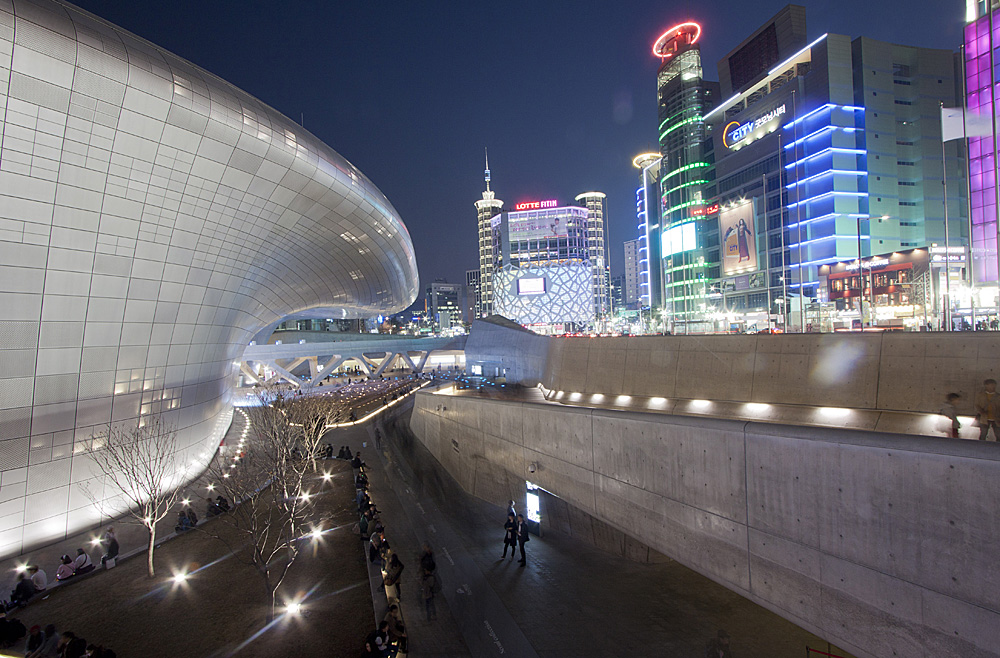
At Dongdaemun Design Plaza, the wall keeps becoming something else. Follow the silver surface and it swells into a roof, dips towards a walkway, then opens a view of the city beyond. After dark, the bright shopfronts and rectangular towers around it make those curves more conspicuous. Seoul’s DDP is especially rewarding when you give yourself permission to walk around a building without immediately looking for its front door.
Seoul-based writer Hallie Bradley recommends arriving around sunset and staying into darkness.[1] For this exterior-only visit, allow 60–90 minutes, beginning about 30 minutes before sunset; that is a suggested pace, not an opening schedule. Start while the sky still separates the roof from the surrounding buildings, then make another circuit as artificial light takes over. The changing view is the evening’s main event.
Arrive below the spectacle
Use Dongdaemun History & Culture Park Station, Exit 1, served by subway Lines 2, 4 and 5. The official address is 281 Eulji-ro.[3] Save the full station name: “Dongdaemun” alone also names a different station. At the exit, pause somewhere clear of the pedestrian flow before choosing your first direction. The building is large enough to orient you; its paths deserve a slower look.
Budget ₩0 for the outdoor architectural walk, with transport and optional purchases separate. The public exterior needs no exhibition booking. A recurring visitor in an r/koreatravel discussion confirms that walking outside remains possible at night; Bradley likewise distinguishes exterior access from building hours.[2][1] A closed gallery door is therefore a poor reason to abandon the whole visit.
The reverse assumption causes trouble too: an illuminated plaza does not mean the galleries are open. Visit Seoul currently lists general hours of 10:00–20:00, with variation by space.[3] If an exhibition matters, check its own closing time and ticket conditions, visit it first, then come outside. Bradley warns that popular exhibition openings can bring queues and recommends advance booking when available.[1] Free access to the architecture does not buy admission to a particular show.
Change level, change the building
A Korean photographer posting as Dodem2 recorded a useful way of seeing DDP soon after it opened: from the second-level railing opposite the subway entrance, then along the curved ramp. The same account follows the fading sky and notices how the neighbouring commercial buildings contribute to the photograph.[4] It is an older visual account, so follow current signs and barriers rather than treating its camera position as a guaranteed reserved viewpoint.
The lesson survives: move away from the first place where everyone raises a phone. Try a view from the plaza, then an accessible higher public path. Bradley identifies the elevated walkway on the Eulji-ro side as a useful broad view.[1] Give each position a few minutes. Up close, the cladding fills your field of vision; farther away, a passer-by or a shop sign restores its scale. Stand to the side when stopping, leaving the ramp available to people using it to get somewhere.
This is also a good place to let the city remain in the frame. Dodem2’s photographs make room for the surrounding shops instead of isolating a silver sculpture.[4] You can use that approach without owning a wide-angle lens: turn until a familiar rectangular building meets the curve, then lower the phone and notice how the two occupy the same evening.
The grounds carry an older Seoul as well. The architects describe the ancient city wall and archaeological remains uncovered before construction as organising elements of the project. Their account of the park draws on traditional Korean gardens: layered views, horizontal movement and changing relationships between inside and outside.[5] That design intention offers another reason to keep walking. The route between viewpoints is part of the composition, even when no performance is running.
Give the lights their own calendar
A spectacular clip online can create the wrong expectation for an ordinary evening. Bradley describes Seoul Light as a seasonal programme whose dates must be checked.[1] Seoul’s 28 September 2026 announcement distinguishes the completed autumn festival from the continuing DDP 365 Light programme. It describes short presentations around the excavation exhibition area, approximately five minutes on the hour and half-hour, while also announcing further programme changes.[6]
Treat those as dated programme details, not a promise that the clip you saved will play tonight. Check the current DDP notice before making a special journey for a show. If one is scheduled, find its stated viewing area before settling in; the brightest surface is not necessarily the performance location. If the programme is between presentations, use the interval to walk rather than waiting at one spot for the entire building to animate.
Visit details were checked on 9 November 2026. The most satisfying departure needs no finale: return towards the station after one last view from a different height. By then, the building you first saw as a single gleaming object has become a set of paths, edges and places to pause.
Sources
- Hallie Bradley, “Dongdaemun Design Plaza (DDP) Seoul: What To See, Do, and Know Before You Visit,” The Soul of Seoul, updated 12 October 2026 — local advice on sunset, exterior access, viewpoints, exhibition queues and seasonal programmes.
- r/koreatravel, “Day 1 in Seoul,” March 2024 — a frequent walker’s account of nighttime exterior access; community experience, not an official opening-hours notice.
- Seoul Tourism Organization, “Dongdaemun Design Plaza (DDP),” Visit Seoul, updated 6 October 2026 — station, exit, address, opening date and space-dependent operating hours.
- Dodem2, “DDP Night View #01: Night Scenery of Dongdaemun Design Plaza,” 28 June 2014, Tistory — Korean-language photography account of the upper railing, curved ramp, twilight and surrounding shops.
- ZHA Architects, “Dongdaemun Design Plaza” — the project team’s account of archaeological remains, public circulation and the park’s relationship to Korean garden traditions.
- Seoul Metropolitan Government / Seoul Design Foundation, “Seoul Light DDP attracted 700,000 visitors and energised Seoul’s nighttime economy,” 28 September 2026 — Korean-language announcement distinguishing the autumn festival from continuing DDP 365 Light programming.
- Nestor Lacle, “Dongdaemun Design Plaza & Park,” photographed 26 March 2014, Wikimedia Commons — original blue-hour photograph, camera metadata and CC BY 2.0 attribution.