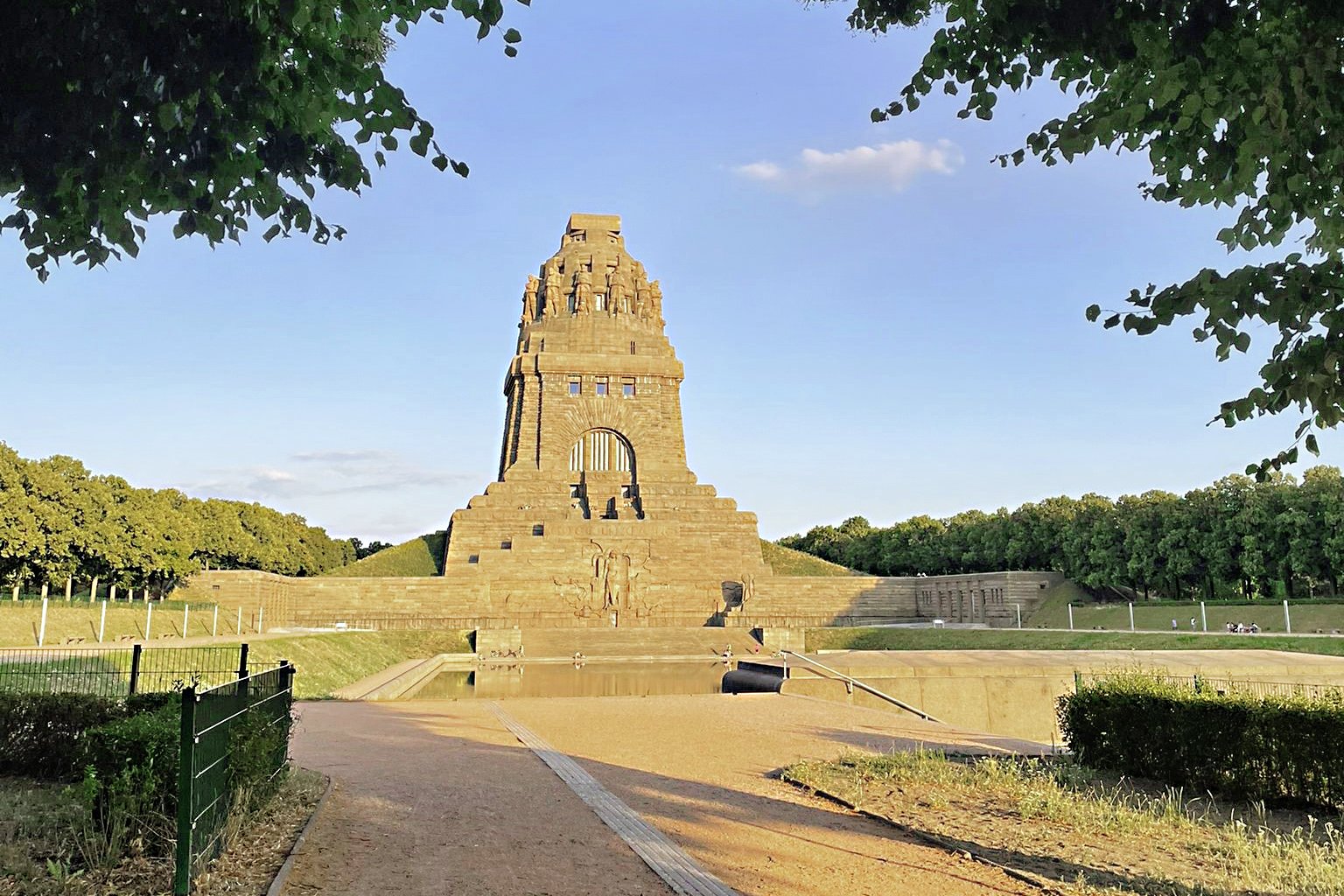
The first place to pause at Leipzig’s Völkerschlachtdenkmal is across the water. From the far end of the reflecting basin, the monument has room to become a complete shape: broad base, rising shoulders, a crown of stone figures. Its reflection supplies a second, less solid version. Before approaching the stairs, stand here long enough to notice how much of the building’s force comes from the space left around it.[9]
The Monument to the Battle of the Nations was inaugurated in 1913, a century after the fighting around Leipzig in 1813. Architect Bruno Schmitz gave it a body of concrete and granite porphyry, a crypt guarded by sculpted knights and interior figures almost 10 metres tall. Those dimensions explain the distant silhouette. They do less to explain why someone living nearby would keep coming back.[1]
Cornelia Schulz offers that smaller perspective in the Leipzig magazine Ahoi. A neighbourhood resident and hotel director, she describes the monument as a familiar place that gives her a sense of belonging, even though she moved to Leipzig as an adult. She notices visitors photographing it and people lingering around the grounds. Her account suggests a useful pace: leave room for the place to become familiar before trying to finish it.[2]
Arrive with time to go inside
For a November visit, I would choose 10:00–12:00, allowing 90–120 minutes for the approach, interior and an optional climb. These are planning suggestions, not a prediction of quiet. The foundation publishes winter opening hours of 10:00–16:00, November through March; the later summer closing time does not apply.[4]
Arriving for the view and discovering that the interior has closed is an avoidable disappointment. A Tripadvisor reviewer who visited in April 2024 describes exactly that outcome: an enjoyable look outside, but no entry. Use the current foundation hours to plan the inside portion first, then leave the waterside pause for afterwards if time is tight.[3][4]
The foundation lists tram 15 as an approach; the museum identifies the stop as Völkerschlachtdenkmal. Save that name and the address, Straße des 18. Oktober 100, and check the live journey before leaving. Once on the grounds, the basin and the broad frontal staircase give you a more useful orientation than a map pin buried in the building.[1][4][9]
For one full-price adult, allow €12–€15 for admission alone or admission with a public guided tour; transport and refreshments are extra. The fee schedule effective 1 April 2026 lists €12 admission and a €3 public-tour supplement. An independent visit can be ticketed online or at the counter.[4][5]
The public tours have a separate rhythm: the fee schedule says no advance booking, with arrival at the ticket office recommended 15 minutes before the advertised start. Check the programme and language before choosing that option. Ordinary entry should not be confused with a guaranteed place on a particular tour.[5]
Give the interior its own visit
One older Tripadvisor account describes leaving with questions about the monument’s sculptures after noticing the audio guide too late. If that is the part that interests you, ask at the counter before heading upstairs. The current hire charge is €1, with a document required as a deposit.[3][5]
There is also a newer reason to resist climbing immediately. An August 2026 epd report describes a renewed exhibition on the building’s conception, construction and changing political meaning. Previously accessible only with a guide, the rooms had opened to ordinary visitors that June following work that included a second escape route. Eight illuminated panels and original objects, including a construction ladder, bring the giant back to the scale of the people who imagined and built it.[8]
Make time for that exhibition within the same visit. The report distinguishes these publicly accessible rooms from another area that remains restricted to guided access; a newly opened exhibition does not mean every passage is yours to explore. Ask staff which route is open that day.[8]
In the main interior, let the figures interrupt your progress. A HolidayCheck reviewer, Susanne, singles out the experience of lingering in the Hall of Fame as well as looking across Leipzig. That is a better invitation than treating every room as a landing on the way to the roof.[7] Look at a figure from where the room allows you to take in its whole body, then notice how small the other visitors appear beneath it.
Keep the pause quiet. The foundation treats the building as a memorial and asks visitors to avoid loud conversation. Personal photographs inside must be taken without flash or a tripod. The hall’s scale can do the dramatic work without anyone testing its echo.[6]
Decide how high you want to go
The lift is useful, but it does not make the entire ascent step-free. Susanne’s review describes a narrow final spiral passage, while other visitor accounts explicitly distinguish the lift-served levels from the remaining stairs. The mistake is to hear “there is a lift” and assume that the highest platform follows automatically.[3][7]
For wheelchair users, the foundation specifies access to the inner gallery at 47 metres, with views through glazed windows. It also advises against the climb for people troubled by heights or enclosed spaces. Decide on the upper ascent before committing to the narrow sections, and ask staff about the accessible route if that is the visit you need.[4]
Leave some slack in the timing. The house rules explain that limited platform capacity can produce waits during busy periods; certain concerts and extreme weather can also restrict access. Follow the staff’s directions and any signals on the route. A ticket buys entry to a working visitor site, where circulation sometimes needs to slow down.[6]
There is no requirement to make the highest viewpoint the verdict on the morning. The crypt, the figures and the exhibition have already changed the building from a distant object into a place with an interior and a history. Returning to the basin afterwards gives you the pleasure of recognising rooms inside the mass of stone.
Schulz’s neighbourhood account ends with attachment to a place she can revisit.[2] A traveller has less time, but can borrow the habit. Pause once more beside the water, let someone else take the central photograph, and look at the monument from slightly off to one side.
Sources
- Stadtgeschichtliches Museum Leipzig, “Völkerschlachtdenkmal & FORUM 1813” — construction, inauguration, interior sculpture, address and transport stop; checked 10 November 2026.
- Cornelia Schulz, “Ein Ort des Verweilens,” Ahoi Leipzig, 19 May 2024 — a nearby resident’s account of returning to the monument and its grounds.
- Tripadvisor, German-language Völkerschlachtdenkmal reviews — Ariane’s April 2024 visit and Al The Cat’s November 2023 account, plus reports distinguishing lift access from the final stairs; historical visitor experiences, not current prices or hours.
- Stiftung Völkerschlachtdenkmal Leipzig, “Plan your visit” — seasonal hours, ticket purchase, tram access and the accessible inner gallery; checked 10 November 2026.
- Stiftung Völkerschlachtdenkmal Leipzig, “Schedule of fees,” effective 1 April 2026 — admission, audio-guide deposit and public-tour arrangements.
- Stiftung Völkerschlachtdenkmal Leipzig, “House rules,” 2026, pages 1–2 — memorial etiquette, photography, capacity waits and restrictions during events or extreme weather.
- HolidayCheck, “Bewertungen Völkerschlachtdenkmal” — Susanne’s August 2023 review of the hall and narrow final ascent; used as a visitor account alongside current official access guidance.
- epd, “Leipziger Völkerschlachtdenkmal: Neue Ausstellung und neue Ideen,” Evangelische Zeitung, 6 August 2026 — newly accessible exhibition, construction objects and the distinction between public and guided-only rooms.
- AccAkut441, “Völkerschlachtdenkmal 2023.jpg,” Wikimedia Commons, photographed 17 September 2023 — visual reference for the monument’s reflection across the basin; CC BY-SA 4.0.