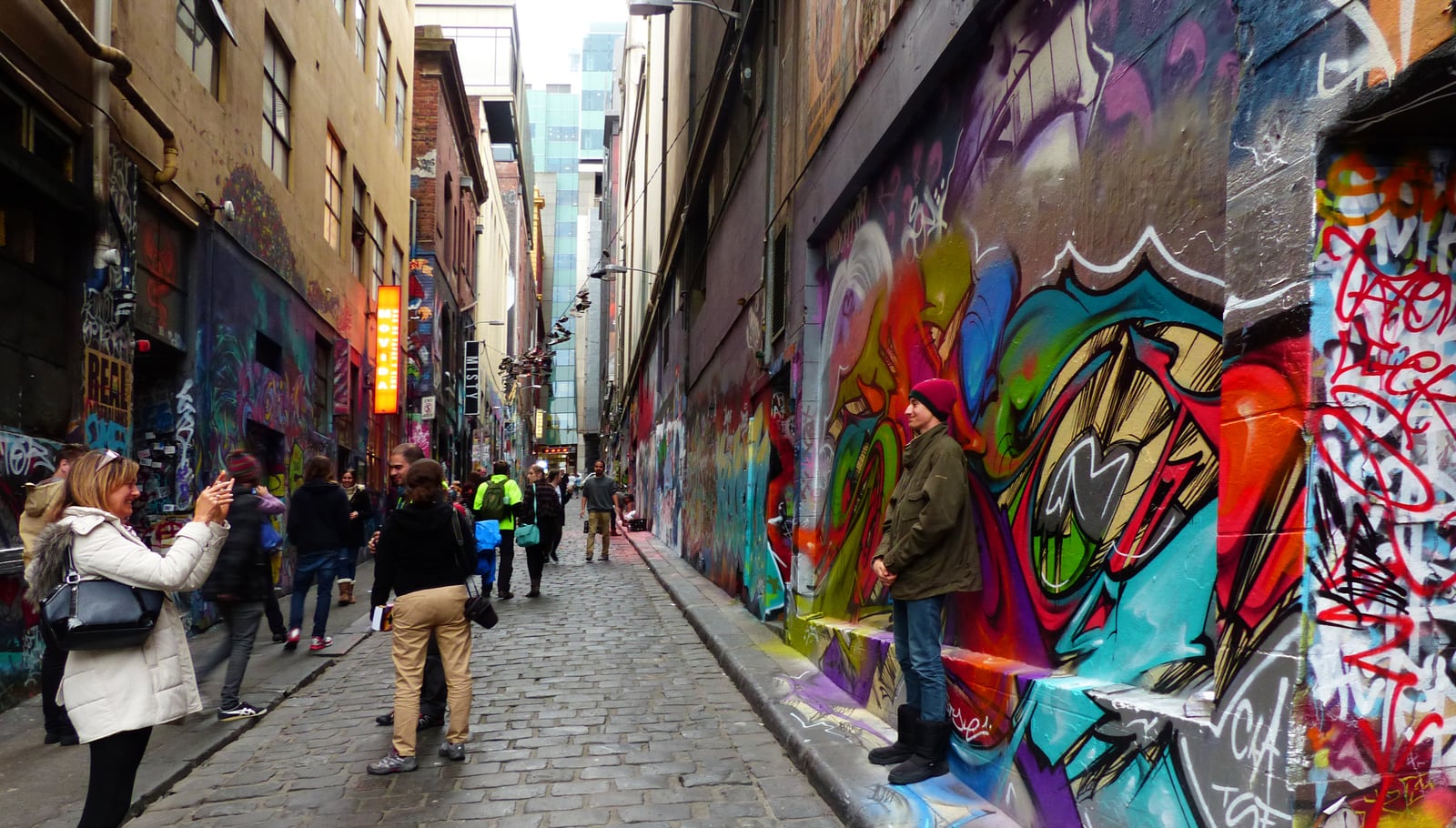
The useful thing to bring to Hosier Lane is a willingness to lose the picture you came for. Melbourne’s famous painted passage keeps its address while changing its face: the city’s own guide describes work appearing and disappearing overnight. A mural saved on your phone may already belong to a previous version of the street.[4]
That makes the small turn east into adjoining Rutledge Lane worth taking. Photographer’s guide Auspano describes a more enclosed passage, with short sightlines and little room to step back. For a visitor, the turn offers a useful interruption: stop searching for the familiar image and start noticing what is actually here.[3]
Enter before the photograph becomes a queue
Approach from Flinders Street, using the Forum Theatre beside Hosier Lane as your recognition cue. Auspano places the station a few minutes away; I would allow 10 minutes on foot from Flinders Street station, including crossings and finding the entrance. That is a planning allowance. You are looking for a street opening, with the city continuing around it.[2][3]
Time Out’s practical advice is to arrive early if you want room for photographs; later visitors should expect other people in the frame or a wait. For this short visit, I would aim for 08:00–09:00 and reserve 30–45 minutes for both lanes. Those are suggested planning windows, not opening hours or a promise of an empty street. Arriving with a carefully staged group photograph in mind is one common source of frustration. Come early, or let the passing people be part of the picture.[2]
The independent walk costs A$0, with no admission booking or ticket queue. A sensible personal spending allowance is A$0–15, entirely optional and excluding transport to the centre; this is a suggested budget, not a quoted tour price. The council includes Hosier in its free self-guided street-art walk.[8]
Once inside, give the lane a full look before choosing where to stop. Raise your eyes above the busy band of paint at head height: the municipal guide points visitors towards Adnate’s 23-metre-high portrait. The change of scale matters. A little doorway can hold several competing marks, while a large face draws the eye across the buildings. You can enjoy both without treating every surface as a separate appointment.[4]
The turn into Rutledge
Turn into Rutledge before leaving Hosier. Auspano recommends bright overcast conditions, which soften the contrast between the enclosed lane and its brighter entrance. Waiting for a dramatic shaft of sun can mean overlooking the even light already available. A grey Melbourne morning can serve the paint surprisingly well.[3]
Here, try a smaller photograph. Let a corner, window or change in brickwork remain visible beside the paint. That is an editorial suggestion rather than a local rule, but it preserves something a tightly cropped mural loses: the work occupies a building. Walk the bend before deciding that you have seen everything. A short lane can still change its proportions when viewed from the other end.
Look down, too. Hosier Inc, the local community organisation, reported the lane’s reopening in August 2026 after access improvements. Parts of the historic bluestone surface were made smoother and the accessible footpath widened. Its account connects the work to residents, businesses, artists and delivery drivers as well as visitors.[5]
For anyone using wheels or finding rough paving tiring, that is a reason to seek out the improved path rather than follow an old photograph’s route across the stones. It is also a reason to leave that path clear. Stand to one side for a photograph without occupying a doorway, and move when somebody needs to pass. Treating the entire lane as a photo set overlooks the everyday access Hosier Inc has spent years advocating.[5]
Leave room for the next layer
The other visitor mistake is expecting a protected outdoor collection. A May 2026 discussion on r/MelbourneGraffiti contains considerable disappointment about Hosier’s commercialisation, alongside a contributor’s account of their own painting being covered within hours. These are individual experiences, not a survey of artists. They do, however, explain why a recommendation for a particular piece has such a short life.[6]
The disagreement is part of the place. Some participants want more space for practice; others miss earlier work or dislike the commercial presence. Looking only for a spotless, finished mural makes those competing uses seem like an interruption. Looking at the layers gives you a better question: what has someone chosen to cover, leave visible or put beside something else?[6]
Recent reporting offers a particularly clear reminder. On 16 September 2026, ABC Melbourne’s Drive programme described the replacement of colourful graffiti with black-and-chrome work and interviewed the lord mayor about it. That report documents a moment in the lane’s repainting; it cannot tell you which colours will greet you now.[7]
Photograph a work you like when you find it, and keep the date with the image. If you pass through again later in your stay, let the second look be a comparison rather than a hunt for the same backdrop. The old photograph can remain valuable precisely because it records something temporary.
At the exit, the useful souvenir may be modest: a painted edge turning around a corner, a window holding its place above successive layers, or a view that includes somebody simply getting through. Hosier and Rutledge make room for looking while remaining streets. The pleasure lies in noticing both.
Sources
- Bernard Spragg, “Hosier Lane Melbourne,” photograph taken 2 September 2015; Wikimedia Commons file record and CC0 provenance.
- Rebecca Russo, Nicola Dowse and contributors, “15 best laneways and arcades in Melbourne,” Time Out Melbourne, 2 December 2024; Hosier entrance, Forum Theatre cue and early-arrival advice.
- Auspano, “Photographing Rutledge Lane,” updated September 2026; photographic guidance on the eastern branch, light and station approach, with an explicitly dated 2011 archive image.
- City of Melbourne, “Guide to Melbourne’s best street art”; changing Hosier Lane walls and the scale of Adnate’s portrait.
- Hosier Inc, “Hosier Lane Reopens: A Laneway for Everyone,” August 2026; community account of paving improvements and the lane’s everyday users.
- r/MelbourneGraffiti, “What happened to hosier lane?”, discussion begun 23 May 2026; individual community accounts of repainting, practice and commercialisation.
- ABC Melbourne Drive, “Where is all the colourful graffiti in Hosier Lane?”, 16 September 2026; written programme description documenting black-and-chrome repainting.
- City of Melbourne, “Melbourne street art walk”; official free self-guided walk including Hosier Lane.