Choose a boat at Seattle’s Ballard Locks and keep watching its relationship to the wall. The interesting movement is vertical. A cabin that sat below the spectators can rise towards them; a deck can sink until the concrete seems taller than it did a moment ago. Following one vessel gives the machinery a human scale. Someone aboard is going somewhere, and the water has to change level before they can continue.
That unhurried attention is also the strongest recommendation in a July 2026 neighborhood discussion. Asked what a new Ballard resident should know, contributors suggest sitting to watch the boats and walking across the gates. Another praises the fish ladder, then admits to repeatedly missing the fish. The replies supply the missing condition: the salmon run has its own calendar.[1] Both observations are useful. Come for a working piece of the city, with enough time to notice what is happening today.
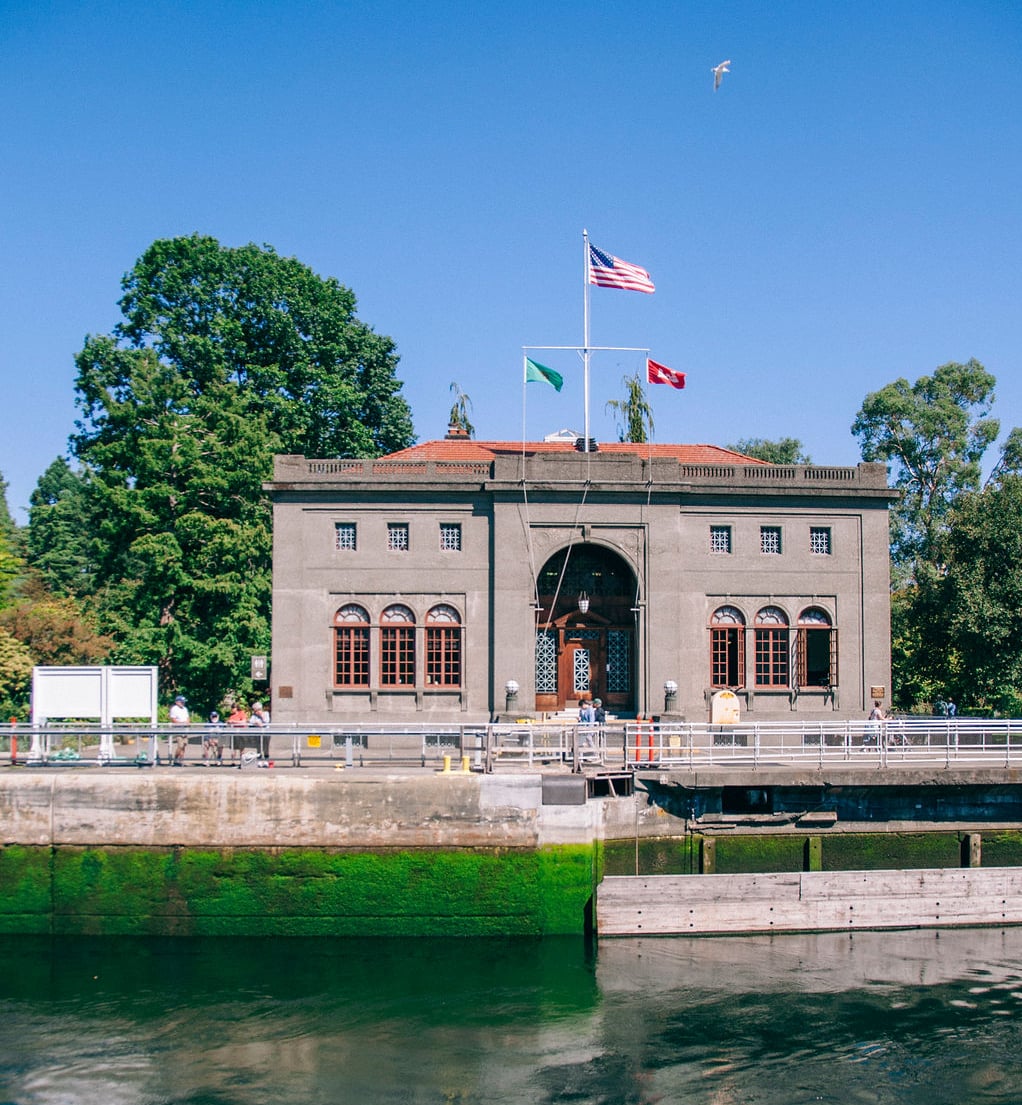
The formal name is Hiram M. Chittenden Locks. Opened in 1917, the complex connects the freshwater route towards Lake Union with saltwater Puget Sound. Visit Ballard’s account places it within the neighborhood’s continuing maritime life: commercial vessels and pleasure boats still pass through infrastructure that reshaped its southern waterfront.[2] The spectator rail puts you close to that ordinary work. A boat does not become a museum object simply because people have stopped to look at it.
For an October first visit, I would set aside 11:00–12:30 on a weekday. This is a suggested ninety-minute daylight window, not a promise about boat traffic or empty paths. The visitor-information site lists grounds hours of 07:00–21:00 daily, with free admission; details were checked on 23 October 2026.[3] Budget US$0–10 per person, excluding transport and parking: zero covers the visit, while ten dollars is an optional allowance for a drink or snack brought along, not a quoted price on site. An independent walk needs no paid admission booking. The unpredictable wait is beside a working waterway, rather than in a timed-entry queue.
Use 3015 NW 54th Street as the navigation address for the Ballard-side approach. The site’s map confirms that pedestrian walkways cross the shipping canal.[4] Follow those public crossings towards the opposite bank and the fish ladder, leaving time to pause when the route is interrupted by operations. For watching, choose a place beside the chamber where you can see both a boat and a fixed part of the wall. Keep the crossing itself clear; a narrow walkway is a poor place to settle in for the whole performance.
The small chamber offers a particularly legible detail. Its boaters secure their craft to floating side walls that rise or fall with the water. Watch the moving assembly against the stationary surroundings and the apparent trick becomes understandable.[5] Pick a railing post or a mark on the concrete as your reference, then look back at the same cabin roof. The vessel remains afloat throughout; the changing water level carries it towards the next stretch of its journey.
There is no reason to treat a quiet moment as a failed visit. The boating guidance gives priority to emergency and commercial traffic, and describes vessel passage as a round-the-clock operation outside maintenance or repairs.[5] Those are boat operating hours; visitors still follow the grounds hours. If you have only a few minutes, you may catch a gate moving without seeing the change that made opening it possible. Give one boat your attention for as much of its passage as your visit allows.
Across at the fish ladder, a different kind of timing matters. The neighborhood discussion is a useful antidote to the assumption that underwater windows guarantee salmon.[1] The visitor site gives typical peaks of mid-June to mid-July for sockeye, August for Chinook, and September for coho. It also warns that fish may be absent from the windows even during peak periods, and directs visitors to daily counts or the visitor center.[6] For a late-October outing, make boat watching the main event and check the counts before making promises to a child about the fish.
Treat access to the viewing room separately from access to the grounds. On 16 June 2026, neighborhood publication My Ballard reported a temporary closure for repairs to leaking concrete in the fish-viewing area, while the locks and gardens remained open. The announced reopening was the following morning; that report is evidence of how a partial closure works, not a claim that the room is closed now.[7] Before a visit built around the windows, check current notices. A repair to one room need not cancel the whole walk.
If you drive, finish reading the parking signs before following everyone towards the water. An August 2026 r/Seattle thread reported several tow trucks near the locks; a reply pointed out that the restrictions were posted. The original contributor recommended photographing the parking location and signs.[8] Treat this as a local reminder, not a measured towing rate. Choose a legal space whose time allowance covers the visit, and include the return walk in that allowance. The boats are very good at making an extra half-hour disappear.
Before leaving, return your attention to the wall. Once you have followed a vessel through part of the process, the concrete stops looking like a backdrop. It becomes the fixed measure against which the whole scene moves. That is the pleasure of this particular Seattle outing: a place you can enter freely, a piece of useful machinery, and a reason to stay still long enough to see it work.
Sources
- r/BallardSeattle, “New resident,” July 2026 — neighborhood recommendations to watch the boats, cross the locks and account for salmon season; individual experiences rather than guaranteed sightings.
- Visit Ballard / Ballard Alliance, “Ballard Locks & Botanical Garden” — local maritime context, opening year, freshwater–saltwater connection and the photograph reproduced here.
- Ballard Locks visitor-information site, supported by the Corps Foundation, “Common Questions” — free admission and daily grounds hours; checked 23 October 2026.
- Ballard Locks visitor-information site, “Map” — NW 54th Street address, pedestrian canal crossings and parking context.
- Ballard Locks visitor-information site, “Boater Information” — floating walls in the small chamber, vessel priorities, operating hours and maintenance exceptions.
- Ballard Locks visitor-information site, “Salmon at the Locks” — typical species-specific viewing peaks, the limits of sightings and links to fish counts.
- Meghan Walker, “Fish ladder viewing area at Ballard Locks closed for repairs,” My Ballard, 16 June 2026 — recent local reporting distinguishing a temporary viewing-room closure from continued grounds access.
- r/Seattle, “PSA: Tow Trap Today at Ballard Locks Fish Ladder,” August 2026 — community reports of towing and advice to check and photograph posted parking restrictions.