Autumn gives Helsinki’s Lammassaari boardwalk two clocks. One belongs to the birds using Vanhankaupunginlahti as a place to feed and rest during migration. The other belongs to anyone walking out through the reeds: this route has no lighting or winter maintenance, and the return deserves daylight too.[4] The rewarding visit leaves room for both. Walk slowly enough to notice movement beside the planks, then turn back while the way home is still easy to read.
There is good local encouragement to choose an ordinary weekday. In an August 2026 r/helsinki discussion, a visitor who had enjoyed Lammassaari suggested workdays for fewer people.[1] Finnish accessibility writer Sanna Kalmari likewise found a Wednesday afternoon relatively peaceful on her earlier visit.[2] Neither account promises solitude. Together they offer a useful correction to the idea that a place described online as a hidden gem will be empty on Saturday.
For a late-October outing, aim for 11:00–14:00 on a weekday, allowing 90–120 minutes within that window. These are suggested planning allowances, not opening hours or a birdwatching forecast. The walk is free; budget €0–10 per person, excluding transport, with the upper end simply an allowance for provisions bought beforehand.[8] An independent walk requires no admission reservation. The practical constraint is sharing the path and viewing space, so leave enough time to wait briefly for a comfortable place to stop.
Begin with the return in mind
Use Katariina Saksilaisen katu 13 as the boardwalk’s navigation address. The city’s route page links directly to the HSL Journey Planner, which is the useful place to check the journey from your actual starting point.[3] Kalmari’s ground-level cue is simpler: from the parking area at the southern end of Jokisuuntie, follow the Lammassaari signs towards the trail, roughly 100 metres away.[2] The dog park and public dry toilet help identify this mainland departure area; use the toilet before heading into the reeds.[4]
The city measures the route from the Vanhankaupunginkoski footbridge at about 1.2 kilometres each way, or 2.4 kilometres return.[3] Kalmari makes the consequential detail explicit: the accessible boardwalk visit goes out and back.[2] Do not spend the outward leg assuming a convenient loop will deliver you to another bus stop. For this visit, make the birdwatching platform your turnaround and keep the same amount of walking time in reserve.
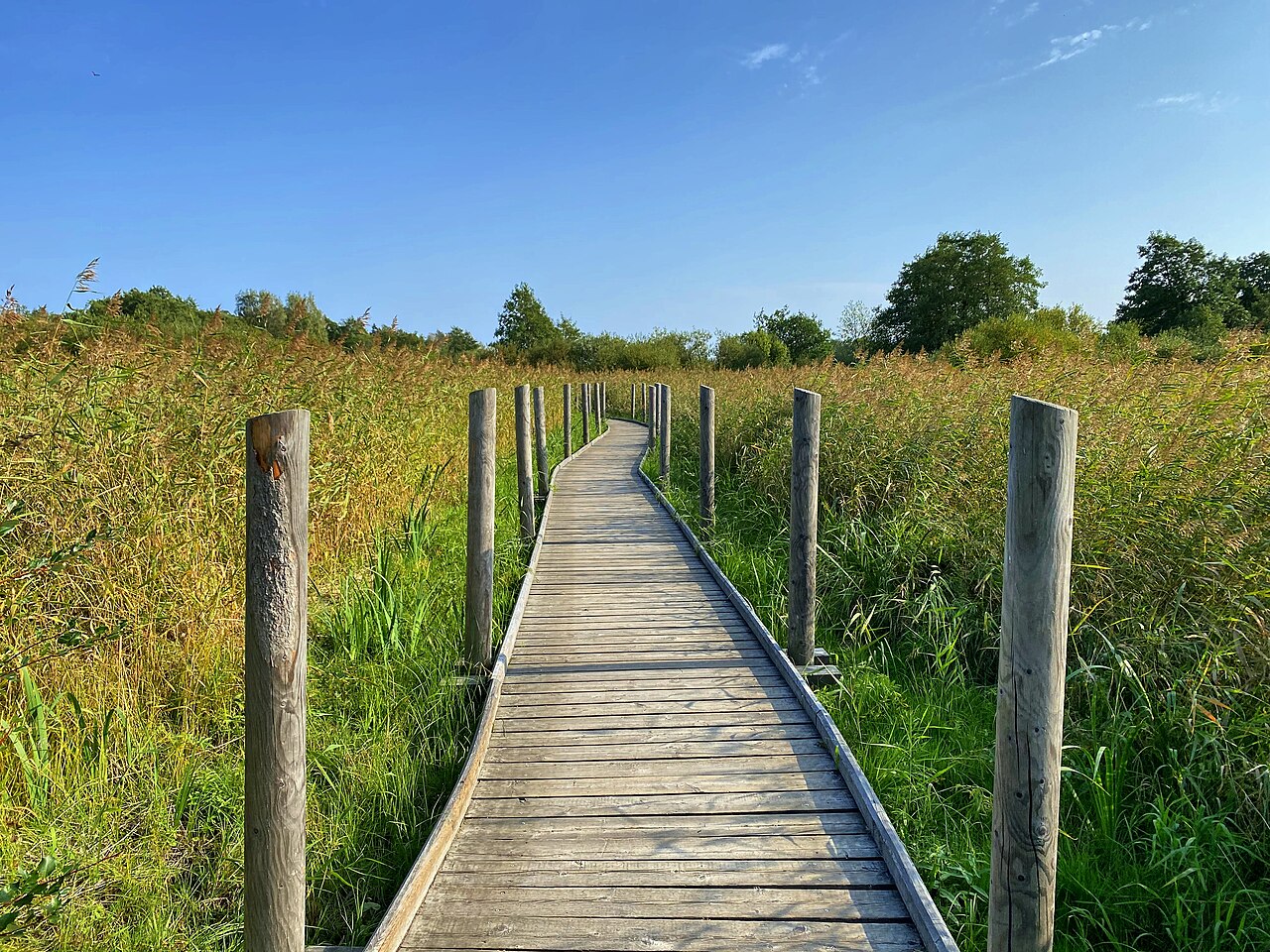
The bends are worth noticing. The renewed route, completed in 2018 by Studio Puisto and Nomaji, reused existing supporting structures and curves through a modular design. Its widened observation platforms have glazed ends so that a view across the wetland is available from a wheelchair or a child’s height.[6] This is a particular kind of Helsinki public space: a modest wooden construction whose success depends on letting more people see something that was already there.
Use the passing places when you want to linger over a photograph; leave the narrower stretches available for movement. The route is at least 1.2 metres wide, with spaces for wheelchairs and pushchairs to pass.[3] A small change of position makes the walk easier for everyone behind you. Once settled at a viewing deck, lower the phone for a moment. The reedbed is worth attending to even when nothing readily identifiable flies across it.
Let the season choose the spectacle
At Lammassaari’s accessible birdwatching platform, the view opens north over meadow and shallow bay; the small island of Loppi lies to the right, towards the east. Bring binoculars and give this view a little time. The city’s account places waders along the muddy shoreline into September–October, and describes white-tailed eagles fishing in autumn until the water freezes.[5] Those are seasonal possibilities, not a list a visitor can expect to complete. A quiet stretch of water can still reward the person who stays beside it.
Summer photographs can set the wrong expectation. Kalmari’s account distinguishes the cattle she saw at Lammassaari from sheep on neighbouring Kuusiluoto; the city describes grazing animals as a May–September sight.[2][5] By late October, an excursion built around finding them risks missing what the place currently offers. Keep this walk centred on the boardwalk and platform. The continuation to Kuusiluoto also loses the accessible-route promise.[2]
Even on the main route, read beyond the word “accessible.” The current municipal audit records uneven patches and a short hill with a maximum 19% gradient.[5] For someone using a mobility aid, that specific detail is more useful than a broad endorsement: assess whether assistance is needed before setting out. The city also distinguishes its accessible viewing platforms from birdwatching towers that are not accessible.[4] You can make the platform the destination without making a tower climb part of the plan.
On the way back, the boardwalk’s curves become familiar. There is less need to look ahead for the next sign, and more opportunity to notice what passed unseen on the outward walk. That second look is part of the pleasure of an out-and-back route. Lammassaari offers an autumn afternoon small enough to fit inside a city day, yet spacious enough that returning along the same planks need not feel like repetition.
Route and visitor information checked on 24 October 2026; suggested timing and provisions budget are editorial planning estimates.
Sources
- r/helsinki, “Less known places to visit?”, August 2026 — recent community discussion recommending Lammassaari and suggesting weekdays for fewer visitors; individual experience, not a crowd guarantee.
- Sanna Kalmari, “Lammassaaren esteettömät pitkospuut,” Palmuasema, 28 June 2020 — first-person Finnish accessibility review, approach signs, Wednesday atmosphere, return-route logic and the distinction from Kuusiluoto.
- City of Helsinki, “Lammassaari accessible boardwalk 2.4 km” — route address, journey-planner link, distances, passing places and detailed accessibility audit.
- City of Helsinki, “Pornaistenniemi ja Lammassaari” — wetland habitat, migration, public toilet, viewing facilities and the absence of lighting and winter maintenance.
- City of Helsinki, “Lammassaaren esteetön lintulava” — platform orientation, seasonal birdwatching possibilities and grazing season; nature content prepared with Eero Haapanen.
- Finnish Architecture, “Lammassaari Boardwalk” — project record, credited to Studio Puisto Architects, on the 2018 completion, reused structures and viewing-platform design.
- Timo Newton-Syms, “Duckboards at Lammassaari in Viikinranta, Helsinki, Finland, 2021 August,” Wikimedia Commons — photograph taken 28 August 2021; CC BY-SA 2.0.
- Puuhat, “Vanhankaupunginlahti – linturetki Helsingin sydämessä” — Finnish activity listing confirming free access and recommending binoculars and provisions.