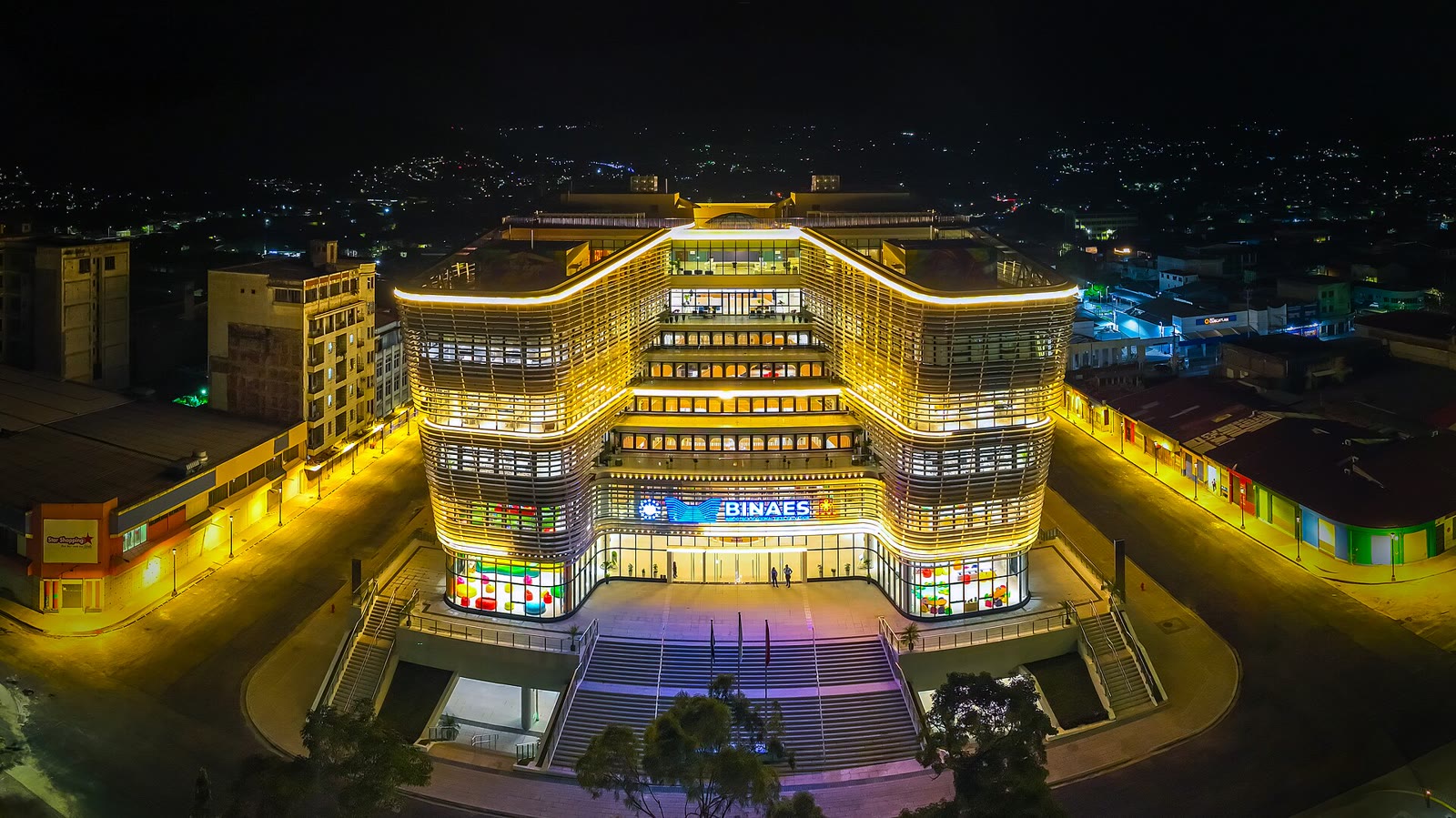
At BINAES, 24 hours is both true and incomplete. The front door keeps one clock. The collections, computers, terraces and staffed services can keep others. A special program may put poetry on Level 5 at 01:00; maintenance may close the whole building from 02:00 to 06:00 less than three weeks later [10][11]. Beyond the entrance, San Salvador's buses, taxis and streets keep clocks of their own.
That split is the reason to come after dark. Use 20:30–22:00, Monday through Thursday, as a first-visit window. It is not a promise of silence or full access. It is a controlled 90 minutes in which the illuminated building, the saved artwork in its lobby, the floor actually operating that night and the journey home can be read as one system [2][6][7][9].
Keep the article to this one non-food anchor. BINAES stands at 4ª Calle Oriente #124, opposite the Metropolitan Cathedral on Plaza Gerardo Barrios. Its ordinary public use is free, and the official baseline is 24 hours a day, 365 days a year [1][3][13]. Budget US$0–10 on site—zero for the visit, with the upper figure only an editorial buffer for an optional drink—not a quoted café price. Transport is separate and should be fixed before arrival.
Clock one: the door never tells the whole story
The first local move is to save two points, not one: the library entrance and the exact return pickup at the plaza edge. BINAES's gold-white horizontal bands, central sign and broad steps are unmistakable from the square [1][14]. The local user account used here notes that buses leave riders a few blocks away rather than at the door, while the historic-center authority warns that routes and stops shift with road works, events and traffic plans [6][8]. A pin that gets you in is not yet a plan that gets you out.
For a first night visit, pre-book a reputable radio-dispatched or hotel-arranged taxi. Current UK travel advice recommends reputable pre-booked or hotel taxis for short city trips and advises against unofficial taxis [9]. Share the pickup point and expected departure with someone you trust. If a known local contact gives you a current public-transport route instead, confirm the last useful departure that same day; do not build the return from an old route list.
The second move happens before leaving your lodging: check the library's current notice or social feed, then check again at the door. Official pages still present Monday-through-Sunday, round-the-clock access [1][2][3]. Yet on August 27, 2026, BINAES announced a preventive-fumigation closure from 02:00 to 06:00 [10]. That exception does not disprove the 24-hour model. It tells you that “always open” is a baseline subject to live operations.
Outside, use the facade as an orientation device. The cover photograph was made on opening night, November 14, 2023, and clearly records the BINAES sign, broad central stair and visible stacked floors [14]. The Metropolitan Cathedral across the square supplies the street-level counterface [1]. Notice that relationship, then cross the threshold. The more consequential clocks are inside.
Clock two: 1960 survives inside 2023
The third move is to begin in the lobby with the mural by Salvadoran artist Carlos Cañas. It was made in 1960, rescued from the previous library and incorporated into the new building [2]. Read it before taking a lift. The work is not a decorative preface; it is the surviving physical link between two institutions that occupied this site under very different architectural and political conditions.
The new scale is deliberately emphatic: about 24,000 square metres, seven levels and capacity for 3,600 people [1]. The official program includes open shelves, children's rooms, sensory and Braille spaces, computers, the Archivo General de la Nación, exhibition areas, technology labs and auditoriums, including a 350-seat hall [2]. BINAES is therefore not one reading room that happens to stay open late. It is a vertical bundle of cultural services whose clocks cannot be inferred from the lobby alone.
The mural also prevents a simple “new library replaces obsolete library” story. A recent architectural account records that a modernist building regarded as heritage was demolished here in 2021 before the Chinese-cooperation project rose, and places the decision inside a wider dispute about heritage, order, security and inclusion in the remade historic center [5]. The preserved artwork does not cancel the demolition. Nor does the demolition make current public use imaginary. BINAES's most specific night-room tension is that material continuity and material rupture occupy the same address.
Stand with that tension for 10 minutes. Do not try to settle it from a single visit. The practical point is sharper: every climb through the new building begins beside an object that has already outlived one building.
Clock three: each floor gives a different answer
The fourth move is to ask the desk two exact questions: Which public levels are open now? Which services on those levels are operating now? Avoid the vaguer “Is everything open?” A yes can describe the building while concealing a closed terrace, an unstaffed technology desk or an event occupying the room you saved.
The official floor description gives the choices. Level 4 contains youth material, lounges, computer rooms and a terrace. Level 5 holds the largest open-shelf general collection and the Sala Clásica, with views across the historic center. Level 6 adds digital reading, virtual reality, robotics, coworking and another terrace; Level 7 includes murals, exhibition space and another auditorium [2]. Those are program locations, not a guarantee that every component is continuously staffed.
The fifth move is to choose one live floor rather than inventory all seven. If Level 5 and the Sala Clásica are open, make that the core night room for 25–35 minutes: request a Salvadoran history, literature or periodical section, then use the city view to locate the collection rather than letting the view replace it [2][6]. If Level 5 is restricted, ask for the nearest open collection or public room. The successful visit follows the operating building, not this article's preferred floor.
The sixth move is to ask before assuming what the Llave del Saber permits. Local reports and current review aggregation associate the credential with controlled resources, but the lending rules are changing [6][7]. In January 2026, the culture minister announced that external book lending would be activated during the year as the collection expanded [12]. That announcement does not prove which titles, users or identity documents qualify on the night you arrive. Ask three things separately: whether a visitor can register, whether the desired resource requires the credential and whether the item may leave its floor or the building.
Travel light. If staff offer a locker, the seventh move is to place a large bag there while keeping phone, money and medication with you; current community reviews identify lockers as a visitor convenience [7]. The FCDO advises leaving a passport in a hotel safe where possible and carrying a copy of its photo page [9]. Bring another suitable photo ID or passport copy for the initial question, and carry the original only if BINAES has explicitly confirmed that a service requires it. A public locker is not a hotel safe.
Clock four: sometimes one in the morning is a start time
BINAES's all-night claim becomes most interesting when a program uses it rather than merely coexisting with it. On August 8, 2026, a published family-weekend agenda listed both a poetry night on Level 5 and a craft activity on Level 4 at 01:00 [11]. That is a rare civic timetable: a national library treating one in the morning as an activity start, not simply an hour at which security has not locked the door.
It was also a special program. This distinction matters. The eighth move is to save an event only with its date, start time, floor and age condition. The same August agenda distributed activities across several levels and age bands, and explicitly advised families to check those details before arriving [11]. Do not convert one remarkable weekend into a standing promise of midnight poetry.
Without a late event, the room remains worthwhile because different users can occupy it on their own schedules. A local regular recommended 22:00–00:00 on a weekday as the less crowded period after the opening novelty had faded [6]. Use that as community experience, not a capacity guarantee. The more conservative 20:30 start recommended here preserves some of the late-night character while keeping a first visitor's exit earlier.
Clock five: your exit still needs a deadline
The ninth and final move is to honor the pickup time even if the library remains open. Finish the floor you are on, return through the lobby, recheck that you have the right bag and meet the car at the agreed plaza point. Do not add an improvised historic-center walk because the BINAES doors are still bright. The night room can be open without making every onward movement equally simple [6][8][9].
If you want a formal architectural or educational tour, arrange that as a different visit. A current Salvadoran service guide gives [email protected] for educational and tourist visits and [email protected] for collection or access questions [4]. Those channels are also the cleanest way to ask, before carrying an original passport across town, what identification a foreign visitor needs for a particular resource.
Four visitor mistakes, reset to the right clock
Mistake one: assuming 24-hour access means 24-hour parity. Local users distinguish open doors from controlled resources, current reviews show crowd and service variability, and a live maintenance notice temporarily overrode the baseline [6][7][10]. Better: ask which floors and services are operating now.
Mistake two: turning a seven-level floor list into a completion challenge. Community accounts describe the building as a place people actually use, not a sequence of boxes to tick [6][7]. Better: choose one open level, stay long enough to understand its role and let the others remain for another visit.
Mistake three: treating the library's late clock as a transport timetable. A local regular notes that buses stop a few blocks away, while the official access page says routes can change [6][8]. Better: confirm a current route and last useful departure with local knowledge, or fix a reputable return car before entering [9].
Mistake four: believing the new room resolves the old building's story. Local discussion registers both genuine public benefit and political criticism, while the architectural record documents demolition of a modernist predecessor regarded as heritage [5][6]. Better: read the saved Cañas mural as continuity without using it to erase the rupture around it.
The go details
- Anchor: BINAES only, at 4ª Calle Oriente #124, opposite the Metropolitan Cathedral on Plaza Gerardo Barrios [1].
- Best first window: 20:30–22:00, Monday–Thursday. This is an editorial compromise between the local late-weekday recommendation and a conservative first-visit transport plan, not an official quiet period [6][7][9].
- Time needed: 90 minutes—about 10 with the lobby and mural, 10 establishing the live floor/service map, 25–35 on one open level, and a firm exit buffer.
- Expected spend: US$0 for ordinary public use; US$0–10 is a planning buffer only if you choose an optional drink. Transport is separate [3][13].
- Queue and reservation reality: current official listings state public, round-the-clock use without an advance reservation step. Guided group visits are separate and should be arranged by email; events and maintenance can change the live flow [1][4][10][11].
- Navigation cue:
Plaza Gerardo Barrios → Metropolitan Cathedral across the square → gold-white BINAES bands → central sign and broad steps → lobby mural[1][2][14]. - Preferred room: Level 5's general collection and Sala Clásica if staff confirm they are open; otherwise take the nearest open public collection or program room [2].
- Credential boundary: ask what the Llave del Saber currently unlocks and whether external lending has activated for your user type; a January announcement is not a same-day rule [6][7][12].
- What to carry: a light bag, minimal valuables, a passport copy or suitable photo ID, and the fixed return details. Keep the original passport in a hotel safe unless BINAES confirms it is required [7][9].
- Live check: verify the door, desired floor, desired service, event details and return transport as five separate clocks [6][8][10][11].
BINAES contains several dates before it contains several floors: a 1960 mural, a 2021 demolition, a 2023 opening and 2026 services still changing. After dark, those dates meet the building's smaller clocks. A door remains open, a floor may narrow, a one-off poem can begin at one in the morning, a maintenance crew can interrupt the baseline, and a visitor still needs a ride home. Read those clocks separately and the library stops looking either infinitely available or merely spectacular. It becomes something more interesting: a contested public institution whose promise depends on how its many rooms actually keep time.
Sources
- Autoridad de Planificación del Centro Histórico de San Salvador, “Biblioteca Nacional de El Salvador” — official address, 24-hour schedule, November 2023 opening, 24,000-square-metre area, seven levels and 3,600-person capacity.
- Ministerio de Cultura de El Salvador, “La nueva Biblioteca Nacional de El Salvador y sus servicios para la población” — official floor program, 350-seat auditorium, accessibility features and the rescued 1960 Carlos Cañas mural.
- Ministerio de Cultura de El Salvador, “Presidente Bukele inauguró la nueva BINAES” (November 15, 2023) — primary opening record for free use, 24-hour/365-day baseline, seven levels and the Llave del Saber.
- Karla Rodas, “Lo que podés hacer en la BINAES más allá de leer libros,” elsalvador.com (April 10, 2026) — recent local service guide with guided-visit and librarian-contact channels for residents and international visitors.
- ArchDaily en Español, “Transformación urbana de San Salvador: Placemaking contemporáneo en Centroamérica” (July 2026) — recent architecture account of the 2021 demolition, Chinese cooperation, design authorship and heritage-and-inclusion debate around the remade center.
- r/ElSalvador, “Un paseo por la BINAES” (September 2024) — local user discussion of weekday late-night use, actual reading after the opening rush, staff help, controlled resources, political criticism and the several-block walk from bus stops.
- Wanderlog, “Biblioteca Nacional de El Salvador (BINAES)” — current Google- and Tripadvisor-review aggregation used for lockers, reading-room behavior, night visits, identification-linked services and crowd variability.
- Autoridad de Planificación del Centro Histórico de San Salvador, “¿Cómo llegar?” — official access guide warning that bus routes and stops change with works, events and traffic plans, plus the main surrounding approach streets.
- UK Foreign, Commonwealth & Development Office, “El Salvador: Safety and security” — current advice on passports, valuables, city transport and reputable pre-booked or hotel taxis.
- Publimetro El Salvador, “Aviso: BINAES permanecerá cerrada temporalmente este jueves por fumigación” (August 27, 2026) — recent local confirmation of a 02:00–06:00 preventive-maintenance exception to the 24-hour baseline.
- Evelyn Alas, “¿Buscás un plan tranquilo con los niños este finde? La BINAES tiene muchas actividades,” elsalvador.com (August 7, 2026) — recent local agenda with 01:00 programs and event-specific level, time and age details.
- Leidy Puente, “Podrás llevarte los libros a casa, BINAES activa préstamos este año,” elsalvador.com (January 23, 2026) — local report of the culture minister's announcement that external lending would activate during 2026, a reason to verify current user and title rules.
- Audiala, “Biblioteca Nacional de El Salvador: Horarios (2026)” (reviewed April 2026) — current visitor guide explicitly confirming free admission and the 24/7 schedule.
- Wikimedia Commons, “Vista aérea de Biblioteca Nacional de El Salvador” — source page for Casa Presidencial El Salvador's real November 14, 2023 night photograph used as the article image.