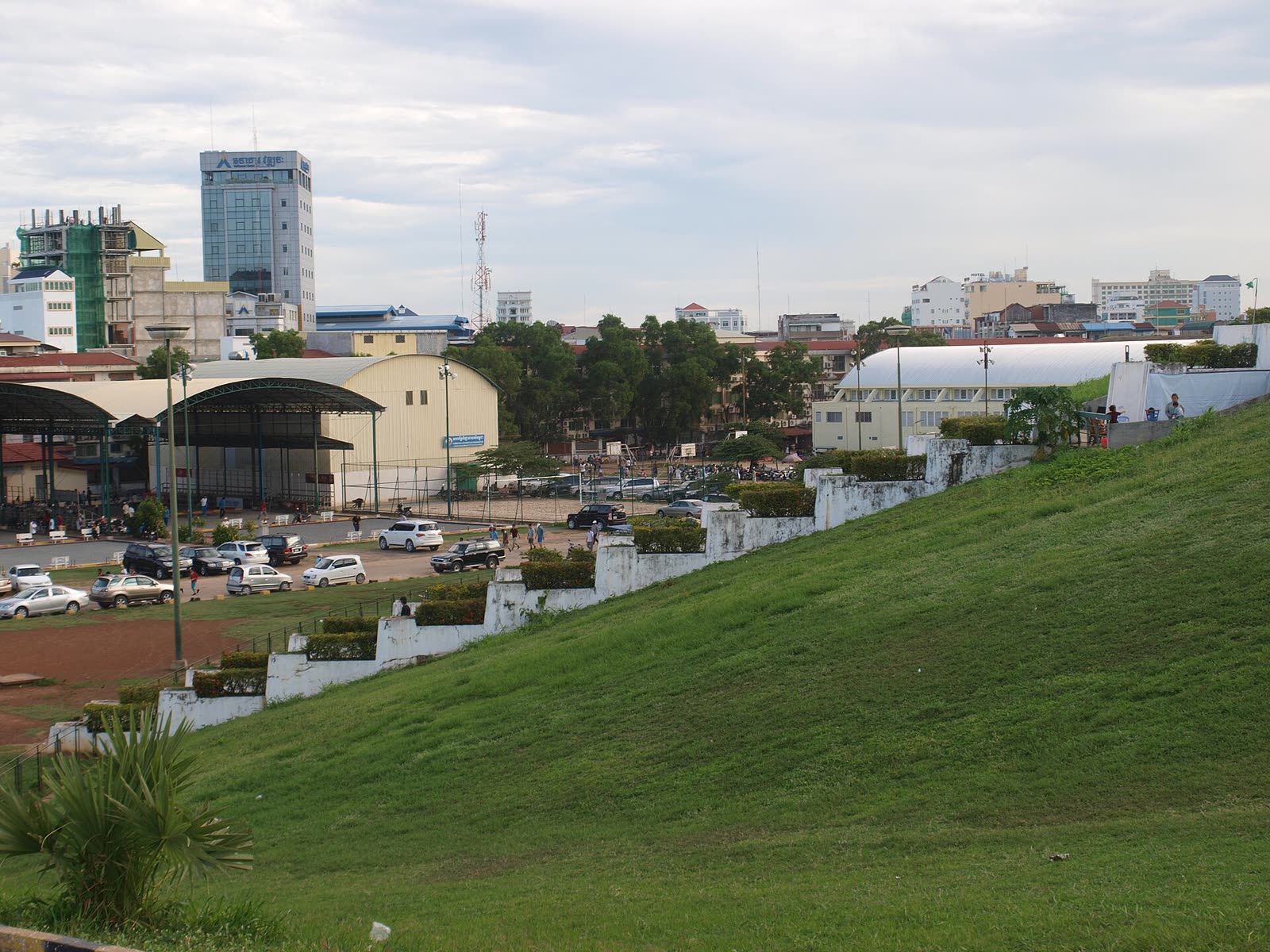
Phnom Penh's National Olympic Stadium first appears to be a concrete arena. Walk its outer ground slowly and a different building comes into focus: a hill.
Vann Molyvann's design team excavated around the site, used the displaced soil to raise the outdoor bowl, and organized water, shade and airflow around that made ground. The original complex occupied 300,000 square metres—30 hectares. Its embankment rose to 12 metres, carrying 50,000 seats with standing space for another 10,000 along the crown [1][2]. The architecture is not only what sits on the earth. The earth is doing architectural work.
The evening crowd completes it. Runners, walkers, footballers and training groups keep using the complex as a practical breathing space inside the city. A 2017 Cambodian account describes entertainment, exercise, dance and sport as everyday uses, especially on weekends; Phnom Penh Athletics Club's August 2026 schedule still places threshold and interval sessions at Olympic Stadium [2][3]. Come to read both systems at once: Molyvann's raised ground, then the public rhythm it makes possible.
Keep the portrait to this one anchor. Allow 75–90 minutes, aim for 16:45–18:15, and carry 2,000 riel in small cash. That window is an editorial recommendation built around current evening exercise use, not an official opening guarantee. Ordinary access, track access and event-day access are different things, and the distinction matters.
Save the old stadium, not merely “National Stadium”
The first local move is to save the exact pin before leaving Wi-Fi: National Olympic Stadium, Charles de Gaulle Boulevard, Phnom Penh 12253 [5]. The capital now also has Morodok Techo National Stadium on Ly Yongphat Street, which the government's National Sports Complex site identifies as the newer state-managed venue [7]. If a driver or map result offers a long ride toward Chroy Changvar, show the Charles de Gaulle address and say Olympic Stadium.
Approach from the Charles de Gaulle Boulevard side and use the rising grass-and-concrete mass as the recognition cue. Do not hunt first for a monumental facade. The outdoor arena is held inside an elliptical embankment; from street level, the slope and broad stairs explain more than a sign does.
The second move is to check whether the old stadium has a match or public event that day. It remains a live venue: the Cambodian Premier League scheduled a March 5, 2026 continental club match here at 19:00 [6]. On an ordinary evening, current review surfaces describe straightforward access to the outer route and paid access to the inner track. On a match day, gates, security and crowd direction outrank this walk [4][5]. There is no useful trick for bypassing a closed gate. Change the hour or return another day.
Arrive by 16:45 rather than at noon. This is the third move. The lower sun makes the relief of the berm readable, and the first exercise groups give you a direction of travel without the densest after-work compression. Current community reviews repeatedly recommend morning or late-day activity; a January 2026 review calls morning and afternoon the most pleasant periods, while Phnom Penh Athletics Club's current training notices place both morning and evening work here [3][5].
Read the hill before joining the loop
Construction began in 1962 for Southeast Asian Games planned for 1963. Those games did not take place in Phnom Penh, but the complex was completed in 1964 after an approximately 18-month build and later hosted the 1966 GANEFO Games [1][2]. Its familiar “Olympic” name can therefore mislead twice: it did not host an Olympics, and its most consequential achievement is not a single sporting event.
The fourth move is to climb only far enough to see how the parts relate before choosing a route. The original plan integrated the outdoor arena, indoor hall and swimming complex so they could operate together or separately. The arena's earth crown made the central rise. Moats and water surfaces collected rain and cooled the campus. On the west side, four overhanging roofs of the indoor hall were each supported and drained through a central column; on the east, three concrete canopies shaded the swimming complex [1][2].
Do not flatten that design into “Angkor-inspired Brutalism.” Molyvann described a combination of concrete and earth architecture: excavating water space and using the spoil to build upward, an approach he related to Angkorian moats and raised sacred ground [2]. At the same time, perforated walls, cross-ventilation, shade and runoff were direct answers to Phnom Penh's heat and rain [1][2]. The historical reference and the climate mechanism are the same composition, not two decorative layers.
The fifth move is to look for evidence, not for a perfectly preserved original. Later development filled or transformed parts of the moat system and reduced the open land around the complex [2]. Read the surviving slope, drainage edges, roof overhangs and air gaps as pieces of an operating idea. A visitor mistake is to treat every current puddle, wall or channel as exactly what Molyvann drew. The sources support the design logic and also document its alteration [1][2].
Give this architectural pass about 20 minutes. Stand clear of stair landings, look across the grassed berm toward the city, and notice how little of the arena's mass needs a conventional exterior wall. Then stop studying the complex as an object. Let the people using it teach you the second half.
Join the evening without turning it into a performance
The sixth move is to watch one minute before stepping into the exercise flow. There is no universal tourist lane. Follow the direction being used on that part of the route, keep to the outer edge if moving slowly, and cross only after checking for runners. Phnom Penh Athletics Club's August 2026 notices show structured threshold, pace-change and benchmark sessions using the stadium, so the fast person approaching from behind may be training rather than sightseeing [3].
Walk one controlled segment rather than trying to inventory every court. The public value is visible in repetition: stair climbs, steady laps, football drills, conversation and groups forming around a coach. Pen Sereypagna's account treats this daily adoption as evidence that the complex was well received as public space [2]. That is the place-specific detail worth carrying away. The arena built to stage a young state's modernity now also works at the scale of an ordinary evening workout.
The seventh move is to separate the free outer route from the inner running track. Recent Google-review aggregation describes the outside loop as free and the track as a small paid upgrade; reports from September 2025 through January 2026 consistently put inner-track access at 2,000 riel, and the 2026 review confirms that the stadium remains actively used for running [5]. Carry the note rather than asking a vendor to break a large dollar bill. Treat 0–2,000 riel as the expected spend for this portrait, not as a promise about pools, parking, courts or a ticketed match.
If a staff member points you away from the inner track, stay outside. If a sports group has claimed a lane or stair flight, give it space. If photographing, make the berm, roofline or crowd pattern the subject; ask before making an identifiable person your close-up. The stadium is not a vacant modernist ruin waiting for a visitor to animate it.
The eighth move is to leave on the same logic with which you arrived. At about 18:15, finish the circuit you are already on instead of cutting across an active field, descend by a lit and used stair, and return to the Charles de Gaulle side. If the site is visibly winding down earlier, follow the gate. The current review surface mentions access as late as 20:00, but community listings are not operating contracts [5].
Four visitor mistakes, corrected
Mistake one: going to the wrong national stadium. Search results can lead to Morodok Techo on Ly Yongphat Street [7]. Better: save the Charles de Gaulle Boulevard pin for the National Olympic Stadium before starting [5].
Mistake two: arriving at midday to photograph an empty monument. Heat strips away the very public behavior that makes this place legible. Better: use the editorial 16:45–18:15 window, read the earthwork first and join the edge of the evening flow [3][5].
Mistake three: stepping directly into the moving lane. The stadium hosts organized training as well as ordinary evening laps, and the quickest runner may approach silently from behind [3][4][5]. Better: watch for one minute, join the direction already in use and keep to the outer edge when walking slowly.
Mistake four: treating access as one all-inclusive ticket. The outer route, inner track, pool, courts and match bowl do not share one visitor promise. Better: budget 0–2,000 riel for the outer portrait and optional track, carry small cash, and accept the live gate decision [4][5][6].
The go details
- Anchor: the National Olympic Stadium / original National Sports Complex on Charles de Gaulle Boulevard—not Morodok Techo National Stadium [5][7].
- Best window: 16:45–18:15 on a non-event weekday. This is an editorial window based on current evening use, not a guaranteed public schedule [3][5][6].
- Time needed: 75–90 minutes: roughly 20 minutes to read the berm and roof systems, then one unhurried exercise-loop segment.
- Expected spend: 0 riel for the outer route or approximately 2,000 riel for inner-track access according to recent community reports. Other facilities and events are separate [4][5].
- Queue reality: no formal sightseeing queue on an ordinary evening; a match, training closure or locked gate can replace casual access entirely [5][6].
- Navigation cue: Charles de Gaulle Boulevard → broad stairs → grassed elliptical embankment. If the route heads toward Ly Yongphat Street, the destination has switched to the newer stadium [5][7].
- What to notice first: the raised ground, then the west indoor-hall roofs and east swimming-pool canopies where visible [1][2].
- Etiquette: observe the direction of movement, keep slow walking to the outer edge, do not block stairs, and ask before photographing people closely.
- Weather boundary: after heavy rain, use only open, well-lit surfaces and do not improvise across wet slopes or drains. The original water logic is an architectural lesson, not an invitation to test the current drainage system [1][2].
- Live check: consult current stadium and Cambodian football channels on the day; event operations beat this route [6].
The National Olympic Stadium is easiest to understand when nobody asks it to be only one thing. It is a 1960s national project, a modified work of New Khmer Architecture, a live sports venue and an evening commons. The most useful sequence is therefore simple: see the hill, understand why it was made, then move with the crowd that still makes room on it.
Sources
- The Vann Molyvann Project, “The National Sports Complex” — measured project history covering the 1962–1964 build, 300,000-square-metre site, earth berm, canals, roof drainage, cooling, shade and integrated sports facilities.
- Pen Sereypagna, “New Khmer Architecture and Japan,” Docomomo Journal 57 (2017) — Cambodian architectural history of the complex's 18-month construction, 12-metre embankment, water system, public integration, later alterations and everyday exercise use.
- Phnom Penh Athletics Club, Telegram channel — local running-community schedule with July–August 2026 morning, evening, threshold, interval and benchmark sessions at Olympic Stadium, including live venue changes.
- Tripadvisor, “The Olympic Stadium” — community review surface distinguishing the free outer road from the 2,000-riel inner track and documenting early/late exercise, ordinary visits and event-day access.
- Wanderlog, “National Olympic Stadium, Phnom Penh” — Google- and Tripadvisor-review aggregation used for the Charles de Gaulle Boulevard address, current 2025–2026 running reports, 2,000-riel track access and non-event gate reality.
- Cambodian Premier League, “League Champions vs. Cup Winners” (March 3, 2026) — official recent confirmation of a 19:00 match at Phnom Penh's National Olympic Stadium and the need to check event-day operations.
- National Sports Complex, Kingdom of Cambodia — current official page locating the newer Morodok Techo National Stadium on Ly Yongphat Street, the key wrong-stadium distinction for navigation.
- Wikimedia Commons, “File:Outer Side of Phnom Penh Olympic Stadium (14564339835).jpg” — I G's real July 3, 2014 photograph of the grassed berm and outer complex used as the article image.